
The 5-Minute Internal Linking Audit
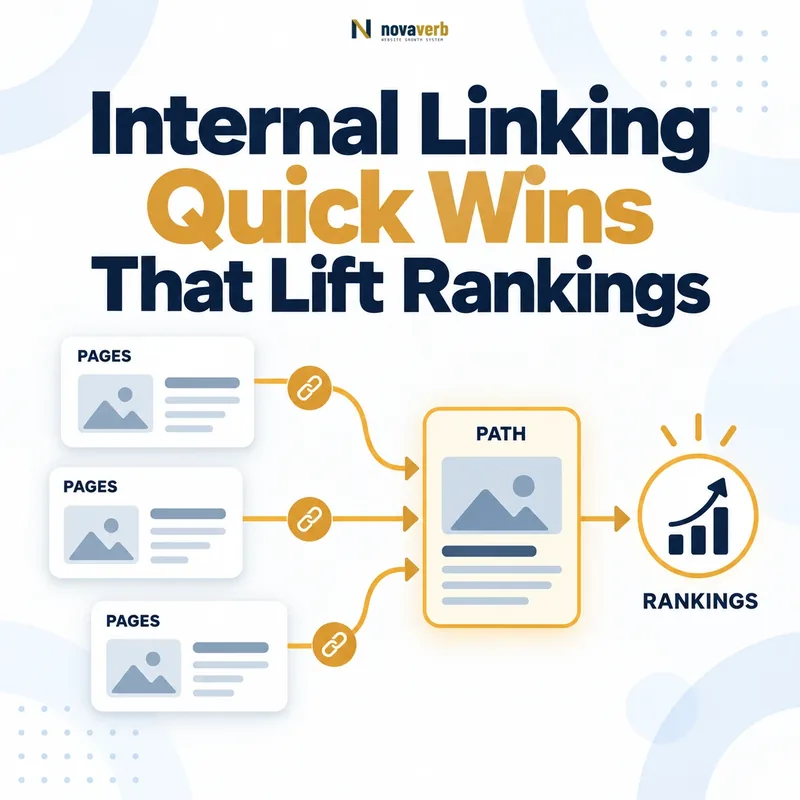
A five-minute internal linking audit should focus on one priority destination rather than trying to evaluate every link on the website. Select an important page, inspect its current paths, find one relevant source page, implement one direct contextual link and preserve evidence for a later recheck.
- Minute 1 - Choose one priority page. Select a product, category, tool, guide or commercial page that deserves stronger discovery or user progression.
- Minute 2 - Inspect its current internal links. Check which pages link to it, how deep it sits and whether any links pass through redirects or broken destinations.
- Minute 3 - Find a relevant source page. Search for an existing page that discusses the same problem, entity, comparison, method or next decision.
- Minute 4 - Add one contextual link. Write a natural sentence with anchor text that accurately describes the destination.
- Minute 5 - Verify and record. Open the link, confirm the final URL, save the source and destination, and schedule a later crawl or performance review.
A quick audit is a prioritization method, not a replacement for a full link-graph review. Use the Site Health Audit when the sample reveals a sitewide pattern.
Quick Win 1: Link From Pages That Already Have Relevant Visibility
Start with pages that already earn impressions, qualified traffic, backlinks or user engagement for a closely related topic. These pages can provide a meaningful contextual route to a priority destination when the link genuinely helps the reader continue the same task or decision.
The source page appears for queries related to the destination’s topic, problem or audience.
The source page has earned relevant backlinks or citations that make it an established entry point.
Visitors logically need the destination after reading the source page.
For example, an article explaining crawl paths can link to a site-audit product when the reader reaches the stage of measuring real paths. A broad article about unrelated marketing trends should not link to that product merely because the source page receives traffic.
Quick Win 2: Give Orphaned and Weakly Linked Pages a Real Crawl Path
An important page should be reachable through at least one crawlable, relevant internal path. A URL listed only in a sitemap, linked only through a search form or exposed only by JavaScript interaction may remain difficult for users and crawlers to reach through the site’s normal architecture.
Find a hub, category, guide or related page that logically introduces the destination.
Use an HTML anchor with a valid href.
Open the source and follow the link to the preferred destination.
Confirm that the page appears in a fresh crawl with the expected source.
A sitemap helps discovery, but it does not explain how the page belongs in the site’s information architecture or user journey. Internal links provide that navigational and contextual relationship.
Review the underlying concept in What Is a Crawl Path in SEO?.
Quick Win 3: Reduce Crawl Depth for Priority Pages
Reduce unnecessary crawl depth when an important page is buried behind several avoidable link transitions. The goal is not to force every URL one click from the homepage; it is to make strategically important destinations reachable through a clear and appropriate route.
Homepage → Blog archive → Year archive → Category → Article → Product
The product is reached only after several indirect transitions.
Relevant guide → Product
The source explains the problem and links directly to the appropriate solution.
Good depth reduction usually comes from strengthening hubs, category pages, related guides and decision-stage content. It should not require placing every important URL in the main navigation or footer.
Quick Win 4: Replace Generic Anchor Text With Descriptive Anchors
A descriptive anchor tells users and crawlers what the destination contains before they follow the link. Replace vague phrases such as “click here,” “learn more” and “this article” when a concise, natural description would make the destination clearer.
| Weak anchor | Improved anchor | Why it is better |
|---|---|---|
| Click here | inspect your website’s crawl paths | Describes the task available on the destination. |
| Read more | internal linking quality over quantity | Identifies the topic and intended lesson. |
| This tool | free Website SEO Checker | Names the destination and the action. |
| See our article | how search engines discover URLs | States the question answered by the target page. |
The anchor should remain concise and natural within its sentence. Put supporting context outside the linked phrase rather than turning an entire paragraph into one link.
Quick Win 5: Link Directly to the Final Canonical URL
Internal links should normally point directly to the live preferred destination instead of an outdated URL that redirects elsewhere. Redirects may preserve access, but controlled internal links should describe the current architecture and avoid unnecessary hops.
Less efficient:
Source page
→ /old-internal-link-guide/
→ 301
→ /internal-linking-quality-over-quantity/

Preferred:
Source page
→ /internal-linking-quality-over-quantity/Does the destination return the intended successful response?
Does the link pass through an avoidable redirect or chain?
Does the destination declare another URL as preferred?
Is the target blocked, noindexed, expired or intentionally excluded?
Trace suspicious paths with Check Redirect Chains and HTTP Status Codes in 5 Minutes.
Quick Win 6: Add Links Where Readers Need the Next Decision
The best contextual link appears where the reader needs a definition, proof, comparison or next action. Link placement should follow the information gap created by the current section rather than a fixed target for how many links every article must contain.
Link an unfamiliar concept to a page that explains it clearly.
Link a major claim to evidence, methodology, a case or a standard.
Link to criteria that help the reader choose between alternatives.
Link to a tool, product or workflow after the reader understands the problem.
For example, a section explaining orphan pages can link to a crawl-path definition. A section showing a sitewide pattern can link to the Site Health Audit. A claim about a technical rule should link to supporting documentation rather than directly to a sales page.
Novaverb organizes these next steps through the Decision Ladder: Orient, Choose, Prove, Rate and Act.
Quick Win 7: Remove Broken, Duplicate and Misleading Links
Internal-link optimization includes removing routes that are broken, duplicated, outdated or misleading. More links do not improve a page when several anchors point to the wrong destination, repeat the same action or promise content the target page no longer provides.
| Problem | What to inspect | Preferred action |
|---|---|---|
| Broken link | The destination returns 404, 410 or an unintended error. | Restore, replace or remove the link based on the page’s purpose. |
| Misleading anchor | The target does not satisfy the promise made by the linked phrase. | Rewrite the anchor or choose the correct destination. |
| Duplicate link | Several links in one short section lead to the same page without adding value. | Keep the clearest, most useful route. |
| Expired destination | The linked offer, event, tool or documentation is no longer current. | Update the destination or redirect to a genuinely equivalent resource. |
| Conflicting destination | Similar anchors link to different pages with overlapping intent. | Clarify page roles and consolidate duplicates where appropriate. |
How to Prioritize Internal Linking Opportunities
Prioritize internal links by destination value, source relevance, current path weakness and implementation confidence. A high-priority opportunity connects a valuable page through a clearly relevant source and can be verified without creating a competing or misleading route.
| Factor | High-priority signal | Low-priority signal |
|---|---|---|
| Destination value | The page serves a strategic product, category, tool or decision. | The page is expired, duplicated or has no defined outcome. |
| Current path | The page is orphaned, weakly linked or unnecessarily deep. | The page already has several strong contextual routes. |
| Source relevance | The source naturally introduces the destination’s topic or next step. | The relationship exists only through a broad keyword. |
| Technical confidence | The destination is live, canonical, indexable and current. | The target redirects, conflicts or may soon be removed. |
| Measurement | The source, destination, baseline and review date can be recorded. | No one can explain what the change is expected to improve. |
How to Measure Whether an Internal Link Helped
Measure implementation, discovery, crawl-path, user and search outcomes separately. A successfully added link proves the task was completed; it does not by itself prove that the link caused a ranking, traffic or conversion change.
| Measurement layer | Example evidence | What it proves | What it does not prove |
|---|---|---|---|
| Implementation | Rendered source page contains a crawlable anchor to the preferred URL. | The link exists as intended. | That crawlers followed or valued it. |
| Crawl graph | Fresh crawl shows a new inlink and reduced shortest-path depth. | The crawler observed the route. | That Google used the same crawl state. |
| User behavior | Qualified clicks from the source to the destination. | Some users followed the route. | That the link caused a ranking change. |
| Search performance | Destination impressions, ranking distribution and qualified clicks over time. | The destination’s observed search performance changed. | That the internal link was the only cause. |
| Business outcome | Signup, lead, activation or revenue after reaching the destination. | The journey produced measurable value. | That every conversion depended on the link. |
| Guardrail | No new broken links, redirect hops, canonical conflicts or irrelevant routes. | The change avoided defined regressions. | That the page will rank higher. |
For the measurement framework, review What Is an SEO KPI?. Novaverb defines internal-link depth, discovery coverage and broken-link regressions as different KPI layers rather than one blended score.
Internal Linking Mistakes to Avoid
Internal linking becomes counterproductive when links are inserted without a clear user, crawl or decision purpose. Common failures include indiscriminate automation, repeated commercial anchors, links to redirected URLs and attempts to make every page link to every important destination.
Repeated links interrupt reading and add little new context.
Mechanical exact-match links can make unrelated sections unnatural.
The destination may be redirected, noindexed, expired or mismatched.
Menus and footers cannot replace meaningful contextual routes.
Similar anchors may reinforce several pages with overlapping intent.
A large number does not prove relevance, discovery or user progression.
Pattern-based insertion can create incorrect destinations and awkward language.
An internal-link implementation is not evidence of a guaranteed ranking outcome.
Internal Linking Quick Wins Checklist
A quick internal-link fix is complete only when the source, anchor, destination, technical result and review condition are documented.
Choose the destination
- The page has a clear intent and business or informational role.
- The page is live, canonical and current.
- The destination is not a duplicate or planned removal.
- The expected next action is defined.
Choose the source
- The source is contextually relevant.
- The source is crawlable and indexable where intended.
- The reader logically needs the destination.
- The page does not already contain a better equivalent link.
Write the link
- The final DOM contains an HTML anchor with a valid href.
- The anchor describes the destination accurately.
- The surrounding sentence explains why the link matters.
- The link does not interrupt or distort the content.
Verify the destination
- The link returns the intended resource.
- No unnecessary redirect hop remains.
- The destination canonical is consistent.
- The page fulfills the anchor’s promise.
Preserve evidence
- The source and destination URLs are recorded.
- The anchor and placement are saved.
- The deployment date is documented.
- The baseline crawl or performance state is retained.
Review outcomes
- A fresh crawl confirms the new path.
- Broken-link and redirect guardrails remain clean.
- Qualified clicks are reviewed where available.
- Ranking or traffic changes are not automatically attributed to one edit.
Frequently Asked Questions About Internal Linking
Do internal links improve Google rankings?
How many internal links should a page have?
What is the fastest internal linking quick win?
What is an orphan page?
Should every orphan page receive an internal link?
Is shallow crawl depth always better?
Is exact-match anchor text bad?
Should internal links open in a new tab?
Should I link to redirected URLs?
Do footer links have the same value as contextual links?
Can internal linking fix keyword cannibalization?
How do I audit internal links for free?
Find Your Best Internal Linking Quick Wins
Start with one important page and inspect how the site currently reaches it. Find weak paths, orphan risks, redirecting links and missed contextual routes, then prioritize the smallest change that improves discovery or user progression.
Run a free website check for a quick snapshot, or use Site Health Audit when you need a complete crawl, prioritized findings and fresh verification after each fix.
Novaverb connects internal-link evidence, crawl paths, destination status and search outcomes so teams can find the problem, implement the fix and verify that the new route exists.