In short
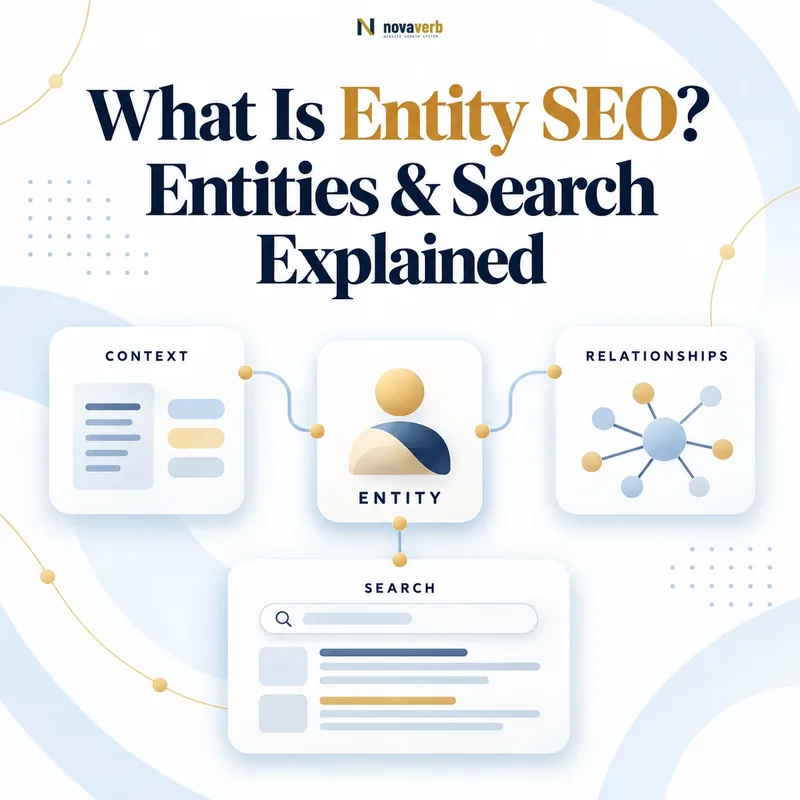
Entity SEO is the practice of optimizing content around entities - distinct, well-defined things such as people, places, organizations, products, and concepts - rather than around keyword strings alone. It aligns content with how modern search engines actually understand the world: as a network of entities and the relationships between them.
What is an entity?
In search, an entity is a uniquely identifiable thing that exists independently of the words used to describe it. 'Apple the company,' 'apple the fruit,' and a specific person are three different entities even though they may share a label. Search engines store entities and their attributes in a knowledge graph, a database of things and facts about them, and connect them to one another - a person works for a company; a product is made by a brand.
How entity SEO works
Entity-based optimization helps search engines identify the entities a page covers, disambiguate them from similarly named things, and connect them to established knowledge. In practice this involves:
- Structured data that explicitly names entities and their properties.
- Consistent naming and references across a site and the wider web.
- Topical depth that covers an entity and its related concepts thoroughly.
- Authoritative associations, such as being referenced by trusted sources that already describe the entity.
Why entity SEO matters
Search shifted from matching strings to understanding meaning. Because engines now reason about entities, they can answer questions, populate knowledge panels, and generate AI answers without relying on exact keyword matches. Content built around clearly defined entities is easier for these systems to trust, cite, and surface.
Strong entity signals also build topical authority: when a site comprehensively covers an entity and its relationships, search engines are more likely to treat it as a reliable source on that subject.
Entity SEO vs keyword SEO
Traditional keyword SEO focuses on the specific phrases users type and matching them to page text. Entity SEO focuses on the underlying meaning - the thing being discussed and its context - so a page can rank for many related queries, including ones it never explicitly mentions.
The two are complementary. Keywords still reveal what users search for, while entities help engines understand and connect your content across a topic.
How to strengthen entity signals
To improve entity SEO:
- Add structured data that identifies key entities and links them to authoritative references.
- Define entities clearly on the page and use consistent names and descriptions.
- Build topic clusters that cover an entity and its related concepts, linked internally.
- Earn mentions and citations from sources search engines already trust.
Novaverb models each page as an entity with a single intent, which helps teams see how clearly their content defines and connects the things it is meant to be known for.