
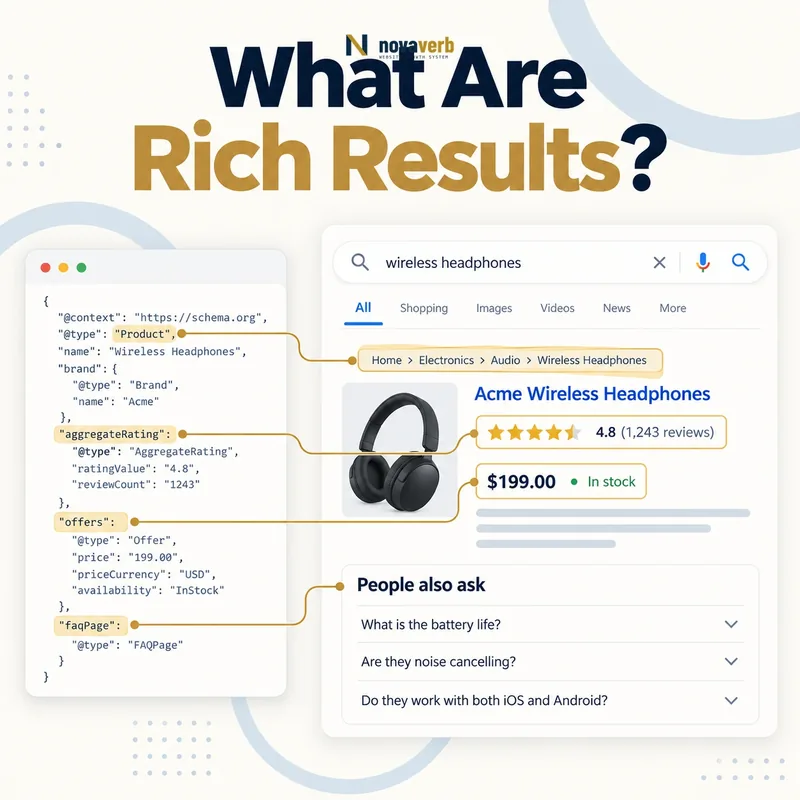
What Are Rich Results?
Depending on the page type and current search feature, an enhanced result may expose product details, event information, recipe attributes, video elements, breadcrumbs, review information or other structured facts. Search platforms decide when and how these appearances render, and the design can vary by query, device, country and experiment.
Structured data can make a page eligible for selected rich results, but eligibility is not a guarantee of display. The page must remain crawlable, accurate and useful. A valid markup block cannot force a feature, and the disappearance of an enhancement does not automatically mean the page lost rankings.
- Frame the decision raised by What Are Rich Results.
- Confirm its value type and the object it describes.
- Compare the markup with visible page information.
- Correct the source data or template without inventing values.
- Validate the rendered result and monitor future changes.
| Concept | Meaning | What it does not guarantee |
|---|---|---|
| Basic result | Title, URL and snippet-style text | Fixed appearance |
| Rich result | Enhanced facts or visuals | Permanent display |
| Eligibility | Page meets technical and content rules | An impression |
| Structured data | Machine-readable page facts | Ranking improvement |
| Search feature | Consumer-specific presentation | Support across every market |
| Impression | Result shown for a query | Click or conversion |
- Treat eligibility and display separately.
- Keep visible facts aligned with markup.
- Measure qualified clicks, not decoration alone.
Rich results are optional enhanced presentations whose availability depends on accurate eligible content and a search platform’s display decision.
The decision for What Are Rich Results should rest on live, traceable evidence and a verified follow-up check.
How Do Rich Results Work?
The process begins with discovery and crawling. The rendered page must expose the relevant content and markup. A parser extracts entities and properties, checks syntax and compares required fields with the feature’s current rules. The system can then decide whether the page remains eligible and whether an enhancement suits the query.
Several decisions occur after validation: which URL is canonical, whether the page is indexed, whether the feature is available in that region and whether the enhancement improves the result set. This is why a testing tool can show valid markup while live search still displays a basic result.
- Evidence for How Do Rich Results Work: the live structured-data entity and property relationship
- The expected value type and any nested object
- Visible page information that supports the structured value
- Related offer or catalog fields needed for interpretation
- A fresh validation result after the page changes
| Stage | What is evaluated | Possible failure |
|---|---|---|
| Discovery | URL and internal links | Page not found |
| Crawl | Status and access | Blocked or server error |
| Render | Visible content and markup | Client script fails |
| Parse | Structured-data syntax | Malformed graph |
| Validate | Feature fields and policies | Required property missing |
| Canonicalize | Preferred page identity | Markup lives on duplicate URL |
| Present | Query and display context | Basic result selected instead |
- Publish useful visible content.
- Add accurate supported markup.
- Validate the rendered page.
- Monitor real search appearances and outcomes.
The practical chain is crawl, parse, validate, evaluate and optionally display - with no guaranteed final presentation.
The decision for How Do Rich Results Work should rest on live, traceable evidence and a verified follow-up check.
Rich Results vs Rich Snippets and Featured Snippets
The terms are often mixed, which leads to bad diagnosis. Structured data is commonly associated with rich-result eligibility. A featured snippet can appear from well-structured visible content even without a dedicated schema type. Sitelinks, knowledge panels and other search experiences have their own systems and should not all be called rich snippets.
Define the exact appearance before optimizing or reporting. Screenshot the result, record query, device, market and date, then map it to the current feature documentation. This prevents teams from claiming a schema fix for a presentation controlled by another system.
- Frame the decision raised by Rich Results vs Rich Snippets and Featured Snippets.
- Confirm its value type and the object it describes.
- Compare the markup with visible page information.
- Correct the source data or template without inventing values.
- Validate the rendered result and monitor future changes.
| Search appearance | Typical input | Structured-data dependency |
|---|---|---|
| Basic result | Page title and content signals | Not required |
| Rich result | Supported page facts and eligibility | Often central |
| Rich snippet | Informal legacy term | Depends on intended feature |
| Featured snippet | Extracted visible answer | Not tied to one schema type |
| Sitelinks | Site and navigation understanding | Not directly controlled by schema alone |
| Knowledge panel | Entity understanding and sources | Broader than page markup |
| Image or video result | Media content and metadata | May use several discovery surfaces |
- Record the exact feature observed.
- Do not label every enhancement a snippet.
- Match fixes to the correct system.
Name the observed search feature precisely so the optimization, evidence and expectations match the mechanism.
The decision for Rich Results vs Rich Snippets and Featured Snippets should rest on live, traceable evidence and a verified follow-up check.
Which Rich Result Types Matter for SEO?
An ecommerce site should prioritize truthful product, offer and availability data. A publisher may focus on article, profile, video and breadcrumb relationships. An event platform needs current dates, locations and status. A software company may benefit from organization, software application, video and page-structure markup where current features support them.
Support changes over time, and not every Schema.org type maps to a rich result. Do not deploy unrelated types simply because their results look prominent. The page must contain the actual entity and meet feature-specific content requirements. Build a backlog from revenue pages and search opportunity, not from the longest feature list.
- Evidence for Which Rich Result Types Matter for SEO: the live structured-data entity and property relationship
- The expected value type and any nested object
- Visible page information that supports the structured value
- Related offer or catalog fields needed for interpretation
- A fresh validation result after the page changes
| Business or content model | Possible feature area | Critical truth |
|---|---|---|
| Ecommerce | Product and offer | Current price and availability |
| Publisher | Article and profile | Author and publication data |
| Events | Event | Real time, place and status |
| Recipes | Recipe | Ingredients, steps and timing |
| Video library | Video | Thumbnail and playable content |
| Jobs site | Job posting | Open role and location |
| Local organization | Organization or local business | Identity and real-world details |
| Site navigation | Breadcrumb | Actual hierarchy |
- Identify high-value page types.
- Map each to a real entity and feature.
- Confirm current eligibility rules.
- Prioritize by opportunity and data quality.
Prioritize rich-result types that truthfully describe high-value pages and support a measurable searcher decision.
The decision for Which Rich Result Types Matter for SEO should rest on live, traceable evidence and a verified follow-up check.
How Can Rich Results Affect CTR?
A product result that shows availability or price can improve expectation matching. An event date can help someone choose quickly. A breadcrumb can make the destination clearer. More visual space does not guarantee more clicks: the enhancement may answer the query without a visit, expose an unattractive constraint or appear beside stronger competitors.
Measure impressions, clicks, CTR and conversions together. Segment by page type, query group, device, market and actual search appearance. Compare periods carefully because rankings, seasonality and SERP layouts change. The business goal is qualified traffic and revenue, not the highest possible CTR in isolation.
- Frame the decision raised by How Can Rich Results Affect CTR.
- Confirm its value type and the object it describes.
- Compare the markup with visible page information.
- Correct the source data or template without inventing values.
- Validate the rendered result and monitor future changes.
| Observed change | Possible interpretation | Next evidence |
|---|---|---|
| CTR rises | Enhancement attracts relevant attention | Conversion and query mix |
| CTR falls, conversion rises | Poor-fit clicks filtered out | Revenue per impression |
| Impressions rise | Page appears in more contexts | Ranking and feature segment |
| Clicks flat | Enhancement changes no selection | Appearance and query comparison |
| CTR falls sharply | Wrong facts or stronger SERP competition | Live screenshot and parity audit |
| Feature disappears | Eligibility, display or layout changed | Validation and live search evidence |
- Measure by page and query cohort.
- Track conversion after the click.
- Preserve dated search-appearance evidence.
Evaluate rich results by qualified click and conversion impact, not by assuming every enhancement is a positive CTR event.
The decision for How Can Rich Results Affect CTR should rest on live, traceable evidence and a verified follow-up check.
Why Can Valid Markup Still Show No Rich Result?
A validator may accept every property, yet the page can be noindexed, canonicalized elsewhere or excluded from the relevant feature. Required values may exist but conflict with visible content. The feature may not be active for the query, country or device. Search presentation can also vary without any page change.
Separate four states: syntactically valid, feature-eligible, indexed and actually displayed. Diagnose them in that order. Avoid repeatedly adding optional properties after eligibility is already green; more markup cannot force presentation and may create maintenance risk.
- Evidence for Why Can Valid Markup Still Show No Rich Result: the live structured-data entity and property relationship
- The expected value type and any nested object
- Visible page information that supports the structured value
- Related offer or catalog fields needed for interpretation
- A fresh validation result after the page changes
| Layer | Question | Evidence |
|---|---|---|
| Syntax | Can the graph be parsed? | Structured-data validator |
| Vocabulary | Are types and properties defined? | Schema vocabulary validation |
| Feature eligibility | Are current required fields and policies met? | Feature-specific test |
| Page parity | Do visible facts match? | Rendered page review |
| Indexing | Is the canonical page eligible and known? | Search performance and index evidence |
| Display | Did the feature appear for this context? | Dated query, device and market observation |
| Outcome | Did qualified traffic improve? | Analytics and conversion data |
- Confirm the canonical page is accessible.
- Validate syntax and feature fields.
- Compare markup with visible content.
- Observe actual search appearance and outcomes.
When an enhancement is absent, diagnose syntax, eligibility, indexing and display as separate layers instead of adding markup blindly.
The decision for Why Can Valid Markup Still Show No Rich Result should rest on live, traceable evidence and a verified follow-up check.
What Rich Result Mistakes Are Common?
Ratings, prices, availability, dates and job status are especially sensitive because they influence decisions. A valid but outdated value misleads searchers. A review aggregate with no genuine visible review basis is not a technical shortcut; it is a false claim. An expired event or closed job should update promptly.
Plugins often emit overlapping schema blocks with different identifiers. Pagination, filters and duplicate product routes may each carry the same rich data while canonicalizing elsewhere. Teams may also preserve deprecated feature markup for years. Remove unsupported fields when they add no durable entity value.
- Frame the decision raised by What Rich Result Mistakes Are Common.
- Confirm its value type and the object it describes.
- Compare the markup with visible page information.
- Correct the source data or template without inventing values.
- Validate the rendered result and monitor future changes.
| Mistake | Risk | Control |
|---|---|---|
| Fabricated rating | Misleads searcher | Use settled visible review evidence |
| Stale price or stock | Wrong purchase expectation | Generate from live commerce state |
| Expired event or job | Promotes unavailable item | Synchronize lifecycle |
| Hidden content | Facts cannot be verified | Show them visibly or remove |
| Wrong page type | Entity does not fit feature | Use truthful type |
| Duplicate graph | Conflicting identities and values | Consolidate stable @id nodes |
| Noncanonical markup | Enhancement tied to duplicate URL | Render on preferred page |
| Deprecated feature chasing | Maintenance without benefit | Review current support |
- Protect commercial truth first.
- Keep time-sensitive fields synchronized.
- Review feature support regularly.
The highest-risk rich-result defect is accurate-looking markup that exposes a false commercial or factual claim.
The decision for What Rich Result Mistakes Are Common should rest on live, traceable evidence and a verified follow-up check.
How Do You Audit Rich Results?
Inventory targeted page types and the exact features they pursue. Extract all JSON-LD, Microdata and RDFa, then validate syntax and current eligibility. Test available, unavailable, discounted and out-of-stock products; upcoming, postponed and past events; published and updated articles; open and closed jobs.
Perform source-authority checks for price, stock, review, date and identity. Compare the canonical rendered page, then capture real appearance data over time. Segment performance by page type and query. When a template changes, run the audit before and after deployment because one shared defect can affect thousands of pages.
- Evidence for How Do You Audit Rich Results: the live structured-data entity and property relationship
- The expected value type and any nested object
- Visible page information that supports the structured value
- Related offer or catalog fields needed for interpretation
- A fresh validation result after the page changes
| Audit check | Evidence | Pass condition |
|---|---|---|
| Target mapping | Page type to feature list | Only relevant features pursued |
| Syntax | All structured-data blocks | Parse without errors |
| Eligibility | Current feature validator | Required fields present |
| Visible parity | Rendered page comparison | Material facts match |
| Source parity | Commerce or CMS record | Authoritative values match |
| Template states | Lifecycle variants | No stale or false output |
| Search appearance | Dated performance evidence | Feature observed or absence documented |
| Business result | CTR and conversions | Qualified impact measured |
- Map page types to intended features.
- Validate every lifecycle state.
- Cross-check visible and source facts.
- Measure actual search appearances.
- Fix shared generators and retest.
A rich-result audit passes when markup is true and eligible across all template states and performance claims are backed by actual search and conversion evidence.
Start with a relevant free SEO check, continue the evidence workflow in Site Health Audit, and review pricing when comparing continuous monitoring with a one-time manual review.
The decision for How Do You Audit Rich Results should rest on live, traceable evidence and a verified follow-up check.