In short
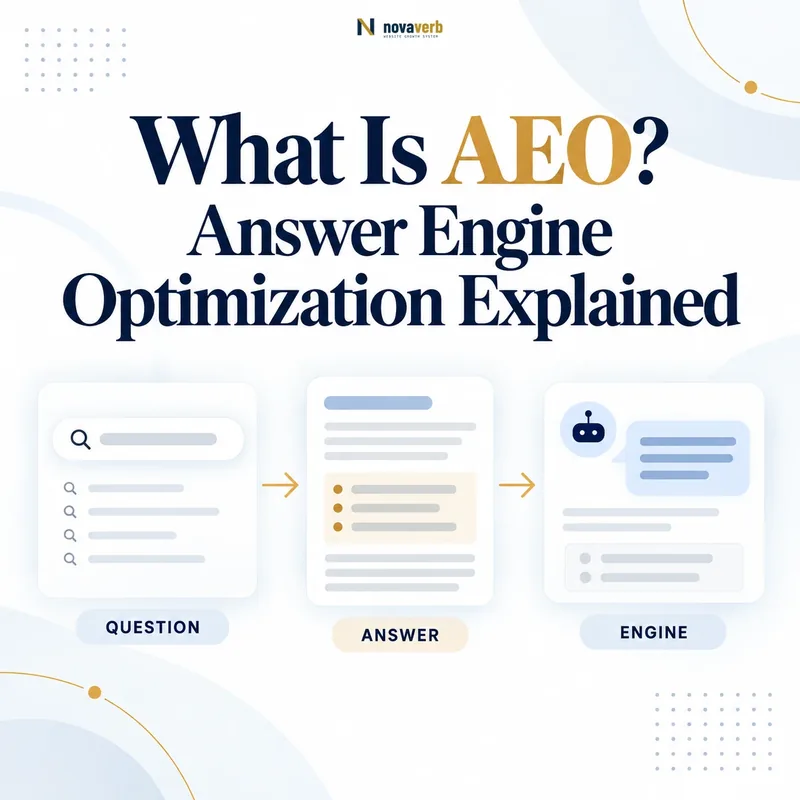
Answer Engine Optimization (AEO) is the practice of structuring and writing content so that answer engines - AI assistants, chatbots, and search features that return a single synthesized response - can extract, trust, and cite it. Where classic SEO aims for a ranked list of links, AEO aims to be the answer.
How answer engines work
Answer engines retrieve candidate passages from many sources, evaluate them for relevance and reliability, and generate a concise reply that may quote or paraphrase the best material. Systems that use retrieval-augmented generation first fetch supporting documents, then compose an answer grounded in them.
To be selected, a passage usually needs to:
- Answer a specific question clearly and early, in plain language.
- Sit under a heading or in a format the model can isolate, such as a short paragraph, list, or table.
- Come from a source the system treats as credible and consistent with other sources.
Why AEO matters
Zero-click behavior is rising: users increasingly read a synthesized answer without visiting a website. If your content is the cited source, you earn visibility, brand authority, and referral traffic even when the interface shows only one response. If it is not, a competitor's framing of the topic wins by default.
AEO also compounds with traditional ranking. Content that is well structured for extraction tends to be eligible for featured snippets, 'People also ask' entries, and voice results, so a single optimization effort pays off across multiple answer surfaces.
How AEO differs from SEO and GEO
SEO optimizes a page to rank in a list of links. AEO optimizes passages to be quoted inside a direct answer. Generative Engine Optimization (GEO) is a closely related, often overlapping term focused specifically on large-language-model answers.
The disciplines share foundations - crawlability, accurate information, and topical authority - but differ in emphasis. AEO rewards question-shaped headings, self-contained answers, structured data, and clear entity signals over keyword density and link-building alone.
How to optimize for answer engines
Practical AEO tactics include:
- Lead with the answer. Put a one- or two-sentence definition directly beneath a question-style heading so it can stand alone when quoted.
- Use structured data. Mark up FAQs, how-tos, articles, and organizations so machines can parse meaning, not just words.
- Strengthen entities. Name people, products, and concepts consistently and link them to establish who and what you are about.
- Show evidence. Cite sources, dates, and authorship so answer engines can verify reliability.
Common mistakes include burying the answer under long introductions, writing walls of text with no extractable units, contradicting yourself across pages, and blocking crawlers that AI systems rely on. Platforms such as Novaverb track which pages are structured for extraction and monitor when AI answer surfaces cite them.