What Is FAQ Schema?
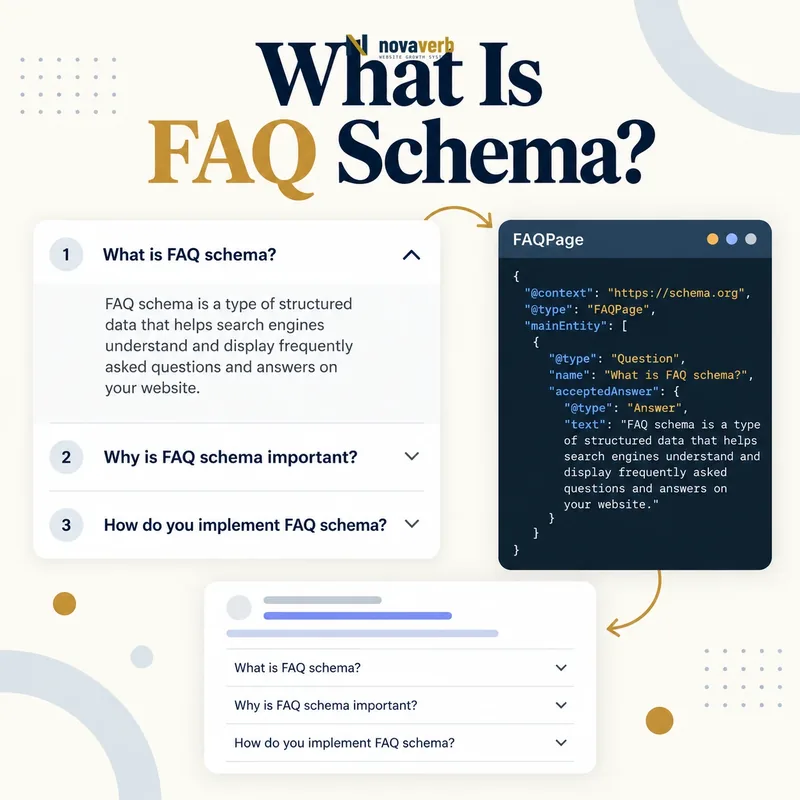
The markup creates a machine-readable representation of FAQ content already available to users. An FAQPage node contains a mainEntity list, each item is a Question, and each Question contains an acceptedAnswer. The question and answer text should remain complete enough to match the visible page.
FAQ schema does not create authority, improve an answer automatically or guarantee a special search appearance. It is a description layer. The page still needs useful questions, direct answers, accessible content and a reason to exist beyond occupying more search-result space.
- Identify the exact page, asset, entity or relationship described in this section.
- Inspect the live implementation and retain the observed evidence.
- Compare the observation with the intended meaning and its primary specification.
- Correct any mismatch, then retest the live result.
- Record the accountable owner and review date.
| Element | Role | Required evidence |
|---|---|---|
| FAQPage | Page with multiple FAQs | Visible FAQ content |
| mainEntity | List of primary questions | Questions belong to page topic |
| Question | Complete user question | Visible wording |
| name | Question text | Matches displayed question |
| acceptedAnswer | Publisher-provided answer | One controlled answer |
| Answer text | Complete response | Visible answer content |
| @id | Optional stable identity | Consistent graph policy |
| url | Canonical page location | Indexable preferred URL |
- Mark up only real visible FAQs.
- Keep question and answer meaning aligned.
- Treat search appearance as conditional.
Primary specification: Schema.org definition for FAQPage.
FAQ schema describes genuine publisher-controlled questions and answers; it is not a CTR guarantee or a substitute for useful content.
How Does FAQ Schema Work?
A crawler renders or reads the structured data, associates it with the canonical page and compares the graph with visible content. JSON-LD can sit separately from the FAQ interface, but the meaning must remain synchronized. Accordions are acceptable content patterns when users can reveal the answers without receiving a different private or gated response.
The vocabulary and a search feature are separate layers. Schema.org defines the types, while individual search products decide whether and how to use them. Valid syntax can therefore remain useful for data clarity without producing a visible rich result.
- The exact page, asset, entity or relationship covered by this section
- The live implementation rather than an editor-only preview
- The primary specification or first-party record defining the expected behavior
- The validation result, accountable owner and review date
| Stage | Action | Failure example |
|---|---|---|
| Select | Choose real FAQ page | Markup added to unrelated article |
| Map | Create Question nodes | Headings marked as questions without answers |
| Answer | Nest acceptedAnswer | Answer placed outside Question |
| Render | Expose visible content | JSON-LD contains hidden sales claims |
| Canonicalize | Attach to preferred URL | Duplicates across parameters |
| Validate | Check syntax and meaning | Tool passes but text conflicts |
| Monitor | Track page and feature changes | Stale answer remains marked up |
- Identify visible publisher-authored FAQs.
- Map each question and answer.
- Add maintainable JSON-LD.
- Validate rendered output.
- Monitor content and eligibility changes.
The graph works when every machine-readable question and answer faithfully mirrors the user-accessible FAQ on the canonical page.
FAQPage vs QAPage: What Is the Difference?
A company support page answering ten common billing questions is an FAQPage pattern. A forum thread where members answer one troubleshooting question is a QAPage pattern. A blog post with one explanatory heading is neither automatically an FAQ nor a community Q&A page.
Using QAPage for publisher-authored FAQs misstates how the content works. Using FAQPage on a forum hides the contribution model and answer choices. Choose the type from the page’s real interaction and editorial control, not from whichever result presentation appears more attractive.
- Identify the exact page, asset, entity or relationship described in this section.
- Inspect the live implementation and retain the observed evidence.
- Compare the observation with the intended meaning and its primary specification.
- Correct any mismatch, then retest the live result.
- Record the accountable owner and review date.
| Page pattern | Correct type | Reason |
|---|---|---|
| Publisher FAQ hub | FAQPage | Multiple controlled answers |
| Product FAQ section | FAQPage when page purpose and rules fit | Publisher answers recurring questions |
| Single forum thread | QAPage | One question with user answers |
| Community support question | QAPage | Users can add responses |
| How-to article | Article or relevant type | Instructional content is not inherently FAQ |
| One answer blog post | Article | No FAQ collection or community answers |
| Chat transcript | Neither by default | Conversation is not FAQ model |
| Search results page | Neither | Generated navigation is not authored FAQ |
- Count the primary questions.
- Identify who can provide answers.
- Model the actual interaction.
Use FAQPage for multiple controlled FAQs and QAPage for one community-answerable question; do not swap them for visibility.
Can FAQ Schema Still Produce Rich Results?
This limitation changes the business case. A software, ecommerce or agency site should not publish thin FAQs or deploy markup sitewide based on historical screenshots of expanded results. Valid markup may remain in place when it accurately describes useful content, but implementation effort should be weighed against other technical and content priorities.
Eligibility never guarantees display. Search features, supported types and presentation rules can change. Recheck the current FAQ rich-result notice and the supported structured-data gallery before relying on a feature in forecasts or client reporting.
- The exact page, asset, entity or relationship covered by this section
- The live implementation rather than an editor-only preview
- The primary specification or first-party record defining the expected behavior
- The validation result, accountable owner and review date
| Site or objective | Realistic expectation | Priority |
|---|---|---|
| Government information site | May qualify when authoritative and compliant | Validate carefully |
| Health authority site | May qualify when authoritative and compliant | Validate carefully |
| SaaS website | No regular FAQ expansion expected | Content value first |
| Ecommerce store | No regular FAQ expansion expected | Product and merchant accuracy first |
| Local business | No regular FAQ expansion expected | Location and conversion accuracy first |
| Agency client report | Do not promise FAQ visibility | Report observed data only |
| Legacy markup | Can remain if accurate | Maintain or remove based on cost |
| New rollout for CTR alone | Weak business case | Choose higher-impact work |
- Confirm the page genuinely fits FAQPage.
- Check current feature eligibility.
- Estimate maintenance cost.
- Deploy only with a defensible purpose.
For most commercial websites, FAQ schema should be treated as semantic markup with limited display expectations - not a dependable CTR tactic.
Which FAQ Schema Properties Matter?
Each mainEntity item should be a Question. Its name contains the question, while acceptedAnswer identifies the publisher’s Answer. HTML can be included where supported, but complexity increases the chance of a mismatch or unsafe rendering. Plain, complete and maintainable answers are usually easier to audit.
Stable IDs can help connect graph nodes, yet IDs do not repair weak content. Avoid adding ratings, authors, offers or unrelated entity properties merely to enlarge the graph. Link broader context through accurate page, organization and product nodes only when those relationships are real.
- Identify the exact page, asset, entity or relationship described in this section.
- Inspect the live implementation and retain the observed evidence.
- Compare the observation with the intended meaning and its primary specification.
- Correct any mismatch, then retest the live result.
- Record the accountable owner and review date.
| Property | Purpose | Audit question |
|---|---|---|
| @type FAQPage | Declares page pattern | Does the page contain multiple FAQs? |
| mainEntity | Lists primary questions | Are all items truly central FAQs? |
| @type Question | Declares each question | Is the wording complete? |
| name | Carries question text | Does it match visible content? |
| acceptedAnswer | Nests controlled answer | Is there exactly one publisher answer? |
| @type Answer | Declares response | Is it a real answer rather than promotion? |
| text | Carries answer content | Is the full meaning visible to users? |
| @id | Optional identity | Is it stable and useful? |
- Keep required relationships intact.
- Favor complete visible answers.
- Add optional fields only for real graph needs.
A small accurate FAQ graph is stronger than a crowded graph filled with irrelevant or unmaintained properties.
How Should FAQ Content Be Written?
Begin with the answer in the first sentence. Then clarify conditions, exceptions, costs, timing or evidence. Questions should use the language customers use, but they should not be cloned across dozens of pages with minor keyword substitutions. Duplicate FAQs dilute page purpose and increase maintenance risk.
For a US audience, state currencies, units, availability, privacy implications and jurisdiction-sensitive limitations explicitly when relevant. Avoid absolute guarantees. If an answer depends on account, plan or location, say so and link to the canonical source that is kept current.
- The exact page, asset, entity or relationship covered by this section
- The live implementation rather than an editor-only preview
- The primary specification or first-party record defining the expected behavior
- The validation result, accountable owner and review date
| Content quality | Strong approach | Weak approach |
|---|---|---|
| Intent | Answer a recurring decision question | Invent keyword-shaped question |
| Opening | Direct answer first | Long brand introduction |
| Scope | State conditions and exceptions | Absolute universal claim |
| Evidence | Link maintained source | Unsupported reassurance |
| Duplication | One canonical answer | Same FAQ on every page |
| Language | Use customer vocabulary | Stuff variants unnaturally |
| Action | Give relevant next step | Force unrelated CTA |
| Maintenance | Assign factual owner | Publish and forget |
- Collect questions from real customer friction.
- Write the direct answer first.
- Add decision-critical qualification.
- Link the canonical next step.
- Review whenever the underlying fact changes.
Useful FAQs reduce uncertainty with direct, scoped and maintainable answers rather than repeating sales claims in question form.
What FAQ Schema Mistakes Are Common?
A frequent technical error occurs when the visible FAQ changes but cached JSON-LD does not. Another occurs when plugins, themes and custom templates each generate an FAQPage node. The result can contain repeated questions, conflicting answers or several page identities.
Content errors matter just as much. Marking up user-generated answers as a single accepted publisher response misrepresents control. Adding schema to questions that exist only in structured data denies users access to the marked information. A validation pass cannot prove editorial truth or current feature eligibility.
- Identify the exact page, asset, entity or relationship described in this section.
- Inspect the live implementation and retain the observed evidence.
- Compare the observation with the intended meaning and its primary specification.
- Correct any mismatch, then retest the live result.
- Record the accountable owner and review date.
| Mistake | Why it fails | Correction |
|---|---|---|
| Hidden schema-only answer | Users cannot access marked content | Show the complete answer |
| QAPage used for FAQs | Wrong contribution model | Use FAQPage when appropriate |
| Duplicate plugin output | Conflicting graph nodes | Choose one output owner |
| Stale cached answer | Markup and page disagree | Invalidate and regenerate |
| Promotional question stuffing | Weak user value | Keep genuine recurring questions |
| Markup on every page | Intent and duplication drift | Limit to fitting pages |
| Guaranteed CTR forecast | Feature may not display | Use observed outcomes |
| Validation-only audit | Truth and rendering untested | Compare rendered page and source evidence |
- Inspect rendered output, not only editor fields.
- Remove duplicate schema generators.
- Set expectations from current eligibility.
Most FAQ schema failures are synchronization, modeling and expectation problems rather than missing optional fields.
How Do You Audit FAQ Schema?
Extract URL, canonical, FAQPage count, Question count and normalized text. Flag pages with multiple FAQPage nodes, missing answers, repeated questions or markup on non-indexable URLs. Sample the rendered interface on desktop and mobile to prove answers are accessible and consistent.
Then review business value. Use Novaverb SEO tools to organize technical findings, check backlinks free when evaluating page authority and Backlinks Explorer to investigate supporting links. Keep schema fixes separate from link signals so each recommendation rests on the correct evidence.
- The exact page, asset, entity or relationship covered by this section
- The live implementation rather than an editor-only preview
- The primary specification or first-party record defining the expected behavior
- The validation result, accountable owner and review date
| Audit layer | Test | Pass condition |
|---|---|---|
| Discovery | Find every FAQPage node | Inventory covers rendered site |
| Multiplicity | Count nodes per canonical | One coherent graph |
| Questions | Compare Question.name | Exact visible meaning |
| Answers | Compare Answer.text | Complete accessible content |
| Indexability | Check status, robots and canonical | Matches intended search URL |
| Duplication | Normalize FAQ text | No uncontrolled sitewide copies |
| Eligibility | Review current feature rules | No outdated promise |
| Outcome | Compare search and page behavior | Observed result reported honestly |
- Crawl rendered structured data.
- Compare every marked item with the page.
- Resolve duplicate and stale output.
- Review current feature support.
- Measure outcomes without causal overclaiming.
A complete FAQ audit proves structural validity, visible equivalence, canonical consistency and a realistic reason to maintain the markup.