Common GEO Mistakes
What Is GEO?
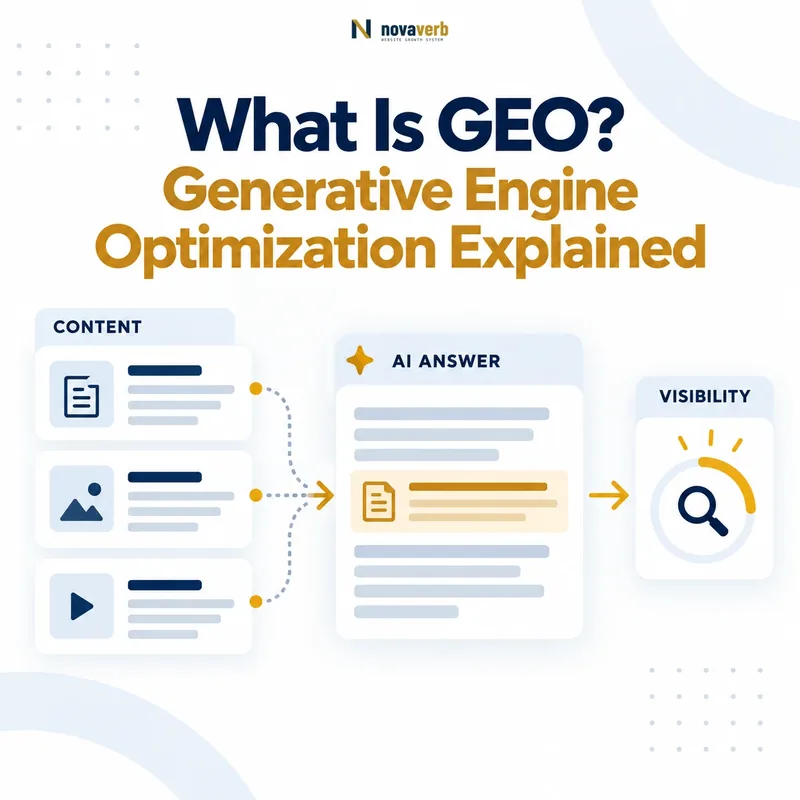
GEO, or Generative Engine Optimization, is the process of making web content easier for AI search systems to understand, retrieve, summarize, and cite. It improves citation readiness by combining answer-first writing, entity clarity, structured data, evidence near claims, and technically accessible HTML.
In digital marketing, GEO does not mean geography or geolocation. It refers to an AI search optimization layer that helps pages become clearer source material for generative answer engines, AI assistants, and AI-powered search results.
- Use GEO when: you want a page to be easier for AI systems to parse, trust, and reference.
- Do not treat GEO as: a shortcut that guarantees AI citations or replaces SEO.
- Best-fit pages: definitions, guides, FAQs, comparison pages, service pages, case studies, and knowledge base articles.
Novaverb fit: GEO becomes operational when teams can connect crawl evidence, answer-ready briefs, entity clarity, schema targets, AI citation monitoring, and recheck workflows inside one search visibility workspace.
Want to improve AI search visibility with crawl evidence, answer-ready briefs, and citation monitoring?
GEO & AEO ReadinessWhy GEO Matters in AI Search
GEO matters because AI search changes how visibility is earned. Users can receive synthesized answers before they click a website, so content must be clear enough to retrieve, trustworthy enough to cite, and structured enough for AI systems to understand without guessing.
In traditional SEO, a page mainly competes for ranking positions and organic clicks. In AI search, a page also competes to become a reliable source inside generated answers, AI summaries, and citation-based search experiences.
- For users: GEO helps them get clearer answers with better source context.
- For brands: GEO creates visibility before the click through AI citations, source mentions, and answer inclusion.
- For SEO teams: GEO forces content, crawl, schema, entity, and proof quality to work together instead of operating as separate tasks.
Novaverb fit: AI search visibility becomes measurable when teams can connect crawl evidence, content briefs, entity coverage, schema targets, and AI citation monitoring inside one search visibility workspace.
Want to track crawl issues, answer readiness, and AI citation gaps in one workflow?
GEO & AEO ReadinessHow Generative Engines
How Generative Engines Use Web Content
Generative engines use web content by retrieving relevant pages, interpreting entities and claims, synthesizing information, and citing sources when attribution is needed. GEO improves this process by making each page easier to crawl, parse, verify, and connect to the user’s search intent.
For a page to become useful source material, the AI system must understand what the page is about, whether the content answers the query, which claims are supported, and whether the source is trustworthy enough to include in a generated answer.
Retrieval
The system finds pages that appear relevant to the user query, topic, entity, or search context.
Understanding
The system identifies entities, headings, claims, facts, relationships, and source context.
Synthesis
The system combines information from one or more sources into a direct answer or summary.
Citation
The system may show sources when it needs attribution, verification, or supporting evidence.
- Retrievable content: clear HTML, clean canonical URLs, indexable pages, and accessible internal links.
- Understandable content: direct headings, answer-first paragraphs, defined entities, and structured sections.
- Citable content: proof near claims, trustworthy author or brand signals, and sources that match the visible content.
Novaverb fit: This workflow is why GEO needs crawl evidence, AEO briefs, schema targets, internal link jobs, and AI citation monitoring. Without those layers, teams may write useful content that AI systems still struggle to retrieve, interpret, or cite.
Want to see which pages are crawlable, answer-ready, and missing AI citation evidence?
GEO & AEO ReadinessHow Generative Engines
How Generative Engines Use Web Content
Generative engines use web content by retrieving relevant sources, interpreting the information, combining context, and generating an answer based on the user query.
- Retrieval: the system finds potentially relevant documents.
- Understanding: the system identifies entities, claims, and context.
- Synthesis: the system combines information into a direct response.
- Citation: the system may show sources when it needs attribution or verification.
GEO vs SEO vs AEO
GEO, SEO, and AEO are connected, but each one solves a different search visibility problem.
| Layer | Main Goal | Optimization Focus |
|---|---|---|
| SEO | Rank and earn organic traffic. | Crawlability, indexability, keywords, authority, internal links, and content quality. |
| AEO | Answer questions directly. | Answer-first sections, FAQ, concise definitions, and snippet-ready formatting. |
| GEO | Become usable in AI-generated answers. | Entities, evidence, source clarity, structured data, and citation readiness. |
The Core Principles of GEO
The core principles of GEO are clarity, retrievability, evidence, entity consistency, and technical accessibility.
- Clarity: say the answer directly.
- Retrievability: make important content easy to find and parse.
- Evidence: support claims with proof near the claim.
- Entity consistency: define terms and connect related concepts.
- Accessibility: ensure the content is visible in rendered HTML.
Answer-First Structure for GEO
An answer-first structure places the direct answer immediately under the H2 or H3. This helps both users and AI systems identify the core response without reading through a long introduction.
The best pattern is simple: answer first, explain second, prove third, and guide the reader to the next step at the end of the section.
Evidence and Source Trust in GEO
Evidence is central to GEO because AI systems need reliable source material. Unsupported claims are harder to trust and easier to ignore.
- Use examples, data, screenshots, case studies, or expert review.
- Place proof close to the claim it supports.
- Show author, reviewer, update date, and editorial standards when relevant.
- Avoid vague claims that cannot be checked.
Schema Markup for GEO
Schema markup helps GEO when it accurately describes visible page content. It gives machines a clearer declaration of the page type, entity, author, breadcrumb, questions, or organization behind the content.
Useful schema types for GEO include Article, FAQPage, DefinedTerm, BreadcrumbList, Organization, Person, Product, Service, and HowTo when the matching content is visible on the page.
Content Chunking for AI Readability
Content chunking means breaking information into clear, self-contained sections that can be understood on their own. This is important for GEO because AI systems often retrieve and summarize parts of a page, not always the whole page.
Each chunk should have a clear heading, a direct answer, supporting detail, and a logical boundary. Avoid long walls of text that mix definitions, examples, objections, and calls to action in the same paragraph.
How to Optimize Existing Pages
How to Optimize Existing Pages for GEO
The fastest way to implement GEO is to improve pages that already have impressions, rankings, or business value.
- Rewrite the opening section with a clear answer-first definition.
- Add missing entity explanations and related terms.
- Move proof closer to important claims.
- Add visible FAQ sections for real user questions.
- Validate schema and check that the content is visible in rendered HTML.
GEO for Product and Service Pages
GEO for product and service pages should help AI systems understand what the offer is, who it is for, what problem it solves, how it works, and why it can be trusted.
A strong service page should include a clear offer definition, use cases, process, pricing context, proof, FAQ, provider information, and action-oriented next steps.
GEO for Blog Posts
GEO for Blog Posts and Knowledge Bases
Blog posts and knowledge base pages are strong GEO assets because they can answer specific questions, define terms, compare options, and explain methods in depth.
- Use one primary intent per page.
- Start each H2 with a direct answer.
- Link terms to entity pages.
- Use examples and proof instead of generic advice.
- End with a logical next step.
Technical SEO Requirements for GEO
Technical SEO is still required for GEO because AI systems and search engines need to access, render, crawl, and understand the page before they can use it.
- Use a clean canonical URL.
- Keep important content visible in HTML.
- Ensure pages are indexable when they should appear in search.
- Maintain clean internal links and sitemap inclusion.
- Validate structured data and fix critical errors.
How to Measure GEO Performance
GEO performance should be measured through both search metrics and AI visibility signals. Rankings alone are not enough because AI search can influence users before a click happens.
- Organic impressions and clicks.
- Branded search growth.
- AI citations and AI answer mentions.
- Referral traffic from AI tools.
- Assisted conversions from informational pages.
- Visibility of key entities across search experiences.
Common GEO Mistakes
Most GEO mistakes happen when teams treat AI search as a trick instead of a source quality problem.
- Using vague definitions that do not answer the query.
- Publishing claims without proof.
- Hiding key answers inside tabs, accordions, or scripts.
- Adding schema that does not match visible content.
- Using generic internal links such as click here or read more.
- Ignoring entity disambiguation when a term has multiple meanings.
CTA: How to Start a GEO Strategy
How to Start a GEO Strategy
Start a GEO strategy by choosing your most important pages, rewriting them with answer-first structure, clarifying entities, adding proof, improving internal links, and validating technical accessibility.
The goal is not to chase every AI platform. The goal is to build a website that is easier for users, search engines, and AI systems to trust.
Explore More AI Search GuidesThe Future of GEO
The future of GEO will likely depend on stronger entity systems, cleaner source attribution, more structured content, and higher expectations for proof. As AI search matures, vague content will become less competitive.
Brands that invest early in clear definitions, original evidence, structured knowledge, and trusted topical authority will have a stronger chance of being selected as AI-readable sources.