
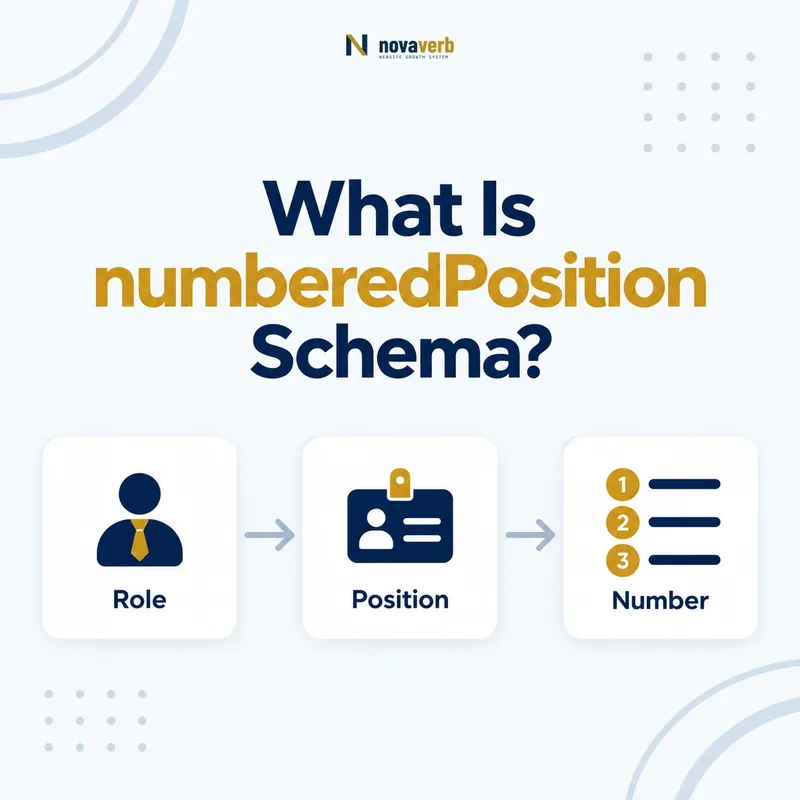
What Is numberedPosition Schema?
numberedPosition is the Schema.org property for a Number associated with an OrganizationRole, such as the number on an athlete’s jersey.
It qualifies the role rather than identifying the Person or Organization directly. The subject must be OrganizationRole or a subtype such as EmployeeRole, and the expected value is Number. A sports team can use it alongside member, roleName, startDate, and endDate to show that a player held a numbered role during a particular period. It is not a generic ranking, list order, employee id, membership number, or database key.
- Place numberedPosition on OrganizationRole.
- Use a Number value.
- Add it only when the organization assigns a number to the role.
- Identify the exact page, asset, entity or relationship described in this section.
- Inspect the live implementation and retain the observed evidence.
- Compare the observation with the intended meaning and its primary specification.
- Correct any mismatch, then retest the live result.
- Record the accountable owner and review date.
| Role element | Expected type | Purpose |
|---|---|---|
| Subject | OrganizationRole | The numbered organization role |
| Property | numberedPosition | Carries the role number |
| Value | Number | The assigned numeric value |
| Common example | Jersey number | Number associated with athlete role |
Primary specification: Schema.org definition for numberedPosition.
numberedPosition represents a number assigned to a role, not every number displayed near a person or organization.
Where Can numberedPosition Be Used?
numberedPosition is used on OrganizationRole and is inherited by EmployeeRole because EmployeeRole is a subtype.
The property should not be attached directly to Person, SportsTeam, Organization, ListItem, Product, ProgramMembership, or JobPosting. A player’s jersey number belongs to the player’s role in a specific team and time period, not permanently to the Person. List ordering uses position, membership identifiers use membershipNumber, and general identifiers use identifier. Correct placement matters when a player changes teams or numbers.
- Create or identify the OrganizationRole.
- Connect the role to the organization relationship.
- Connect the Person or Organization holding the role.
- Add numberedPosition to the role node.
- Use dates when the assignment changes over time.
- The exact page, asset, entity or relationship covered by this section
- The live implementation rather than an editor-only preview
- The primary specification or first-party record defining the expected behavior
- The validation result, accountable owner and review date
| Wrong subject | Better property | Reason |
|---|---|---|
| Person | OrganizationRole.numberedPosition | Number belongs to role context |
| ListItem | position | List order |
| ProgramMembership | membershipNumber | Membership identifier |
| Thing identifier | identifier | General identifier |
| Organization | numberOfEmployees or other specific fact | Not a role number |
Keep numberedPosition on the role so the number remains tied to the correct organization and period.
How Does numberedPosition Work for Jersey Numbers?
For jersey numbers, numberedPosition should describe the number assigned to an athlete’s OrganizationRole on a specific team for the supported time period.
The SportsTeam can use member with an OrganizationRole wrapper containing the Person, roleName, dates, and numberedPosition. A player who wears 12 for Team A and 7 for Team B needs separate role contexts. A player who changes numbers within one team may also need separate dated roles if the history is material. Do not assume the number from an image, merchandise listing, fan page, or old roster without current authoritative evidence.
- Identify the canonical SportsTeam and Person.
- Create the member OrganizationRole.
- Add roleName or position when supported.
- Add the jersey number as Number.
- Qualify the assignment with accurate dates or season context.
- The exact page, asset, entity or relationship covered by this section
- The live implementation rather than an editor-only preview
- The primary specification or first-party record defining the expected behavior
- The validation result, accountable owner and review date
| Scenario | Model | Avoid |
|---|---|---|
| One current team number | One current role | Number on Person |
| Two teams, two numbers | Separate roles | One merged number array |
| Number changed by season | Dated roles when useful | Overwriting history without context |
| Unknown current number | Omit | Guessing from old media |
| Merchandise number | Verify roster | Assuming product equals current role |
Jersey numbers become reliable only when team, athlete, role, and time context stay connected.
Is numberedPosition a Ranking or List Position?
numberedPosition is not a general ranking or list-order property; it represents a number associated with an organization role.
Use ListItem.position for the order of an item in ItemList or BreadcrumbList. Use position where that property applies to sequence. A league standing, draft pick, search rank, employee rank, department order, or org-chart level should not be forced into numberedPosition unless the organization genuinely assigns that number to the role. The presence of a visible numeral is insufficient; the number’s semantic meaning must match the property.
- Use ListItem.position for ordered lists.
- Use numberedPosition for an assigned organization role number.
- Model rankings with a vocabulary that actually describes rank.
- Omit unsupported numeric semantics.
- Identify the exact page, asset, entity or relationship described in this section.
- Inspect the live implementation and retain the observed evidence.
- Compare the observation with the intended meaning and its primary specification.
- Correct any mismatch, then retest the live result.
- Record the accountable owner and review date.
| Visible number | Property | Meaning |
|---|---|---|
| Jersey 23 | numberedPosition | Role number |
| Item 3 in list | ListItem.position | Sequence |
| Search result rank 4 | Not numberedPosition | Observed ranking |
| Employee grade 6 | Not automatically | Internal classification |
| Membership code 0012 | membershipNumber | Identifier Text |
Choose the property from what the number means, not from how it looks on the page.
How Is numberedPosition Different From identifier?
numberedPosition describes a numeric role assignment, while identifier identifies an entity and can accept Text, URL, or PropertyValue.
A jersey number can be reassigned to another player and can change across teams or seasons, so it should not become the Person’s canonical identifier. Employee ids, member codes, database ids, roster ids, and federation ids identify records or entities and belong in identifier or a more specific property when publication is justified. A numbered role may have both a role number and a separate identifier, but they answer different questions.
- Use numberedPosition for the assigned role number.
- Use identifier for a stable identifying value.
- Never use a jersey number as a Person @id.
- Keep private internal ids out of public markup.
- Identify the exact page, asset, entity or relationship described in this section.
- Inspect the live implementation and retain the observed evidence.
- Compare the observation with the intended meaning and its primary specification.
- Correct any mismatch, then retest the live result.
- Record the accountable owner and review date.
| Number or code | Use | Why |
|---|---|---|
| Jersey number | numberedPosition | Assignment to role |
| Federation athlete id | identifier, if public | Identifies athlete record |
| Employee id | Usually omit | Private internal identifier |
| Membership code | membershipNumber, usually private | Identifies membership |
| Role database key | Do not publish | Implementation detail |
A role number can change or be reused, while an identifier should distinguish the entity or record.
How Should Zero, Decimals, and Leading Zeros Be Handled?
Use a valid Number for numberedPosition and preserve only numeric meaning; leading-zero formatting cannot be reliably represented as a distinct Number value.
Zero can be a legitimate role number when the organization assigns it. Decimal values are technically numeric but rarely make sense for jersey or organization role numbers and need strong evidence. A displayed 007 becomes numeric 7 if modeled as Number; if the leading zeros carry essential identity meaning, numberedPosition may not be the right property. Do not send quoted numeric strings merely to preserve formatting when the expected type is Number.
- Confirm the organization treats the value as a number.
- Allow zero when it is a real assignment.
- Avoid decimals unless the role system genuinely uses them.
- Do not rely on leading-zero formatting.
- Use a different identifier property when formatting is semantically essential.
- The exact page, asset, entity or relationship covered by this section
- The live implementation rather than an editor-only preview
- The primary specification or first-party record defining the expected behavior
- The validation result, accountable owner and review date
| Value | Use? | Reason |
|---|---|---|
| 0 | Yes when assigned | Valid Number |
| 00 | Becomes numeric 0 | Formatting is not distinct |
| 7 | Yes | Ordinary role number |
| 7.5 | Rarely | Needs real organization semantics |
| 007 as code | Use identifier instead | Leading zeros may carry identity |
The Number type preserves numeric value, not decorative or code-like formatting.
How Do Reassignment and Retired Numbers Work?
Reassigned numbers require distinct role contexts, while retired numbers should not be attached to a current Person unless that person’s historical role actually held the number.
Organizations can reuse a jersey number after a player leaves, or retire it in honor of a former player. The role history should show who held the number and when. A retired number is an organization policy or historical fact, not necessarily a current OrganizationRole. Do not let one canonical role node move from person to person; create separate roles and use dates to preserve each assignment.
- Create one role context per person and assignment period.
- Use startDate and endDate where supported.
- Keep historical Person and team ids stable.
- Do not model retirement as a current member role.
- Update current rosters without erasing history.
- The exact page, asset, entity or relationship covered by this section
- The live implementation rather than an editor-only preview
- The primary specification or first-party record defining the expected behavior
- The validation result, accountable owner and review date
| Number lifecycle | Model | Avoid |
|---|---|---|
| Reassigned next season | New role for new person | Reusing one role node |
| Player changes number | Separate periods when material | Two current numbers without context |
| Retired number | Historical/policy content | Current empty role |
| Temporary number | Dated role | Permanent assignment claim |
| Unknown period | Use available precision | Invented dates |
Role-specific identities and dates prevent reused numbers from collapsing several people into one assignment.
What numberedPosition Mistakes Are Common?
Common mistakes include putting the property on Person, using it for list order or ranking, quoting numeric strings, treating a jersey number as identity, and ignoring team or time context.
Teams may also publish internal employee grades, roster ids, database keys, or membership numbers through numberedPosition. A player’s number may be copied from stale product pages or images and kept after a transfer. One role can accumulate several numbers without dates, making the assignment ambiguous. Validation catches wrong types but cannot prove the number belongs to that role now.
- numberedPosition placed directly on Person or Team.
- List rank or search position modeled as a role number.
- String value used to preserve formatting.
- Jersey number used as canonical Person identity.
- Multiple assignments merged without dates.
- Old team number kept as current.
- Private employee or member code exposed.
- Identify the exact page, asset, entity or relationship described in this section.
- Inspect the live implementation and retain the observed evidence.
- Compare the observation with the intended meaning and its primary specification.
- Correct any mismatch, then retest the live result.
- Record the accountable owner and review date.
| Error | Impact | Fix |
|---|---|---|
| Wrong subject | Invalid placement | Move to OrganizationRole |
| Wrong semantics | Misleading number | Use correct property |
| String value | Type mismatch | Use Number or choose identifier |
| Stale assignment | Outdated role | Update lifecycle |
| Merged roles | Ambiguous history | Split role contexts |
| Private code | Data exposure | Remove from public markup |
Correct syntax is only the floor; the number must belong to the right role, organization, person, and period.