
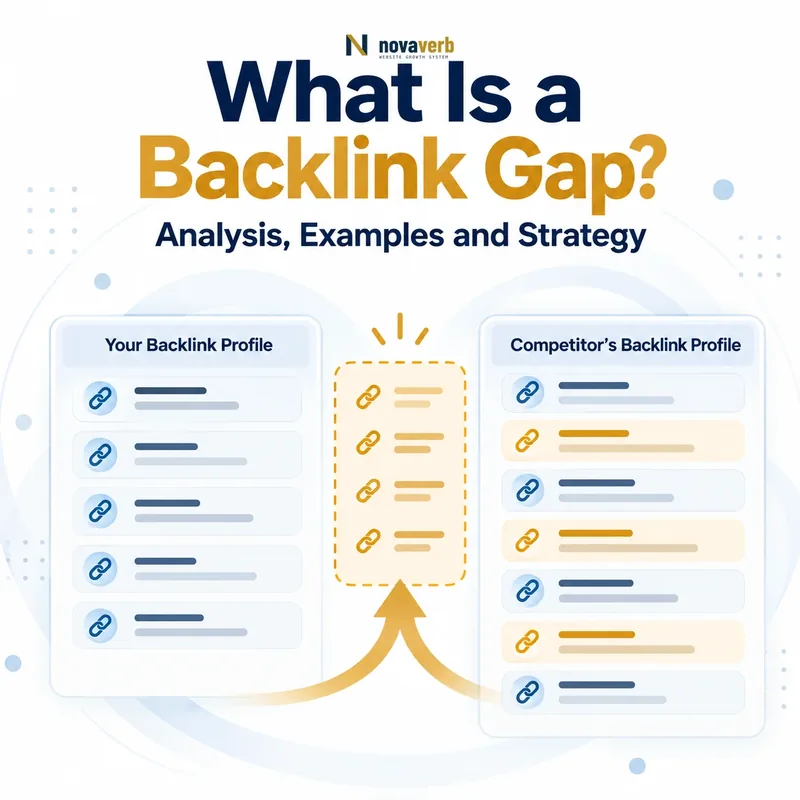
What Is a Backlink Gap?
The comparison can operate at domain, subdomain, directory or exact-page level. A domain-level gap is useful for market coverage, while a page-level gap can reveal sources that cite competing guides, tools or category pages serving the same search need.
A reliable gap report names the provider, crawl date, scope and comparison set. Without those details, an apparent gap may simply reflect index coverage, a redirected source, a recently lost link or a competitor that is not truly comparable.
- Target website or page
- Comparable competitor set
- Shared provider and snapshot
- Missing referring domains
- Missing source pages
- Relevance and feasibility filters
| Gap unit | What is missing | Best use |
|---|---|---|
| Referring domain | Any observed link from a domain | Market coverage |
| Source page | One specific live citation | Outreach research |
| Destination type | Links to comparable assets | Content planning |
| Anchor theme | Topic language used by sources | Message research |
| Link pattern | Repeated source or placement class | Strategy diagnosis |
A backlink gap is a consistently measured absence that becomes an opportunity only after the source and business fit are verified.
How Does Backlink Gap Analysis Work?
The subtraction step is simple; the hard work is choosing a fair comparison set and resolving messy records. Canonicalize domains, follow redirects, separate root domains from subdomains when needed and compare live source evidence rather than exported rows alone.
Run the calculation for referring domains first, then open representative pages. One domain can contain thousands of irrelevant URLs, so domain overlap should guide investigation rather than automatically populate an outreach queue.
- Define the target scope
- Select true search or business competitors
- Use one provider and snapshot window
- Normalize domains and destination URLs
- Remove sources already linking to the target
- Verify representative source pages
- Score relevance and acquisition fit
- Assign the next action
| Workflow stage | Input | Output |
|---|---|---|
| Scope | Domain, folder or page | Comparable target |
| Collection | Provider backlink records | Source inventory |
| Normalization | Domains, redirects and URLs | Comparable rows |
| Subtraction | Target versus competitors | Raw gaps |
| Qualification | Live evidence and fit | Prioritized opportunities |
| Execution | Owner and next step | Outreach or content task |
Gap analysis succeeds when a normalized comparison is followed by live verification and an owned next step.
Backlink Gap vs Competitor Backlink Analysis
A competitor profile can reveal publishing partnerships, digital PR campaigns, tools, research assets, directories and sitewide relationships. A gap report retains only observations not already associated with the target, which reduces noise but can hide useful lessons from shared sources.
Use both views together. Study the full profile to understand why links exist, then use the gap to find specific sources and asset types worth investigating for your own market position.
- Full competitor source inventory
- Target-versus-competitor difference
- Shared referring domains
- Competitor-only domains
- Asset and campaign patterns
- Verified opportunity shortlist
| Analysis | Primary question | Typical output |
|---|---|---|
| Competitor backlinks | How does this competitor earn links? | Complete observed profile |
| Backlink gap | Which relevant sources are missing for us? | Competitor-only sources |
| Link intersect | Which sources link to several competitors? | Repeated market sources |
| Shared links | Where do both sites already appear? | Existing coverage |
| Content gap | Which topics or assets are missing? | Content opportunities |
The full competitor profile explains the system, while the backlink gap isolates missing coverage for qualification.
How Do You Choose Competitors for a Backlink Gap?
Separate search competitors from business competitors. A publisher may outrank a software company for an informational query but have a backlink model that the company cannot or should not copy. A direct product competitor may be commercially relevant even when its current organic footprint is smaller.
Use three to five close comparisons for the primary report and keep broader aspirational sites in a separate discovery set. Record why each site belongs so the list can be reviewed when markets or products change.
- Same search intent
- Same customer problem
- Comparable business model
- Similar market geography
- Comparable asset type
- Realistic editorial environment
- Documented reason for inclusion
| Competitor type | Include when | Caution |
|---|---|---|
| Direct product | Serves the same buyer | May target different topics |
| Search competitor | Ranks for the same intent | May use a different model |
| Editorial publisher | Earns citations for comparable assets | Not a commercial peer |
| Marketplace | Competes for category discovery | Link patterns may be platform-driven |
| Aspirational leader | Provides pattern ideas | Scale may be unrealistic |
A defensible competitor set matches the decision being made and keeps incomparable link models out of the primary gap.
What Makes a Backlink Gap a Good Opportunity?
Open the source and determine why the competitor earned the citation. The page may reference original data, a free tool, an expert quote, a definition or a commercial relationship. Your path should match the source’s purpose rather than copy the competitor’s anchor or pitch.
Confirm that the destination you would offer is live, useful and aligned with the source. If no suitable destination exists, route the gap to content planning instead of premature outreach.
- Topic and audience relevance
- Live indexable source page
- Editorially appropriate placement
- Suitable destination asset
- Clear differentiated value
- Realistic contact or contribution path
- No known deceptive requirement
| Signal | Strong evidence | Weak evidence |
|---|---|---|
| Relevance | Same problem and audience | Shared broad category |
| Source quality | Maintained legitimate page | Metric score alone |
| Feasibility | Clear editorial path | Competitor has a link |
| Destination fit | Useful matching asset | Homepage by default |
| Value | Original data, tool or expertise | Generic request |
The strongest gap is not the highest-scoring domain; it is a verified source with genuine audience, asset and acquisition fit.
How Do You Prioritize Backlink Gaps?
A source linking to three close competitors may indicate a recurring editorial resource, but overlap can also come from a directory, syndicated widget or paid arrangement. Inspect the actual pages before assigning a high priority.
Use separate queues for ready outreach, asset improvement, partnership review and monitoring. This keeps a large export from becoming an undifferentiated list that nobody can execute.
- Verify the source is live
- Confirm topical and audience relevance
- Identify why competitors were cited
- Match or create the right destination
- Assess acquisition feasibility
- Check relationship and policy risks
- Estimate business value
- Assign owner, action and review date
| Priority factor | Question | Example rating |
|---|---|---|
| Relevance | Does the source serve the same need? | High, medium, low |
| Overlap | How many close competitors appear? | Count with context |
| Readiness | Is the destination ready? | Ready, improve, create |
| Feasibility | Is there a legitimate path? | Clear, uncertain, none |
| Value | Could qualified users benefit? | Commercial or informational |
| Risk | Is the relationship appropriate? | Accept, review, exclude |
Prioritization turns verified gaps into separate, executable queues based on fit, readiness, feasibility and value.
How Do You Find Backlink Gaps With SEO Tools?
Start with Backlink Checker to inspect representative sources. Use Backlinks Explorer for broader source evidence and compare the result with each site’s backlink profile rather than relying on a single total.
Export the smallest useful dataset. Include source URL, referring domain, target URL, anchor, link attributes, first-seen date and last-seen date so the team can group patterns and revisit uncertain records.
- Enter the same target scope for every site
- Select a consistent provider snapshot
- Compare referring domains first
- Filter to competitor-only sources
- Group sources shared by multiple competitors
- Open representative live pages
- Tag opportunity type and destination
- Save evidence with the task
| Tool field | Why retain it | Verification use |
|---|---|---|
| Source URL | Identifies the exact page | Open live evidence |
| Referring domain | Groups pages by source | Measure overlap |
| Target URL | Shows cited asset | Match destination type |
| Anchor | Provides placement context | Review language |
| Link attribute | Describes observed markup | Classify relationship |
| Seen dates | Adds time context | Detect stale records |
SEO tools make gap discovery scalable, but every prioritized record should retain the exact source evidence behind it.
How Do You Turn a Backlink Gap Into a Strategy?
If several sources cite competitor research, the strategic need may be original data rather than more outreach. If resource pages cite practical utilities, a free SEO tool or clearer educational guide may create the missing value. If citations come from expert commentary, the route may be a repeatable subject-matter response process.
Connect gap tasks to the SEO tools system so content readiness, destination health, ownership and follow-up remain visible. Measure outreach replies, placements, qualified visits and assisted conversions separately from provider link counts.
- Resource-page opportunities
- Original research opportunities
- Free-tool citations
- Expert contribution requests
- Partner ecosystem coverage
- Unlinked brand mentions
- Broken destination replacements
- Content asset improvements
| Observed gap pattern | Strategic response | Asset or process |
|---|---|---|
| Competitor research cited | Publish differentiated evidence | Original study |
| Useful tools cited | Solve a narrow task | Free interactive tool |
| Definitions cited | Improve clarity and examples | Reference guide |
| Experts quoted | Build response workflow | Subject-matter outreach |
| Resource lists | Demonstrate audience fit | Resource-page pitch |
| Dead competitor pages | Offer a valid replacement | Updated destination |
A backlink-gap strategy reproduces the legitimate value behind citations, not merely the competitor’s visible link placement.
Frequently Asked Questions About Backlink Gaps
- Compare like-for-like scopes
- Verify source pages
- Prioritize realistic value
What is a backlink gap?
How many competitors should I compare?
Is every competitor link an opportunity?
Should I compare backlinks or referring domains?
Why do gap tools show different results?
Can a backlink gap guide content planning?
How often should I rerun the analysis?
Does closing a backlink gap guarantee rankings?
Backlink gaps are useful discovery inputs when their scope, evidence and acquisition assumptions remain explicit.
Find the Link Opportunities That Actually Fit
Discover representative links for free, organize competitor evidence in Backlinks Explorer and connect each viable opportunity to the complete SEO workflow.
- Choose comparable competitors
- Normalize the source data
- Verify live pages
- Match the right destination
- Assign the next action
The best gap list is smaller, verified and connected to a legitimate reason the source could serve its audience with your asset.