
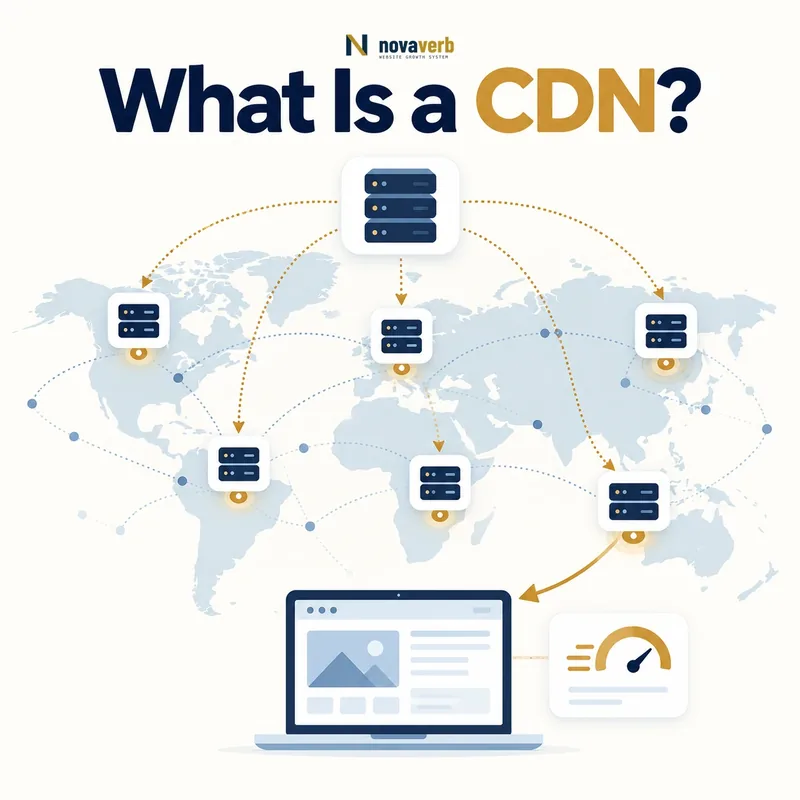
What Is a Content Delivery Network?
The CDN sits between browsers and the origin. It receives requests, applies routing and security rules, and may serve a cached response from an edge location. When the edge has no eligible copy, it retrieves the response from the origin, returns it to the visitor and may store it for later requests.
CDNs commonly deliver images, CSS, JavaScript, fonts, video and public HTML. They can also terminate TLS, compress responses, negotiate modern protocols and absorb traffic spikes. A CDN does not automatically make a site fast or search-friendly: its value depends on correct cache policies, stable routing and responses that remain equivalent across locations.
- Identify the exact page, asset, entity or relationship described in this section.
- Inspect the live implementation and retain the observed evidence.
- Compare the observation with the intended meaning and its primary specification.
- Correct any mismatch, then retest the live result.
- Record the accountable owner and review date.
| Term | Meaning | Why it matters |
|---|---|---|
| Origin | Authoritative application or storage | Creates or stores the source response |
| Edge | Regional CDN server | Serves visitors with less distance |
| PoP | Physical point of presence | Houses edge infrastructure |
| Cache hit | Response served from edge storage | Avoids an origin round trip |
| Cache miss | Edge must contact origin | Adds origin work and latency |
- A CDN is different from a web host.
- Not every response should be cached.
- The public edge response is the one users experience.
Primary specification: MDN content delivery network reference.
A CDN is a delivery layer whose SEO value comes from faster, reliable and consistent public responses.
How Does a CDN Work?
DNS and anycast routing commonly help direct a visitor to a nearby or healthy edge. The edge evaluates the hostname, path, query parameters, request headers and configured rules. If a fresh matching object exists, the edge returns it. Otherwise it forwards the request upstream and waits for the origin response.
The edge then decides whether that response can be stored, for how long and under which key. Subsequent visitors may receive the same public object until it expires, is purged or is replaced. Dynamic acceleration can still improve uncached requests through connection reuse, optimized routing and protocol handling, although the origin remains involved.
- The exact page, asset, entity or relationship covered by this section
- The live implementation rather than an editor-only preview
- The primary specification or first-party record defining the expected behavior
- The validation result, accountable owner and review date
| Stage | CDN decision | Possible result |
|---|---|---|
| Routing | Choose a healthy edge | Shorter network path |
| Key lookup | Find matching object | Hit, miss or bypass |
| Freshness | Check cache policy | Serve or revalidate |
| Origin fetch | Request upstream response | Store or pass through |
| Delivery | Apply protocol and compression | Return public response |
- The browser resolves the hostname.
- The request reaches an edge location.
- The edge evaluates rules and its cache.
- A cached or origin response is returned.
The practical request flow is route, match, serve or fetch, then store only when the response is safe to reuse.
CDN vs Browser Cache and Web Hosting
Browser caching can eliminate a repeat transfer for the same person, while CDN caching can eliminate repeated origin work across many people. Hosting remains responsible for the canonical application, files and data. These layers complement one another but have different privacy boundaries and invalidation controls.
A long browser lifetime can keep an asset local even after the CDN has been purged. A CDN can keep serving an object even when the origin was updated. A fast host can reduce miss latency but cannot reproduce the geographic reach of a broad edge network. Teams should document which layer owns freshness for each resource class.
- Identify the exact page, asset, entity or relationship described in this section.
- Inspect the live implementation and retain the observed evidence.
- Compare the observation with the intended meaning and its primary specification.
- Correct any mismatch, then retest the live result.
- Record the accountable owner and review date.
| Layer | Location | Reused for | Primary control |
|---|---|---|---|
| Browser cache | Visitor device | One browser profile | Response headers |
| CDN cache | Distributed edges | Many eligible visitors | Edge rules and headers |
| Web host | Origin region | Source requests | Application and server |
| Application cache | Origin services | Computed data or pages | Framework or data layer |
- Purging a CDN does not clear browser storage.
- Private responses must not become shared objects.
- Origin performance still matters on misses.
Treat hosting, edge caching and browser caching as separate layers with coordinated but explicit policies.
How Can a CDN Help SEO?
Shorter network paths can improve response and asset delivery, especially when audiences are far from the origin. Edge caching may reduce load on the application during traffic peaks, allowing important pages to remain available. Consistent compression, HTTP protocol support and image delivery can also support page experience.
The benefit is indirect and must be measured on real pages. A cached image may help Largest Contentful Paint, yet slow origin HTML can still delay discovery of that image. A fast edge cannot repair an incorrect canonical, thin page or blocked crawl. Evaluate CDN work alongside Time to First Byte, Largest Contentful Paint and browser caching.
- The exact page, asset, entity or relationship covered by this section
- The live implementation rather than an editor-only preview
- The primary specification or first-party record defining the expected behavior
- The validation result, accountable owner and review date
| Potential benefit | Mechanism | Evidence to inspect |
|---|---|---|
| Lower latency | Nearby edge serves response | Regional field and lab timing |
| Origin protection | Hits avoid application work | Hit ratio and origin load |
| Availability | Traffic spreads across network | Error rate during peaks |
| Asset efficiency | Compression and protocol support | Transferred bytes and timing |
| Global consistency | Common delivery rules | Headers and content by region |
- Identify high-value regions and templates.
- Measure the current origin path.
- Enable one controlled delivery improvement.
- Compare real-user and edge evidence.
A CDN supports search performance when it improves real delivery without changing the meaning or accessibility of the page.
What Should a CDN Cache?
Fingerprint-named CSS and JavaScript, public fonts and versioned images are strong candidates for long edge lifetimes. Public HTML may use shorter caching, revalidation or controlled stale serving when the publishing model supports it. APIs require endpoint-specific decisions because one route may be public while another contains account data.
Cookies alone are not a complete safety policy. The cache key and bypass rules must distinguish logged-in state, locale, device variants and experiments when those factors alter the response. Avoid adding every request header to the key, because excessive variation destroys reuse and makes behavior harder to reason about.
- Identify the exact page, asset, entity or relationship described in this section.
- Inspect the live implementation and retain the observed evidence.
- Compare the observation with the intended meaning and its primary specification.
- Correct any mismatch, then retest the live result.
- Record the accountable owner and review date.
| Resource | Typical edge approach | Invalidation |
|---|---|---|
| Hashed CSS/JS | Long public lifetime | New fingerprinted URL |
| Versioned image | Long public lifetime | New URL or purge |
| Public HTML | Short lifetime or revalidation | Purge and freshness rules |
| Account page | Bypass shared cache | Always origin/private delivery |
| Public API data | Endpoint-specific lifetime | Purge, version or validate |
| Checkout response | No shared storage | Origin-controlled response |
- Classify public and private responses first.
- Set lifetimes from acceptable staleness.
- Keep the cache key as small as correctness allows.
Cache by resource behavior and privacy boundary, not by file extension alone.
What CDN Cache Headers Matter?
Cache-Control communicates storage and freshness rules. s-maxage can specify shared-cache freshness separately from browser max-age. Vary identifies request headers that change the representation. ETag and Last-Modified support validation when the edge or browser holds a stale object.
Age may reveal how long a response has lived in a shared cache. Provider-specific cache-status headers often label hits, misses, bypasses and revalidations. These diagnostic values are useful, but the final HTML, status, redirects and canonical signals must also be compared. A “HIT” is not success if it is the wrong response.
- The exact page, asset, entity or relationship covered by this section
- The live implementation rather than an editor-only preview
- The primary specification or first-party record defining the expected behavior
- The validation result, accountable owner and review date
| Header or signal | Purpose | Audit question |
|---|---|---|
| Cache-Control | Storage and freshness policy | Is shared reuse allowed intentionally? |
| s-maxage | Shared-cache lifetime | Does edge freshness differ from browser freshness? |
| Vary | Representation dimensions | Does the key separate real variants? |
| ETag | Version validator | Does revalidation behave consistently? |
| Age | Object residency | Is the edge serving an expected lifetime? |
| Cache status | Provider diagnostic | Are hits, misses and bypasses explainable? |
- Capture the public response headers.
- Repeat requests from more than one region.
- Compare hits, misses and bypasses.
- Validate the associated page content.
Read headers together with the delivered body and status so cache efficiency never hides content inconsistency.
What CDN SEO Problems Can Occur?
A stale edge object can preserve an old canonical, title, internal link or status code after the origin changes. Incorrect rules may cache a redirect longer than intended or transform a temporary error into a persistent regional problem. Bot-management controls can challenge legitimate crawlers or monitoring systems, making availability look different by user agent or geography.
Query normalization can collapse distinct pages or fragment one resource into unnecessary variants. Country redirects may prevent a visitor or crawler from reaching the requested URL. Edge-generated HTML rewriting, image optimization and script injection can introduce markup differences. These failures are especially difficult because the origin may look correct during local testing.
- Identify the exact page, asset, entity or relationship described in this section.
- Inspect the live implementation and retain the observed evidence.
- Compare the observation with the intended meaning and its primary specification.
- Correct any mismatch, then retest the live result.
- Record the accountable owner and review date.
| Problem | SEO or user symptom | First check |
|---|---|---|
| Stale HTML | Old canonical or content | Age, TTL and purge history |
| Cached redirect | Wrong destination persists | Status and location by region |
| Bot challenge | Crawler receives block page | Security event and user-agent test |
| Bad cache key | Wrong locale or variant | Key inputs and Vary |
| Edge error | Regional 5xx or timeout | PoP and origin health |
| HTML transformation | Markup differs unexpectedly | Compare edge and origin bodies |
- Test status, headers and body together.
- Compare multiple regions and user agents.
- Preserve an origin-only diagnostic path.
The central CDN SEO risk is disagreement between the intended origin response and what the public edge actually delivers.
How Do You Audit a CDN for SEO?
Build a representative set: homepage, category, content article, product page, static asset, redirect, 404 and any localized or personalized route. Capture DNS, TLS, status, redirect chain, headers, body hash and timing. Repeat requests to identify the cache lifecycle instead of drawing conclusions from one request.
Compare anonymous and authenticated states without exposing private data. Test desktop and mobile variants only where they genuinely differ. Purge or publish a controlled change and measure how quickly every edge returns the new response. Use logs and provider analytics to explain misses, bypasses, errors and unusually low hit ratios.
- The exact page, asset, entity or relationship covered by this section
- The live implementation rather than an editor-only preview
- The primary specification or first-party record defining the expected behavior
- The validation result, accountable owner and review date
| Audit area | Test | Pass evidence |
|---|---|---|
| DNS and TLS | Resolve and connect by region | Correct host and valid certificate |
| Response parity | Compare origin and edge | Expected status, headers and body |
| Cache lifecycle | Repeat then age request | Explainable hit and freshness |
| Purge | Publish controlled update | Edges converge within policy |
| Variants | Test locale/session/device | No cross-variant leakage |
| Errors | Request missing and failing paths | Correct 404/5xx handling |
| Security | Test legitimate automated access | No unintended challenge or block |
- Choose revenue and traffic-critical URL types.
- Capture first and repeat requests.
- Compare edge regions with the origin.
- Test a real update and rollback.
- Prioritize correctness before hit ratio.
A credible CDN audit proves response correctness and update behavior, not just a high cache-hit percentage.