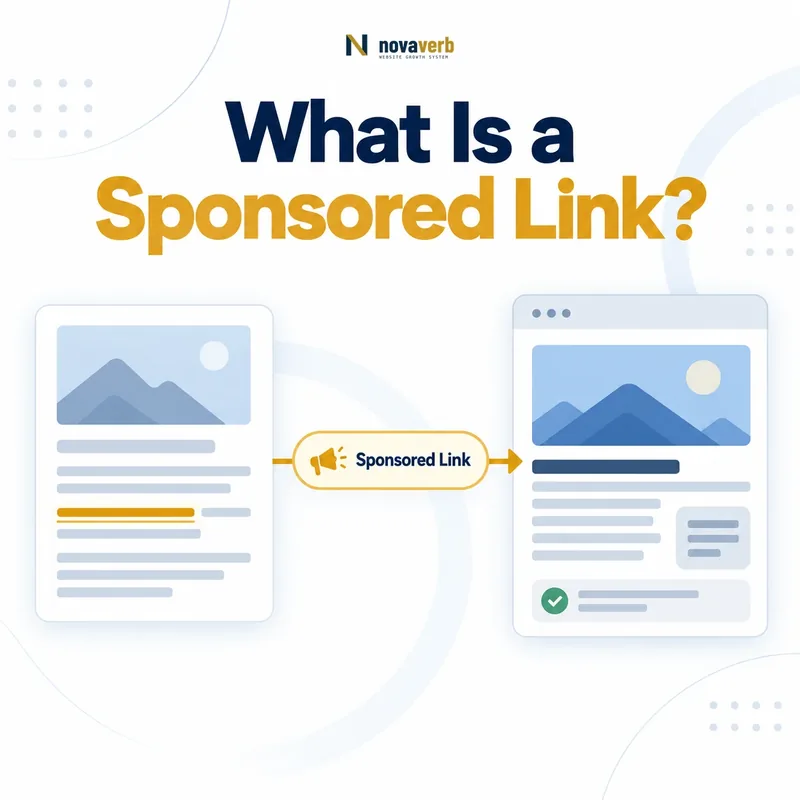
What Is a Sponsored Link?
Examples include links in sponsored articles, paid product placements, advertorials, sponsor acknowledgments and some compensated reviews. Payment can be monetary or take another form, such as free products, services, travel or contractual benefits.
Visible disclosure and HTML attributes describe important parts of implementation, but neither alone proves the complete business relationship. Retain contracts, invoices, campaign briefs and publisher records beside live source evidence.
- Payment or material value
- Publisher and sponsor relationship
- Linked brand, product or destination
- Visible source-page context
- Disclosure where applicable
- Observed link attributes
- Campaign and contract records
- Identify the commercial relationship behind the placement.
- Confirm that readers can understand the sponsorship.
- Inspect the link's rel attributes in the live HTML.
- Check whether the destination matches the surrounding offer.
- Record the source, destination and review date.
| Sponsored-link element | Question | Evidence |
|---|---|---|
| Relationship | What value was exchanged? | Contract or invoice |
| Placement | Where does the link appear? | Live source page |
| Disclosure | How is sponsorship communicated? | Visible label |
| Attribute | How is the link marked in HTML? | Rendered markup |
| Destination | What page receives the link? | Final URL |
| Control | Who selected anchor and target? | Campaign brief |
A sponsored link is classified by the material relationship, then documented through placement, disclosure, markup and campaign evidence.
What Are Sponsored Link Examples?
Not every commercial relationship looks like an advertisement. A publisher may retain editorial control over a sponsored article, while a sponsor may supply required destinations or claims. Record the actual division of control rather than assuming it from page design.
A legitimate sponsorship can serve users by funding useful content, events or tools. Transparency, accuracy and audience fit matter independently from any SEO effect.
- Sponsored article or advertorial
- Paid product review
- Event sponsor listing
- Newsletter sponsorship archive
- Influencer campaign page
- Brand-funded research or guide
- Paid resource placement
- Compensated partner feature
- Review the agreement that created the placement.
- Locate the disclosure where a reader will encounter it.
- Inspect every linked destination and redirect.
- Verify attribution in the rendered HTML.
- Classify the example from evidence rather than appearance.
| Example | Material relationship | Link context |
|---|---|---|
| Advertorial | Publication fee | Sponsored article |
| Product review | Payment or product value | Review page |
| Event sponsor | Sponsorship package | Sponsor listing |
| Newsletter sponsor | Media buy | Issue or archive |
| Funded research | Research sponsorship | Method and acknowledgments |
| Influencer feature | Campaign compensation | Creator content |
Sponsored links appear in many content formats, so the underlying compensation and control records are more reliable than visual style.
What Does rel Sponsored Mean?
A link can carry several rel values, and tools may report the observed tokens differently. Inspect the live anchor element because rendered pages, JavaScript, redirects and provider refresh timing can affect what an export shows.
Missing rel="sponsored" does not turn a paid relationship into an editorial one. Conversely, a publisher can conservatively mark a link as sponsored even when the exact commercial arrangement is unavailable to an outside analyst.
- Attribute belongs to the anchor element
- Value communicates compensated relationship
- Several rel tokens can coexist
- Visible disclosure is a separate layer
- Provider reports can lag live markup
- Relationship records remain authoritative
- Open the live source page.
- Locate the sponsored link in its actual context.
- Inspect the anchor element and rel values.
- Confirm that attribution applies to the intended link.
- Recheck after templates or campaign content change.
| Evidence layer | What it communicates | What it cannot prove alone |
|---|---|---|
| rel="sponsored" | Observed link relationship token | Exact payment terms |
| Visible sponsored label | Audience-facing disclosure | HTML attribute state |
| Contract | Commercial obligations | Live implementation |
| Invoice | Payment evidence | Which exact link remained live |
| Campaign brief | Control over placement | Final publisher changes |
| Source page | Current rendered context | Historical agreement |
Use markup, disclosure and commercial records together because each explains a different part of the sponsored placement.
Sponsored Links vs Affiliate and Editorial Links
A paid review may contain tracked affiliate links, making the page both sponsored and affiliate-connected. An independent article can use an affiliate link under a publisher’s standard monetization model without direct payment from the destination for that specific coverage.
Use the editorial backlink framework to assess publisher control. Do not describe compensated placement as independent simply because the source is relevant or professionally written.
- Direct payment for coverage
- Referral-based affiliate compensation
- Independent editorial selection
- Provided products or services
- Publisher monetization policy
- Sponsor control over anchor or target
- Transparent overlapping relationships
- Determine whether compensation influenced placement.
- Identify who selected the destination.
- Review disclosure and attribution separately.
- Check whether the destination serves the reader's context.
- Use the relationship evidence to choose the correct category.
| Link class | Relationship trigger | Primary evidence |
|---|---|---|
| Sponsored | Payment or material value | Contract and disclosure |
| Affiliate | Referral commission | Tracking and terms |
| Editorial | Independent publisher choice | Source and acquisition history |
| Partner | Real business relationship | Agreement and user purpose |
| Reciprocal | Return-link condition | Exchange records |
| Self-created | Destination controls account | Account ownership |
Classify links from their real economic and editorial relationships, retaining multiple labels when more than one arrangement applies.
How Should Sponsored Links Be Disclosed?
A vague partner label may not communicate that compensation influenced coverage. The disclosure should match the actual relationship and should not be hidden in an unrelated footer or ambiguous page.
Keep disclosure copy, placement and approval records with the campaign. This article provides SEO content operations guidance, not jurisdiction-specific legal advice.
- Plain language describing material relationship
- Prominent placement near relevant content
- Readable across mobile and desktop
- Consistency with the actual arrangement
- Accessible presentation
- Campaign approval record
- Qualified review for legal requirements
- Write a plain-language disclosure for the relationship.
- Place it where readers encounter the sponsored content.
- Keep the disclosure visually readable on mobile.
- Apply sponsored attribution to qualifying links.
- Review the published page rather than the editor preview alone.
| Disclosure question | Operational check | Risk signal |
|---|---|---|
| Clarity | Would an ordinary reader understand? | Vague euphemism |
| Proximity | Is it near the sponsored material? | Unrelated footer only |
| Visibility | Can it be noticed on mobile? | Hidden styling |
| Accuracy | Does wording match value exchanged? | Incomplete relationship |
| Consistency | Do campaign pages use approved language? | Publisher variation |
| Governance | Who reviewed the disclosure? | No accountable owner |
Effective disclosure communicates the real material relationship clearly, prominently and consistently for the audience using the page.
Can Sponsored Links Provide Business Value?
A relevant sponsorship can reach a concentrated professional audience or support a useful event. The linked destination should continue the promise made by the creative and disclosure rather than defaulting to an unrelated homepage.
Measure impressions, qualified clicks, engaged sessions, leads, assisted conversions and brand outcomes using campaign definitions agreed before launch. Compare performance with the full cost, including creative and publisher fees.
- Qualified audience reach
- Referral traffic
- Product or service education
- Event and community visibility
- Lead and trial generation
- Assisted conversion
- Partner relationship value
- Reusable campaign learning
- Define the audience and commercial objective before placement.
- Select a source whose readers match the destination.
- Use a landing page that fulfills the promoted promise.
- Measure visits and outcomes through the named analytics source.
- Evaluate value without assigning unsupported causal credit.
| Business objective | Metric | Decision |
|---|---|---|
| Reach | Qualified impressions | Audience fit |
| Traffic | Tracked referral sessions | Destination relevance |
| Engagement | Useful actions or time | Content fit |
| Acquisition | Leads, trials or sales | Commercial efficiency |
| Brand | Survey or direct response evidence | Message effectiveness |
| Partnership | Renewal and joint outcomes | Relationship value |
A sponsorship succeeds when it produces defined audience and business outcomes, not when a backlink provider records the placement.
What SEO Risks Do Sponsored Links Create?
One paid placement does not describe an entire profile. Group campaigns by publisher, vendor, destination, anchor, timing and contract, then compare live implementation with approved terms.
Third-party risk scores can prioritize review but cannot prove payment or account consequences. Use first-party invoices, messages and search account evidence for severe conclusions.
- Undisclosed commercial relationship
- Large controlled placement campaigns
- Coordinated keyword anchors
- Paid coverage reported as earned
- Irrelevant publishers and audiences
- Destination concentration
- Contract and implementation mismatch
- Missing governance and ownership
- Inventory sponsored placements and their destinations.
- Check disclosure and rel attribution on the live page.
- Review repeated anchors, networks and redirect patterns.
- Separate transparent advertising from manipulative schemes.
- Repair the relationship or placement before rechecking.
| Risk signal | Evidence needed | Response |
|---|---|---|
| Paid relationship hidden | Contract and source page | Correct disclosure and record |
| Anchor controlled at scale | Brief and live links | Stop manipulative requirement |
| Irrelevant placements | Audience and campaign list | End low-fit buying |
| Earned-report mismatch | Spend and reporting fields | Correct attribution |
| Provider score only | No payment evidence | Investigate, not verdict |
| Direct account concern | First-party account record | Use scoped remediation |
Sponsored-link risk is strongest when direct commercial records and live implementations show deceptive or signal-driven control.
How Do You Audit Sponsored Links?
Use Backlink Checker to discover representative sources and Backlinks Explorer to group publishers, anchors and destinations. Compare controlled patterns with the link spam and reciprocal link frameworks.
Connect disclosure fixes, destination repairs, publisher reviews and campaign renewals through the SEO tools system. Preserve verification dates and screenshots or notes where allowed.
- Inventory sponsored publishers and campaigns
- Map exact live source URLs
- Match links to contracts and invoices
- Check visible disclosure
- Inspect observed rel attributes
- Resolve final destinations
- Compare anchor and placement with brief
- Measure qualified campaign outcomes
- Correct, renew, stop or investigate
- Assign owner and retest date
- The contract or campaign record describing the relationship
- The live source page and visible disclosure
- The rendered anchor element and rel attributes
- The complete redirect path to the final destination
- The owner responsible for correction and re-verification
| Audit finding | Action | Completion evidence |
|---|---|---|
| Accurate transparent placement | Keep and measure | Relationship and outcomes recorded |
| Missing disclosure | Correct with publisher | Live label verified |
| Missing sponsored attribute | Review implementation | Live markup documented |
| Broken destination | Repair | Valid matching page |
| Paid placement labeled earned | Correct reporting | Acquisition field updated |
| Manipulative controlled campaign | Stop and remediate | Campaign ended and records preserved |
Use the free backlink checker for an initial source review, monitor placement evidence in Backlinks Explorer, and review Novaverb pricing when comparing an ongoing audit workflow with manual checks.
A complete audit aligns live placement, commercial records, transparency, destination health, reporting and measurable campaign value.