
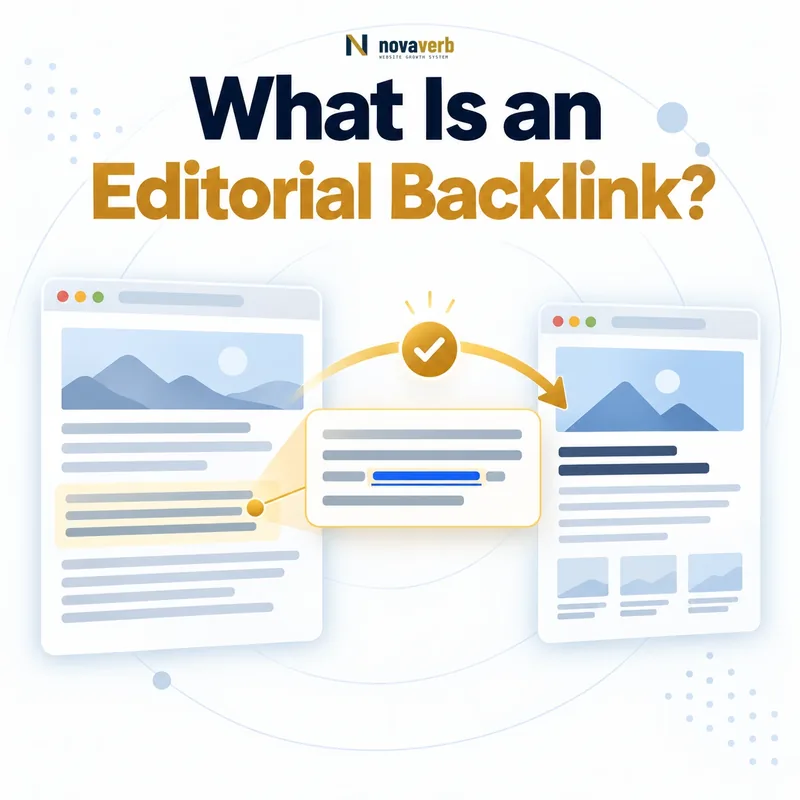
What Is an Editorial Backlink?
Typical examples include a journalist citing original research, a guide referencing a useful tool or an expert article linking to a clear definition. The link usually appears where readers need the supporting resource, although editorial choices can also occur in curated reference sections.
Editorial intent cannot be proven from a metric or HTML attribute alone. Inspect the source, relationship and acquisition history, and distinguish observed page evidence from an inference about why the publisher placed the link.
- Publisher controls the placement
- Destination supports the source content
- Link serves the source audience
- Context explains the reference
- No required reciprocal placement
- No destination-controlled template
- Evidence is verified on the source page
- Open the referring page and locate the link in context.
- Confirm that the publisher chose the destination independently.
- Check whether the destination supports the surrounding claim.
- Review attribution and disclosure where a relationship exists.
- Record the live source, destination and evidence date.
| Editorial element | Question | Evidence |
|---|---|---|
| Control | Who decided to include the link? | Publisher decision |
| Purpose | Why does the page reference it? | Audience utility |
| Context | Does surrounding text support it? | Relevant passage |
| Destination | Does the target fulfill the reference? | Healthy matching page |
| Relationship | Was placement contractually required? | Acquisition history |
| Status | Is the link live now? | Source verification |
An editorial backlink is defined by an independent publisher decision supported by source context and relationship evidence.
Editorial Backlinks vs Other Link Types
A contextual link describes location and relevance, not necessarily editorial independence. A paid placement can appear inside an article, and an editorial citation can use an attribute that changes how tools classify it.
Do not infer quality from a type label alone. A legitimate directory listing may serve customers, while a deceptive article placement may imitate editorial styling. Record what is observed and what is known about the relationship.
- Editorial publisher choice
- Sponsored commercial arrangement
- Affiliate tracked relationship
- Self-created profile or comment
- Directory or citation listing
- Reciprocal business agreement
- Sitewide template placement
- Identify who controlled the placement decision.
- Check whether compensation or an exchange influenced the link.
- Read the surrounding copy for a genuine citation reason.
- Inspect the destination for relevance and accessibility.
- Classify the link from evidence rather than its label alone.
| Link type | Placement control | Primary evidence |
|---|---|---|
| Editorial | Independent publisher | Context and relationship |
| Sponsored | Commercial arrangement | Disclosure and records |
| Affiliate | Referral compensation structure | Tracking and terms |
| Self-created | Destination representative | Account ownership |
| Directory | Listing policy or submission | Directory purpose |
| Reciprocal | Both parties link | Documented relationship |
Classify links by the real placement relationship before using descriptive labels such as contextual, directory or sitewide.
What Are Editorial Backlink Examples?
A business publication may cite a proprietary industry benchmark. A tutorial may link to a calculator needed to complete a step. A university resource may reference a clear public methodology or dataset. In each case, the source page supplies the evidence for the classification.
Brand mentions, interviews and product reviews can also contain editorial links when the publisher retains genuine control. Conversely, a link inside contributed content is not automatically independent merely because an editor reviewed the page.
- Journalist citation to first-party research
- Tutorial link to a free calculator
- Reference guide link to a definition
- Analysis link to a public dataset
- Article link to technical documentation
- Expert roundup attribution
- Curated resource link to a template
- Find the exact statement supported by the link.
- Identify the resource, evidence or utility being cited.
- Confirm that the source and destination audiences align.
- Check that the link works and reaches the intended page.
- Preserve the source-page context for future verification.
| Source context | Cited destination | Editorial reason |
|---|---|---|
| News analysis | Original report | Supports factual claim |
| How-to guide | Free tool | Completes reader task |
| Technical article | Documentation | Clarifies implementation |
| Market overview | Public dataset | Enables verification |
| Educational resource | Definition guide | Explains terminology |
| Professional workflow | Template | Provides reusable help |
The clearest examples connect an independently written source passage to a destination that genuinely strengthens it.
How Can You Identify an Editorial Backlink?
Begin with the referring page. Locate the link, read the paragraph and inspect author, publisher, disclosure and page purpose. Then resolve redirects and confirm that the destination still delivers the cited value.
Look beyond provider authority metrics. They can filter a large dataset but cannot reveal contracts, editorial discussions or account ownership. If relationship evidence is unavailable, record the classification as a confidence-based inference rather than a confirmed fact.
- Open the exact source URL
- Confirm the page is live and legitimate
- Locate the link in rendered content
- Read the surrounding passage
- Check anchor, placement and attributes
- Resolve the final destination
- Review disclosure and relationship evidence
- Separate observed facts from inference
- Record confidence and next action
- A citation embedded in relevant editorial copy
- Anchor text that describes the referenced destination
- A destination that supports the surrounding statement
- No evidence that placement was purchased or exchanged
- A live source page that can be independently reviewed
| Check | Supports editorial inference | Does not prove it alone |
|---|---|---|
| Context | Resource directly supports passage | Link appears in body |
| Publisher | Identifiable maintained publication | High domain metric |
| Destination | Fulfills cited need | Commercial page exists |
| Disclosure | No conflicting paid statement | Missing disclosure |
| Control | Known publisher choice | Natural-looking anchor |
| History | Unrequested or earned process | First-seen date |
A defensible classification combines live source context, destination fit and relationship evidence while making uncertainty explicit.
Why Are Editorial Backlinks Valuable?
The benefit is not automatic. An editorial link from an irrelevant, inactive or unread page may have limited business impact, and provider metrics do not establish search outcomes. Measure referral behavior, destination engagement and search performance separately.
Editorial citations can also reveal product and content demand. Repeated links to research, tools or templates show which owned assets solve external publishing needs and deserve continued maintenance.
- Relevant referral traffic
- Direct asset discovery
- Evidence of publisher demand
- Broader destination coverage
- Brand and expert visibility
- Content validation
- Opportunities for durable relationships
- Verify the source page and its intended audience.
- Confirm the link's purpose in the surrounding passage.
- Assess whether referral visitors would find the destination useful.
- Separate editorial relevance from provider authority metrics.
- Track business value without assigning unsupported causality.
| Potential value | Evidence to measure | Limitation |
|---|---|---|
| Referral traffic | Qualified sessions | Source may have low audience |
| Asset discovery | Crawl and access evidence | Not a ranking guarantee |
| Audience trust | Engagement and responses | Hard to isolate |
| Commercial support | Assisted actions | Attribution is partial |
| Content insight | Repeated citation themes | Provider coverage varies |
| Relationship growth | Future legitimate collaboration | Requires ongoing value |
Editorial links are most useful when source relevance, audience behavior and destination outcomes are measured instead of assumed.
How Do You Earn Editorial Backlinks?
A linkable asset can supply original data, a free utility, a template, an expert explanation or a maintained reference. Select the format after validating the publisher and audience need.
Outreach can introduce the asset, but it should explain why the exact source audience benefits. Avoid promises, manufactured testimonials or arrangements presented as independent editorial choices when they are not.
- Define a publisher and audience need
- Create original evidence or utility
- Publish a stable accessible destination
- Document methods and limitations
- Find sources covering the exact problem
- Explain the relevant value concisely
- Respect editorial control and rejection
- Track live source evidence
- Maintain the cited destination
- Original research with documented methods
- Free tools that complete a real audience task
- Templates that reduce repeatable work
- Clear visual explanations of difficult concepts
- Maintained reference pages with verifiable information
| Earning method | Useful input | Editorial outcome |
|---|---|---|
| Digital PR | Timely original data | Independent coverage |
| Resource discovery | Focused useful tool | Curated recommendation |
| Expert response | Qualified first-party insight | Attributed citation |
| Original research | Transparent methodology | Evidence reference |
| Public documentation | Clear implementation detail | Technical citation |
| Organic discovery | Exceptional evergreen asset | Unrequested mention |
Editorial links are earned most sustainably when publishers discover distinct value and retain control over their own citation decisions.
Are Guest Post Links Editorial Backlinks?
A publisher may independently edit contributed expert material and choose a supporting citation, which can contain editorial judgment. A contributor may also insert a self-serving link as a condition of participation, which is contributor-controlled even if it appears in main content.
Preserve both labels when helpful: contributed content describes authorship, while editorial, sponsored or self-created describes the placement relationship. Do not use visual context to conceal a commercial or controlled arrangement.
- Authorship of the source content
- Control over link and anchor
- Publisher review and changes
- Compensation or exchange
- Disclosure on the page
- Destination relevance
- Contractual placement requirement
- Identify who proposed and controlled the destination.
- Review any payment, exchange or publication agreement.
- Check whether the link is necessary for the reader.
- Confirm appropriate disclosure and link attributes.
- Describe the placement accurately instead of forcing an editorial label.
| Guest-content scenario | Likely classification | Reason |
|---|---|---|
| Editor independently adds source | Editorial inference | Publisher controls citation |
| Contributor requires own link | Contributor-controlled | Placement is part of submission |
| Paid article with disclosure | Sponsored | Commercial arrangement |
| Expert quote, publisher adds bio | Publisher policy or attribution | Context-specific |
| Link exchanged for publication | Reciprocal or controlled | Material relationship |
| Editor removes promotional target | No backlink | Editorial control exercised |
Guest authorship and editorial placement are separate questions; classify the link by actual control and relationship evidence.
How Do You Audit and Monitor Editorial Backlinks?
Start with Backlink Checker to discover representative citations. Use Backlinks Explorer to organize sources, anchors and destination changes, then compare findings with the full backlink profile.
Connect repairs, asset updates and relationship tasks through the SEO tools system. Store the source URL, quoted context summary, final destination, verification date, relationship evidence, owner and outcome.
- Collect candidate source records
- Open each priority referring page
- Locate and classify the placement
- Resolve the destination chain
- Review relationship and disclosure evidence
- Assign confidence level
- Group syndication and template events
- Protect, repair, reclaim or monitor
- Retest after material changes
- Verified source-page context and destination relevance
- New, changed or removed referring pages
- Broken destinations and redirect chains
- Anchor patterns that require manual review
- Referral visits defined by the analytics source
| Audit finding | Action | Completion evidence |
|---|---|---|
| Strong live editorial citation | Protect and monitor | Source and target remain healthy |
| Citation points to moved asset | Repair redirect or destination | Equivalent final page |
| Publisher removed link | Investigate or reclaim | Confirmed source decision |
| Syndicated copies | Group under one content event | Accurate relationship count |
| Relationship uncertain | Document and monitor | Confidence stated |
| Known sponsored placement | Classify honestly | Disclosure and records aligned |
Use the free backlink checker for an initial source review, evaluate ongoing evidence in Backlinks Explorer, and review Novaverb pricing when comparing monitored workflows with manual checks.
An editorial-link audit is complete when current source evidence, relationship confidence and destination health support an owned next action.