What Is a Linkable Asset?
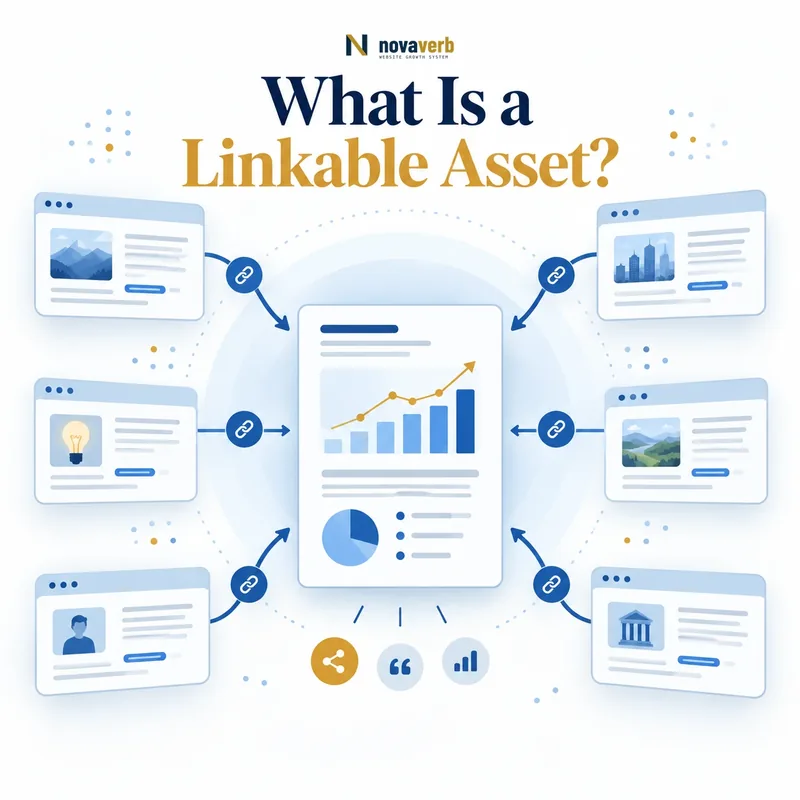
The label describes a resource’s role, not a guarantee that it will earn backlinks. An asset becomes linkable when relevant people have a credible reason to reference its evidence, functionality, clarity or utility from their own pages.
A commercial landing page can sometimes earn citations, but a generic sales page is not automatically a linkable asset. The resource needs value that stands on its own and a stable URL that can honor references over time.
- Solves a specific audience problem
- Provides distinct evidence or utility
- Has a clear citation reason
- Uses a stable accessible URL
- Matches relevant source audiences
- Can be promoted legitimately
- Has an owner and maintenance plan
- Define the audience problem the resource will solve.
- Choose the original evidence, utility or explanation it will provide.
- Publish the resource on a stable, accessible URL.
- Identify the publishers and readers who would genuinely use it.
- Maintain the resource so existing citations remain useful.
| Asset characteristic | Question | Evidence |
|---|---|---|
| Usefulness | Does it complete a real task? | User outcome |
| Distinctiveness | Why cite this version? | Original value |
| Reference fit | Who needs to mention it? | Source audience |
| Accessibility | Can users reach the value? | Working public page |
| Durability | Will the URL remain useful? | Maintenance owner |
| Proof | Can outcomes be measured? | Links, visits and use |
A linkable asset combines a real audience need, a specific citation reason and a destination that can remain trustworthy after promotion ends.
Why Do Linkable Assets Earn Backlinks?
A journalist may cite original data, an educator may recommend a calculator, and a practitioner may reference a template. Each relationship exists because the asset contributes something useful to the referring page and its audience.
Promotion still matters. Even an excellent resource can remain undiscovered, while aggressive outreach cannot create durable editorial value where none exists. Product quality, audience fit and distribution must work together.
- Supports a factual claim
- Supplies original evidence
- Lets readers perform a task
- Provides a reusable template
- Explains a difficult idea clearly
- Offers current reference information
- Adds a trustworthy example
- Start with the reader question behind a potential citation.
- Make the asset more useful than a short unsupported claim.
- Present the evidence or utility in a form that is easy to reference.
- Match outreach to pages whose audiences need that resource.
- Verify the live link and destination before recording the result.
| Publisher need | Useful asset | Citation reason |
|---|---|---|
| Evidence | Original study or dataset | Supports a claim |
| Calculation | Free calculator or checker | Completes a task |
| Implementation | Template or checklist | Saves time |
| Explanation | Diagram or definitive guide | Improves clarity |
| Examples | Curated reference library | Shows applications |
| Current status | Maintained benchmark | Adds fresh context |
Assets earn citations when their distinct value improves the referring page for its intended audience.
What Are the Best Linkable Asset Types?
Original research requires credible methodology and future updates. A free tool needs dependable inputs, outputs and technical ownership. A template must save time without creating hidden complexity, while a guide needs distinctive clarity rather than another summary of existing pages.
Choose format after validating demand. Do not build an interactive product when a maintained dataset would serve sources better, and do not publish a long report when users primarily need a calculation.
- Original research and surveys
- First-party datasets and benchmarks
- Free tools and calculators
- Templates and checklists
- Definitive reference guides
- Visualizations and diagrams
- Glossaries and resource libraries
- Open methods and practical examples
- Choose the job the audience needs to complete.
- Select the format that makes that job easiest.
- Define the original contribution before production begins.
- Test whether the format is accessible and easy to cite.
- Assign an owner for updates and corrections.
| Asset type | Strong use case | Primary maintenance risk |
|---|---|---|
| Research | Sources need new evidence | Data becomes stale |
| Dataset | People need reusable facts | Version control |
| Free tool | Users need a calculation | Functional breakage |
| Template | Users repeat a workflow | Format becomes outdated |
| Guide | Topic needs clear reference | Commodity content |
| Visualization | Relationships need explanation | Missing source context |
Select the smallest format that delivers the strongest defensible value and that the team can maintain reliably.
How Do You Find Linkable Asset Ideas?
Use competitor backlink analysis to identify asset patterns and backlink gap analysis to find relevant sources missing from your profile. The goal is to understand why sources cite, not to copy a competitor’s content.
Customer support questions, sales objections, workflow bottlenecks and proprietary data can reveal assets competitors cannot easily reproduce. Record the audience, task, existing alternatives, differentiated input and likely distribution path for each idea.
- Collect repeated audience and customer questions
- Map tasks that require evidence or calculation
- Review competitor-linked asset patterns
- Open the exact referring pages
- Identify weaknesses in existing resources
- Inventory first-party expertise and data
- Define a differentiated value hypothesis
- List realistic source audiences
- Choose a testable minimum asset
- Repeated questions from customers, editors or sales teams
- Missing evidence in otherwise strong industry explanations
- Manual tasks that a template or free tool could simplify
- Data that can be collected and explained responsibly
- Existing resources that have become incomplete or outdated
| Idea source | Signal | Possible asset |
|---|---|---|
| Support tickets | Repeated implementation question | Checklist or guide |
| Product usage | Frequent calculation task | Free tool |
| Owned data | Unique market pattern | Research report |
| Competitor citations | Repeated asset class | Differentiated resource |
| Broken resources | Sources need current replacement | Updated reference |
| Sales objections | Missing proof or comparison | Methodology or case evidence |
A strong idea begins with verified demand and a defensible reason your version can serve the audience better.
How Do You Validate a Linkable Asset Before Building?
Open representative source pages instead of relying on keyword volume or domain metrics alone. Identify what each source references, why it helps their readers, how current alternatives perform and whether the editorial pattern remains active.
Test the concept with a concise outline, sample dataset, manual service or lightweight prototype. Early feedback can reveal whether users need a calculator, downloadable template, current benchmark or clearer explanation before engineering and promotion costs grow.
- Define the target user and job
- Collect live source-page evidence
- Review current alternatives
- State the unique contribution
- Check data and methodology feasibility
- Prototype the core value
- Test with representative users
- Confirm distribution paths
- Estimate maintenance cost
- Set go, revise or stop criteria
- A clearly defined audience and problem
- A distinct contribution that can be verified
- A practical reason another page would reference it
- A feasible production and maintenance owner
- A promotion list based on relevance rather than volume
| Validation test | Pass evidence | Stop or revise signal |
|---|---|---|
| Audience need | Repeated real task | Vague broad interest |
| Citation demand | Relevant live sources | Only metric-based prospecting |
| Differentiation | Unique data, utility or clarity | Cosmetic rewrite |
| Feasibility | Owned input and capability | Unreliable dependency |
| Distribution | Reachable matching sources | No credible audience path |
| Maintenance | Named owner and cadence | One-time launch only |
Validation reduces waste by proving audience, citation, differentiation, delivery and maintenance assumptions before full production.
How Do You Create a Linkable Asset?
If the asset includes data, publish enough methodology for readers to evaluate scope, timing and limitations. If it performs a function, test inputs, errors, mobile behavior and outputs. If it teaches, make examples and definitions precise and original.
Build the page around the asset rather than a promotional introduction. Give sources a descriptive title, concise answer, clear provenance, useful visuals, update date and an easy way to reach the exact section or result they need.
- Write the audience outcome and citation reason
- Collect or create the core evidence or utility
- Document methods, limits and sources
- Design the primary interaction or explanation
- Build a stable canonical destination
- Test accessibility, mobile and failure states
- Add internal discovery paths
- Prepare outreach evidence and examples
- Assign update ownership
- Launch with measurement in place
- Document the source and method for every factual claim
- Design the page around the audience's task
- Make key evidence easy to scan and reference
- Add accessible labels, captions and table headings
- Plan updates before the asset becomes outdated
| Build layer | Required output | Quality check |
|---|---|---|
| Purpose | One clear audience job | User can state the value |
| Evidence | Data, function or explanation | Claims are traceable |
| Experience | Usable public destination | Mobile and accessible |
| Citation | Stable title and sections | Exact ideas are referenceable |
| Distribution | Matching source list | Audience fit is documented |
| Maintenance | Owner and review schedule | Asset remains accurate |
Creation is complete when the core value, public destination, evidence, distribution and long-term ownership work as one system.
How Do You Promote a Linkable Asset?
Segment sources by why they might care: evidence for an article, a practical utility for a resource page, fresh data for news coverage or a template for a learning program. Personalize the evidence and point to the exact useful section.
Combine direct outreach with owned distribution, expert participation, partner communication and product surfaces. Respect editorial decisions and track responses accurately; a mention, referral visit or product use can be valuable even when no backlink is added.
- Identify source categories and audience fit
- Find the exact relevant page or contact route
- State the asset’s unique value concisely
- Reference the publisher’s real context
- Link directly to the useful destination
- Avoid manufactured urgency or false claims
- Track reply, coverage and referral outcomes
- Retest live placements
- Maintain relationships without repeated pressure
- Pages already discussing the problem the asset solves
- Editors maintaining relevant resource collections
- Writers who need evidence for a specific claim
- Teams that can use the template, tool or dataset directly
- Existing mentions that point to an incomplete destination
| Distribution route | Best asset fit | Measure |
|---|---|---|
| Targeted outreach | Relevant reference resource | Qualified replies |
| Digital PR | Original timely evidence | Editorial coverage |
| Communities | Practical tool or template | Use and discussion |
| Partners | Shared customer resource | Referral engagement |
| Owned content | Supporting guides and product pages | Asset discovery |
| Expert contribution | Method or data insight | Attributed references |
Promotion works when the message connects a verifiable asset benefit with a real source-audience need.
How Do You Measure and Maintain Linkable Assets?
Use Backlink Checker to discover representative citations and Backlinks Explorer to monitor source and destination patterns. Review exact referring pages before classifying coverage or outreach outcomes.
Connect updates, broken destinations and promotion work through the SEO tools system. Preserve baseline dates, source evidence, traffic definitions and conversion attribution so performance comparisons remain honest.
- Record launch baseline and goals
- Monitor asset usage and completion
- Find and verify new referring pages
- Measure qualified referral visits
- Track assisted product or lead outcomes
- Check page and tool functionality
- Refresh data and examples
- Repair moved or broken destinations
- Retire only with a valid replacement plan
- New referring pages verified at the source URL
- Relevant visits to the asset destination
- Engagement with the tool, template or reference material
- Corrections, refreshes and accessibility improvements
- Broken, redirected or no-longer-relevant citations
| Measurement layer | Metric example | Decision |
|---|---|---|
| Discovery | Views from relevant audiences | Improve distribution |
| Utility | Tool completions or downloads | Improve asset experience |
| Citations | Verified referring pages and domains | Understand source fit |
| Referral | Qualified visits and actions | Assess audience value |
| Business | Assisted trials or leads | Evaluate commercial role |
| Health | Errors, freshness and broken paths | Maintain or replace |
Use the free backlink checker for an initial source review, evaluate the ongoing workflow in Backlinks Explorer, and review Novaverb pricing when comparing a managed SEO system with a standalone asset workflow.
A durable asset is measured by useful audience outcomes, verified citations and continued destination health - not link totals alone.