
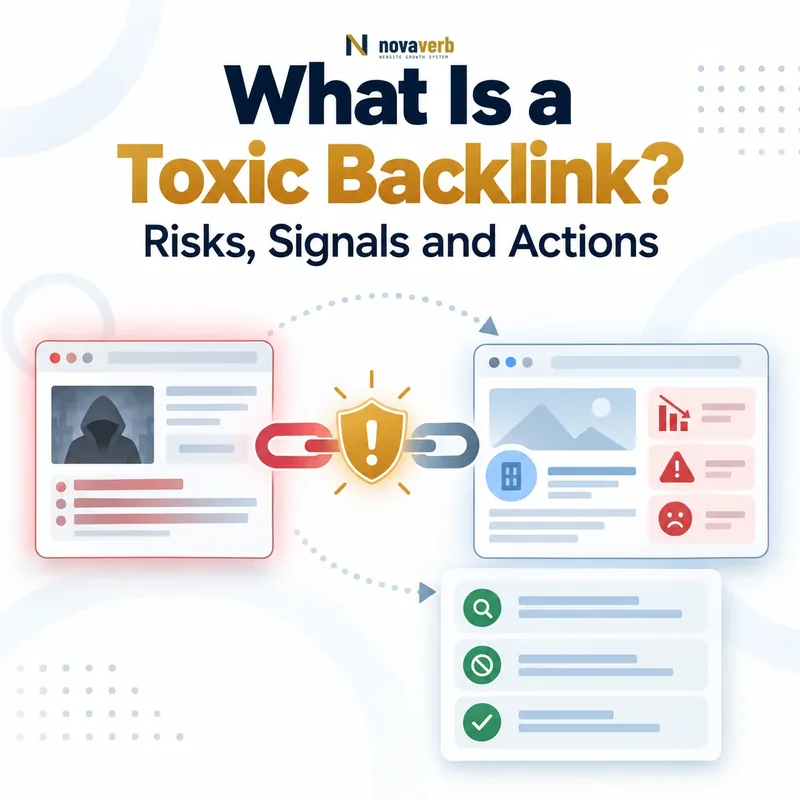
What Is a Toxic Backlink?
Backlink tools use proprietary rules to flag patterns such as irrelevant sources, repeated anchors, link networks, automated pages or unusual domain behavior. Those rules can help prioritize a large review, but different providers can classify the same link differently.
The live referring page, exact link, destination and acquisition history provide the evidence for a decision. A score should open an investigation, not automatically trigger removal or disavowal.
- Provider-specific risk label
- Not a universal link category
- Requires source-page verification
- Must be interpreted with relationship history
- Should lead to monitor, investigate or act based on evidence
| Term | What it means | What it does not prove |
|---|---|---|
| Toxic backlink | Suspected risky relationship | Confirmed search penalty |
| Toxicity score | Provider estimate | Search-engine score |
| Spam pattern | Observable unusual behavior | Automatic harm |
| Manual action | Account-level search evidence | A provider flag alone |
Treat toxic as a review label until live evidence and relationship history justify a specific action.
How Do Toxic Backlink Scores Work?
A provider may consider domain patterns, anchor repetition, source-page content, network similarity, placement and known link classifications. The weighting and crawl coverage are usually specific to its own index.
Scores can generate false positives. A legitimate niche directory, translated page, new domain or technical redirect may look unusual without being manipulative. Review the source before turning an estimate into a verdict.
- Record the provider and model version when available
- Keep score thresholds consistent within one audit
- Open high-priority source pages
- Separate measurable facts from inferred risk
- Do not merge scores from different vendors
| Score input | Possible observation | Verification needed |
|---|---|---|
| Domain pattern | Many similar sites or hosts | Ownership and source legitimacy |
| Anchor pattern | Repeated commercial wording | Live sentence and acquisition context |
| Placement | Footer, sidebar or template repetition | Rendered page location |
| Source topic | Low topical similarity | Actual audience and page purpose |
| Link attributes | Follow, nofollow or sponsored | Exact rendered rel value |
A toxicity score can rank an investigation queue, but the provider cannot replace the evidence on the live referring page.
What Signals May Indicate a Risky Backlink?
Look for combinations and history. One exact-match anchor can be editorially natural; hundreds of coordinated exact-match links across similar sites are a different pattern. One low-traffic source can be a legitimate specialist publication; a cluster of generated pages with no real purpose deserves closer review.
Record what you can reproduce: source availability, page topic, link location, rel attributes, anchor, destination and relationship origin. Keep speculation labeled as investigation.
- Deceptive or generated source pages
- Undisclosed paid placement
- Injected or compromised-page links
- Coordinated network footprints
- Large irrelevant sitewide patterns
- Systematic controlled anchor repetition
- Destination mismatch or cloaked route
| Signal | Observable evidence | Caution |
|---|---|---|
| Paid placement | Commercial arrangement and missing disclosure | Payment history may be unavailable |
| Network pattern | Shared ownership or repeated templates | Similarity alone is not proof |
| Injected link | Link appears in compromised or unrelated copy | Confirm source integrity |
| Anchor repetition | Same controlled phrase across sources | Natural citations can repeat |
| Irrelevance | Source topic conflicts with destination | Broad publications cover many topics |
Risk rises when multiple verified signals describe a controlled or deceptive relationship, not simply because a source looks unfamiliar.
Which Backlinks Are Not Automatically Toxic?
A local business directory can provide useful discovery. A foreign-language publication can cite an international brand. A nofollow link can send qualified referral traffic. A new domain can belong to a real organization that has not accumulated provider metrics yet.
Avoid using unfamiliarity as a risk test. Open the source, understand its purpose and check how the link appears before deciding that a relationship needs action.
- Low provider authority
- nofollow attributes
- Relevant directories
- International or translated sources
- Newly registered legitimate sites
- Low-traffic niche publications
- Unrequested scraper links
| Pattern | Why it may be legitimate | What to inspect |
|---|---|---|
| Low score | New or niche source | Ownership and editorial purpose |
| Directory link | Business discovery or citation | Relevance and listing quality |
| Foreign language | International audience | Context and destination fit |
| nofollow link | Referral or attribution value | Source legitimacy |
| Scraper link | Created without your control | Whether any action is necessary |
A link should not be condemned for being small, new, international or nofollow when its real context remains legitimate.
How Do You Audit Suspected Toxic Backlinks?
Start with the free backlink checker to discover referring pages and link details. For a full workflow, use What Is a Backlink Audit? to preserve provider, filters, source evidence, destination health and action ownership.
Group records before review. Hundreds of links from one footer or one network pattern may represent a single underlying event and should not become hundreds of independent verdicts.
- Define target scope and provider
- Export flagged links and stated signals
- Group by domain, template and anchor pattern
- Open exact referring pages
- Verify placement, attributes and destination
- Document acquisition or ownership history
- Classify monitor, investigate, remove or disavow review
| Audit state | Evidence standard | Action |
|---|---|---|
| Benign | Legitimate context verified | Keep or monitor |
| Uncertain | Source or history incomplete | Investigate |
| Problematic and controlled | Relationship can be changed directly | Correct or remove |
| Problematic and external | Outreach may resolve it | Request removal |
| Severe unresolved pattern | Strong documented reason remains | Consider formal disavow review |
A strong audit reduces a score-driven export into a smaller set of verified concerns, benign links and unresolved questions.
Should You Remove Toxic Backlinks?
If your organization purchased, placed or controls the link, correcting the relationship is usually more direct than asking an external party to interpret a score. Remove deceptive placements, add appropriate disclosure attributes or stop the underlying campaign.
For links you did not create, first determine whether they have any real consequence or whether they are simply low-quality web noise. Removal outreach can consume time and may create unnecessary contact with unreliable sites.
- Confirm the exact live link
- Identify whether your team controls it
- Preserve evidence and relationship history
- Correct attributes or placement when appropriate
- Request removal only with a specific reason
- Revisit the source and record the result
| Relationship | Preferred first step | Reason |
|---|---|---|
| Owned paid placement | Correct or remove | You control the source of risk |
| Partner link with wrong attribute | Coordinate disclosure fix | Relationship is legitimate but mislabeled |
| Unknown scraper link | Usually monitor first | You did not create it |
| Compromised source placement | Contact responsible owner when safe | Source integrity issue |
| Score-only concern | Verify before outreach | Estimate is insufficient |
Removal is appropriate for a verified controllable problem, not as an automatic response to every unfamiliar link.
When Should You Consider a Disavow File?
A disavow file asks a search engine to disregard specified links or domains for link calculations. Broad or careless entries can discard legitimate relationships, and uploaded files can outlive the analysis that created them.
Keep exact evidence, ownership, reasons, scope and review dates for every proposed entry. If the organization has direct account evidence of a manual action or a known history of manipulative acquisition, involve an experienced specialist before submitting changes.
- Document the acquisition pattern
- Confirm the links and domains live
- Fix controllable sources first
- Record removal attempts when appropriate
- Review legitimate-link false-positive risk
- Use exact domain or URL scope deliberately
- Require accountable approval before upload
| Situation | Disavow posture | Why |
|---|---|---|
| Provider score only | Do not submit | No direct evidence |
| Random links you did not create | Usually monitor | Web noise is common |
| Known artificial campaign | Conduct formal review | Relationship history supports concern |
| Manual-action evidence plus unresolved links | Specialist review warranted | Direct account evidence exists |
| Legitimate editorial links mixed in | Stop and refine scope | High false-positive risk |
Disavowal requires stronger evidence and stricter review than ordinary backlink monitoring because the action can exclude legitimate relationships.
How Do You Prioritize Backlink Risk Actions?
Use a decision ladder: keep legitimate links, monitor weak signals, investigate clusters, correct owned placements, request removal for documented external problems and reserve disavow review for severe unresolved cases.
The Backlinks Explorer helps connect source evidence and history, while the Decision Ladder prevents uncertain records from skipping directly to destructive action.
- Strength of live evidence
- Scale and coordination of the pattern
- Whether the organization created or controls it
- Observed account or business consequence
- Cost and reversibility of the action
- Ability to verify completion
| Priority | Example | Next action |
|---|---|---|
| Immediate | Known controlled deceptive campaign | Stop and correct it |
| High | Verified coordinated pattern with clear history | Investigate and remove where possible |
| Medium | Repeated unusual links with incomplete ownership | Gather evidence |
| Low | Isolated provider flag without consequence | Monitor |
| No action | Legitimate source wrongly flagged | Record false positive |
Evidence-rich controllable patterns deserve attention before isolated score-only flags, regardless of which row looks most alarming.
Frequently Asked Questions About Toxic Backlinks
- Treat scores as estimates
- Verify important sources
- Use removal and disavow cautiously
Can one toxic backlink hurt a website?
Are spammy-looking backlinks always dangerous?
Should I remove every high-toxicity link?
Is nofollow a toxic signal?
Can a good domain have a risky link?
Can a low-score domain provide a legitimate link?
Should backlink audits include disavowal?
Which tool can check suspicious backlinks?
The safest toxic-backlink workflow moves from provider signal to verified evidence and only then to the least destructive valid action.
Investigate the Link Before You Act on the Score
Use the checker for initial discovery, organize recurring evidence in Backlinks Explorer and connect findings across the SEO tools system. Keep risk estimates clearly separated from facts observed on the live page.
- Discover the flagged relationship
- Verify source and destination
- Document history and control
- Choose a proportionate action
- Retest and preserve the result
A backlink risk decision is defensible when another analyst can reproduce the evidence and understand why the chosen action is proportionate.