
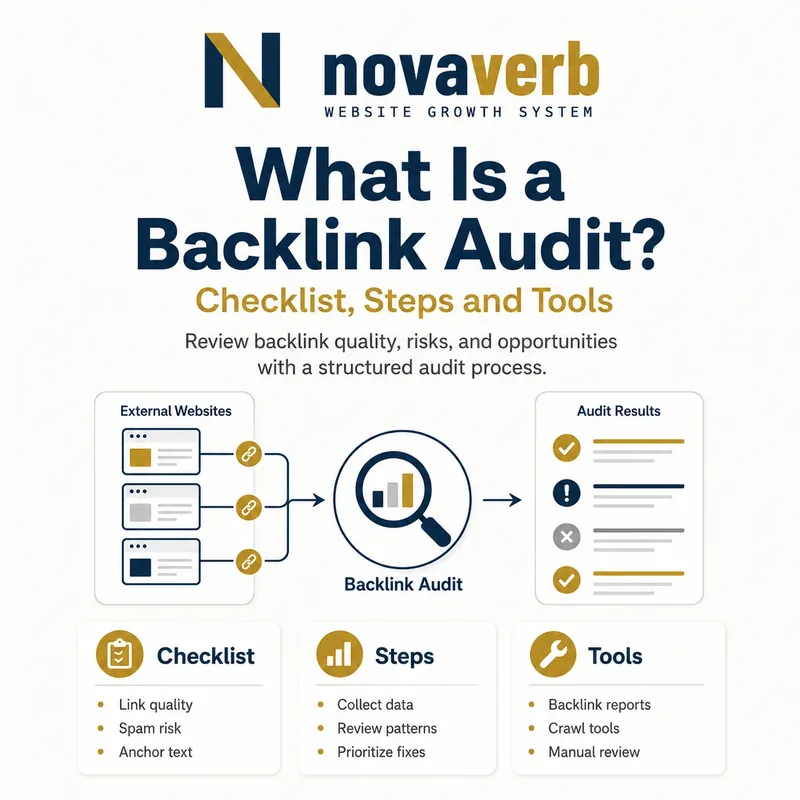
What Is a Backlink Audit?
The audit is not a single authority score or a list sorted by link count. Provider data helps discover and organize records, while the live referring page and destination provide the evidence needed to judge what currently exists.
A useful audit distinguishes links worth protecting, broken routes worth repairing, relationships worth reclaiming, unusual patterns worth investigating and records that require no action.
- Define the target and measurement window
- Collect backlink and referring-domain records
- Open important source pages
- Resolve destination status and redirects
- Classify context and relationship attributes
- Assign one evidence-based next action
| Audit layer | Question | Output |
|---|---|---|
| Scope | What site or page is being reviewed? | Defined target |
| Discovery | Which links were observed? | Provider inventory |
| Verification | What is live now? | Source evidence |
| Destination | Where does the link end? | Final URL and health |
| Decision | What should happen next? | Owned action |
A backlink audit turns observed links into verified relationships and explicit actions rather than unexplained scores.
Why Is a Backlink Audit Important?
A website can show thousands of backlinks from one template and still have limited source diversity. Another site can have fewer links but strong editorial citations to important pages. Counts alone cannot explain that difference.
Audits also protect operational work. They identify old URLs that still receive external references, source relationships affected by migrations and links whose referral paths matter to customers even when no ranking claim can be made.
- Find broken external routes
- Separate backlinks from referring domains
- Detect sitewide and duplicate patterns
- Identify important linked assets
- Monitor new and lost relationships
- Connect link evidence to business priorities
| Hidden issue | Raw total misses | Audit reveals |
|---|---|---|
| Sitewide repetition | One source creates many links | Template-level event |
| Broken target | Link is counted historically | Reader reaches an error |
| Lost link | Current total declines | Exact source change |
| Misdirected link | Destination responds 200 | Context does not match |
| Valuable citation | One link appears small | Relevant source and referral path |
The audit matters because the same backlink count can contain very different relationships, failures and opportunities.
What Data Do You Need for a Backlink Audit?
Use an external backlink index for links outside your property, because your own crawler cannot discover the full external web. Then check destination health with a live request and open priority source pages to confirm placement and context.
Record target scope precisely. Auditing one URL, a subdomain and an entire registered domain can return different datasets, so comparisons are valid only when scope and filters remain consistent.
- Provider and refresh time
- Exact target scope
- Referring domain and page
- Observed destination and final URL
- Anchor and surrounding context
- rel attributes and placement
- First seen, last seen and live-check time
| Field | Source | Purpose |
|---|---|---|
| Referring page | Backlink provider plus live page | Exact external evidence |
| Anchor | Observed link | Expectation and context |
| Link attributes | Rendered source | Relationship classification |
| Original target | Provider record | Preserves historical route |
| Final status and URL | Live destination check | Confirms current outcome |
| Observation dates | Provider and verifier | Defines evidence window |
A reproducible backlink finding preserves the provider record and the current source-to-destination path together.
How Do You Run a Backlink Audit?
Start broad enough to capture the site’s important linked pages, then narrow by source relevance, destination role and observed change. Group links from the same domain or template so one underlying event does not become hundreds of duplicate tasks.
Use the free backlink checker for initial discovery. The exported queue becomes actionable only after the important source pages and final destinations are checked live.
- Set exact URL, prefix, subdomain or domain scope
- Export backlinks and referring domains
- Normalize source and target URLs
- Group sitewide and duplicate relationships
- Check source availability and link presence
- Resolve destination status and redirects
- Classify evidence and assign an owner
- Recheck completed actions
| Step | Primary evidence | Deliverable |
|---|---|---|
| Scope | Target definition | Audit boundary |
| Collect | Provider index | Link inventory |
| Normalize | URL rules | Comparable records |
| Verify | Live source and destination | Confirmed findings |
| Prioritize | Impact, evidence and effort | Action queue |
| Retest | Fresh observations | Closed or reopened work |
The audit is complete only when verified findings have owners, actions and a method for retesting the result.
How Do You Evaluate Backlink Quality?
A relevant link inside a maintained guide can serve readers even when the source has a moderate provider score. A high-scoring domain can still produce an irrelevant boilerplate link or a destination mismatch. Quality is contextual, not a universal number.
Use metrics to sort large datasets consistently within one provider. Do not present those estimates as a search-engine score or proof that a specific link caused rankings.
- Legitimate and accessible source
- Relevant topic and audience
- Editorial reason for the citation
- Descriptive anchor and surrounding copy
- Appropriate link attribute
- Healthy matching destination
| Signal | Stronger relationship | Weaker relationship |
|---|---|---|
| Source | Maintained legitimate page | Automated or deceptive page |
| Relevance | Same topic and reader task | Unrelated topic |
| Placement | Editorial citation | Injected or repeated boilerplate |
| Destination | Direct and aligned | Broken or mismatched |
| Context | Clear reason to click | No meaningful explanation |
A high-quality backlink is a coherent live relationship between source, context and destination, not merely a favorable score.
How Do You Audit Anchor Text?
Separate branded, exact-match, partial-match, URL, generic and image-based anchors for analysis, but open important sources before judging them. A phrase that appears aggressive in a spreadsheet may be the clearest natural label in its sentence.
Use What Is Anchor Text? for definitions and examples. Keep anchor analysis connected to source placement, rel attributes and destination fit.
- Normalize capitalization without losing original text
- Group common anchor types
- Identify repeated sitewide patterns
- Open exact-match examples live
- Check destination alignment
- Record misleading or malformed labels
| Anchor type | Example | Audit question |
|---|---|---|
| Branded | Novaverb | Does the link lead to the expected brand page? |
| Exact match | backlink checker | Does wording fit naturally? |
| Partial match | check backlinks free | Is the destination aligned? |
| URL | novaverb.com/tool | Is the URL current and readable? |
| Generic | learn more | Does surrounding text supply context? |
Anchor text should be evaluated as part of a live sentence and destination relationship, not as an isolated keyword count.
How Do You Find Backlink Risks and Problems?
Begin with observable failures. A source link that reaches a 404 is a verified broken path. Hundreds of identical links from one template form a verified repetition pattern. Neither observation alone proves a search-engine action.
Use the broken backlink guide and lost backlink guide to keep destination failures separate from source-side losses.
- Broken and unavailable destinations
- Redirect chains and irrelevant final pages
- Lost high-value source relationships
- Unusual sitewide repetition
- Incorrect sponsored or UGC labeling
- Source pages with no topical relationship
| Finding | Evidence | First action |
|---|---|---|
| Broken target | Live source reaches an error | Restore, redirect or retire |
| Lost link | Historical record plus current absence | Verify and assess recovery |
| Redirect mismatch | Final page conflicts with anchor | Choose a relevant destination |
| Sitewide repetition | Same relationship across templates | Group as one event |
| Irrelevant source | Source and destination topics diverge | Investigate before deciding |
Audit risk from facts you can reproduce, then investigate consequences separately instead of converting every unusual pattern into a verdict.
How Do You Prioritize Backlink Audit Actions?
A practical decision ladder uses protect for valuable live relationships, repair for controllable destination failures, reclaim for existing relationships that can be restored, investigate for uncertain patterns, expand for repeatable wins and ignore for low-value records.
For recurring team workflows, Backlinks Explorer connects source evidence to monitoring, while the Decision Ladder keeps actions tied to verified findings.
- Confirm the finding live
- Identify the destination’s business role
- Estimate reader or referral consequence
- Choose the smallest valid action
- Assign one accountable owner
- Set a fresh verification condition
| Action | Use when | Completion evidence |
|---|---|---|
| Protect | Relationship is valuable and healthy | Monitoring retained |
| Repair | Destination path is controllably broken | Final route works |
| Reclaim | Existing relationship can be restored | Live source relationship returns |
| Investigate | Evidence is incomplete or unusual | Cause is documented |
| Expand | A legitimate pattern can be repeated | New verified relationships |
| Ignore | No useful consequence or fit exists | Reason recorded |
The highest-priority action is the smallest verified change that protects or restores an important relationship.
Frequently Asked Questions About Backlink Audits
- Declare scope and provider
- Open important sources
- Retest every completed action
How often should I run a backlink audit?
Can I audit backlinks for free?
Do more backlinks always mean a stronger profile?
Should I remove every suspicious backlink?
What is the difference between backlinks and referring domains?
Can an authority score replace an audit?
Does a backlink audit guarantee ranking growth?
What should a completed audit contain?
A useful backlink audit is reproducible: another analyst can open the evidence and understand why each action follows.
Move From a Backlink Export to a Verified Action Plan
Use the checker for a fast first review, then move ongoing monitoring and deeper analysis into the complete SEO tools system. Preserve provider, filters and timestamps so every future comparison remains defensible.
- Collect the observed links
- Open the important sources
- Check final destinations
- Group repeated patterns
- Assign and retest actions
The audit creates value when every important row becomes a verified relationship and a clear next decision.