
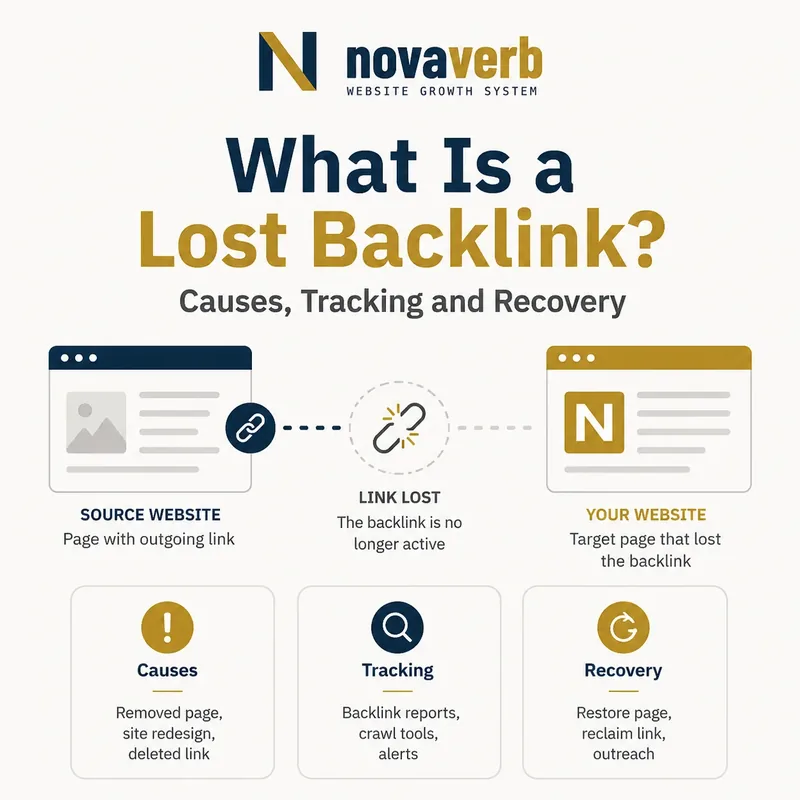
What Is a Lost Backlink?
A lost label describes a change in observation, not a proven editorial decision. The source page might still exist without the link, redirect elsewhere, block the provider crawler or disappear entirely. The provider might also revisit the source at a different time than your own check.
Keep the historical record, observation dates and target scope beside the label. Without that context, an analyst cannot tell whether the change is recent, persistent or caused by a different measurement rule.
- Previously observed source URL
- Previously observed destination URL
- Defined comparison window
- Current provider state
- Live source verification
| State | Source page | Link | Working label |
|---|---|---|---|
| Live page, link absent | Available | Not present | Verified lost backlink |
| Source returns error | Unavailable | Cannot inspect | Source unavailable |
| Link remains, target fails | Available | Present | Broken backlink |
| Provider says lost, link remains | Available | Present | Provider observation gap |
A backlink should be called lost only after its historical observation and current live state are kept separate.
Why Do Backlinks Become Lost?
Editorial changes are common and not automatically negative. A publisher may update an article, remove an outdated section or choose a different supporting source. Sitewide links can disappear in large numbers when one navigation or footer template changes.
Infrastructure and provider coverage create different cases. A source URL may redirect, time out or block automated access, while the link remains visible to a normal visitor. Verify the page before attributing intent to the publisher.
- Editorial update
- Source page deletion
- Template or navigation change
- Source-site migration
- Access or rendering change
- Provider crawl and refresh difference
| Cause | Observed pattern | Next check |
|---|---|---|
| Editorial removal | Page remains, link absent | Review current context |
| Page deletion | Source returns 404 or 410 | Look for a moved source |
| Template change | Many links disappear together | Inspect shared layout |
| Migration | Source redirects | Check final page for the link |
| Provider gap | Live link remains | Record provider and check time |
The right response depends on whether the publisher changed the content, the source became unavailable or the provider simply stopped observing it.
Lost Backlink vs Broken Backlink
The distinction changes ownership. You can often repair a broken destination by restoring a page or adding a relevant redirect. A genuinely lost link depends on the external publisher and may require outreach, or no action if the source context has changed.
Read the full broken backlink guide before combining both states in one repair queue.
- Check whether the source link still exists
- Resolve the destination separately
- Assign source-side and destination-side owners
- Measure recovered and repaired links separately
| Question | Lost backlink | Broken backlink |
|---|---|---|
| Is the link on the live source? | No or not currently observed | Usually yes |
| Where is the failure? | Source relationship | Destination route |
| Who controls the first fix? | External publisher | Destination owner |
| Typical action | Verify and assess outreach | Restore or redirect |
Lost and broken backlinks should remain separate because they require different evidence and different actions.
How Do Backlink Tools Detect Lost Links?
Providers crawl different portions of the web at different times. Their lost-link dates normally reflect the observation window, not necessarily the exact second when a publisher changed the page. Filters for target scope, link type, duplicates and canonicalization also affect totals.
For reproducible reporting, state the provider, target, filters, comparison dates and refresh time. Never merge counts from different providers as though they share one index.
- Record the provider
- Define exact URL, prefix, subdomain or domain scope
- Preserve first-seen and last-seen dates
- Retain link attributes and source URL
- Verify priority losses live
| Provider field | Meaning | Limitation |
|---|---|---|
| First seen | Earliest stored observation | May be later than link creation |
| Last seen | Latest stored observation | May be earlier than removal |
| Lost date | Provider comparison result | Not always exact event time |
| Target scope | URLs included in analysis | Changes the total |
| Link type filter | Qualifying relationship rules | Can exclude a live link |
A lost-link date is a provider observation, so every important case needs live page evidence before action.
How Do You Find Lost Backlinks?
Start with the free backlink checker to inspect observed backlink and referring-domain data. For recurring monitoring, preserve snapshots so changes can be compared rather than relying on one current export.
Group repeated links from the same template or domain before review. Fifty lost footer links caused by one template change are one underlying event, not fifty independent editorial decisions.
- Choose the target and comparison window
- Export lost backlink records
- Group duplicates and sitewide patterns
- Open the current source page
- Search rendered content for the destination
- Classify verified, unavailable or provider-gap states
| Evidence field | Why it matters | Required |
|---|---|---|
| Source URL | Identifies the external page | Yes |
| Historical target | Shows the prior destination | Yes |
| Historical anchor | Preserves link context | Yes |
| Last observed | Dates provider evidence | Yes |
| Current source response | Shows availability | Yes |
| Current rendered link | Confirms live state | Yes |
A useful lost-backlink report connects a historical provider observation with a current live-source check.
Which Lost Backlinks Should You Prioritize?
A link from a relevant guide to an evergreen product or research page may deserve investigation. A lost link from an automated scraper, expired source or unrelated page usually does not justify outreach.
Use metrics to sort within one provider, but open the source before choosing work. Relevance, placement and reader purpose cannot be proven by a domain-level score.
- Evidence confidence
- Source relevance and legitimacy
- Destination business role
- Historical referral value when available
- Reason for the source change
- Recovery feasibility and relationship risk
| Signal | Higher priority | Lower priority |
|---|---|---|
| Evidence | Live source and clear historical record | Unverified provider row |
| Context | Relevant editorial citation | Unrelated automation |
| Destination | Maintained important page | Obsolete asset |
| Consequence | Known referral or customer route | No observed use |
| Recovery | Specific reader benefit | Generic request |
The best priority is a verified loss where recovery would restore a useful path for real readers.
How Do You Recover a Lost Backlink?
Reference the exact source page and current passage. Explain what changed, provide one relevant destination and state why it helps the reader. Avoid generic praise, ranking claims and repeated follow-ups.
If the link disappeared because your old destination was broken, repair that route before outreach. The backlink reclamation guide covers restore, redirect, correction and recovery workflows across multiple loss types.
- Verify that the link is truly absent
- Review the source’s current topic
- Confirm your destination is accurate and live
- Identify a specific reader benefit
- Send one concise request
- Record recovered, declined and no-response outcomes
| Current source state | Action | Reason |
|---|---|---|
| Context remains and citation still fits | Consider outreach | Reader value is clear |
| Section was removed | Usually no outreach | Original need no longer exists |
| Publisher chose another current source | Review before contacting | Editorial choice may be intentional |
| Your destination was broken | Repair first | Do not request a faulty link |
| Source is unavailable | Monitor or close | No live page to update |
Recovery outreach is justified only when the live source still has a clear reason to reference your destination.
When Should You Not Recover a Lost Backlink?
Reclamation effort has an opportunity cost and a relationship cost. Repeated outreach about weak or outdated references can damage trust while distracting the team from controllable site repairs and better-fit opportunities.
Document the reason for ignoring a record so the same low-value case does not re-enter every monthly queue.
- Source topic no longer matches
- Original destination should remain retired
- Publisher removed the entire cited section
- Link originated from spam or automated duplication
- No clear reader benefit exists
- Outreach risk exceeds plausible value
A disciplined lost-link workflow closes unsuitable cases instead of treating every provider row as a recovery target.
How Do You Monitor Backlink Loss Over Time?
Choose a review cadence based on business risk and how often important content changes. Weekly monitoring may suit active digital PR campaigns, while a stable informational site may need a less frequent operational review.
The Backlinks Explorer supports ongoing evidence review, while the broader SEO tools system connects link changes to destination health and assigned follow-up.
- Keep provider and filters stable
- Store each observation timestamp
- Group related losses into events
- Verify priority sources live
- Assign owners and outcomes
- Compare recovered links separately from new links
| Monitoring layer | Question | Output |
|---|---|---|
| Snapshot | What did the provider observe? | Dated backlink inventory |
| Change | Which records changed? | New and lost queue |
| Event grouping | Do many rows share one cause? | Underlying event |
| Verification | What is live now? | Confirmed state |
| Action | Who should do what? | Owned recovery decision |
Monitoring becomes useful when repeated provider snapshots lead to verified events and owned actions.
Frequently Asked Questions About Lost Backlinks
- Keep provider evidence dated
- Check the rendered source
- Separate loss from breakage
Does a lost backlink mean the publisher removed it?
Can a lost backlink still exist?
Are lost backlinks harmful?
Should every lost backlink be recovered?
What is the difference between lost and broken backlinks?
How quickly should I contact a publisher?
Can redirects prevent backlink loss?
Which tool can track lost backlinks?
A lost backlink becomes actionable only after its source state, destination value and recovery fit are verified.
Turn Lost-Link Alerts Into Verified Decisions
Start free with a backlink check, retain historical records for comparison and move recurring reviews into Backlinks Explorer. A smaller verified queue is more valuable than a large export with no source confirmation.
- Detect the change
- Open the live source
- Check the intended destination
- Choose one defensible action
- Retest and record the outcome
The goal is not to recover every lost row; it is to restore the relationships that still serve a real reader and business purpose.