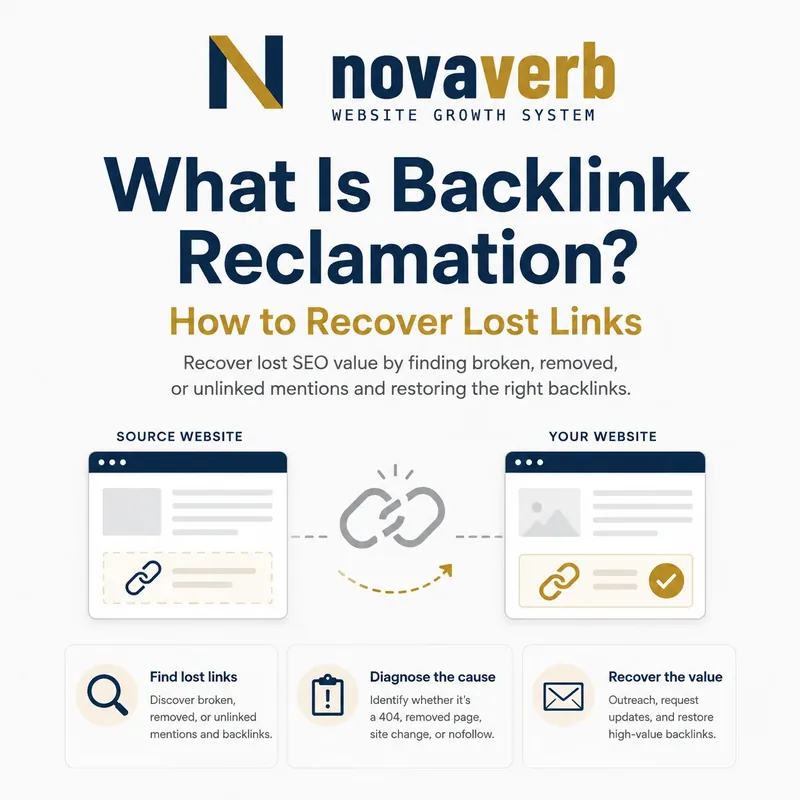
What Is Backlink Reclamation?
Reclamation differs from acquiring a completely new backlink. The external website already referenced your brand, page, research or product at some point; the task is to recover the usefulness of that existing relationship.
A reclamation record does not guarantee SEO improvement. It proves that a specific source and destination relationship can be investigated and, when appropriate, restored for readers.
- Broken destination links
- Removed or lost links
- Incorrect destination URLs
- Unlinked brand mentions
- Redirect and canonical mismatches
| Opportunity | Observed state | Typical action |
|---|---|---|
| Broken backlink | Source link remains, destination fails | Restore or redirect |
| Lost backlink | Previously observed link is absent | Verify and assess outreach |
| Wrong URL | Link reaches an unintended page | Request correction or repair route |
| Unlinked mention | Brand is named without a link | Request a useful citation when appropriate |
Backlink reclamation recovers an existing relationship; it does not manufacture evidence that the relationship exists.
How Is Backlink Reclamation Different From Link Building?
A link-building prospect may know nothing about your site. A reclamation source already linked, mentioned the brand or referenced an asset. This prior context can make the request more specific, but it does not obligate the publisher to restore anything.
Keep the campaigns separate so results remain honest. Counting a restored link as newly acquired hides the source of the outcome and makes future performance difficult to reproduce.
- Classify prior evidence before outreach
- Keep recovered and newly acquired links separate
- Use the existing source context in the request
- Respect the publisher’s current editorial decision
| Dimension | Backlink reclamation | Link building |
|---|---|---|
| Starting point | Existing or historical relationship | New prospect |
| Evidence | Observed link, mention or prior record | Topical and audience fit |
| Primary goal | Restore usefulness | Earn a new citation |
| Success record | Recovered relationship | New relationship |
Reclamation starts with prior evidence, whereas link building starts with a new opportunity.
Which Backlinks Can Be Reclaimed?
Broken links to deleted evergreen content are often controllable because you can restore the page or provide an equivalent successor. Lost links require more caution: the publisher may have intentionally revised the article, removed the reference or replaced it with a better source.
Provider exports should create a review queue, not an automatic outreach list. Open the source page, locate the current context and confirm that your page remains a useful destination.
- Live source page with relevant context
- Broken URL with an equivalent replacement
- Brand mention where a citation helps the reader
- Malformed URL that clearly intended your page
- Lost link whose surrounding section still exists
| Candidate | Reclaimability | Reason |
|---|---|---|
| Live source to 404 target | High when an equivalent page exists | Destination is controllable |
| Misspelled destination URL | High when intent is clear | Correction is specific |
| Removed source paragraph | Low | The original context no longer exists |
| Obsolete product reference | Low unless a true successor exists | User intent may have changed |
| Unlinked brand mention | Conditional | A link must add reader value |
A reclaimable backlink needs both a relevant source context and an honest destination.
What Causes Backlinks to Be Lost or Broken?
Website migrations are a common controllable cause. An old URL pattern disappears without a mapping, leaving external references on a 404. Source-side changes are different: an editor may update a guide, remove a section or replace the cited resource.
A provider can also report a link as lost because its crawler has not recently observed the source. That is why the live page, current link and timestamp matter more than the label alone.
- Unmapped migration
- Deleted or consolidated content
- Redirect loop or irrelevant redirect
- Publisher removes or changes the source
- Source page becomes unavailable
- Provider refresh or crawl-coverage change
| Cause | Controlled by | Evidence to check |
|---|---|---|
| Destination migration | Your team | Old URL and redirect map |
| Content retirement | Your team | Current content decision |
| Source edit | Publisher | Live referring page |
| Source removal | Publisher or infrastructure | Current source response |
| Provider coverage | Data provider | Observation date and live verification |
The cause determines whether you should fix your destination, contact the publisher or simply update the record.
How Do You Find Backlink Reclamation Opportunities?
Use the free backlink checker to discover observed links and referring pages. Group records by source, target and current state so repeated sitewide links do not overwhelm the review.
A useful export preserves the exact source URL, anchor, original target, final target, response and observation time. Without those fields, an analyst cannot reproduce the finding or confirm the repair.
- Export current and historical backlink records
- Normalize source and destination URLs
- Resolve status and redirect chains
- Separate broken, lost, wrong-target and mention cases
- Open live priority sources
- Assign an action and owner
| Field | Purpose | Required for verification |
|---|---|---|
| Source URL | Identifies the external document | Yes |
| Anchor or mention | Preserves context | Yes |
| Observed target | Records the original route | Yes |
| Final URL and status | Shows the current outcome | Yes |
| First and last observed | Defines the comparison window | Yes |
| Provider metric | Helps sort a queue | No, never sufficient alone |
A trustworthy reclamation queue connects provider discovery to a live source, destination and timestamp.
How Do You Prioritize Backlink Reclamation?
A relevant editorial link to a maintained commercial or evergreen page may justify immediate repair. A stale automated source with no meaningful context may be safe to ignore even if a provider score appears high.
Use provider metrics consistently within the same dataset, but do not present them as search-engine scores. The live relationship determines the action; the metric only helps order the review.
- Confirm the source still exists
- Check topical and audience relevance
- Identify the intended destination role
- Estimate repair effort and risk
- Record traffic or customer-path evidence when available
- Choose an owner and due date
| Priority signal | Higher priority | Lower priority |
|---|---|---|
| Evidence | Live repeatable finding | Unverified historical row |
| Source | Relevant editorial context | Automated unrelated source |
| Destination | Important maintained page | Obsolete asset |
| Repair | Direct safe action | No equivalent destination |
| Consequence | Referral or customer path affected | No observed user impact |
The best first opportunity combines strong evidence, meaningful context and a repair that preserves the reader’s task.
How Do You Reclaim a Broken Backlink?
Read the anchor and surrounding sentence before selecting a destination. A generic homepage may return 200 but fail the promise of a specific research link. The repair should preserve meaning, not merely remove an error response.
The detailed broken backlink guide explains how to distinguish a failed destination from a lost source link and how to choose restore, redirect, outreach or retirement.
- Verify the source link
- Read its anchor and context
- Choose an equivalent maintained destination
- Restore, redirect or request correction
- Check status, canonical and content
- Revisit the source and record the result
| Situation | Action | Pass condition |
|---|---|---|
| Original content remains useful | Restore the URL | Original route serves current content |
| Equivalent successor exists | Add a direct 301 | Final page satisfies the source |
| External href is malformed | Request source correction | Publisher updates the URL |
| No honest successor exists | Leave retired | No misleading redirect is introduced |
A broken backlink is reclaimed only when the final path works and still matches the original context.
How Do You Reclaim a Lost Backlink?
Open the live source and search for the previous anchor, destination and surrounding topic. The link may have moved, changed format or become hidden behind a rendered component. It may also have been intentionally removed during an editorial update.
Outreach should identify the exact page and explain the reader benefit of restoring or correcting the reference. Avoid pressure, rankings claims or generic templates. The publisher owns the source and may reasonably decline.
- Confirm the link is absent in rendered content
- Compare the current source topic with the historical context
- Check whether your destination is still current
- Make one precise reader-focused request
- Record accepted, declined and no-response outcomes separately
A lost link is reclaimable only when the current source still has a genuine reason to reference the destination.
How Do Redirects Affect Backlink Reclamation?
Keep external legacy routes stable when relevant backlinks still point to them, but update internal links to the final URL. One permanent redirect is easier to inspect and maintain than multiple historical hops.
After implementation, verify the original target, every response hop, the final status, final canonical and page content. A technically successful redirect is not a completed repair if the destination is unrelated.
- Use one direct permanent hop
- Match the original topic and task
- Point to the canonical URL
- Remove loops and unnecessary chains
- Retest the complete route
| Redirect pattern | Reclamation result | Action |
|---|---|---|
| Old guide to equivalent guide | Preserves the intended path | Keep and monitor |
| Old guide through three hops | Adds avoidable complexity | Update to one direct hop |
| Specific tool to homepage | Loses the original task | Choose a closer target or retire |
| Loop or dead final URL | Route remains broken | Repair redirect rules |
A redirect supports reclamation only when it is direct, stable and contextually equivalent.
How Do You Measure Backlink Reclamation Results?
Report the denominator as well as the result: reviewed opportunities, verified issues, attempted repairs and confirmed recoveries. This prevents a campaign from presenting ten recovered links without disclosing that hundreds of rows were unverified or ineligible.
Recheck after enough time for source and provider observations to refresh, but retain the live verification timestamp. A provider may lag behind a repair, while a live page can already prove that the route works.
- Verified opportunities reviewed
- Eligible relationships identified
- Destination repairs completed
- Publisher corrections completed
- Live relationships recovered
- Referral sessions restored when measured
| Metric | Definition | Do not confuse with |
|---|---|---|
| Verified issue | Live source and failure confirmed | Raw provider row |
| Completed repair | Owned change implemented | Recovered source relationship |
| Recovered link | Live useful path verified | Ranking increase |
| Referral recovery | Visits return through the link | Organic search traffic |
| Provider rediscovery | Index observes the link again | First-party live proof |
A reclamation report is complete when every count has a definition, denominator and verification source.
Frequently Asked Questions About Backlink Reclamation
- Verify before outreach
- Preserve the source context
- Measure recovered relationships separately
Is backlink reclamation the same as broken link building?
Can every lost backlink be reclaimed?
Should every broken URL redirect to the homepage?
Are nofollow links worth reclaiming?
How often should lost backlinks be reviewed?
Does reclaiming links guarantee rankings?
What should reclamation outreach include?
Which tool helps find reclamation opportunities?
Backlink reclamation succeeds when a useful relationship is restored and the result can be reproduced.
Turn Link Loss Into a Verified Recovery Workflow
Use the free checker for the first review, then move recurring monitoring and team decisions into the broader backlink and SEO workflow. Keep every recovery tied to its source page, final destination and fresh verification time.
- Discover the candidate
- Verify the source and failure
- Choose the smallest honest action
- Retest the live route
- Record the outcome separately from rankings
Reclaim the relationship only when the repaired route is useful, live and verifiable.