What Is Employer Aggregate Rating Schema?
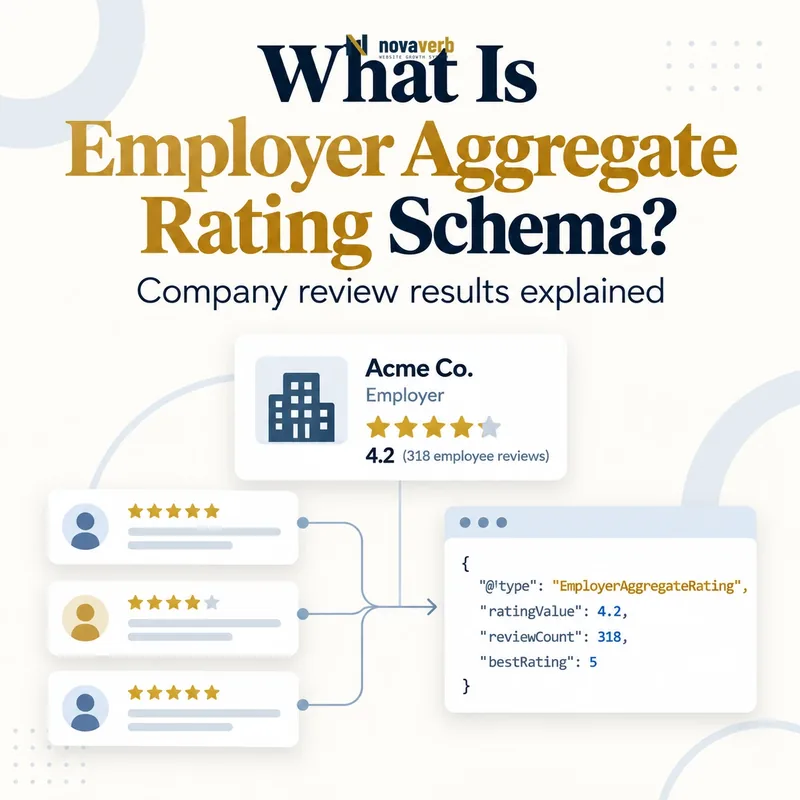
Employer Aggregate Rating Schema is structured data that summarizes user-generated ratings of one specific hiring organization.
The EmployerAggregateRating type is a specialized form of aggregate rating designed for employer-review platforms. It identifies the hiring organization with itemReviewed, publishes a calculated ratingValue, and supplies at least one participation total through ratingCount or reviewCount. Unlike a product score, the number describes an organization in its role as an employer. The rating content must be immediately visible on the page, and the site must host ratings submitted by users. Eligible data can support employer information in enriched job-search experiences, but implementation does not guarantee display, rankings or applicants.
- Identify the exact page, asset, entity or relationship described in this section.
- Inspect the live implementation and retain the observed evidence.
- Compare the observation with the intended meaning and its primary specification.
- Correct any mismatch, then retest the live result.
- Record the accountable owner and review date.
| Element | Purpose | Example |
|---|---|---|
| EmployerAggregateRating | Rating summary | 4.2 out of 5 |
| itemReviewed | Hiring organization | Example Labs |
| ratingCount | All rating submissions | 1,240 |
| reviewCount | People providing reviews | 680 |
| Scale | Defines score range | 1 to 5 |
- Host user-submitted ratings.
- Name one hiring organization.
- Publish a reproducible aggregate.
Primary specification: Schema.org definition for EmployerAggregateRating.
This markup is appropriate only when a site can prove a real user-rating dataset about a specific employer.
Who Should Use EmployerAggregateRating?
Employer review platforms that let users submit and view ratings about hiring organizations are the intended publishers of EmployerAggregateRating.
A company profile on an independent careers or workplace-review site may qualify when users can post ratings and the platform hosts those submissions. A hiring company should not add a favorable score to its own careers page from testimonials, employee surveys or a third-party widget and treat that as the platform use case. A list titled “Top Tech Employers” is also not a page about one specific organization. Recruiting agencies and job boards need to distinguish employer profiles from job listing pages: the profile may carry employer ratings, while each vacancy uses JobPosting Schema.
- The exact page, asset, entity or relationship covered by this section
- The live implementation rather than an editor-only preview
- The primary specification or first-party record defining the expected behavior
- The validation result, accountable owner and review date
| Publisher/page | Appropriate? | Reason |
|---|---|---|
| Employer-review platform profile | Yes, if rules are met | Hosts user ratings |
| Company careers page | No for self-published score | Rated entity controls page |
| Top-employers list | No | Not one organization |
| Individual job listing | No for rating object alone | Use JobPosting |
| Editorial company article | No without hosted user ratings | Not user aggregate |
- Identify the publisher relationship.
- Confirm user submission capability.
- Separate employer profiles from jobs.
- Reject category and list pages.
The decisive test is whether users can submit hosted ratings about the employer on that site.
Which Properties Are Required?
EmployerAggregateRating requires itemReviewed, ratingValue and at least one trustworthy count through ratingCount or reviewCount.
The itemReviewed value must be an Organization representing the employer, with an exact public name and a useful identity reference such as sameAs when appropriate. ratingValue is the numerical aggregate derived from hosted ratings. ratingCount records all ratings, while reviewCount records people who provided reviews; at least one is required. bestRating and worstRating clarify a non-default scale. More fields do not compensate for weak source data. Preserve the organization relationship with Organization Schema.
- Identify the exact page, asset, entity or relationship described in this section.
- Inspect the live implementation and retain the observed evidence.
- Compare the observation with the intended meaning and its primary specification.
- Correct any mismatch, then retest the live result.
- Record the accountable owner and review date.
| Property | Status | Quality check |
|---|---|---|
| itemReviewed | Required | One Organization |
| ratingValue | Required | Reproducible average |
| ratingCount | One count option | Actual hosted ratings |
| reviewCount | One count option | Actual reviewers |
| bestRating/worstRating | Recommended for custom scale | True boundaries |
- Use the exact employer identity.
- Calculate the current average.
- Publish at least one accurate count.
Required properties are complete only when their values can be traced back to the visible employer profile and rating records.
How Should the Employer Be Identified?
Identify the employer as one Organization with a stable name and identity reference, avoiding brand, subsidiary and location conflation.
A job seeker may distinguish a parent corporation from a regional subsidiary, franchise operator or staffing entity. The rating dataset must use the same scope as itemReviewed. If reviews belong to “Example Retail USA,” do not attach the aggregate to the global parent merely because the names are similar. Use a canonical employer profile, stable internal identifier and an appropriate public sameAs URL when it unambiguously identifies the same organization. Mergers, renames and duplicate profiles need governance because combining histories can materially alter the score and count.
- The exact page, asset, entity or relationship covered by this section
- The live implementation rather than an editor-only preview
- The primary specification or first-party record defining the expected behavior
- The validation result, accountable owner and review date
| Identity issue | Risk | Control |
|---|---|---|
| Parent vs subsidiary | Mixed workforce experience | Separate profiles |
| Franchise location | Wrong employer entity | Identify operating company |
| Staffing agency vs client | Misattributed employment | Rate legal employer |
| Company rename | Duplicate history | Managed identity merge |
| Look-alike name | Wrong sameAs | Verify exact organization |
- Resolve the legal or operating employer.
- Map parent and subsidiary relationships.
- Assign stable profile IDs.
- Review merges and renames.
Employer identity is sound when the reviewed workforce relationship and the Organization object have the same scope.
ratingCount vs reviewCount for Employer Ratings
ratingCount measures total rating submissions, while reviewCount measures people who provided reviews; publish each only according to its real source event.
An employer profile may allow a user to submit star scores across several workplace dimensions and optionally write a review. The platform needs a consistent rule for what constitutes one overall rating and one reviewer. Do not count every dimension as a separate rating if the visible total represents people. Remove duplicates, rejected moderation states, test accounts and deleted submissions according to the published methodology. If one review can be updated, it should not create an additional historical count unless the platform explicitly presents versioned submissions. Use one count when only one definition is reliable.
- Identify the exact page, asset, entity or relationship described in this section.
- Inspect the live implementation and retain the observed evidence.
- Compare the observation with the intended meaning and its primary specification.
- Correct any mismatch, then retest the live result.
- Record the accountable owner and review date.
| Event | ratingCount impact | reviewCount impact |
|---|---|---|
| Score-only submission | Usually +1 | 0 |
| Written review with score | Usually +1 | Usually +1 |
| Edited review | No new person | No new person |
| Rejected spam | 0 | 0 |
| Multiple dimension scores | Follow published aggregation rule | One reviewer |
- Define a unit of participation.
- Exclude invalid submissions.
- Avoid double-counting dimensions.
- Keep visible labels precise.
Counts are trustworthy when the same moderation and deduplication rules drive the page, markup and aggregate calculation.
How Should Employer Rating Scales Work?
Use the platform’s actual rating scale and declare bestRating and worstRating whenever it differs from the default 1-to-5 range.
A 4.1 score on a five-point scale can use the default boundaries, though explicitly publishing accurate bounds improves maintainability. A score of 82 on a 1–100 scale requires those boundaries so it is not interpreted as an impossible five-star number. The average must remain inside the range and use a period for decimal notation in structured data. If the platform shows several category scores - culture, pay, management and work-life balance - the primary ratingValue must follow a documented overall formula rather than selecting the most favorable category.
- The exact page, asset, entity or relationship covered by this section
- The live implementation rather than an editor-only preview
- The primary specification or first-party record defining the expected behavior
- The validation result, accountable owner and review date
| Scale | Example value | Required clarity |
|---|---|---|
| 1–5 | 4.1 | Default or explicit bounds |
| 1–10 | 8.2 | bestRating 10, worstRating 1 |
| 1–100 | 82 | bestRating 100, worstRating 1 |
| Percentage | 82% | Visible meaning |
| Category subscores | Several values | Document overall calculation |
- Document the source scale.
- Set accurate boundaries.
- Validate the average range.
- Explain overall versus category scores.
A scale is correctly modeled when a job seeker can reproduce what the number means from the visible methodology.
How Does Employer Rating Relate to JobPosting?
EmployerAggregateRating describes the hiring organization, while JobPosting describes one open role; the two may appear in the same job ecosystem but serve different intents.
A persistent employer profile can host the user rating summary. A vacancy page carries title, employer, location, dates, employment type, description and application information through JobPosting. Copying the employer aggregate onto every vacancy page may create duplication and make a role page appear to host rating content that is not immediately visible. Instead, connect organization identity consistently and link users to the employer profile where the ratings live. Closing a job should not remove the employer profile or change its score; deleting an employer rating should not silently alter the facts of an archived vacancy.
- Identify the exact page, asset, entity or relationship described in this section.
- Inspect the live implementation and retain the observed evidence.
- Compare the observation with the intended meaning and its primary specification.
- Correct any mismatch, then retest the live result.
- Record the accountable owner and review date.
| Entity | Describes | Typical URL |
|---|---|---|
| EmployerAggregateRating | Workplace reputation | Employer profile |
| Organization | Hiring entity identity | Company profile |
| JobPosting | One vacancy | Job detail |
| ProfilePage | Profile context | Employer overview |
| AggregateRating | Generic rating summary | Other supported items |
- Separate profile and vacancy entities.
- Reuse stable organization identity.
- Avoid invisible copied ratings.
Keep employer reputation on its visible profile and job facts on each vacancy page.
What Employer Rating Schema Mistakes Are Common?
Common mistakes include self-published employer scores, list-page markup, fabricated counts, mixed organizations, hidden ratings and averages that cannot be recalculated.
A company may quote an internal engagement survey on its own careers page and label it as user-generated employer reviews. A directory may put one aggregate on “Best Companies in Austin,” even though no single organization is being rated. Import pipelines can combine subsidiaries, count review categories as separate users or retain deleted spam. Other pages show a score only after login or hide the count in a collapsed component, making rating content non-obvious. Syntax validators cannot detect most of these integrity failures, so an audit must inspect publisher role, visible content and underlying records.
- The exact page, asset, entity or relationship covered by this section
- The live implementation rather than an editor-only preview
- The primary specification or first-party record defining the expected behavior
- The validation result, accountable owner and review date
| Mistake | Why it fails | Correction |
|---|---|---|
| Company rates itself | Wrong publisher context | Remove employer aggregate |
| Category page aggregate | No specific employer | Use profile pages |
| Mixed subsidiaries | Wrong itemReviewed scope | Split datasets |
| Inflated count | False evidence | Deduplicate records |
| Hidden rating | Not obvious to users | Render score and count |
- Check publisher eligibility.
- Resolve the employer identity.
- Recalculate score and counts.
- Confirm immediate visibility.
The highest-risk defect is a rating claim whose publisher, employer identity or underlying users cannot be verified.