What Is Organization Schema?
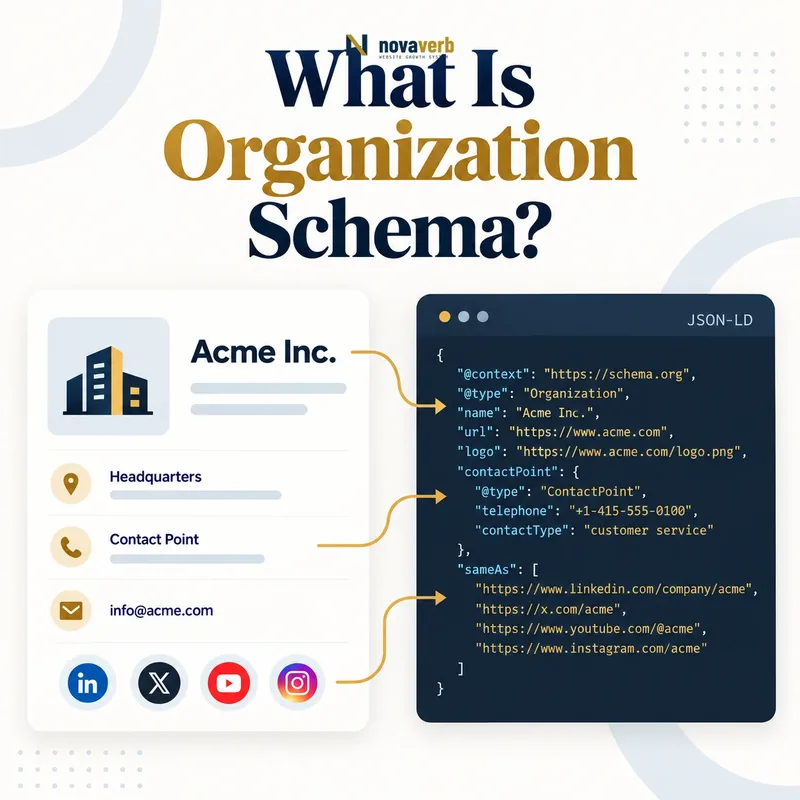
The Organization type represents the company, nonprofit, association or other entity - not the website document itself. A WebSite or WebPage node can reference the Organization as publisher, owner or related entity. Stable identifiers allow those references to point to one consistent organization across templates.
Organization markup does not create brand authority, verify a business or guarantee a knowledge panel. It expresses facts already supported by the public site and authoritative business records. The most useful implementation prioritizes identity accuracy over filling every optional property.
- Frame the decision raised by What Is Organization Schema.
- Confirm its value type and the object it describes.
- Compare the markup with visible page information.
- Correct the source data or template without inventing values.
- Validate the rendered result and monitor future changes.
| Property or node | Represents | Evidence source |
|---|---|---|
| name | Public organization name | Brand and legal records |
| legalName | Registered legal name when relevant | Corporate record |
| url | Canonical organization website | Preferred public domain |
| logo | Official brand image | Public brand asset |
| @id | Stable entity identifier | Canonical identity policy |
| sameAs | Profiles for the same entity | Verified official profiles |
| contactPoint | Purpose-specific contact route | Published support or sales data |
| identifier | Registered or business ID | Authoritative organization record |
- Model one real organization identity.
- Use stable canonical identifiers.
- Publish only verifiable business facts.
Organization schema is a machine-readable identity record for a real organization, grounded in consistent public and business evidence.
The decision for What Is Organization Schema should rest on live, traceable evidence and a verified follow-up check.
How Does Organization Schema Work?
A parser reads the node’s type, @id, name, URL and properties. Other nodes can then reference the same ID instead of creating disconnected organizations. An Article may identify the Organization as publisher, while a Product can reference it as brand or manufacturer only when that relationship is true.
Consumers independently decide which facts they use and how they present them. Syntax validity does not prove identity. A page can publish a valid logo URL or social profile that belongs to another company. Entity resolution depends on consistent names, URLs, identifiers and external evidence over time.
- Evidence for How Does Organization Schema Work: the live structured-data entity and property relationship
- The expected value type and any nested object
- Visible page information that supports the structured value
- Related offer or catalog fields needed for interpretation
- A fresh validation result after the page changes
| Stage | Graph action | Failure example |
|---|---|---|
| Identify | Assign stable @id | New ID on every page |
| Name | Set public and legal names | Subsidiary name used for parent |
| Connect website | Link canonical URL | Tracking or staging domain |
| Connect pages | Reference publisher or owner | Unrelated entity claims authorship |
| Connect profiles | Add same-entity URLs | Directory listing added as sameAs |
| Validate | Compare facts with public evidence | Logo or contact mismatch |
| Maintain | Update real lifecycle changes | Old domain remains canonical |
- Define the real organization scope.
- Choose one durable entity ID.
- Map verified properties and relationships.
- Reuse and audit that identity sitewide.
The working model is identify one organization, connect truthful relationships and maintain the same identity across every structured graph.
The decision for How Does Organization Schema Work should rest on live, traceable evidence and a verified follow-up check.
Organization vs LocalBusiness Schema
A software company with no walk-in location may need Organization but not LocalBusiness. A retailer with several stores can have one parent Organization plus separate LocalBusiness nodes for eligible locations. A headquarters address does not automatically make every corporate entity a local business.
Choose the most specific truthful subtype. Do not add opening hours, geographic coordinates or local contact details to a global organization when those facts belong to individual locations. Corporate, brand, department, nonprofit and educational structures can require other subtypes and relationships.
- Frame the decision raised by Organization vs LocalBusiness Schema.
- Confirm its value type and the object it describes.
- Compare the markup with visible page information.
- Correct the source data or template without inventing values.
- Validate the rendered result and monitor future changes.
| Entity situation | Likely type | Key distinction |
|---|---|---|
| Online software company | Organization or suitable subtype | No public local storefront required |
| Single public store | LocalBusiness subtype | Customer-facing physical location |
| Multi-location retailer | Parent Organization plus locations | Separate identity and hours per location |
| Corporate headquarters | Organization with address when relevant | Not automatically local business |
| Brand owned by company | Brand plus Organization | Brand is not always legal entity |
| Nonprofit | NGO or Organization subtype | Mission and registered identity |
| Department | Organization relationship | Not a duplicate parent organization |
- Separate parent entities from locations.
- Do not manufacture local presence.
- Attach local facts to the correct node.
Use Organization for the parent identity and LocalBusiness only for real public locations whose details users can verify and use.
The decision for Organization vs LocalBusiness Schema should rest on live, traceable evidence and a verified follow-up check.
Which Organization Properties Matter Most?
Start with @id, name, url and logo. Add legalName when it helps distinguish the registered entity. Identifiers can clarify a company in jurisdictions or business systems when they are safe and relevant to publish.
Use sameAs only for pages that represent the same organization, such as verified official profiles or authoritative entity pages. A news article, customer review, directory mention or partner site is not the same entity. Contact points should identify their purpose, language or region when the real support system differs.
- Evidence for Which Organization Properties Matter Most: the live structured-data entity and property relationship
- The expected value type and any nested object
- Visible page information that supports the structured value
- Related offer or catalog fields needed for interpretation
- A fresh validation result after the page changes
| Property | Priority | Audit question |
|---|---|---|
| @id | Foundational | Does every page reference the same entity? |
| name | High | Is this the current public name? |
| url | High | Is this the canonical organization URL? |
| logo | High | Is the official asset public and stable? |
| legalName | Situational | Does it match registration? |
| sameAs | Selective | Does the URL represent the same entity? |
| contactPoint | Situational | Is the route current and purpose-specific? |
| foundingDate | Optional | Can the date be verified? |
| address | Situational | Does it belong to this entity and remain public? |
- Establish ID, name and canonical URL.
- Publish one stable official logo.
- Add verified identifiers and profiles.
- Assign contacts to real purposes and regions.
Prioritize identity-defining properties and add optional details only when they are accurate, useful and maintainable.
The decision for Which Organization Properties Matter Most should rest on live, traceable evidence and a verified follow-up check.
How Should @id and sameAs Be Used?
@id as the organization’s durable graph identity and sameAs only to connect pages that unambiguously represent that same organization.An ID can use the canonical domain with a fragment such as an organization-specific anchor. The exact pattern matters less than stability and uniqueness. WebPage, WebSite, Product and Article nodes can reference that ID, allowing one Organization node to carry shared facts.
sameAs is not a backlink list. It should not contain press coverage, generic directories, customers, subsidiaries or founders unless the URL is truly another identity page for the organization. Overuse blurs entity boundaries and can connect inaccurate information. Verify ownership and public branding of each profile.
- Frame the decision raised by How Should @id and sameAs Be Used.
- Confirm its value type and the object it describes.
- Compare the markup with visible page information.
- Correct the source data or template without inventing values.
- Validate the rendered result and monitor future changes.
| URL relationship | Use @id or sameAs? | Reason |
|---|---|---|
| Canonical internal entity ID | @id | Primary graph identity |
| Official verified social profile | sameAs | Same organization represented externally |
| Authoritative entity profile | sameAs when exact match | Disambiguates same entity |
| Press article | Neither as sameAs | About the company, not the company |
| Partner website | Relationship property if relevant | Different organization |
| Subsidiary website | Separate Organization plus relationship | Distinct entity |
| Founder profile | Separate Person plus founder relation | Person is not the organization |
| Customer review page | Not sameAs | External evaluation |
- Keep one organization ID sitewide.
- Verify every sameAs target manually.
- Model distinct entities separately.
Stable IDs consolidate identity, while selective sameAs links disambiguate it without turning the graph into a promotional link collection.
The decision for How Should @id and sameAs Be Used should rest on live, traceable evidence and a verified follow-up check.
How Can Organization Schema Help SEO?
Connected identity can help a parser understand which organization publishes an article, owns a website, makes a product or operates a brand. Accurate logos and contact facts may support selected organization appearances where current feature rules apply. The value is strongest when the markup reinforces evidence already present across the site and real-world sources.
It cannot replace brand mentions, backlinks, trustworthy content or customer experience. Connect the graph with JSON-LD, accurate schema markup and truthful Product schema. Measure entity consistency and qualified search outcomes rather than claiming direct ranking gains.
- Evidence for How Can Organization Schema Help SEO: the live structured-data entity and property relationship
- The expected value type and any nested object
- Visible page information that supports the structured value
- Related offer or catalog fields needed for interpretation
- A fresh validation result after the page changes
| SEO value | Possible contribution | Separate requirement |
|---|---|---|
| Brand disambiguation | Stable name, URL and IDs | Real public evidence |
| Publisher clarity | Article points to organization | Genuine editorial ownership |
| Product relationship | Brand or manufacturer connection | Verified catalog relationship |
| Logo consistency | Official image identified | Stable public asset |
| Enhanced appearance | Eligible organization facts | Consumer display decision |
| Rankings | No guarantee | Relevance, quality and authority |
| Trust | Can express facts | Business must earn trust operationally |
- Fix public identity inconsistencies.
- Build one canonical organization node.
- Connect truthful page and product relationships.
- Monitor search and brand evidence.
Organization schema supports SEO through identity clarity and consistent relationships, not through manufactured brand authority.
The decision for How Can Organization Schema Help SEO should rest on live, traceable evidence and a verified follow-up check.
What Organization Schema Mistakes Are Common?
Plugins may emit a new Organization node on every page without a shared ID. One template may use the legal company name and another a product brand as though they are interchangeable. A migration can leave old domains and logos in cached JSON-LD. These conflicts make entity resolution harder.
Some sites add every profile or mention to sameAs, publish private addresses or invent support phone numbers solely to fill fields. A parent organization may claim reviews or products that belong to another entity. Remove unsupported properties rather than creating data the business cannot maintain.
- Frame the decision raised by What Organization Schema Mistakes Are Common.
- Confirm its value type and the object it describes.
- Compare the markup with visible page information.
- Correct the source data or template without inventing values.
- Validate the rendered result and monitor future changes.
| Mistake | Identity risk | Control |
|---|---|---|
| Multiple @ids | One company becomes several nodes | Canonical ID policy |
| Brand used as legal entity | Relationships become inaccurate | Separate Brand and Organization |
| Old domain | Canonical identity fragments | Migration update and redirects |
| Unrelated sameAs | Different entities are merged | Manual target verification |
| Changing logo URL | Asset identity becomes unstable | Durable public logo |
| Fake contact point | Users cannot reach service | Published operational route only |
| Parent/location mix | Hours or address attach incorrectly | Separate location nodes |
| Private data exposure | Unnecessary personal or address detail | Publish only appropriate facts |
- Consolidate duplicate IDs.
- Separate brands, parents and locations.
- Remove unverifiable optional fields.
The most damaging organization defect is a structured identity that combines facts from different real entities into one convincing but false profile.
The decision for What Organization Schema Mistakes Are Common should rest on live, traceable evidence and a verified follow-up check.
How Do You Audit Organization Schema?
Sample the homepage, About page, product pages, articles, contact pages and localized templates. Parse all JSON-LD, Microdata and RDFa together. Inventory Organization, Brand, LocalBusiness and Person nodes plus their IDs, names and connections.
Compare the graph with the canonical domain, current brand guidelines, company registration where appropriate, published contacts and real corporate relationships. Request every logo and sameAs URL. Test a controlled brand or contact update to prove all templates converge instead of preserving stale copies.
- Evidence for How Do You Audit Organization Schema: the live structured-data entity and property relationship
- The expected value type and any nested object
- Visible page information that supports the structured value
- Related offer or catalog fields needed for interpretation
- A fresh validation result after the page changes
| Audit check | Evidence | Pass condition |
|---|---|---|
| Entity inventory | All structured-data nodes | Every real entity is distinct |
| ID consistency | @id references across templates | One stable organization identity |
| Name and URL | Brand and canonical records | Current exact values |
| Logo | HTTP response and visual asset | Official stable image |
| sameAs | Manual destination review | Every target is the same entity |
| Contacts | Published operational routes | Purpose and region match |
| Relationships | Parent, brand and location records | Corporate structure is truthful |
| Lifecycle | Controlled update test | All templates synchronize |
- Extract organization and related nodes.
- Normalize IDs, names and URLs.
- Verify every property and relationship.
- Test public assets and profiles.
- Fix the source graph and retest updates.
An Organization schema audit passes when one coherent graph represents the real corporate structure and every public fact can be verified and maintained.
Start with a relevant free SEO check, continue the evidence workflow in Site Health Audit, and review pricing when comparing continuous monitoring with a one-time manual review.
The decision for How Do You Audit Organization Schema should rest on live, traceable evidence and a verified follow-up check.