What Is JSON-LD?
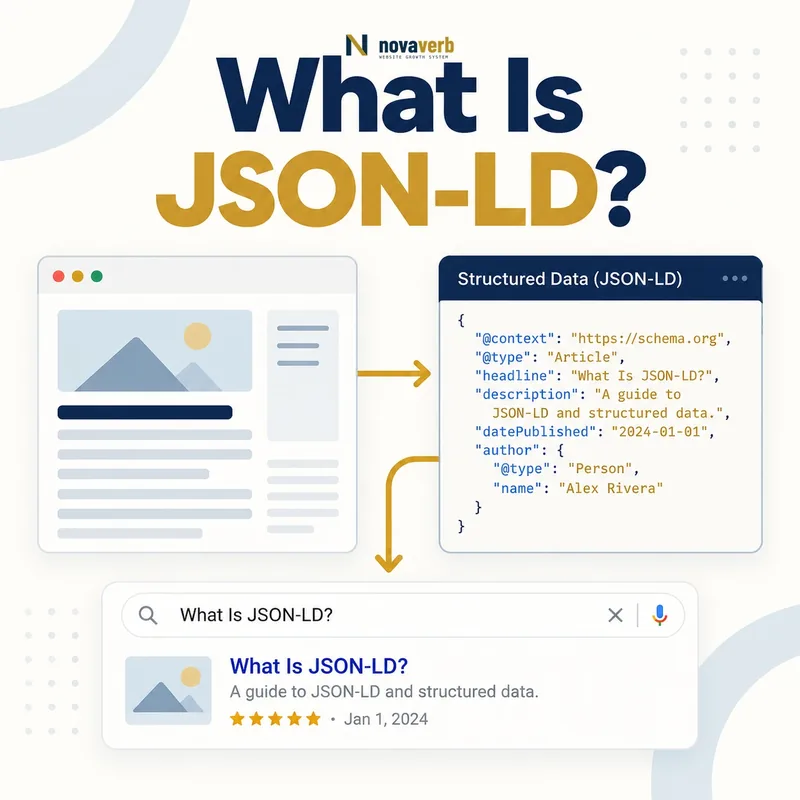
JSON-LD adds keywords such as @context, @type and @id to familiar JSON structures. A context maps compact terms to full identifiers, a type states what kind of entity a node represents, and an ID gives a node a stable identity that other nodes can reference.
For SEO, JSON-LD is commonly embedded in an HTML script element to carry schema markup. It is a syntax, not a vocabulary and not a search feature. The same format can express vocabularies other than Schema.org, while Schema.org data can also be written with Microdata or RDFa.
- Frame the decision raised by What Is JSON-LD.
- Confirm its value type and the object it describes.
- Compare the markup with visible page information.
- Correct the source data or template without inventing values.
- Validate the rendered result and monitor future changes.
| JSON-LD concept | Purpose | SEO example |
|---|---|---|
| @context | Maps terms to vocabulary identifiers | Schema.org context |
| @type | Declares entity class | Product or Article |
| @id | Provides stable node identity | Canonical URL plus fragment |
| Property | Describes fact or relationship | name, author or offers |
| Value | Text, number, URL or node | Price or Person reference |
| @graph | Contains connected nodes | Page, organization and author |
| Script element | Embeds JSON-LD in HTML | application/ld+json block |
- Separate syntax from vocabulary.
- Use stable identifiers for real entities.
- Keep graph facts aligned with visible content.
JSON-LD is a linked-data serialization that can carry a coherent entity graph inside a web page without changing visible layout.
The decision for What Is JSON-LD should rest on live, traceable evidence and a verified follow-up check.
How Does JSON-LD Work?
A processor reads the document, resolves the context and interprets keys as vocabulary properties rather than arbitrary field names. Values may be literals, URLs or nested node objects. When two references use the same @id, they can identify the same entity instead of creating disconnected copies.
The serialized shape can be compact, expanded or flattened while representing equivalent linked data. SEO implementations usually favor readable compact JSON-LD. The parser’s ability to understand the graph does not prove that a search feature will use every property; consumer eligibility remains a separate layer.
- Evidence for How Does JSON-LD Work: the live structured-data entity and property relationship
- The expected value type and any nested object
- Visible page information that supports the structured value
- Related offer or catalog fields needed for interpretation
- A fresh validation result after the page changes
| Processing step | Input | Result |
|---|---|---|
| Load | JSON-LD document | Data becomes available |
| Resolve context | Compact terms and vocabulary | Full property meaning |
| Identify node | @id value | Stable entity reference |
| Assign type | @type value | Entity class |
| Connect | Nested node or ID reference | Relationship graph |
| Normalize form | Compact, expand or flatten | Equivalent representation |
| Consumer evaluation | Feature-specific rules | Used, ignored or eligible data |
- Choose the vocabulary and context.
- Identify the primary entity.
- Add truthful properties and relationships.
- Process and validate the complete graph.
The working model is context, identify, type, connect and process - then validate consumer-specific use separately.
The decision for How Does JSON-LD Work should rest on live, traceable evidence and a verified follow-up check.
JSON-LD vs JSON and Schema Markup
A normal JSON object can contain fields named type and name, but their meaning is local to the application. JSON-LD uses a context to connect terms to globally identifiable concepts. Schema.org supplies a shared collection of types and properties that can be serialized through JSON-LD.
This distinction prevents a common error: copying an application API response into a JSON-LD script does not automatically create valid schema markup. The fields must map to defined properties, the values need correct types and the graph must describe what the page presents.
- Frame the decision raised by JSON-LD vs JSON and Schema Markup.
- Confirm its value type and the object it describes.
- Compare the markup with visible page information.
- Correct the source data or template without inventing values.
- Validate the rendered result and monitor future changes.
| Technology | What it defines | What it does not define |
|---|---|---|
| JSON | Objects, arrays and primitive values | Shared semantic meaning |
| JSON-LD | Linked-data interpretation of JSON | One required business vocabulary |
| Schema.org | Types and properties | One required serialization |
| Microdata | HTML attribute syntax | JSON data format |
| RDFa | HTML linked-data attributes | Search feature eligibility |
| Rich result rules | Consumer-specific page requirements | General JSON-LD validity |
- Do not publish raw API JSON as schema blindly.
- Map fields to defined vocabulary properties.
- Validate syntax and meaning independently.
JSON-LD supplies linked-data structure, while the chosen vocabulary supplies the actual semantic definitions.
The decision for JSON-LD vs JSON and Schema Markup should rest on live, traceable evidence and a verified follow-up check.
What Do @context, @type and @id Mean?
@context defines term interpretation, @type classifies a node and @id gives that node a reusable identifier for graph relationships.The context often sets a default vocabulary so compact terms such as name or offers resolve consistently. A type can be one value or several when an entity truthfully belongs to multiple classes. An ID should be a stable IRI; for page entities, a canonical URL with a durable fragment is often easier to manage than a changing database key.
IDs let a WebPage reference the Organization that publishes it and an Article reference the Person who wrote it without duplicating full nodes. Do not use the same ID for different real things or generate a new ID on every request. Identity design is foundational to a coherent graph.
- Evidence for What Do @context, @type and @id Mean: the live structured-data entity and property relationship
- The expected value type and any nested object
- Visible page information that supports the structured value
- Related offer or catalog fields needed for interpretation
- A fresh validation result after the page changes
| Keyword | Core question | Good practice |
|---|---|---|
| @context | What do these terms mean? | Use correct stable vocabulary mapping |
| @type | What kind of thing is this? | Choose narrow truthful class |
| @id | Which exact thing is this? | Use durable canonical identifier |
| @graph | Which nodes are described together? | Connect related entities |
| @language | Which language is this value? | Use when value language matters |
| @value | What literal value is represented? | Pair with type or language when needed |
| @list | Is ordering semantically important? | Use only for ordered values |
- Set the intended vocabulary context.
- Choose the entity’s truthful type.
- Assign one durable identity.
- Reference that identity across the graph.
Use context to define meaning, type to classify and ID to preserve entity identity across every valid reference.
The decision for What Do @context, @type and @id Mean should rest on live, traceable evidence and a verified follow-up check.
How Should JSON-LD Entity Graphs Be Built?
@id references.A product page might connect WebPage, Product, Offer, Brand and Organization nodes. An article page can connect WebPage, Article, Person and publisher Organization. The graph should distinguish the page document from the thing the page is about; they can have different IDs and relationships.
Central entities such as the organization should use the same identity across templates. Page-specific facts belong on the page or creative-work node, while a person’s identity should not be recreated with conflicting names and URLs. Prefer one coherent graph over multiple plugin blocks that accidentally describe duplicates.
- Frame the decision raised by How Should JSON-LD Entity Graphs Be Built.
- Confirm its value type and the object it describes.
- Compare the markup with visible page information.
- Correct the source data or template without inventing values.
- Validate the rendered result and monitor future changes.
| Node | Represents | Typical relationship |
|---|---|---|
| WebSite | Whole website | publisher Organization |
| WebPage | Current document | mainEntity or about |
| Product | Item offered | offers Offer and brand |
| Offer | Commercial terms | itemOffered Product |
| Article | Editorial work | author Person and publisher |
| Person | Real individual | author of creative work |
| Organization | Business entity | publisher or brand |
| BreadcrumbList | Page path representation | itemListElement pages |
- Separate the page from its subject.
- Reuse organization and person IDs.
- Avoid conflicting plugin-generated nodes.
A useful graph separates documents from entities and connects the same real thing through one durable identity.
The decision for How Should JSON-LD Entity Graphs Be Built should rest on live, traceable evidence and a verified follow-up check.
How Can JSON-LD Help SEO?
When accurate structured data matches a supported feature, the page may become eligible for rich results. Enhanced presentation can influence qualified CTR, but display is not guaranteed. JSON-LD also helps internal QA because structured facts can be extracted and compared across large page sets.
The format does not create relevance, authority or content quality. A valid Product node cannot replace a useful product page, and an Article graph cannot prove authorship by itself. Treat JSON-LD as an expression of existing evidence and page truth, then measure impressions, clicks and conversions honestly.
- Evidence for How Can JSON-LD Help SEO: the live structured-data entity and property relationship
- The expected value type and any nested object
- Visible page information that supports the structured value
- Related offer or catalog fields needed for interpretation
- A fresh validation result after the page changes
| SEO value | JSON-LD contribution | Separate requirement |
|---|---|---|
| Entity understanding | Explicit nodes and relationships | Real page evidence |
| Rich eligibility | Supported structured fields | Current feature rules |
| Template consistency | Reusable data generator | Accurate source contracts |
| CTR opportunity | Enhanced facts may appear | Query and display decision |
| Auditability | Machine-readable values at scale | Human parity review |
| Ranking | No direct guarantee | Relevance, quality and authority |
| Conversion | Can qualify expectations | Strong page and offer experience |
- Choose high-value page templates.
- Model their real entities.
- Render reliable JSON-LD.
- Measure search and business outcomes.
JSON-LD supports SEO through clarity, consistency and eligibility - not through a direct ranking switch.
The decision for How Can JSON-LD Help SEO should rest on live, traceable evidence and a verified follow-up check.
What JSON-LD Mistakes Are Common?
A trailing comma, unescaped quote or accidental HTML can break the entire block. A misspelled property may remain valid JSON but lose vocabulary meaning. Relative IDs can resolve unexpectedly under a base URL. Currency, dates, URLs and enumerated values need appropriate formats rather than human display strings copied blindly.
Multiple plugins may emit separate Product or Organization nodes with different prices, names or IDs. Client rendering may leave old markup after an application state changes. The most serious failures are factual: invented ratings, unavailable stock marked available or a named author who does not match the page.
- Frame the decision raised by What JSON-LD Mistakes Are Common.
- Confirm its value type and the object it describes.
- Compare the markup with visible page information.
- Correct the source data or template without inventing values.
- Validate the rendered result and monitor future changes.
| Mistake | Failure mode | Control |
|---|---|---|
| Invalid JSON | Block cannot parse | Serialize with a JSON library |
| Wrong context | Terms resolve incorrectly | Use intended vocabulary mapping |
| Misspelled property | Field has no expected meaning | Vocabulary validation |
| Unstable @id | Duplicate entities across requests | Canonical ID policy |
| Wrong value type | Date, URL or number misread | Typed source contract |
| Duplicate nodes | Conflicting identities and values | Merge graph by stable IDs |
| Stale commercial fact | Search display misleads | Generate from authoritative source |
| Hidden mismatch | Markup differs from visible page | Rendered parity audit |
- Use a serializer, not string concatenation.
- Validate vocabulary and value types.
- Protect commercial and identity truth.
The highest-risk JSON-LD defect is a parseable graph that publishes false or conflicting facts about the page or business.
The decision for What JSON-LD Mistakes Are Common should rest on live, traceable evidence and a verified follow-up check.
How Do You Audit JSON-LD?
Sample important template states: product availability, discounts, authors, updated articles, events, profiles and errors. Check server HTML and the final DOM to find differences introduced by client rendering. Parse all blocks together so duplicate IDs and conflicting nodes become visible.
Validate JSON syntax, JSON-LD processing, vocabulary properties and current feature eligibility as separate checks. Compare URLs, prices, stock, ratings, dates, authors and images with the rendered page and backend source. Test a controlled update to prove the graph changes with the source rather than remaining cached or stale.
- Evidence for How Do You Audit JSON-LD: the live structured-data entity and property relationship
- The expected value type and any nested object
- Visible page information that supports the structured value
- Related offer or catalog fields needed for interpretation
- A fresh validation result after the page changes
| Audit check | Evidence | Pass condition |
|---|---|---|
| Block extraction | Server HTML and final DOM | All JSON-LD captured |
| JSON syntax | Strict parser | No malformed objects |
| Linked-data processing | JSON-LD processor | Context and nodes resolve |
| Vocabulary | Type and property validation | Defined terms used correctly |
| Entity identity | @id graph | No unintended duplicates |
| Visible parity | Rendered page | Material facts match |
| Source parity | CMS or commerce state | Authoritative values match |
| Lifecycle | Controlled update and rollback | Graph stays synchronized |
- Select important templates and states.
- Extract all JSON-LD blocks.
- Parse and normalize the graph.
- Compare facts with page and source.
- Fix the generator and retest lifecycle changes.
A JSON-LD audit passes when one coherent graph is parseable, semantically valid, factually true and synchronized across every important page state.
Start with a relevant free SEO check, continue the evidence workflow in Site Health Audit, and review pricing when comparing continuous monitoring with a one-time manual review.
The decision for How Do You Audit JSON-LD should rest on live, traceable evidence and a verified follow-up check.