
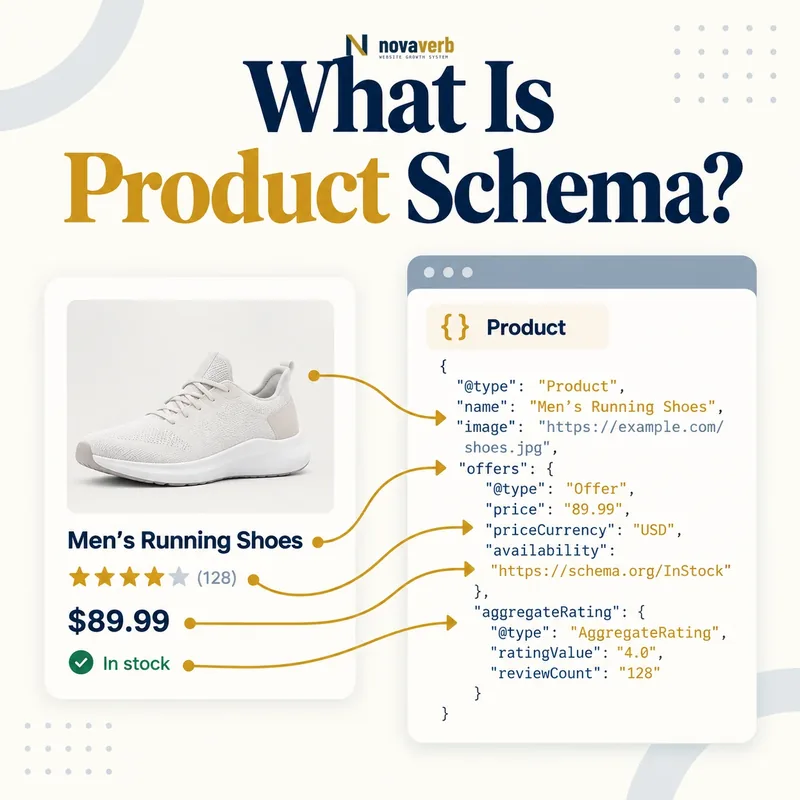
What Is Product Schema?
The Product type represents the item, while an Offer or AggregateOffer can represent commercial terms. JSON-LD is a common serialization, but the underlying model matters more than the syntax. Product facts should come from the same catalog and commerce sources that render the visible page.
Product schema can support eligibility for enhanced product presentations, but it does not create a product, prove quality or guarantee rankings and clicks. A page must genuinely present the item, and decision-making facts must remain accurate for the shopper’s country, currency, variant and current purchase state.
- Frame the decision raised by What Is Product Schema.
- Confirm its value type and the object it describes.
- Compare the markup with visible page information.
- Correct the source data or template without inventing values.
- Validate the rendered result and monitor future changes.
| Entity or property | Represents | Authoritative source |
|---|---|---|
| Product | Specific item or product model | Catalog record |
| Offer | Purchasable terms | Live commerce state |
| AggregateOffer | Range or collection of offers | Eligible offer inventory |
| Brand | Product brand identity | Catalog or manufacturer data |
| sku | Seller stock-keeping identifier | Catalog system |
| gtin/mpn | Standard or manufacturer identifier | Verified product data |
| AggregateRating | Settled aggregate review evidence | Visible review system |
- Separate product identity from its offer.
- Use current catalog and commerce facts.
- Never fabricate reviews or availability.
Product schema is a machine-readable reflection of a real product page and its current commercial facts, not a promotional substitute for them.
The decision for What Is Product Schema should rest on live, traceable evidence and a verified follow-up check.
How Does Product Schema Work?
A Product node identifies the item. Offer nodes can state seller, price, currency, availability, condition and URLs when those values are real and visible. Reviews or an aggregate rating can connect only when the page has genuine review evidence and the values match the displayed review experience.
A consumer parses the graph, validates required fields for a current product feature and checks the page’s accessibility and consistency. Eligibility does not guarantee display. Search presentation can change by query and market, while incorrect commerce facts remain incorrect regardless of whether an enhancement appears.
- Evidence for How Does Product Schema Work: the live structured-data entity and property relationship
- The expected value type and any nested object
- Visible page information that supports the structured value
- Related offer or catalog fields needed for interpretation
- A fresh validation result after the page changes
| Stage | Data action | Failure example |
|---|---|---|
| Identify | Create stable Product node | Same SKU receives changing IDs |
| Describe | Add name, image and brand | Fields belong to another variant |
| Offer | Attach live commercial terms | Old price remains cached |
| Review | Connect genuine review evidence | Rating invented or hidden |
| Render | Output graph on product page | Markup missing when out of stock |
| Validate | Check vocabulary and feature rules | Required field absent |
| Observe | Measure actual search appearance | Eligibility assumed to mean display |
- Identify the exact product or variant.
- Read authoritative catalog and offer facts.
- Render visible and structured values together.
- Validate every commerce state.
The process is identify the product, attach verified offer data, validate page parity and allow each consumer to decide presentation.
The decision for How Does Product Schema Work should rest on live, traceable evidence and a verified follow-up check.
Product Schema vs Offer and AggregateOffer
A product can exist without being sold on the page, while an offer cannot make sense without an item offered. A merchant page may have one Offer for a selected variant and seller. A marketplace or multi-seller page may have several offers or a truthful AggregateOffer when the visible page presents the range.
Do not use AggregateOffer merely to display a promotional “starting at” price while hiding the applicable items. The low and high values must reflect the actual eligible offer collection. Currency, seller and availability should be modeled at the level where they genuinely vary.
- Frame the decision raised by Product Schema vs Offer and AggregateOffer.
- Confirm its value type and the object it describes.
- Compare the markup with visible page information.
- Correct the source data or template without inventing values.
- Validate the rendered result and monitor future changes.
| Node | Best use | Important fields | Common misuse |
|---|---|---|---|
| Product | Item identity | name, image, identifiers | Putting seller terms directly everywhere |
| Offer | One purchasable option | price, currency, availability, url | Mixing several variants |
| AggregateOffer | Real offer range | lowPrice, highPrice, offerCount | Fabricated starting price |
| Brand | Manufacturer or commercial brand | name or stable ID | Using seller as brand |
| Organization | Seller or manufacturer entity | name and identity | Duplicating company nodes |
| Review | One genuine review | author, body, rating | Writing promotional copy as review |
- Keep item identity stable.
- Attach terms to the correct offer.
- Use ranges only for real visible collections.
Model the product once, then attach the exact offer structure the page lets a shopper verify and use.
The decision for Product Schema vs Offer and AggregateOffer should rest on live, traceable evidence and a verified follow-up check.
How Should Price and Availability Be Marked Up?
Price should represent the amount a shopper can actually use under the visible conditions. If taxes, membership, quantity or region change the payable amount, the page and structured data need a consistent policy. Sale prices and validity windows should not outlive the promotion.
Availability must update when inventory or ordering state changes. “In stock” is not a design color or marketing label; it is a claim about purchase capability. Cache layers, client rendering and feeds can each introduce delay, so test the public page after stock and price transitions.
- Evidence for How Should Price and Availability Be Marked Up: the live structured-data entity and property relationship
- The expected value type and any nested object
- Visible page information that supports the structured value
- Related offer or catalog fields needed for interpretation
- A fresh validation result after the page changes
| Commerce field | Required truth | Failure example |
|---|---|---|
| price | Current usable amount | Expired sale price |
| priceCurrency | Currency for that amount | USD markup on CAD page |
| availability | Current ordering state | InStock after inventory reaches zero |
| priceValidUntil | Real offer end date | Past date left active |
| url | Exact purchasable destination | Generic category page |
| itemCondition | Actual product condition | Used item marked NewCondition |
| seller | Entity making the offer | Brand substituted for marketplace seller |
| eligibleRegion | Real offer geography when modeled | Unsupported country included |
- Read the selected live offer.
- Render price and currency visibly.
- Update availability with inventory state.
- Test cache and feed convergence after changes.
Commercial schema is trustworthy only when price, currency and availability stay synchronized with the offer a shopper can complete.
The decision for How Should Price and Availability Be Marked Up should rest on live, traceable evidence and a verified follow-up check.
How Should Product Variants Be Handled?
A parent group can connect related variants, while each variant keeps its own SKU, identifiers and offer facts. The canonical strategy should match the site’s user-facing URL design. If every variant has an indexable page, each page needs unique visible content and consistent structured data. If variants share one canonical page, selected-state markup must not expose contradictory invisible options.
Do not merge stock across variants. A blue medium shirt can be unavailable while a red large shirt remains purchasable. Images and offers should belong to the exact selected item. Stable product-group and variant IDs make catalog updates and audits easier.
- Frame the decision raised by How Should Product Variants Be Handled.
- Confirm its value type and the object it describes.
- Compare the markup with visible page information.
- Correct the source data or template without inventing values.
- Validate the rendered result and monitor future changes.
| Variant concern | Correct model | Risk |
|---|---|---|
| Product group | Connects related family | Parent treated as purchasable item |
| SKU | Unique seller identifier per variant | Same SKU reused |
| GTIN or MPN | Verified item identifier | Identifier copied across variants |
| Color or size | Exact distinguishing property | Selected option differs visibly |
| Image | Shows selected variant | Generic image misrepresents color |
| Offer | Variant-specific price and stock | Stock pooled incorrectly |
| URL and canonical | Matches page strategy | Variant points to conflicting identity |
- Use unique variant identifiers.
- Keep stock and price variant-specific.
- Align canonical URLs with visible selection.
Variant schema succeeds when each purchasable option retains its exact identity, media and offer state without leaking facts from siblings.
The decision for How Should Product Variants Be Handled should rest on live, traceable evidence and a verified follow-up check.
How Can Product Schema Affect SEO and CTR?
Visible price, stock, ratings, shipping or return details can attract qualified shoppers or filter out visitors whose needs do not match. A lower CTR is not always failure if conversion per impression improves. Conversely, an attractive enhancement can increase clicks while a weak or mismatched product page loses trust.
Measure rich results by impressions, clicks, CTR, conversion and revenue together. Product schema does not guarantee ranking gains and cannot replace useful product copy, strong image SEO, internal links or authority. The commercial page must deliver what the search appearance promises.
- Evidence for How Can Product Schema Affect SEO and CTR: the live structured-data entity and property relationship
- The expected value type and any nested object
- Visible page information that supports the structured value
- Related offer or catalog fields needed for interpretation
- A fresh validation result after the page changes
| Possible outcome | Interpretation | Metric to pair |
|---|---|---|
| CTR rises | Product facts attract attention | Conversion rate |
| CTR falls, conversion rises | Poor-fit clicks filtered out | Revenue per impression |
| Impressions rise | More product contexts available | Ranking and query mix |
| Clicks rise, sales flat | Landing page or offer mismatch | Checkout funnel |
| Feature disappears | Eligibility or display changed | Validation and live appearance |
| Returns rise | Product expectation mismatch | Return reason and page content |
- Record baseline search and commerce outcomes.
- Implement truthful product data.
- Observe actual rich appearances.
- Measure qualified clicks and settled sales.
Product schema helps when accurate pre-click facts improve qualified selection and the landing page fulfills the same offer.
The decision for How Can Product Schema Affect SEO and CTR should rest on live, traceable evidence and a verified follow-up check.
What Product Schema Mistakes Are Common?
Plugins may cache an old sale price after the visible page updates. Inventory feeds can lag and preserve InStock. Review counts may include unrelated products or testimonials that are not product reviews. A manufacturer code can be mislabeled as a GTIN. These errors affect decisions and deserve priority over optional-field completeness.
Multiple JSON-LD blocks can describe the same product under different IDs or prices. Currency can reflect a default market while the page localizes another. Category pages may mark every card as the primary product despite serving a collection intent. Fix the catalog-to-template contract rather than patching emitted JSON.
- Frame the decision raised by What Product Schema Mistakes Are Common.
- Confirm its value type and the object it describes.
- Compare the markup with visible page information.
- Correct the source data or template without inventing values.
- Validate the rendered result and monitor future changes.
| Mistake | Shopper impact | Control |
|---|---|---|
| Stale price | Unexpected checkout amount | Live source and cache audit |
| False InStock | Cannot complete order | Inventory-state synchronization |
| Invented rating | Misleading social proof | Settled visible reviews only |
| Wrong GTIN/SKU | Product identity collision | Verified catalog identifiers |
| Mixed variants | Wrong color, size or offer | Variant-level nodes |
| Currency mismatch | Wrong market expectation | Locale and offer parity |
| Duplicate Product nodes | Conflicting facts | Stable IDs and graph consolidation |
| Hidden offer | Fact not visible or usable | Render terms or remove markup |
- Protect price, stock and review truth first.
- Verify identifiers from catalog sources.
- Consolidate duplicate product graphs.
The highest-risk Product schema defect is a convincing commercial claim that the visible purchasable offer cannot support.
The decision for What Product Schema Mistakes Are Common should rest on live, traceable evidence and a verified follow-up check.
How Do You Audit Product Schema?
Test high-value templates and states: regular price, sale, out of stock, preorder, multiple variants, multiple sellers and discontinued items. Capture server HTML and final DOM. Parse all JSON-LD, Microdata and RDFa together so duplicate Products and Offers become visible.
Compare SKU, GTIN, brand, selected variant, images, price, currency, availability, seller and reviews with the catalog and live checkout path. Change one price and stock state in a controlled environment or approved production workflow, then verify page, structured data, cache and feeds converge.
- Evidence for How Do You Audit Product Schema: the live structured-data entity and property relationship
- The expected value type and any nested object
- Visible page information that supports the structured value
- Related offer or catalog fields needed for interpretation
- A fresh validation result after the page changes
| Audit check | Evidence | Pass condition |
|---|---|---|
| Identity | SKU, GTIN, MPN and @id | Exact product or variant |
| Page parity | Rendered name, image and offer | Facts match visibly |
| Commerce parity | Catalog, inventory and price source | Current authoritative state |
| Graph integrity | All structured-data blocks | No conflicting duplicates |
| Feature eligibility | Current product validator | Required fields present |
| Variants | Selection and URL states | Correct item-specific data |
| Checkout test | Purchasable path | Price and availability hold |
| Lifecycle test | Sale, stock and discontinue change | Every surface updates together |
- Select products and lifecycle states.
- Extract and normalize every graph.
- Validate identity and eligibility.
- Cross-check catalog, page and checkout.
- Fix the source contract and retest transitions.
A Product schema audit passes when one coherent product graph matches the exact visible and purchasable state across every important variant and lifecycle condition.
Start with a relevant free SEO check, continue the evidence workflow in Site Health Audit, and review pricing when comparing continuous monitoring with a one-time manual review.
The decision for How Do You Audit Product Schema should rest on live, traceable evidence and a verified follow-up check.