
What Is a Contextual Backlink?
Contextual describes placement and relationship, not how the link was acquired. A natural editorial citation, an outreach-earned citation or a disclosed sponsored placement can all appear inside content, although their relationship types should remain separate.
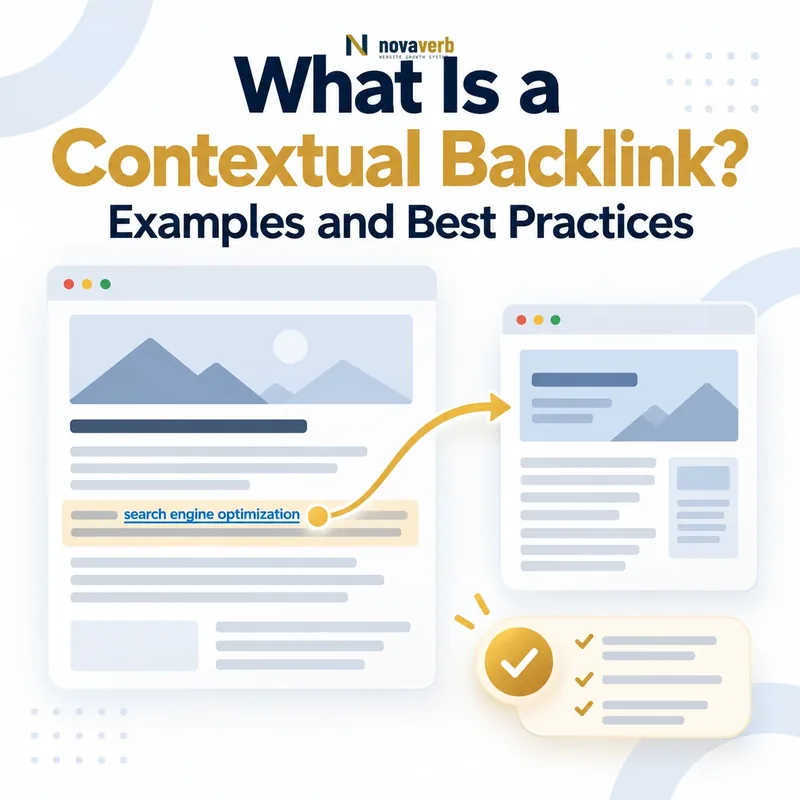
The defining feature is that the link participates in the explanation rather than sitting apart from it in a navigation menu, generic author box, sitewide footer or unrelated widget.
- Placed within meaningful page copy
- Surrounded by relevant explanation
- Uses an anchor that fits the sentence
- Points to a destination that satisfies the promise
- Can be verified on the live referring page
| Link placement | Contextual? | Reason |
|---|---|---|
| Citation inside a relevant paragraph | Yes | Copy explains the destination |
| Resource link under a matching section | Usually | Section supplies context |
| Sitewide footer | No | Placement repeats outside the discussion |
| Navigation menu | No | Navigation role rather than editorial explanation |
| Unrelated widget | No | Source context does not support the target |
A backlink is contextual when its surrounding content gives the reader a clear reason to follow that specific destination.
How Do Contextual Backlinks Work?
A source may cite research to support a statistic, link to a definition for clarification or recommend a tool that lets the reader perform a task. In each case, the link has a visible job within the current passage.
The relationship fails when the anchor promises one topic but the destination serves another, when a redirect ends on a generic homepage or when the source copy is unrelated to the link.
- Reader reaches a relevant source passage
- Copy creates a question or next step
- Anchor labels the destination
- Link resolves to the final URL
- Destination satisfies the source expectation
- Reader can return to the source with added value
| Source purpose | Contextual destination | Reader benefit |
|---|---|---|
| Support a claim | Original evidence | Verify the statement |
| Define a term | Complete definition | Understand the concept |
| Complete a task | Working tool | Act immediately |
| Show an example | Detailed case or visual | See the concept applied |
| Extend a guide | Focused supporting page | Learn the next layer |
A contextual link works when the destination completes a task created by the source passage.
Contextual Backlinks vs Other Backlink Placements
Navigation links help users move through a site. Author-bio links identify a contributor. Directory listings supply profile or location information. Each can be legitimate without carrying the same source-sentence relationship as an in-content citation.
Group placements before comparing profiles. Hundreds of footer links created by one template are one pattern, while a contextual citation on a specific page is an individual editorial relationship.
- Editorial body link
- Resource-list link
- Navigation link
- Footer or sidebar link
- Author-bio link
- Directory and profile link
- Widget or embedded link
| Placement | Primary role | Context level |
|---|---|---|
| Editorial paragraph | Support the current discussion | High |
| Curated resource section | Recommend useful destinations | Medium to high |
| Author bio | Identify the contributor | Specific but not topic-body context |
| Navigation | Move around the source site | Structural |
| Footer or widget | Repeat a sitewide utility | Low editorial context |
Placement should be classified by its actual page role rather than forcing every legitimate link into the contextual category.
Contextual Backlinks vs Natural Backlinks
A paid article can contain an in-content contextual link, but the commercial relationship means it should not be described as an independent unpaid citation. An editor can naturally add a brand attribution in a caption or source note that is not part of a normal paragraph.
Read What Is a Natural Backlink? for signals of independent editorial choice. Keep acquisition, disclosure and placement as separate fields.
- Classify placement first
- Record rel and commercial attributes
- Preserve acquisition history
- Infer naturalness with stated confidence
- Avoid treating contextual as proof of editorial independence
| Question | Contextual backlink | Natural backlink |
|---|---|---|
| What does it describe? | Placement and relevance | Editorial independence |
| Can outreach create it? | Yes | Publisher may still choose independently |
| Can it be sponsored? | Yes, with disclosure | Commercial placement is separate |
| Can it appear outside a paragraph? | Usually no | Yes, when editorially chosen elsewhere |
| Can software prove it? | Placement can be observed | Intent usually cannot be proven |
Contextual placement and natural acquisition are related quality clues but answer different questions about the link.
What Makes a Contextual Backlink Relevant?
A broad marketing publication can contain a highly relevant technical SEO article, while a dedicated SEO domain can publish an unrelated company announcement. The exact referring page and section provide stronger context than the homepage label.
Destination specificity also matters. A sentence recommending a backlink checker should lead to the checker or a focused explanation, not a generic product catalog that makes the reader search again.
- Source-page topic
- Local heading and paragraph
- Anchor meaning
- Destination topic and format
- Reader intent before and after the click
- Final URL after redirects
| Relevance layer | Strong match | Weak match |
|---|---|---|
| Domain | Audience overlaps | No audience relationship |
| Page | Same subject area | Unrelated article |
| Passage | Link supports the exact point | Inserted without explanation |
| Anchor | Describes the destination | Misleading generic or commercial phrase |
| Destination | Completes the source task | Changes topic or intent |
The strongest contextual relevance is visible in the exact passage and final destination, not merely in two related domain categories.
How Do You Earn Contextual Backlinks?
Original research, free tools, transparent definitions, maintained examples and reusable templates give writers a concrete reason to cite. The resource should be stable, accurate and specific enough to fit inside an existing explanation.
Outreach should reference the real source page and reader task rather than demanding a keyword-rich anchor. Suggest the resource, not the exact editorial sentence the publisher must use.
- Identify recurring citation needs
- Create an original useful resource
- Publish on a stable canonical URL
- Find genuinely relevant source pages
- Explain the reader fit concisely
- Let the publisher choose wording and placement
- Maintain the resource after links appear
| Resource | Context it can support | Reason publishers may cite |
|---|---|---|
| Original research | Claim requiring evidence | Primary data |
| Free checker | Task requiring execution | Immediate utility |
| Definition guide | Complex term | Clear explanation |
| Template | Repeatable workflow | Reusable asset |
| Case example | Abstract recommendation | Concrete application |
Contextual links are earned most sustainably when a resource fits a specific sentence-level need on another page.
How Do You Evaluate a Contextual Backlink?
Use the free backlink checker to discover referring pages, then verify priority links live. Record whether the placement is editorial, sponsored, user-generated or controlled through another relationship.
The backlink audit guide provides the complete workflow for assigning protect, repair, reclaim, investigate, expand or ignore actions.
- Confirm the source page is available
- Locate the rendered link
- Read the heading and surrounding copy
- Record anchor and rel attributes
- Resolve redirect and final status
- Compare the destination with the link promise
- Document confidence and action
| Evidence | Question | Possible action |
|---|---|---|
| Source context | Does the link support the passage? | Protect or investigate |
| Anchor | Does it describe the target? | Keep or request correction |
| Attributes | Is the relationship labeled accurately? | Correct disclosure if controlled |
| Destination | Does the final page work and match? | Repair or reclaim |
| Placement history | Is the link stable or changing? | Monitor |
A contextual backlink review is complete when another analyst can reproduce the placement, context, destination and chosen action.
Do Contextual Backlinks Guarantee SEO Value?
A contextual link may be nofollow, sponsored, blocked from crawling or placed on a page with limited visibility. Even a legitimate follow link cannot isolate its own ranking effect from content, technical changes and other links.
Use What Is Link Equity? to understand why source, placement, attributes and destination form one relationship. Measure referrals in analytics and search performance in the appropriate search dataset.
- Record source and destination access
- Check link attributes
- Measure referral sessions when available
- Track destination health
- Measure search outcomes independently
- Avoid promising ranking gains from one placement
| Potential outcome | Relevant evidence | Guarantee? |
|---|---|---|
| Referral traffic | Web analytics | No |
| Reader discovery | Live contextual path | No |
| Topical relationship | Source and destination copy | Observable context, not ranking |
| Search performance change | Search performance data | Cannot isolate automatically |
| Conversions | Analytics and settled outcomes | Depends on visitor behavior |
Context improves the clarity of a link relationship, but it does not turn an individual backlink into a guaranteed search result.
Frequently Asked Questions About Contextual Backlinks
- Inspect the exact passage
- Keep placement separate from acquisition
- Verify the final destination
Are contextual backlinks always natural?
Can contextual backlinks be sponsored?
Is a resource-page link contextual?
Are footer links contextual?
Does exact-match anchor text make a link contextual?
Are nofollow links contextual?
How can I find contextual backlinks?
Do contextual backlinks guarantee rankings?
Contextual backlink analysis remains credible when placement, acquisition, attributes and outcome claims stay separate.
Inspect the Sentence, Not Just the Backlink Row
Start with Backlink Checker, manage recurring source evidence in Backlinks Explorer and connect link findings to the complete SEO tools system.
- Discover the referring page
- Locate the exact placement
- Read anchor and context
- Verify the final destination
- Protect or improve the relationship
A contextual backlink becomes useful evidence only after the exact source sentence and destination have been verified together.