What is link equity in SEO?
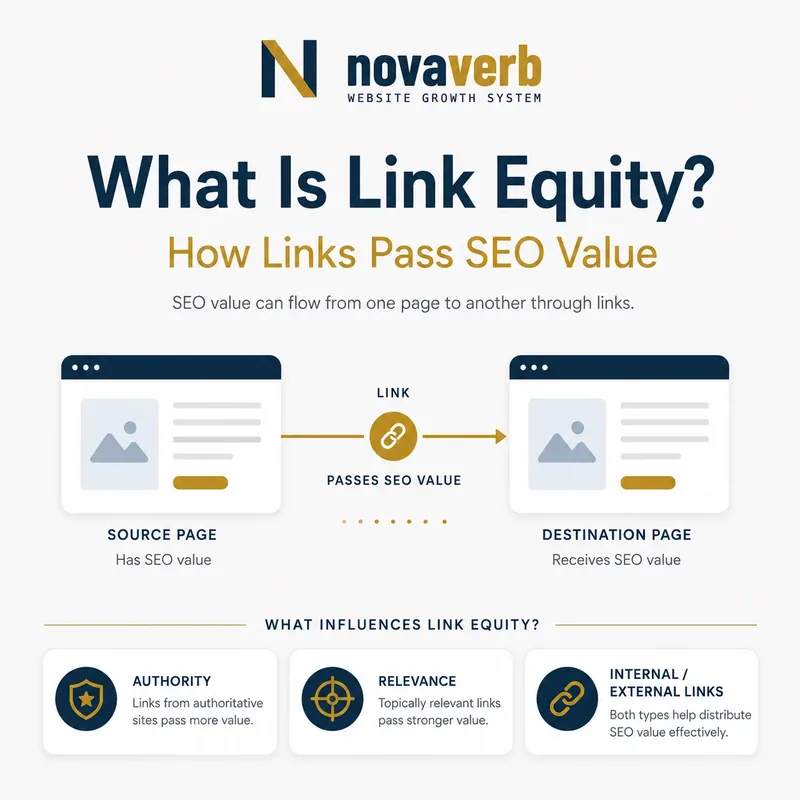
Link equity is a practical term for the contextual value that a crawlable link may transfer from one page to another. The amount is not a public score: it depends on the source page, the link, the destination and the surrounding site structure.
SEO teams also call this idea “link juice,” although link equity is the clearer term because it avoids suggesting that every link passes a fixed quantity. A link connects documents, helps discovery and can contribute context, but its effect cannot be reduced to one visible number.
A useful analysis starts with evidence you can inspect: whether the source is accessible, whether the link exists in rendered HTML, which URL it resolves to, what anchor text it uses and whether the destination answers the implied promise.
- The source page and its relevance
- The link’s crawlability and placement
- The destination URL and response
- The relationship between both documents
| Concept | What it describes | What it does not prove |
|---|---|---|
| Link equity | Potential value carried by a link relationship | A guaranteed ranking increase |
| Anchor text | The visible label of the link | The total value of the link |
| Authority metric | A provider’s comparative estimate | A search engine’s internal score |
Link equity is best treated as a relationship to inspect, not a score to copy into a report.
How does link equity flow between pages?
Link equity flows through crawlable links from a source page toward a destination, but it is distributed within a network rather than transferred as a simple one-to-one payment. Every additional path, redirect and competing destination changes what must be evaluated.
Imagine a strong guide linking to three supporting pages. Each destination gains a discovery path and contextual connection to the guide. If the guide instead contains dozens of unrelated links, the relationships become less focused and users have a less obvious next step.
Internal links also form routes through a site. Pages linked from navigation, hubs and relevant editorial passages usually have more paths leading to them than isolated pages. Use the internal link architecture system to map those routes instead of judging one URL at a time.
- A crawler reaches the source page
- The rendered page exposes a crawlable link
- The link resolves to a destination
- The destination returns a usable response
- The relationship joins the wider site graph
| Stage | Question to verify | Useful evidence |
|---|---|---|
| Source | Can the page be reached? | Live response and crawl record |
| Link | Is the URL present and crawlable? | Rendered HTML and link attributes |
| Destination | Does the final URL work? | Status, canonical and content |
| Graph | How many meaningful routes exist? | Internal link map |
Link equity can only flow through a working chain from accessible source to relevant destination.
Which factors affect the value of a link?
The value of a link is influenced by source quality, topical relevance, placement, crawlability, destination health and the number of competing links. No single factor is sufficient, so the complete relationship should be reviewed together.
A prominent editorial link from a closely related page is different from a repeated footer link or a URL hidden inside an interaction that a crawler may not expose. Likewise, a relevant source cannot rescue a destination that redirects through a long chain, returns an error or fails to satisfy the label.
External provider metrics can help prioritize a large export, but they should not replace checking the live pages. Novaverb’s free backlink checker can surface link records; the next step is to verify the source, destination and relationship.
- Source relevance and accessibility
- Editorial context and placement
- Link attributes and rendered availability
- Destination status and canonical target
- Competing links and site-wide repetition
| Factor | Stronger pattern | Weaker pattern |
|---|---|---|
| Relevance | Closely related source and destination | Unrelated topic |
| Placement | Editorial link within useful copy | Boilerplate repetition |
| Destination | Direct, healthy and aligned | Broken, redirected or mismatched |
| Context | Clear reason to click | Inserted without explanation |
The strongest link is usually the one whose source, context and destination all make sense together.
Do nofollow links pass link equity?
A nofollow link should not be treated as a dependable route for passing link equity. Its attribute signals that the relationship should not receive ordinary endorsement treatment, although the link can still be useful for discovery, referral traffic and reader navigation.
The important operational distinction is between what the link visibly does for users and what an SEO team can safely assume about value transfer. A nofollow link still opens its destination and may send qualified visitors. It simply should not be counted as equivalent to an ordinary crawlable editorial link.
Use the dofollow versus nofollow guide when you need to interpret rel attributes and link types in more detail.
- Record the rel attribute exactly
- Keep referral value separate from assumed SEO value
- Check whether the link is sponsored or user-generated
- Do not discard a useful mention only because it is nofollow
| Link type | Reliable assumption | Possible business value |
|---|---|---|
| Ordinary crawlable link | Can participate in the link graph | Discovery, context and visits |
| nofollow | Do not rely on normal endorsement treatment | Referral visits and visibility |
| sponsored | Commercial relationship is declared | Campaign and referral value |
| ugc | User-generated origin is declared | Community discovery |
Nofollow changes the SEO assumption, not the fact that a relevant link can still help a real reader.
How do internal links distribute link equity?
Internal links distribute link equity by connecting important pages to hubs, navigation and relevant supporting content. A deliberate structure gives priority pages multiple clear paths while preventing useful documents from becoming orphaned.
Internal linking is one of the most controllable parts of link equity. You choose which pages become hubs, which supporting articles connect to a commercial page and which anchor labels explain each destination. This makes internal links useful for both navigation and content strategy.
Do not solve the problem by adding the same link everywhere. Build contextual paths around user tasks. A definition article can link to a checker, a workflow can link to an SEO platform and a hub can organize the complete topic cluster.
- Choose the page that represents the core topic
- List supporting pages with distinct search intent
- Add contextual links where the next step is useful
- Use descriptive, varied anchor text
- Crawl again and confirm the final graph
| Page role | Internal linking job | Example |
|---|---|---|
| Hub | Organizes a topic and routes users | Backlink learning center |
| Supporting guide | Explains one specific concept | Anchor text definition |
| Tool page | Lets the user perform the task | Backlink checker |
| Product page | Connects repeated work to software | SEO tools system |
Internal link equity improves when every link supports a clear page role and a useful next action.
Can redirects preserve link equity?
A direct, relevant redirect can preserve the relationship between an old URL and its replacement, but redirects are not a reason to keep unnecessary chains. The final destination should be intentional, healthy and equivalent enough to satisfy the original link.
When a page moves permanently, update important internal links to point straight to the final URL and use a permanent redirect for old external references. This reduces extra hops and makes the destination easier to verify.
A redirect to an unrelated homepage may keep the request alive but break the meaning of the original link. Chains, loops and temporary redirects also introduce ambiguity. Review both the status sequence and the content at the final destination.
- Prefer one direct permanent redirect
- Update internal links to the final URL
- Keep the replacement topically equivalent
- Remove loops and unnecessary chains
- Verify the final canonical URL
Redirects preserve link relationships best when they lead directly to a genuinely equivalent replacement.
What causes link equity to be wasted?
Link equity is commonly wasted when links point to broken, redirected, duplicate, blocked or irrelevant destinations. It can also be diluted operationally when site-wide templates create thousands of low-value paths that obscure the pages users actually need.
Start with failures that can be observed. A link to a 404 page is a concrete broken path. A link through several redirects is a concrete efficiency problem. A vague anchor leading to unrelated content is a concrete expectation mismatch.
Avoid calling every low-priority link “wasted.” Legal, account and navigation links can remain necessary even when they are not SEO priorities. The audit should distinguish required product navigation from accidental clutter.
- Broken destination URLs
- Redirect chains and loops
- Links to duplicate URL variants
- Orphaned priority pages
- Unrelated site-wide template links
| Problem | Observed consequence | First action |
|---|---|---|
| 404 destination | The route ends at an error | Replace or restore the target |
| Redirect chain | Extra hops obscure the final URL | Link directly to the destination |
| Duplicate variant | Signals split across multiple URLs | Normalize links and canonicals |
| Orphan page | No meaningful internal path exists | Add a relevant route from a hub |
Fix proven broken paths before spending time estimating invisible losses.
How do you audit link equity on a website?
Audit link equity by crawling the site, classifying important pages, mapping inbound internal links and checking the live destination behind each priority relationship. Combine graph evidence with business purpose instead of ranking pages by link count alone.
Begin with a complete internal crawl and a list of pages that matter to acquisition, activation or support. Compare page roles with the links they receive. A high-value page with no contextual routes is a clear opportunity; a utility page with many template links may be completely normal.
For external links, use backlink data to build a review queue, then verify live sources and destinations. The broader Novaverb SEO tools system helps teams connect crawl findings, link evidence and follow-up work in one workflow.
- Crawl all indexable and linked URLs
- Assign each important page a role
- Count and classify incoming internal links
- Inspect anchors, placement and destinations
- Prioritize broken routes and missing contextual links
- Re-crawl after changes and compare the graph
| Audit layer | Question | Output |
|---|---|---|
| Coverage | Which URLs and links were observed? | Crawl inventory |
| Role | Which pages deserve stronger routes? | Priority page map |
| Relationship | Are links relevant and descriptive? | Link review queue |
| Destination | Does the final URL work? | Repair list |
| Change | Did the graph improve after edits? | Before-and-after comparison |
A useful audit ends with verified actions, not a spreadsheet of unexplained link totals.
How should you prioritize link equity fixes?
Prioritize link equity fixes by combining impact, evidence and effort. Repair broken routes to important pages first, then improve missing contextual links, redirect chains and unclear anchors where the intended destination is already known.
A prioritization model should reflect the site’s business goals. A broken link in a high-traffic product workflow is usually more urgent than a weak anchor in an old glossary entry. Evidence also matters: a confirmed 404 deserves action before a speculative authority concern.
Group changes so they can be verified. Repair destinations, update source links, crawl the affected area and confirm the final graph before starting the next batch.
- Business importance of the destination
- Number and quality of affected routes
- Certainty of the observed problem
- Effort and regression risk
- Ability to verify the result
The best next fix is the smallest verified change that restores a meaningful route to an important page.
What is the difference between link equity and PageRank?
Link equity is an SEO working concept used to discuss value moving through links, while PageRank is a specific link-analysis model. The terms overlap conceptually, but they should not be treated as interchangeable public measurements.
PageRank explains why the structure of a link graph matters, whereas link equity discussions usually include additional practical considerations such as relevance, placement, redirects, attributes and destination quality. Modern SEO work cannot observe a current per-page PageRank value directly.
Third-party authority scores can be useful for comparison within the same provider, but they are not PageRank and they do not prove how a search engine evaluated a specific link. Use them to sort records, then return to live evidence.
- Keep model concepts separate from provider metrics
- Do not present authority scores as search-engine scores
- Use comparative metrics consistently
- Verify important links on the live source and destination
| Term | Useful meaning | Important limitation |
|---|---|---|
| Link equity | Working concept for link value and flow | No universal public unit |
| PageRank | A link-analysis model | Current per-page values are not public |
| Authority score | Provider-specific comparison metric | Not a search-engine score |
| Link count | Observed quantity of links | Does not measure relevance or quality |
Use link equity to reason about relationships, but never turn a provider metric into a claim about PageRank.