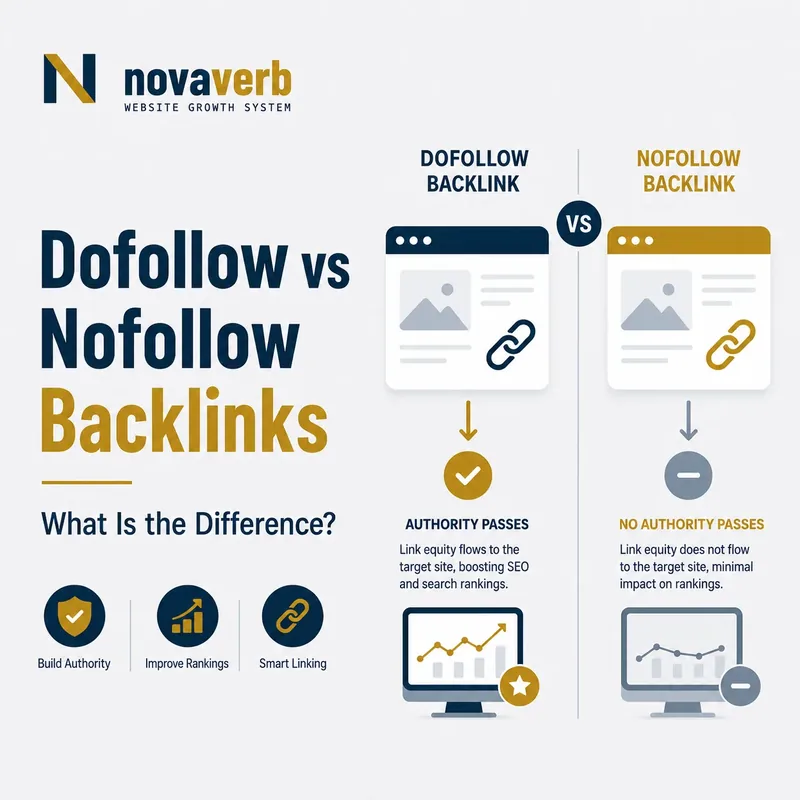
What Is the Difference Between Dofollow and Nofollow Backlinks?
A normal backlink has no restrictive relationship attribute, while a nofollow backlink contains rel="nofollow" to qualify how the publisher wants the link interpreted.
The word dofollow is industry shorthand. HTML does not require a rel="dofollow" attribute. The difference is visible in the link markup, not in its color or anchor text.
| Property | Normal or “dofollow” | Nofollow |
|---|---|---|
| HTML | <a href="…"> | <a href="…" rel="nofollow"> |
| Clickable | Yes | Yes |
| Referral traffic | Possible | Possible |
| Relationship qualifier | None specified | Nofollow specified |
- A normal link is often called dofollow in SEO tools.
- A nofollow link explicitly carries the nofollow relationship value.
- Both remain clickable links and can send referral traffic.
Section takeaway: Dofollow describes the absence of a restrictive rel value; nofollow describes an explicit relationship qualifier.
What Is a Dofollow Backlink?
A dofollow backlink is common SEO shorthand for a standard external link that does not include nofollow, sponsored or UGC as a restrictive relationship value.
A standard link can still contain other useful attributes such as target, hreflang or aria-label. Those do not automatically make the link nofollow.
<a href="https://example.com/research">original research</a>- Inspect the actual anchor element.
- Confirm the destination is external to the source site.
- Record any rel values before classifying the link.
Section takeaway: A dofollow backlink is a normal link classification, not a special HTML attribute that must be added.
What Is a Nofollow Backlink?
A nofollow backlink is an external link whose anchor element includes nofollow in the rel attribute.
The publisher can combine nofollow with other relationship values. For example, rel="nofollow sponsored" states both a nofollow qualification and a commercial relationship.
<a href="https://example.com" rel="nofollow">example</a>- The link remains visible and clickable.
- The source page still provides real referral context.
- The relationship value should be checked on the live source page.
Section takeaway: Nofollow qualifies the relationship; it does not erase the link or make the visitor path disappear.
Nofollow vs Sponsored vs UGC
Nofollow is a general relationship qualifier, sponsored identifies paid or compensated placements, and UGC identifies links in user-generated content.
More than one value can appear on the same link. The values describe the publisher's relationship to the destination; they do not grade the destination page.
| rel value | Best-fit relationship | Typical placement |
|---|---|---|
| nofollow | General qualified reference | Untrusted or unendorsed external reference |
| sponsored | Commercial compensation | Advertisement, sponsorship or affiliate placement |
| ugc | User-generated contribution | Forum, comment or community post |
| Combined | More than one condition applies | rel="nofollow sponsored" |
- Use sponsored for advertising, sponsorships and compensated placements.
- Use UGC for forums, comments and other user-authored areas.
- Use nofollow when the publisher needs a general qualification and a more specific value does not fit.
Section takeaway: Choose the rel value that accurately describes why and where the link exists.
How Do You Check Whether a Backlink Is Dofollow or Nofollow?
Check the source page's anchor element and read its rel attribute; do not classify the link from its visible design.
Use the Novaverb Free Backlink Checker to find source pages, then verify important links directly. A tool result is an observation from its crawl; a live check confirms the current page state.
- Open the exact referring page.
- Find the link to the destination URL.
- Inspect the anchor element in the rendered DOM or source.
- Read every rel value.
- Record the source URL, destination URL and observation time.
Section takeaway: The rel attribute on the actual source-page link is the evidence for dofollow or nofollow classification.
Can Nofollow Backlinks Send Traffic?
Yes. Nofollow backlinks remain clickable and can send qualified referral traffic when the source audience is relevant and the placement is visible.
A useful community answer, publication citation or partner resource can send interested visitors even when the link is nofollow. The attribute does not block a browser from opening the destination.
- Measure referral sessions separately from link attributes.
- Check whether visitors reach the intended destination.
- Evaluate engagement and conversion with honest first-party analytics.
Section takeaway: Nofollow changes the stated relationship, not the visitor's ability to follow the link.
Do Nofollow Backlinks Help SEO?
Nofollow backlinks can contribute referral traffic, discovery and legitimate brand exposure, but the link attribute alone does not prove a ranking benefit.
Do not convert a correlation into a claim that one nofollow link caused a ranking change. Search performance reflects many changing inputs, and Google-specific outcomes require Google evidence.
- Treat the backlink as an observed relationship, not a guaranteed outcome.
- Use Search Console for claims about Google's search performance.
- Measure referral and conversion outcomes in first-party analytics.
Section takeaway: A nofollow link can be useful without being presented as verified ranking impact.
Are Dofollow Backlinks Always Better?
No. A normal link from an irrelevant or manipulated placement is not automatically better than a relevant nofollow link that reaches the right audience.
Attribute type is one field in a backlink record. It should be reviewed alongside source legitimacy, topic, anchor, destination health and acquisition relationship.
| Scenario | Attribute | Practical assessment |
|---|---|---|
| Relevant editorial citation | Normal | Strong contextual fit |
| Relevant community resource | Nofollow or UGC | Can reach a qualified audience |
| Paid editorial-looking placement | Normal | Relationship is inaccurately represented |
| Unrelated sitewide template link | Normal | High count does not establish relevance |
- Compare source relevance and audience fit.
- Inspect editorial context and placement.
- Check whether the destination satisfies the source page's promise.
Section takeaway: A backlink should be judged from its real source and purpose, not from dofollow status alone.
When Should Publishers Use Nofollow?
Publishers should use nofollow when they need to qualify a link and sponsored or UGC does not more accurately describe the relationship.
Apply the value to the individual link that needs qualification. A sitewide rule can accidentally change editorial links, navigation and trusted references that have different relationships.
- Qualify references the publisher does not want to present as an unqualified endorsement.
- Use sponsored for compensated links rather than hiding the commercial relationship.
- Use UGC for links created by users in community areas.
Section takeaway: Use the narrowest accurate relationship value at link level.
When Should Publishers Use Sponsored?
Publishers should use rel="sponsored" for advertisements, sponsorships, affiliate placements and other links created because compensation exists.
A commercial link can still be useful to readers, but its relationship must be represented honestly. Styling a paid placement like editorial content does not change why the link exists.
- Disclose the commercial relationship to readers.
- Apply sponsored to the compensated link.
- Keep editorial and advertising workflows distinguishable.
Section takeaway: Sponsored is the specific relationship value for compensated link placements.
When Should Publishers Use UGC?
Publishers should use rel="ugc" for external links placed by users in comments, forums, profiles and other user-generated areas.
UGC describes authorship context. It does not automatically label every community contribution as low quality, and it does not replace spam prevention or moderation.
- Apply UGC where users control the linked destination.
- Moderate abuse independently from the rel attribute.
- Allow trusted exceptions only through a documented editorial process.
Section takeaway: UGC identifies user-created link context while moderation controls whether the contribution should remain.
Can a Link Have Multiple rel Values?
Yes. A link can contain multiple space-separated rel values when more than one relationship or browser behavior applies.
For example, rel="nofollow sponsored noopener" combines relationship qualification with a browser-security behavior. Each value has its own meaning.
| Markup | Interpretation | Review |
|---|---|---|
rel="nofollow sponsored" | Commercial and generally qualified | Check compensation disclosure |
rel="ugc nofollow" | User-generated and qualified | Check moderation context |
rel="sponsored noopener" | Commercial plus browser behavior | Meanings are independent |
| Two separate rel attributes | Invalid authoring pattern | Combine into one attribute |
- Separate values with spaces inside one rel attribute.
- Avoid duplicate rel attributes on the same element.
- Choose only values that truthfully apply.
Section takeaway: Multiple rel values are valid when every included value accurately describes the link.
How Do SEO Tools Classify Dofollow and Nofollow Links?
SEO tools classify link attributes from the HTML or rendered DOM their crawler observed, then aggregate those link-level records into reports.
Counts can differ because providers crawl different pages at different times, handle JavaScript differently or retain lost records for different periods. Use one stable provider for trend analysis.
Backlinks Explorer connects each classification to its source, destination and observation evidence.
- Check whether the tool crawls source HTML or renders JavaScript.
- Record the report refresh time.
- Verify important links when the classification affects an action.
Section takeaway: A tool classification is a timestamped observation that should remain traceable to the source link.
How Do Dofollow and Nofollow Links Affect Referring-Domain Reports?
A single referring domain can supply normal, nofollow, sponsored and UGC backlinks simultaneously, so domain-level labels require an explicit aggregation rule.
Calling an entire domain “nofollow” because one link is nofollow can hide normal editorial links from other pages. Read What Is a Referring Domain? for the domain-counting contract.
| Domain state | Observed links | Accurate report |
|---|---|---|
| Normal only | All active links are normal | Normal-link domain |
| Nofollow only | All active links are nofollow | Nofollow-only domain |
| Mixed | Normal and qualified links coexist | Mixed attributes |
| Lost | No active observed links remain | Lost under the declared window |
- Keep attributes on individual backlink records.
- State whether a domain needs one or all links to match a filter.
- Open the referring pages behind mixed domains.
Section takeaway: Mixed referring domains should be summarized from transparent link-level rules.
Common Dofollow and Nofollow Mistakes
Common mistakes invent a dofollow attribute, classify links from appearance, use nofollow to hide paid relationships or treat every nofollow link as worthless.
Another mistake is changing attributes solely to increase an SEO-tool score. The markup should describe the real relationship, and outcomes should be measured separately.
| Mistake | Why it fails | Correction |
|---|---|---|
rel="dofollow" | Not required for a normal link | Use a standard anchor |
| Judging by link color | CSS does not reveal rel values | Inspect the anchor element |
| Nofollow on paid links only | Hides the specific relationship | Use sponsored |
| Calling nofollow useless | Ignores traffic and audience value | Measure real outcomes |
| Domain-wide attribute assumption | Domains can supply mixed links | Retain link-level evidence |
- Inspect markup instead of visual styling.
- Use sponsored for compensation and UGC for user-created links.
- Evaluate audience, context and destination independently from rel values.
Section takeaway: Accurate relationship markup is more useful than chasing a preferred label.
Dofollow and Nofollow Audit Checklist
A dofollow and nofollow review passes QA when every important classification is traceable to a live source link, exact rel value, destination and observation time.
The checklist is complete only when another analyst can reproduce both the classification and the next action from the same evidence.
- Record the source URL and destination URL.
- Inspect the actual anchor element.
- Capture every rel value.
- Separate normal, nofollow, sponsored and UGC links.
- Check whether JavaScript changes the rendered link.
- Record source status and canonical.
- Check destination status and redirect chain.
- Document editorial, paid, partner or UGC context.
- Keep link metrics separate from referring-domain metrics.
- Label provider data and refresh time.
- Use Search Console for Google-specific outcomes.
- Retest completed corrections.
Section takeaway: A defensible link-attribute finding contains source, markup, relationship, destination and timestamp.
Frequently Asked Questions About Dofollow and Nofollow Backlinks
Dofollow is shorthand for a normal link, while nofollow is an explicit rel value that qualifies the publisher's relationship to the destination.
Is dofollow an HTML attribute?
Can nofollow links be clicked?
Can nofollow backlinks send traffic?
Are nofollow backlinks bad?
Should paid links use nofollow or sponsored?
Can a link use sponsored and nofollow together?
How do I check a link attribute?
Can one domain have dofollow and nofollow links?
- Check the actual rel attribute to classify a link.
- Use sponsored for compensated placements.
- Use UGC for user-created links.
Section takeaway: Dofollow and nofollow should be reported from the source markup and interpreted in their real relationship context.
Check the Attribute, Then Check the Relationship
Use the backlink record to find the source, then verify the actual rel attribute and why the placement exists before deciding what to do.
Novaverb connects each link classification to its source page, destination and observation time so teams can act from evidence rather than a label.
Read What Is a Backlink? for the complete link-quality framework or use the Decision Ladder to choose the next verified action.
- Find the exact source page.
- Inspect the link attribute and context.
- Connect the evidence to a specific next action.
Section takeaway: The correct classification comes from the source markup, and the correct action comes from the complete relationship evidence.