What Is a Natural Backlink?
Natural does not mean accidental or impossible to influence. A team can publish research, tools and explanations, promote them to relevant audiences and make them easy to cite. The deciding publisher still evaluates whether and how to include the link.
No public field proves that a link is natural. Analysts infer the relationship from source legitimacy, editorial context, relevance, placement and known acquisition history, while keeping uncertainty explicit.
- Independent editorial choice
- Relevant source and destination
- Useful context for the reader
- Placement not controlled by the destination owner
- Anchor chosen naturally by the publisher
| Characteristic | Natural pattern | Controlled pattern |
|---|---|---|
| Decision | Publisher chooses independently | Destination owner specifies placement |
| Anchor | Fits the source sentence | Prescribed commercial wording |
| Placement | Editorially useful context | Required template or transaction |
| Purpose | Help the reader | Create the appearance of popularity |
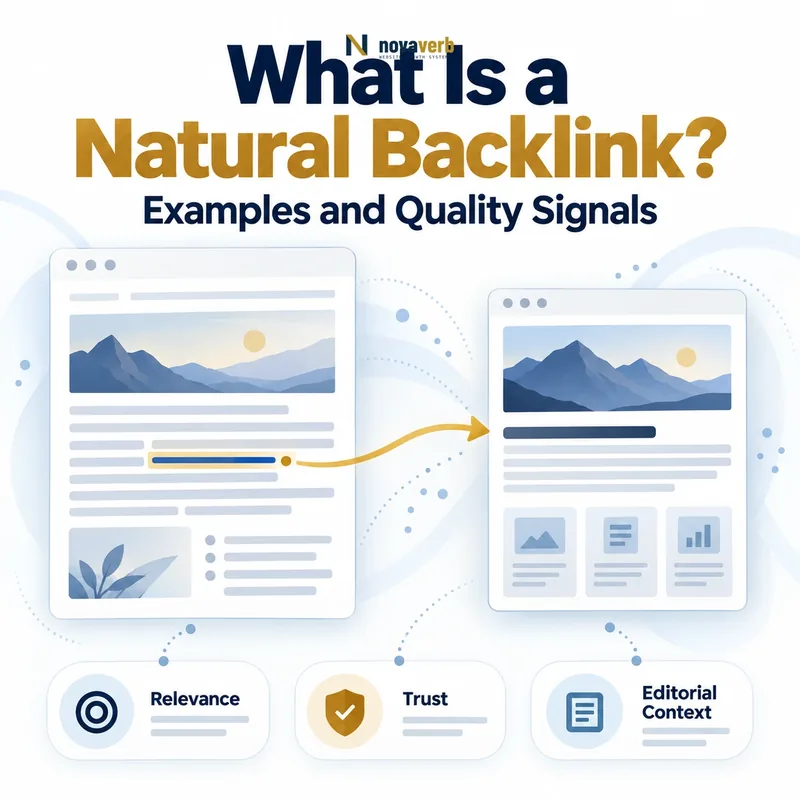
A natural backlink reflects an independent editorial choice to connect readers with a relevant destination.
Natural Backlinks vs Manually Built Backlinks
A legitimate partnership page, relevant directory profile, contributor biography or publisher-approved outreach link can be manually initiated and still serve users transparently. The important questions are who controls the placement, whether the relationship is disclosed and whether the destination fits.
Keep earned, manually placed, sponsored and user-generated relationships separate in reporting. Combining them under one quality label hides how the links were created.
- Editorially earned links
- Publisher-approved outreach links
- Partner and association links
- Relevant directory submissions
- Sponsored placements
- User-generated links
| Relationship | Who initiates | Who controls final editorial choice |
|---|---|---|
| Natural citation | Publisher | Publisher |
| Outreach-earned citation | Destination owner contacts publisher | Publisher |
| Directory submission | Destination owner | Directory rules |
| Sponsored placement | Commercial parties | Contract and publisher |
| User-generated link | Community member | User under platform rules |
Manual participation should be disclosed and classified, while editorial independence determines whether a citation is naturally chosen.
What Are Examples of Natural Backlinks?
The shared pattern is resource fit. A statistic receives a citation because it supports a claim; a calculator receives a link because it completes a task; a definition receives a link because it clarifies a concept for the source audience.
Brand mentions can also become natural links when a publisher chooses to help readers reach the named company or source. The destination should be the most useful specific page rather than automatically the homepage.
- Original research cited in an article
- Free tool included in a resource guide
- Definition linked from a technical explanation
- Unique dataset referenced by a journalist
- Template or checklist used in a workflow
- Brand source credited for a quoted fact
| Source need | Natural destination | Reason to link |
|---|---|---|
| Support a statistic | Original research page | Provides evidence |
| Complete a calculation | Working calculator | Lets readers act |
| Explain terminology | Detailed definition | Adds clarity |
| Show a process | Checklist or template | Makes steps reusable |
| Credit an idea | Original source | Provides attribution |
Natural links appear when a destination performs a specific job that improves the source page.
What Signals Suggest a Backlink Is Natural?
Read the complete sentence and section. A branded anchor may be natural when citing a company; an exact-match phrase may be natural when it is the clearest name for a tool. Anchor text type alone cannot establish the relationship.
Review source history and placement patterns. One contextual link in a maintained guide differs from repeated links across an unrelated footer network.
- Topical and audience relevance
- Editorial placement within useful copy
- Anchor that fits the sentence
- Destination that satisfies the link promise
- Independent source ownership
- No contradictory acquisition evidence
| Signal | Supports natural interpretation | Needs caution |
|---|---|---|
| Context | Link advances the discussion | Link is isolated or unrelated |
| Anchor | Publisher-friendly descriptive wording | Repeated prescribed phrase |
| Placement | Editorial body content | Sitewide template |
| Destination | Specific useful resource | Generic sales page |
| Source | Legitimate maintained publication | Coordinated or deceptive property |
A natural interpretation is strongest when source, context, anchor and destination all make sense without a controlled-link explanation.
How Do You Earn Natural Backlinks?
Strong linkable assets often contain original data, transparent methods, free tools, expert definitions, reusable templates, practical examples or maintained reference material. They remain available at stable URLs and disclose limitations.
Promotion can introduce a resource to relevant writers and communities without controlling the final link. Outreach should identify a genuine audience fit and leave the publisher free to cite, mention, ignore or choose another source.
- Identify recurring questions that need a source
- Choose a resource format that answers them
- Create original, verifiable value
- Publish on a stable canonical URL
- Add clear authorship and update ownership
- Promote to relevant audiences
- Measure citations and maintain the asset
| Asset type | Why publishers cite it | Maintenance requirement |
|---|---|---|
| Original research | Supports claims with evidence | Methods and data updates |
| Free tool | Completes a reader task | Reliable functionality |
| Definition guide | Clarifies terminology | Current examples |
| Template | Makes a process reusable | Version ownership |
| Visual explanation | Simplifies a complex concept | Accessible labels and source notes |
Natural backlinks are most likely when the resource remains useful enough to deserve citation after the promotion ends.
How Does Content Quality Affect Natural Links?
Length alone does not create linkability. A concise calculator with clear inputs can be more useful than a long generic article. A research page without methodology can be harder to trust than a shorter report that explains its sample and limits.
Design also matters when it supports comprehension: descriptive headings, answer-first sections, tables, examples and accessible visuals help publishers find the exact evidence they need.
- Accurate answer-first explanations
- Original evidence or distinctive utility
- Transparent methods and limitations
- Clear authorship and update dates
- Stable destination and canonical URL
- Scannable structure and accessible design
| Quality dimension | Citation-friendly pattern | Weak pattern |
|---|---|---|
| Evidence | Source and method are visible | Unsupported claim |
| Originality | Unique data, tool or synthesis | Rewritten common advice |
| Usability | Answer is easy to find | Key fact buried |
| Maintenance | Owner and updates are clear | Abandoned resource |
| Stability | Persistent canonical URL | Frequent unredirected moves |
Publishers cite resources that make verification and reader use easier, not content that is merely long or optimized around a keyword.
How Do You Analyze Natural Backlinks?
Use the free backlink checker to discover observed referring pages, then open the important sources. Compare natural-looking editorial links with partner, sponsored, directory and user-generated relationships without treating the latter categories as automatically bad.
The backlink audit guide explains how to turn the full profile into verified protect, repair, reclaim, investigate, expand or ignore actions.
- Define provider, target and filters
- Open the exact referring page
- Locate the link in rendered content
- Read anchor and surrounding section
- Check rel attributes and placement
- Review known acquisition history
- Record evidence and confidence
| Evidence | Natural interpretation | Alternative explanation |
|---|---|---|
| Editorial body link | Publisher chose a useful citation | Paid or arranged placement |
| Varied anchor | Publisher wrote naturally | Campaign still allowed variation |
| Relevant source | Topic fit is clear | Partner content |
| Specific resource target | Reader task is served | Optimized campaign landing page |
| No internal acquisition record | May be independently earned | History may be incomplete |
Classify with confidence levels because live context can support editorial independence but rarely proves private intent.
Do Natural Backlinks Always Pass SEO Value?
Separate relationship quality from outcome claims. A natural link can provide attribution, referral traffic, brand discovery and reader value even when no ranking change can be isolated.
The link equity guide explains why source, context, attributes and destination matter, while Dofollow vs Nofollow Backlinks covers relationship attributes.
- Check crawlable source access
- Record the exact rel attribute
- Resolve redirects and final destination
- Measure referral traffic when available
- Measure search outcomes independently
- Avoid promising rankings from one link
| Outcome | Can a natural link provide it? | Evidence source |
|---|---|---|
| Referral visits | Yes | Web analytics |
| Attribution | Yes | Live source page |
| Discovery path | Potentially | Crawlable link evidence |
| Ranking change | Cannot be guaranteed | Search performance data |
| Conversion | Possible after referral | Analytics and settled outcomes |
Natural describes how a relationship appears to be chosen, not a guaranteed ranking or revenue result.
Frequently Asked Questions About Natural Backlinks
- Inspect the exact source
- Preserve relationship history
- Measure outcomes independently
Can outreach earn a natural backlink?
Are exact-match anchors unnatural?
Are directory backlinks natural?
Are nofollow links natural?
Can paid backlinks be natural?
How many natural backlinks do I need?
Can tools detect natural backlinks automatically?
Do natural backlinks guarantee rankings?
Natural backlink analysis is credible when it states the evidence, uncertainty and user value without turning a pattern into a promise.
Create Resources Publishers Have a Reason to Cite
Use Backlink Checker to understand which assets already attract citations, continue analysis in Backlinks Explorer and connect resource decisions through the SEO tools system.
- Find citation-worthy questions
- Create original useful resources
- Publish on stable URLs
- Promote to relevant audiences
- Verify and protect earned relationships
The most durable natural-link strategy is to maintain resources that remain worth citing when no campaign is running.