
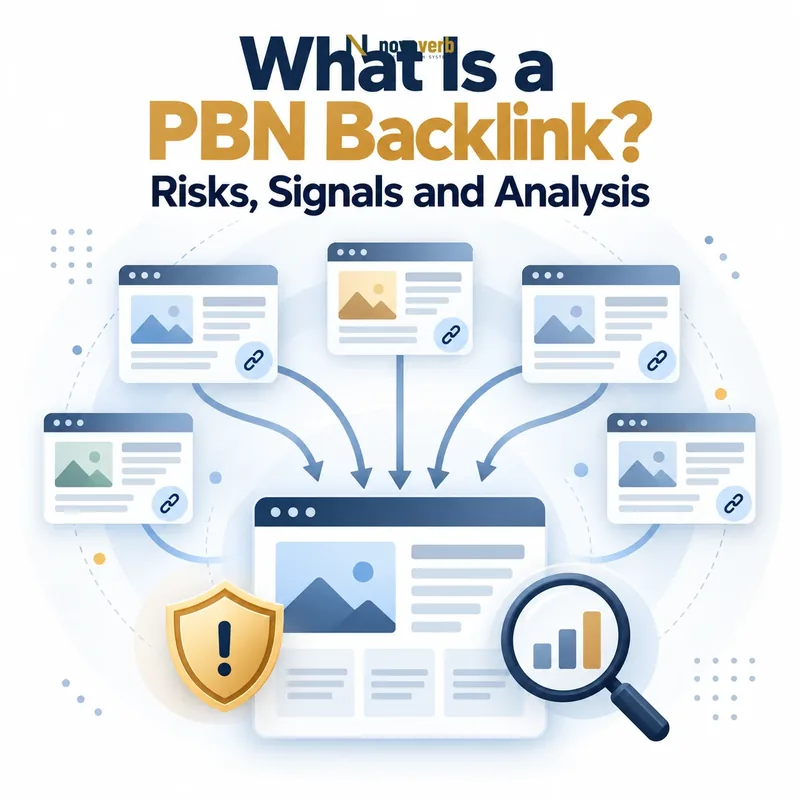
What Is a PBN Backlink?
Network sites may appear independent while publishing articles that link to the same clients or money pages. Some reuse acquired domains, generic content or standardized placement patterns, but no single characteristic proves membership in a PBN.
An unfamiliar low-quality backlink is not automatically a PBN link. Scrapers, syndication, shared platforms and unrelated publishers can create visual or technical similarities. Use a confidence-based investigation supported by source and campaign evidence.
- Multiple apparently separate sites
- Shared or coordinated control
- Links toward selected beneficiaries
- Placement driven by network purpose
- Repeated acquisition patterns
- Limited independent audience value
- Evidence stronger than surface similarity
| Concept element | Required question | Evidence type |
|---|---|---|
| Control | Are sites owned or coordinated together? | Ownership or account evidence |
| Purpose | Why are links being placed? | Campaign and content pattern |
| Beneficiary | Which destinations repeatedly receive links? | Target overlap |
| Independence | Do publishers make separate decisions? | Relationship evidence |
| Audience | Do sites serve real users independently? | Live source review |
| Confidence | How strong is the conclusion? | Corroborated signals |
A PBN classification requires coordinated control and link-manufacturing intent supported by multiple independent pieces of evidence.
How Do Private Blog Networks Work?
The sites can publish content around different topics, but coordinated beneficiaries, anchors, timing or commercial records may expose a common acquisition system. Some networks sell placements to outside buyers; others support properties owned by the same operator.
This description is for risk analysis, not a construction guide. Operational details vary, and visible implementation can change. Focus on what your organization controlled, purchased or approved and what is verifiable on live source pages.
- Central or coordinated placement control
- Multiple publishing domains
- Selected destination pages
- Repeated link patterns
- Commercial or owned beneficiary relationship
- Attempts to resemble independent sources
- Network-wide changes or removals
| Network layer | Observed pattern | Analysis question |
|---|---|---|
| Publishers | Several apparently distinct sites | Are they independently controlled? |
| Content | Articles built around placements | Does content serve a real audience? |
| Targets | Same beneficiaries recur | Who requested or funded links? |
| Anchors | Coordinated commercial wording | Was language controlled? |
| Timing | Links appear in aligned waves | Was there one campaign? |
| Operations | Sites change together | Is infrastructure or ownership shared? |
The relevant risk comes from coordinated control over purportedly independent link placements, not from a particular website template.
PBNs vs Legitimate Publisher Networks
Media groups can own multiple publications with independent editorial teams and clear disclosures. Franchise sites, university departments and hosted communities can also share technology without coordinating outbound links for ranking manipulation.
Evaluate business purpose, audience, disclosure, editorial independence, beneficiary patterns and acquisition history together. A hidden ownership connection can strengthen a network hypothesis, but it still needs placement-purpose evidence.
- Real audience and publishing purpose
- Transparent organization or ownership
- Independent editorial decisions
- Original maintained content
- Diverse legitimate outbound references
- Business model beyond selling links
- No required beneficiary placement
| Dimension | Potential PBN | Legitimate publisher group |
|---|---|---|
| Primary purpose | Manufacture link placements | Serve audiences and publish |
| Ownership | Often obscured | Can be transparent |
| Editorial control | Coordinated for beneficiaries | Defined independent processes |
| Content value | Placement-led or thin | Audience-led and maintained |
| Outbound links | Repeated commercial targets | Diverse relevant citations |
| Revenue | Link sales may dominate | Audience, subscriptions or advertising |
Treat shared ownership as one fact and determine whether real audience purpose and independent editorial decisions explain the sites more accurately.
What Are Common PBN Backlink Signals?
Technical similarities such as hosting, analytics identifiers, themes or DNS can indicate common infrastructure, but legitimate platforms and agencies also create shared footprints. Content and link patterns can be stronger when they align across otherwise unrelated sites.
Build an evidence matrix and seek corroboration. Separate observable facts from inferences, and document missing evidence before escalating a source cluster as a network.
- Beneficiary overlap across domains
- Coordinated commercial anchors
- Aligned first-seen dates
- Repeated article and placement templates
- Shared account or ownership artifacts
- Minimal independent audience activity
- Known invoices or vendor records
- Network-wide addition or removal events
| Signal | Why it matters | False-positive risk |
|---|---|---|
| Shared targets | Suggests coordination | Popular sites attract broad citations |
| Same anchors | Can reflect campaign control | Common product names |
| Aligned timing | May show one deployment | Provider recrawl |
| Shared infrastructure | Can connect operators | Common hosting platform |
| Thin content | May show placement purpose | New or neglected legitimate site |
| Payment records | Direct relationship evidence | Must match exact placement |
A responsible PBN assessment combines ownership, purpose, target, timing and commercial evidence instead of treating one footprint as proof.
What Can Cause False PBN Positives?
A news article syndicated to many outlets can create aligned anchors and dates from distinct or contractually connected publishers. A SaaS platform can make many customer sites share code, DNS or analytics patterns without controlling their editorial links.
Provider data can also cluster rediscovered links as new or preserve expired records. Open representative sources, trace original content and check business relationships before assigning a severe label.
- Shared website platforms
- Managed hosting providers
- Common themes and plugins
- Syndicated articles
- Franchise or branch websites
- Transparent media ownership
- Agency-built customer sites
- Scrapers and content mirrors
- Provider recrawl events
| Apparent footprint | Legitimate explanation | Verification |
|---|---|---|
| Same IP range | Shared hosting | Check unrelated tenants |
| Same theme | Popular template | Review ownership evidence |
| Same article | Authorized syndication | Find original and disclosures |
| Many regional domains | Franchise network | Check business structure |
| Aligned first-seen dates | Provider refresh | Compare historical records |
| Repeated links from copies | Scraping | Verify control and source origin |
Rule out platform, syndication, organizational and provider explanations before interpreting shared signals as network control.
What Are the Risks of PBN Backlinks?
Networks can be deindexed, abandoned, resold or changed without notice. A buyer can lose many links in one event and have limited ability to explain what was purchased, where it appeared or whether destinations remain appropriate.
The opportunity cost is also significant. Budget spent on controlled placements does not build durable audience assets, transparent partnerships or independent editorial demand. Keep financial and campaign records so risk decisions are accountable.
- Coordinated link loss
- Unreliable source ownership
- Misleading acquisition reporting
- Vendor and payment exposure
- Destination and anchor concentration
- Limited qualified referral traffic
- Reputational and policy concerns
- Opportunity cost versus durable assets
| Risk | Operational impact | Evidence to retain |
|---|---|---|
| Network removal | Many links disappear together | Source and timing groups |
| Account concern | Manual review or message possible | First-party account evidence |
| Budget waste | Spend lacks audience outcome | Invoices and referrals |
| Reporting distortion | Placements labeled earned | Campaign records |
| Reputation | Brand appears on deceptive sites | Live source captures |
| Concentration | Few controlled sources dominate | Domain and event distribution |
PBN risk assessment should cover operational, financial, reputational and search evidence without inventing consequences that have not been observed.
How Do You Analyze Suspected PBN Backlinks?
Use backlink profile and link velocity views to find coordinated changes, then inspect exact referring pages. Group template or syndicated copies into underlying events.
Preserve a record for each hypothesis: observed facts, alternative explanations, direct account or payment evidence, confidence and next step. Do not contact publishers or take irreversible action solely because a provider labels domains toxic or suspicious.
- Define target scope and provider snapshot
- Cluster referring domains by target and timing
- Compare anchors, placements and content templates
- Open representative live source pages
- Identify original versus copied content
- Check owned vendor, invoice and campaign records
- Test legitimate alternative explanations
- Grade confidence as confirmed, likely, uncertain or unsupported
- Assign a proportionate action and owner
| Analysis layer | Question | Output |
|---|---|---|
| Source | What is live now? | Verified pages |
| Pattern | Which records share features? | Candidate clusters |
| Control | Who owns or coordinates sites? | Ownership evidence |
| Purpose | Why were links placed? | Relationship inference |
| Beneficiary | Which targets recur? | Target overlap |
| Campaign | Did we authorize or buy this? | First-party records |
| Confidence | How complete is evidence? | Graded decision |
A defensible analysis moves from observed source patterns to direct control and campaign evidence, with uncertainty preserved at every step.
What Should You Do About PBN Backlinks?
Start with Backlink Checker for source discovery and organize clusters with Backlinks Explorer. Compare suspected sources with the broader toxic backlink decision framework instead of equating labels with verdicts.
Connect investigation, vendor termination, removal attempts and monitoring through the SEO tools system. Keep exact source evidence, account messages, ownership, action dates and outcomes together.
- Confirm whether the organization controlled acquisition
- Stop active deceptive purchases or submissions
- Preserve vendor, payment and campaign evidence
- Separate confirmed networks from uncertain clusters
- Request removal when justified and safe
- Document unsuccessful attempts
- Follow direct account instructions when present
- Monitor unrequested sources without panic
- Retest the profile and business outcomes
| Evidence state | Default action | Reason |
|---|---|---|
| Confirmed controlled PBN campaign | Stop and remediate | Direct acquisition evidence |
| Likely network, control uncertain | Investigate and monitor | Severe claim not proven |
| Unrequested scraper cluster | Monitor first | Destination lacks control |
| Legitimate shared publisher group | Classify correctly | Alternative explanation verified |
| Direct account message | Follow scoped process | First-party search evidence |
| Provider score only | Do not escalate alone | Third-party estimate |
The right response is proportional to verified control, relationship and account evidence rather than fear generated by a network score.
Frequently Asked Questions About PBN Links
- Seek corroborated control evidence
- Rule out legitimate shared systems
- Respond proportionately
What does PBN stand for?
Are all links from PBNs harmful?
How can I identify a PBN backlink?
Does shared hosting prove a PBN?
Can a publisher group look like a PBN?
Should I remove every suspected PBN link?
What if an agency built PBN links without approval?
Do PBN links guarantee ranking gains?
PBN analysis remains credible when confirmed facts, alternative explanations and confidence levels are visible to every decision-maker.
Replace Network Guesswork With Verified Evidence
Check backlinks free, investigate source clusters in Backlinks Explorer and coordinate monitoring or remediation through the complete SEO workflow.
- Discover exact sources
- Cluster coordinated patterns
- Verify live pages
- Check first-party records
- Grade confidence
- Stop, monitor or remediate proportionately
A network label is only a hypothesis until source, control, purpose and campaign evidence support the conclusion.