
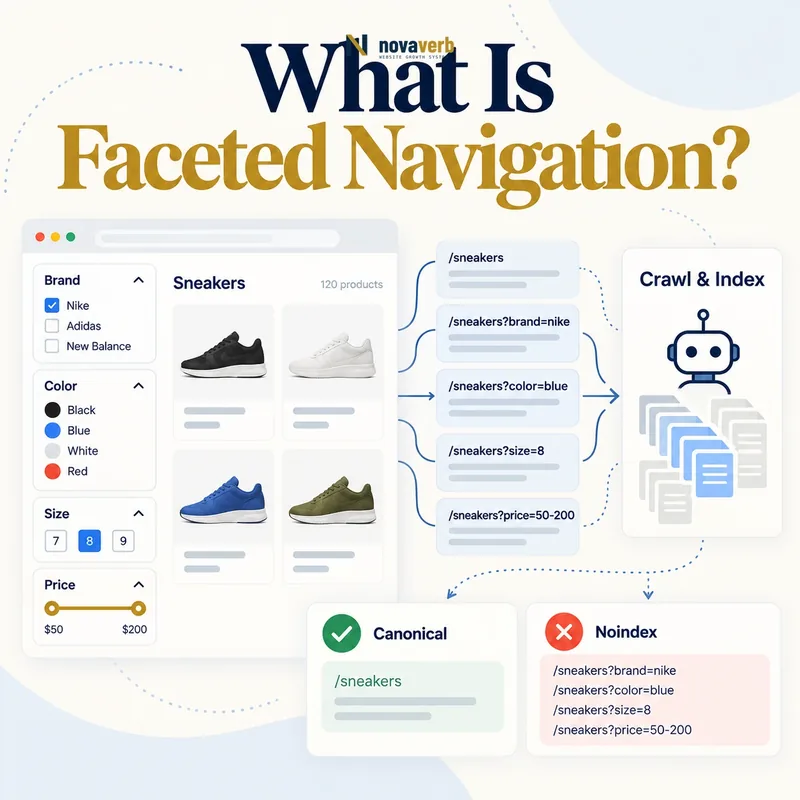
What Is Faceted Navigation?
Facets are common in ecommerce catalogs, marketplaces, job sites, property searches, software directories and large content libraries. They help users move from a broad collection to a relevant subset without navigating a separate fixed category for every combination.
For SEO, the central question is not whether filters exist. It is which states create stable crawlable URLs, which combinations serve distinct search needs and which should remain user-only application states.
- Broad collection or result set
- Attribute-based refinement controls
- One or more selected values
- Updated result list
- Possible URL or history state
- Clear and reset actions
- Crawl and index policy per state
- Frame the decision raised by What Is Faceted Navigation.
- Crawl representative clean and parameterized URLs.
- Record links, responses, canonicals and robots behavior.
- Choose one consistent policy for duplicate or sequential states.
- Implement the policy and verify it with a fresh crawl.
| Facet element | Example | System effect |
|---|---|---|
| Attribute | Brand | Defines refinement dimension |
| Value | Novaverb | Selects a subset |
| Combination | Brand plus price | Narrows further |
| Result count | 24 items | Shows available set |
| URL state | ?brand=x&price=y | Can create crawlable variant |
| Clear action | Remove price | Returns to broader set |
Faceted navigation is a discovery interface whose SEO behavior depends on how each selected state is rendered, linked, addressed and governed.
Facets vs Filters, Sorting and Categories
Brand, color and storage can act as facets. In-stock-only is often a binary filter. Price low-to-high is sorting. Laptops can be a category with its own hierarchy, copy and navigation.
The terms are often used interchangeably in product teams, so audits should document behavior instead of relying on labels. Ask whether selection changes membership, order, URL, crawl path, canonical, index state and internal links.
- Facet attribute and value
- Filter inclusion rule
- Sort order
- Category hierarchy
- Search query state
- Pagination state
- Combined application state
- Frame the decision raised by Facets vs Filters, Sorting and Categories.
- Crawl representative clean and parameterized URLs.
- Record links, responses, canonicals and robots behavior.
- Choose one consistent policy for duplicate or sequential states.
- Implement the policy and verify it with a fresh crawl.
| Control | Changes membership? | Typical SEO role |
|---|---|---|
| Facet | Yes | Selected combinations may need policy |
| Binary filter | Yes | Often low-demand utility state |
| Sort | No, order only | Usually not distinct landing need |
| Category | Yes, curated set | Stable architecture page |
| Search query | Yes | Usually user-specific result state |
| Pagination | Partitions set | Requires separate crawl decision |
Classify controls by actual result, URL and graph behavior so category and filter states do not inherit the wrong SEO rules.
How Do Faceted URLs Work?
A catalog might produce /shoes?color=black&size=10, /shoes/black/size-10 or a client-side state that leaves the URL unchanged. Parameter order, repeated values, default filters and tracking parameters can multiply technically distinct URLs.
Define a deterministic URL model. Normalize facet order, value format, empty states, default selections, trailing slashes and canonical destinations before exposing links at scale.
- Query parameter URLs
- Path-segment URLs
- Hash or fragment state
- Client-side history state
- Multiple values per attribute
- Parameter ordering
- Default and empty values
- Canonical URL mapping
- Frame the decision raised by How Do Faceted URLs Work.
- Crawl representative clean and parameterized URLs.
- Record links, responses, canonicals and robots behavior.
- Choose one consistent policy for duplicate or sequential states.
- Implement the policy and verify it with a fresh crawl.
| URL model | Benefit | Risk |
|---|---|---|
| Query parameters | Flexible combinations | Permutation growth |
| Path segments | Readable selected states | Hierarchy ambiguity |
| Fragments | Can avoid server variants | May limit shareable rendered state |
| No URL change | Simple crawl graph | Cannot share selection reliably |
| History API | Shareable interactive state | Rendering and parity issues |
| Mixed model | Supports complex features | Inconsistent normalization |
A stable faceted system generates one predictable address for each intentionally addressable state and prevents equivalent permutations from proliferating.
What SEO Risks Does Faceted Navigation Create?
Ten attributes with several values can produce far more states than the product catalog contains distinct user needs. Sorting, pagination and tracking parameters can multiply the set again.
Not every combination is harmful or useless. Some facets represent meaningful demand, such as a product type plus compatible platform or a property type plus location. The system needs evidence-based inclusion rules instead of blocking every filtered page.
- Combinatorial URL growth
- Duplicate result sets
- Thin or empty combinations
- Unstable inventory states
- Long redirect or canonical chains
- Overlinked low-value URLs
- Weak category and hub focus
- Conflicting crawl and index controls
- Frame the decision raised by What SEO Risks Does Faceted Navigation Create.
- Crawl representative clean and parameterized URLs.
- Record links, responses, canonicals and robots behavior.
- Choose one consistent policy for duplicate or sequential states.
- Implement the policy and verify it with a fresh crawl.
| Risk | Evidence | Operational response |
|---|---|---|
| URL explosion | Crawl and route counts | Limit exposed combinations |
| Duplicate states | Same normalized result set | Consolidate generation |
| Empty pages | Zero-result crawlable URLs | Prevent or handle explicitly |
| Thin inventory | Few unstable items | Review index value |
| Graph dilution | Many template edges | Control link exposure |
| Canonical conflict | Markup and redirects disagree | Unify policy |
| Crawl waste | Logs show repeated low-value paths | Refine crawl controls |
Faceted risk comes from unmanaged state multiplication, not filtering itself, and should be measured in real URLs, crawl activity and landing-page value.
Which Faceted Pages Should Be Indexable?
Use first-party search demand, conversion behavior, inventory stability and content differentiation. A brand-plus-product category can deserve a maintained landing page, while a transient combination of four attributes may be useful only inside the application.
Treat the rule as a product decision with explicit ownership. Avoid generating indexable pages solely because a keyword tool suggests a phrase when the live result set is empty, unstable or duplicative.
- Define the user and search need
- Confirm the result set is distinct
- Measure inventory depth and stability
- Review overlap with category pages
- Assess query and conversion evidence
- Provide useful title, heading and context
- Choose one canonical URL
- Add deliberate internal discovery
- Set index and crawl behavior
- Assign owner and minimum quality checks
- Evidence for Which Faceted Pages Should Be Indexable: the clean path and every parameter or pagination state
- Crawlable links entering and leaving the page set
- Canonical, robots and response behavior for each variant
- Duplicate or near-duplicate destinations created by the pattern
- A fresh crawl proving the chosen policy works
| Indexability factor | Supports indexability | Supports user-only state |
|---|---|---|
| Intent | Distinct recurring need | Arbitrary combination |
| Inventory | Sufficient and stable | Thin or volatile |
| Uniqueness | Different useful result set | Near duplicate |
| Demand | First-party query or user evidence | No observed need |
| Content | Maintained helpful context | Generated labels only |
| Architecture | Deliberate hub or category path | Only filter clicks |
| Ownership | Review and retirement process | Unmanaged generation |
An indexable facet combination should behave like a maintained landing page, not an accidental by-product of interface state.
How Should Faceted Navigation Be Implemented?
The product must remain usable when non-indexable states are not exposed as crawlable links. Forms, buttons or application controls can refine results, while approved landing combinations can receive stable anchor links from relevant categories or hubs.
Server and client rendering should agree on selected values, result counts, headings, canonical targets and empty states. Test shared links, browser history, back navigation and mobile controls.
- Inventory every facet and value type
- Define membership and sort behavior
- Choose addressable versus user-only states
- Normalize URL generation
- Create approved landing combinations
- Set canonical and index rules
- Control crawlable link exposure
- Render selected state consistently
- Handle empty and invalid combinations
- Test accessibility, history and mobile behavior
- Evidence for How Should Faceted Navigation Be Implemented: the clean path and every parameter or pagination state
- Crawlable links entering and leaving the page set
- Canonical, robots and response behavior for each variant
- Duplicate or near-duplicate destinations created by the pattern
- A fresh crawl proving the chosen policy works
| Implementation layer | Decision | Verification |
|---|---|---|
| State model | Which combinations exist? | Deterministic result set |
| URL model | How is state encoded? | One normalized form |
| Rendering | Server and client parity | Same items and labels |
| Crawl links | Which states are discoverable? | Approved edges only |
| Canonical | What is preferred URL? | Self-consistent output |
| Index state | Which landings qualify? | Policy matches value |
| UX | Can users refine and undo? | Accessible tested controls |
Implementation succeeds when user discovery remains flexible while only deliberate, stable landing states enter the crawlable site architecture.
How Do You Control Crawling of Faceted URLs?
No single control solves every problem. Canonicals describe preferred consolidation but do not prevent a crawler from requesting URLs. A robots rule can limit crawling but can also prevent access to page-level signals. Index directives address index state but still require crawling to be observed.
Select controls based on the actual goal and verify them in rendered pages, server responses, logs and first-party search data. Preserve navigation functionality for users while changing crawl exposure.
- Map exposed facet links and permutations
- Remove crawlable links to useless states
- Normalize parameter order and defaults
- Redirect invalid or duplicate variants when appropriate
- Set canonical output consistently
- Apply index directives to defined page classes
- Use robots controls only for a scoped crawl goal
- Exclude nonlanding states from sitemaps
- Monitor logs and discovered URLs
- Retest after product and inventory changes
- Evidence for How Do You Control Crawling of Faceted URLs: the clean path and every parameter or pagination state
- Crawlable links entering and leaving the page set
- Canonical, robots and response behavior for each variant
- Duplicate or near-duplicate destinations created by the pattern
- A fresh crawl proving the chosen policy works
| Control | Primary function | Important limitation |
|---|---|---|
| Link exposure | Controls graph discovery | External URLs can still exist |
| Normalization | Reduces duplicate variants | Requires deterministic logic |
| Redirect | Consolidates invalid equivalents | Must preserve user intent |
| Canonical | Declares preferred address | Does not stop requests |
| Index directive | Controls page index state | Needs crawler access |
| Robots control | Limits crawling scope | Can hide page signals |
| Sitemap | Surfaces approved pages | Does not block other URLs |
Crawl control is a layered system in which every mechanism has a distinct function and limitation that must be tested against the desired outcome.
How Do You Audit Faceted Navigation?
Use internal link audit and orphan page methods to understand graph exposure and approved landing coverage. Review breadcrumb navigation when selected facets change visible hierarchy or removal paths.
Connect findings to the SEO tools system. Group defects by facet rule, template or URL generator instead of opening thousands of individual tasks.
- Inventory categories, facets, values and sorts
- Generate representative state combinations
- Crawl rendered internal facet links
- Count normalized unique URLs
- Group equivalent result sets and permutations
- Check response, canonical and index state
- Test empty and invalid combinations
- Review server logs and search landing data
- Classify approved versus user-only states
- Fix shared rules and recrawl the full radius
- Evidence for How Do You Audit Faceted Navigation: the clean path and every parameter or pagination state
- Crawlable links entering and leaving the page set
- Canonical, robots and response behavior for each variant
- Duplicate or near-duplicate destinations created by the pattern
- A fresh crawl proving the chosen policy works
| Audit finding | Action | Completion evidence |
|---|---|---|
| Permutation duplicates | Normalize or redirect | One stable URL form |
| Indexable thin states | Reclassify or improve | Policy and page align |
| Valuable unlinked landing | Add deliberate architecture path | Relevant inlink exists |
| Empty crawlable states | Prevent or handle | No misleading landing |
| Canonical mismatch | Fix shared output | Response and markup agree |
| Robots conflict | Revise scoped control | Desired evidence becomes observable |
| Template link explosion | Limit exposed combinations | Graph size reduced |
Start with a relevant free SEO check, continue the evidence workflow in Crawl Explorer, and review pricing when comparing continuous monitoring with a one-time manual review.
A faceted audit succeeds when shared state and URL rules are corrected, then verified across the entire combination space they affect.