
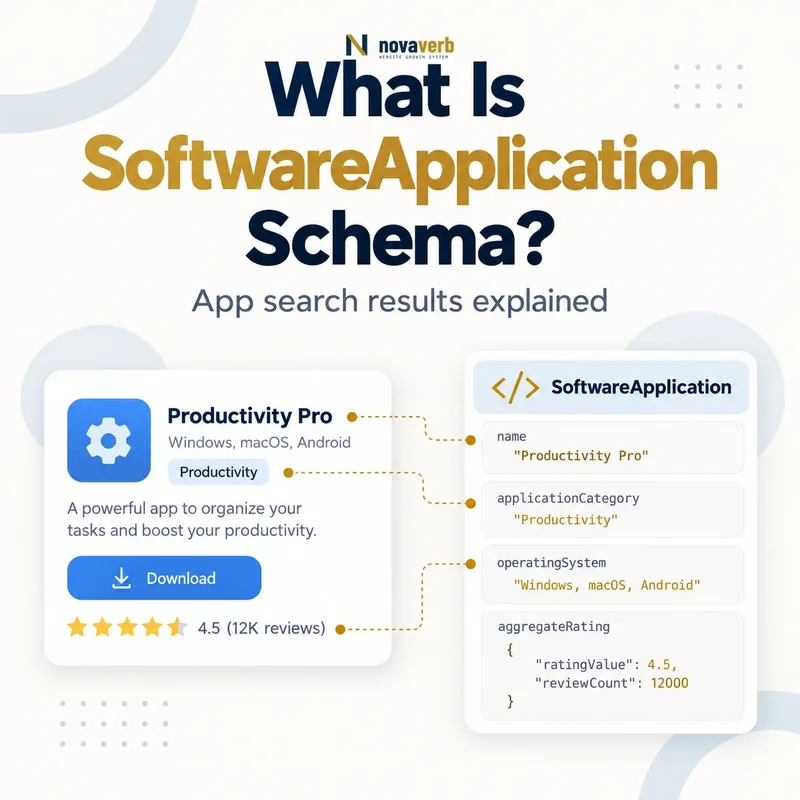
What Is SoftwareApplication Schema?
The type can represent desktop software and serve as a parent for more specific forms such as WebApplication and MobileApplication. It belongs on a page where users can understand, access, download, subscribe to or evaluate the actual application. A software company homepage is not automatically the same entity as every app it publishes.
The graph expresses product facts already supported on the page and in commercial systems. It does not verify the software, manufacture reviews or guarantee a special search appearance. Accurate pricing, platform requirements and application identity matter more than filling every optional property.
- Frame the decision raised by What Is SoftwareApplication Schema.
- Confirm its value type and the object it describes.
- Compare the markup with visible page information.
- Correct the source data or template without inventing values.
- Validate the rendered result and monitor future changes.
| Property | Represents | Evidence source |
|---|---|---|
| name | Public application name | Product page and app UI |
| @id | Stable software identity | Canonical product URL |
| applicationCategory | Functional app category | Actual primary use |
| operatingSystem | Supported platforms | Technical requirements |
| offers | Price and commercial access | Billing catalog |
| softwareVersion | Current represented version | Release system |
| aggregateRating | Eligible rating summary | First-party review records |
| downloadUrl | Official installer route | Controlled download endpoint |
| featureList | Supported capabilities | Current product documentation |
- Model the software product, not just its vendor.
- Use authoritative billing and platform facts.
- Keep optional claims current and visible.
SoftwareApplication schema is a machine-readable product record for real software, grounded in visible and operational facts.
The decision for What Is SoftwareApplication Schema should rest on live, traceable evidence and a verified follow-up check.
How Does SoftwareApplication Schema Work?
A parser reads the rendered graph and compares it with the visible page. The application can reference an Organization as provider or publisher, while an Offer represents a specific commercial path. WebApplication or MobileApplication can refine the product type when the delivery model supports it.
Syntax validation cannot prove that a plan costs the stated amount, that an operating system remains supported or that ratings come from eligible reviews. Reliable output therefore depends on authoritative product, billing and review sources rather than duplicated marketing fields.
- Evidence for How Does SoftwareApplication Schema Work: the live structured-data entity and property relationship
- The expected value type and any nested object
- Visible page information that supports the structured value
- Related offer or catalog fields needed for interpretation
- A fresh validation result after the page changes
| Stage | Graph action | Failure example |
|---|---|---|
| Scope | Choose one application | Suite and module merged ambiguously |
| Classify | Use truthful subtype | Web app called mobile app |
| Identify | Assign stable @id | New ID per pricing page |
| Categorize | Set primary function | Keyword category stacking |
| Price | Connect current Offer | Expired promotional price |
| Platform | State real requirements | Every OS listed without support |
| Validate | Compare graph and page | Markup says free while checkout charges |
- Define the software entity.
- Choose the accurate subtype and category.
- Map product and billing sources.
- Connect stable provider relationships.
- Validate rendered commercial truth.
The graph works when one stable application identity connects the same product, platform and commercial facts users encounter.
The decision for How Does SoftwareApplication Schema Work should rest on live, traceable evidence and a verified follow-up check.
SoftwareApplication vs WebApplication and MobileApplication
A SaaS SEO platform accessed primarily through a browser commonly fits WebApplication. A companion iOS or Android app can be a separate MobileApplication connected to the same product family. Downloadable desktop crawlers may remain SoftwareApplication or use another suitable subtype based on the real delivery model.
Do not treat “SaaS” as a Schema.org type by itself. Express the actual application plus its offers and provider. If a suite includes distinct products with different pricing, platforms or URLs, model them separately rather than collapsing all capabilities into one overloaded node.
- Frame the decision raised by SoftwareApplication vs WebApplication and MobileApplication.
- Confirm its value type and the object it describes.
- Compare the markup with visible page information.
- Correct the source data or template without inventing values.
- Validate the rendered result and monitor future changes.
| Product situation | Likely type | Identity choice |
|---|---|---|
| Browser-based SEO platform | WebApplication | One canonical web app node |
| Native iOS app | MobileApplication | Separate mobile app identity |
| Native Android app | MobileApplication | Separate store or product identity |
| Desktop crawler | SoftwareApplication | Platform-specific software node |
| Cross-platform desktop app | SoftwareApplication | List supported systems truthfully |
| SaaS suite | WebApplication or product nodes | Separate modules when commercial entities differ |
| Browser extension | SoftwareApplication or suitable subtype | Do not call full web app automatically |
| API only | Service or software context | SoftwareApplication only if page represents an app |
- Classify by real delivery environment.
- Separate applications with distinct commercial identities.
- Represent SaaS through actual software and offers.
Use the narrowest accurate application type and keep distinct web, mobile and desktop products separately identifiable.
The decision for SoftwareApplication vs WebApplication and MobileApplication should rest on live, traceable evidence and a verified follow-up check.
Which SoftwareApplication Properties Matter Most?
Current Google Search documentation identifies the application name and offer price as required for its supported software-app appearance, with category and operating system among useful supported details. Feature eligibility and display remain conditional. Schema.org permits more properties, but a larger graph is not automatically better.
Use a stable @id and canonical URL to prevent pricing, comparison and feature pages from creating separate versions of the same app. Connect the vendor through the Organization identity established in Organization schema. Only publish version data when the delivery model exposes a meaningful current version.
- Evidence for Which SoftwareApplication Properties Matter Most: the live structured-data entity and property relationship
- The expected value type and any nested object
- Visible page information that supports the structured value
- Related offer or catalog fields needed for interpretation
- A fresh validation result after the page changes
| Property | Priority | Audit question |
|---|---|---|
| name | Required for supported feature | Does it match the public app name? |
| offers.price | Required for supported feature | Is the represented access price accurate? |
| applicationCategory | Recommended and useful | Does it describe the primary function? |
| operatingSystem | Recommended and useful | Are supported platforms current? |
| @id | Foundational graph practice | Is one app reused across pages? |
| url | High | Does it resolve to the canonical product page? |
| provider | Useful | Does it identify the actual vendor? |
| softwareVersion | Situational | Is version meaningful for this delivery model? |
| aggregateRating | Conditional | Is it based on eligible visible evidence? |
- Establish name, ID and canonical URL.
- Map current pricing from billing.
- Select a truthful application category.
- Publish real platform requirements.
- Add only verifiable optional properties.
Prioritize supported identity, pricing, category and platform facts before expanding the software graph.
The decision for Which SoftwareApplication Properties Matter Most should rest on live, traceable evidence and a verified follow-up check.
How Should SaaS Pricing and Offers Be Marked Up?
A free app can use a zero price when users can genuinely access the represented application at no charge. A free trial is not always a zero-priced permanent offer; explain duration, payment requirements and the price after trial visibly. “Contact sales” cannot be converted into an invented numeric price for markup convenience.
Tiered SaaS pricing may require one clearly representative offer or multiple offers, depending on the page and supported consumer. Avoid mixing monthly and annual effective prices without stating billing period. Source price and currency from the billing catalog so schema cannot drift from checkout.
- Frame the decision raised by How Should SaaS Pricing and Offers Be Marked Up.
- Confirm its value type and the object it describes.
- Compare the markup with visible page information.
- Correct the source data or template without inventing values.
- Validate the rendered result and monitor future changes.
| Pricing model | Markup approach | Quality check |
|---|---|---|
| Permanent free plan | Offer with price 0 | Access is genuinely available |
| Free trial | Describe trial context visibly | Do not imply permanent free access |
| Monthly subscription | Offer with monthly price and currency | Billing period is clear |
| Annual subscription | Annual price or clearly scoped effective rate | No monthly ambiguity |
| Multiple tiers | Supported offer structure or representative choice | All visible conditions align |
| Contact sales | Do not invent a price | Commercial route remains truthful |
| Temporary promotion | Use valid dates when maintained | Expired price removed |
| Regional pricing | Correct currency and market context | User sees matching offer |
- Pull prices from the commercial source.
- Distinguish free plans from trials.
- State billing period and currency clearly.
Software offers must describe a real purchase or access path without disguising trials, billing periods or sales-only pricing.
The decision for How Should SaaS Pricing and Offers Be Marked Up should rest on live, traceable evidence and a verified follow-up check.
How Should Ratings and Reviews Be Used?
Do not copy a rating from an unrelated marketplace, manually choose favorable reviews or invent a count. AggregateRating needs a truthful rating value and review or rating count that stay synchronized as reviews change. The represented reviews must apply to the same software entity and version context where relevant.
Self-controlled testimonials and independent user reviews are not interchangeable evidence. Review eligibility depends on the relationship, page type and current feature rules. When evidence is incomplete, omit rating markup rather than turning marketing claims into numeric authority.
- Evidence for How Should Ratings and Reviews Be Used: the live structured-data entity and property relationship
- The expected value type and any nested object
- Visible page information that supports the structured value
- Related offer or catalog fields needed for interpretation
- A fresh validation result after the page changes
| Rating situation | Use in markup? | Reason |
|---|---|---|
| Verified first-party product reviews | Potentially, when eligible and visible | Evidence can be reproduced |
| Marketplace rating copied manually | No by default | External source and freshness conflict |
| Selected testimonials | Not an aggregate rating | Not a complete rating population |
| Editor-assigned score | Review markup only when appropriate | Different evidence model |
| Zero reviews | No invented AggregateRating | No observed rating evidence |
| Mixed ratings across products | Separate by entity | Counts cannot be merged blindly |
| Old version ratings | Review relevance and policy needed | Version context may differ |
| Hidden review database | Not sufficient alone | Users need corresponding evidence |
- Identify the review source and ownership.
- Confirm reviews apply to this software.
- Reproduce score and count.
- Expose supporting content appropriately.
- Monitor changes and eligibility.
Rating markup is defensible only when the score, count, entity and visible reviews all trace to genuine evidence.
The decision for How Should Ratings and Reviews Be Used should rest on live, traceable evidence and a verified follow-up check.
How Does SoftwareApplication Schema Support SEO?
Accurate structured data can reduce ambiguity between the vendor, product, plans and platform variants. Offers may help a consumer interpret price, while category and operating system describe fit. These benefits depend on a canonical product page with useful visible information and an accessible conversion path.
Markup cannot replace product-market relevance, editorial evidence, trustworthy reviews, links or competitive positioning. Connect technical findings with Product schema principles when comparing commerce models and rich results guidance when setting expectations.
- Frame the decision raised by How Does SoftwareApplication Schema Support SEO.
- Confirm its value type and the object it describes.
- Compare the markup with visible page information.
- Correct the source data or template without inventing values.
- Validate the rendered result and monitor future changes.
| SEO objective | Possible contribution | Separate requirement |
|---|---|---|
| App disambiguation | Stable software identity | Consistent public product evidence |
| Category clarity | Accurate applicationCategory | Focused product positioning |
| Platform fit | Current operatingSystem | Technical compatibility |
| Price understanding | Truthful Offer | Working checkout or access path |
| Enhanced appearance | Eligible software details | Search display decision |
| Rankings | No guarantee | Relevance, quality and authority |
| CTR | May change when appearance changes | Measure observed query-level data |
| Conversions | Clearer commercial context | Strong page and onboarding journey |
- Use markup to clarify product facts.
- Keep eligibility separate from guaranteed display.
- Measure search and conversion outcomes honestly.
Software schema supports SEO through accurate product clarity and conditional eligibility, not through automatic ranking or CTR gains.
The decision for How Does SoftwareApplication Schema Support SEO should rest on live, traceable evidence and a verified follow-up check.
What SoftwareApplication Schema Mistakes Are Common?
Global templates can accidentally label every feature, pricing or help page as a separate SoftwareApplication. Plugins may add Product markup while custom code adds a second software node, each with a different price or rating. Use one coherent graph and decide whether pages reference the same app or distinct products.
SaaS teams also misrepresent trials, “starting at” prices and enterprise plans. A valid numeric field can still be commercially false. Audit rendered markup against billing, product and review systems rather than relying on schema testing alone.
- Evidence for What SoftwareApplication Schema Mistakes Are Common: the live structured-data entity and property relationship
- The expected value type and any nested object
- Visible page information that supports the structured value
- Related offer or catalog fields needed for interpretation
- A fresh validation result after the page changes
| Mistake | Risk | Correction |
|---|---|---|
| Trial marked as permanently free | Misleading offer | Represent conditions visibly |
| Expired price | Checkout mismatch | Sync billing source |
| Invented aggregate rating | False evidence | Remove or use genuine records |
| Every page creates new app ID | Fragmented identity | Reuse stable @id |
| Web app marked as mobile app | Wrong platform context | Choose truthful subtype |
| Unsupported OS listed | Compatibility failure | Use current requirements |
| Product and software nodes conflict | Ambiguous graph | Connect or consolidate correctly |
| Generic category stacking | Misleading classification | Use primary real function |
- Compare identity across templates.
- Reconcile offers with billing.
- Verify platforms and categories.
- Trace every rating to evidence.
- Consolidate duplicate graph output.
The largest software-schema risks are commercial and identity conflicts, not missing optional technical fields.
Start with a relevant free SEO check, continue the evidence workflow in Site Health Audit, and review pricing when comparing continuous monitoring with a one-time manual review.
The decision for What SoftwareApplication Schema Mistakes Are Common should rest on live, traceable evidence and a verified follow-up check.