
What Should An All-In-One SEO Platform Do for a Buyer?
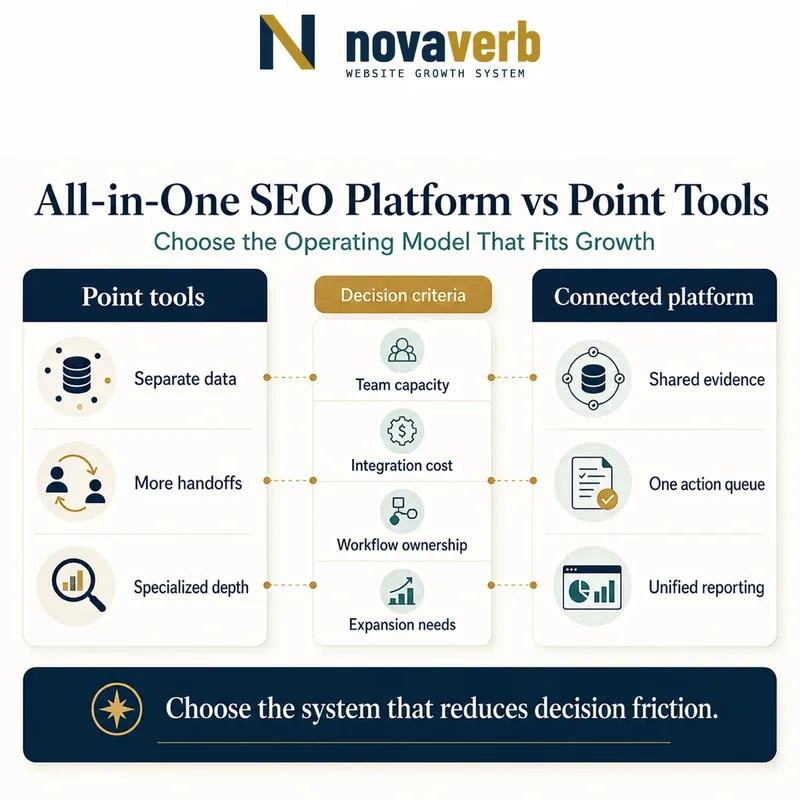
An all-in-one SEO platform is usually the better operating model when shared evidence and ownership matter more than maximum depth in one isolated task; point tools fit teams that can integrate specialist outputs themselves.
- The buying decision is not only feature breadth; it is whether the team can reliably connect evidence, definitions, ownership and reporting across the stack.
- Start with the recurring decision, not the longest feature list.
- Require every important output to retain its source and scope.
- Write down the business decision.
- Name the evidence required.
- Map the owner and next action.
| Buyer question | Required capability | Decision test |
|---|---|---|
| What changed? | Comparable evidence over time | Can the team reproduce the observation? |
| What matters now? | Prioritization with scope | Can the team see affected pages or keywords? |
| What should happen next? | Action and ownership | Can one person take a defined next step? |
| Did it work? | Fresh verification | Can the same condition be checked again? |
Choose software that shortens the path from evidence to an owned and verifiable decision.
Which Business Problems Should An All-In-One SEO Platform Solve?
An all-in-one seo platform should solve a defined operating problem rather than merely add another dashboard.
- Use the same captured page evidence across findings.
- Connect keywords, links and competitors to projects.
- Move findings into owned work and rechecks.
- Preserve definitions across stakeholder views.
- List the recurring work that currently needs manual assembly.
- Estimate who touches the work and where handoffs occur.
- Prioritize the problems that delay action or weaken reporting.
| Capability | Business use | Buying question |
|---|---|---|
| Connected crawl and audit | Use the same captured page evidence across findings. | Will this reduce friction in the connected crawl and audit workflow? |
| Shared research context | Connect keywords, links and competitors to projects. | Will this reduce friction in the shared research context workflow? |
| One action model | Move findings into owned work and rechecks. | Will this reduce friction in the one action model workflow? |
| Unified reporting | Preserve definitions across stakeholder views. | Will this reduce friction in the unified reporting workflow? |
A strong buying case connects each feature to a recurring business decision and a clear owner.
Which An All-In-One SEO Platform Features Matter Most?
The most valuable features are the ones that preserve evidence, expose scope, guide action and support a later recheck.
- Connected crawl and audit: Use the same captured page evidence across findings.
- Shared research context: Connect keywords, links and competitors to projects.
- One action model: Move findings into owned work and rechecks.
- Unified reporting: Preserve definitions across stakeholder views.
- Separate must-have workflows from occasional analysis.
- Test each feature with a real project.
- Reject outputs that cannot be traced to evidence.
| Feature | Minimum acceptable behavior | Operational value |
|---|---|---|
| Connected crawl and audit | Use the same captured page evidence across findings. | Turns analysis into a repeatable team workflow |
| Shared research context | Connect keywords, links and competitors to projects. | Turns analysis into a repeatable team workflow |
| One action model | Move findings into owned work and rechecks. | Turns analysis into a repeatable team workflow |
| Unified reporting | Preserve definitions across stakeholder views. | Turns analysis into a repeatable team workflow |
Prioritize features by how reliably they move real work forward, not by how many menu items appear in the product.
How Should Buyers Evaluate Data and Evidence?
Buyers should verify that every important field comes from the source authorized to answer that question and remains labelled by scope and observation time.
- Point-tool output should come from Each specialist provider.
- Connected page state should come from Shared project crawl.
- Search performance should come from Connected Search Console.
- Market observations should come from Configured external providers.
- Choose one real project and connect only sources you control.
- Open a metric and confirm its source, scope and date.
- Check that unavailable evidence stays unavailable instead of becoming a synthetic value.
| Question | Authoritative source | What it may support |
|---|---|---|
| Point-tool output | Each specialist provider | Depth inside that provider's measured scope |
| Connected page state | Shared project crawl | One current source for on-site facts |
| Search performance | Connected Search Console | Property data retained with its own limits |
| Market observations | Configured external providers | Fields remain labelled by source |
Evidence quality is a product feature because every later priority, action and report depends on it.
What Workflow Should An All-In-One SEO Platform Support?
A practical platform should support the complete path from scoped evidence to action and fresh verification.
- Map decisions: List the recurring decisions the team must make.
- Map evidence: Identify the authoritative source required by each decision.
- Map handoffs: Count exports, joins, reviews and ownership changes.
- Choose: Select the operating model with acceptable depth and friction.
- Run the workflow with one representative project.
- Record every export, handoff and manual join.
- Confirm that the final verification connects back to the original finding.
| Stage | Required behavior | Failure signal |
|---|---|---|
| Map decisions | List the recurring decisions the team must make. | The team must leave the workflow to reconstruct context |
| Map evidence | Identify the authoritative source required by each decision. | The team must leave the workflow to reconstruct context |
| Map handoffs | Count exports, joins, reviews and ownership changes. | The team must leave the workflow to reconstruct context |
| Choose | Select the operating model with acceptable depth and friction. | The team must leave the workflow to reconstruct context |
The best workflow is the one your team can repeat without losing source, scope or ownership between stages.
How Can An All-In-One SEO Platform Create Business Value?
Business value comes from reducing decision friction, protecting trustworthy evidence and increasing the share of findings that become verified work.
- Platform continuity: Shared project and page identifiers
- Point-tool depth: Specialized datasets and controls
- Platform governance: One permission and reporting model
- Point-tool flexibility: Independent vendor choices
- Measure the current manual workflow before purchase.
- Define the operating change expected from the platform.
- Review adoption and verified outcomes after implementation.
| Value lever | Product behavior | Business interpretation |
|---|---|---|
| Platform continuity | Shared project and page identifiers | Less reconciliation across workflows |
| Point-tool depth | Specialized datasets and controls | More depth for a narrow expert task |
| Platform governance | One permission and reporting model | Simpler team operations |
| Point-tool flexibility | Independent vendor choices | Swap one capability without replacing the stack |
Model value from observable workflow changes rather than promising rankings, revenue or savings the software cannot guarantee.
Who Is An All-In-One SEO Platform Best For?
The best fit depends on team capacity, project complexity, required evidence and how much integration work the buyer can own.
- Lean team: Connected platform
- Large specialist team: Point tools or hybrid
- Agency: Connected platform with export depth
- Enterprise: Hybrid with clear source governance
- Identify the primary operator and decision owner.
- Choose a representative project and workflow.
- Confirm that plan limits match real usage before purchase.
| Buyer profile | Priority capability | Fit rationale |
|---|---|---|
| Lean team | Connected platform | Reduce manual integration and handoffs |
| Large specialist team | Point tools or hybrid | Preserve deep expert controls |
| Agency | Connected platform with export depth | Standardize delivery while retaining evidence |
| Enterprise | Hybrid with clear source governance | Balance controls, procurement and specialist needs |
Fit is strongest when the product matches both the analytical need and the team that must operate it.
How Should Buyers Compare Price and Choose the Next Step?
Compare total operating cost, included evidence, usage limits and the work required to turn output into action before choosing a plan.
- Licenses: Platform plan versus combined subscriptions
- Integration: APIs, exports and spreadsheet joins
- Training: Interfaces and definitions
- Governance: Permissions, retention and auditability
- Run the relevant free check or product workflow.
- Compare plan limits against actual projects, users and cadence.
- Choose the smallest plan that supports the complete required workflow.
| Cost area | What to inspect | How to compare |
|---|---|---|
| Licenses | Platform plan versus combined subscriptions | Compare the complete required stack |
| Integration | APIs, exports and spreadsheet joins | Price recurring connection work |
| Training | Interfaces and definitions | Include onboarding and role changes |
| Governance | Permissions, retention and auditability | Include operational risk |
Make the buying decision from a real workflow, its evidence requirements and its full operating cost.