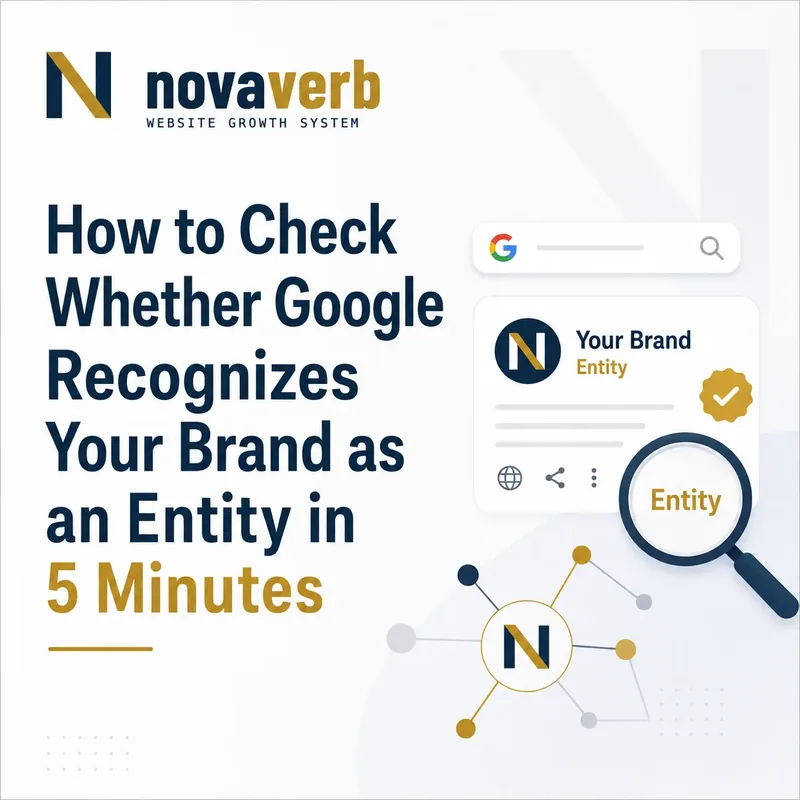
The 5-Minute Takeaway: Entity Recognition Is Not the Same as Ranking
Brand entity recognition means Google can distinguish your brand as a specific real-world subject rather than treating its name as an ambiguous string of words. Recognition may improve identity clarity, but it does not guarantee rankings, a Knowledge Panel, rich results, or citations.
Enter the brand or entity name in the free Knowledge Graph Checker . Do not submit the website URL as the entity name.
What Does It Mean for Google to Recognize a Brand as an Entity?
Google recognizes a brand as an entity when it can associate the brand with a distinct identity, type, description, properties, and relationships. This allows the brand to be distinguished from similarly named companies, products, people, places, or generic terms.
“A knowledge graph represents a network of real-world entities.”
Source: Wikipedia, “Knowledge graph” .
Entity recognition is therefore broader than exact keyword matching. The system must determine which specific subject the name refers to.
What Can a Five-Minute Entity Check Actually Prove?
A five-minute entity check can confirm whether a confident public entity match is returned for the tested name and reveal identity signals that require deeper review. It cannot expose Google’s complete internal understanding of the brand.
It can prove
- The exact entity name submitted.
- Whether a matching public result was returned.
- The type and description attached to the returned match.
- Whether the result appears to represent the intended brand.
It can suggest
- The brand name may be ambiguous.
- Organization information may be inconsistent.
- External profiles may not corroborate the same identity.
- People and products may be weakly connected to the brand.
It cannot prove
- That a Knowledge Panel must appear.
- That the brand will rank for a query.
- That all mentions have been consolidated.
- That Google accepts every declared schema property.
An empty result means no confident match was returned during that lookup. It should be treated as a starting point for identity cleanup, not as a permanent verdict.
Minute 0–1: Confirm the Brand’s Official Identity
The first minute should establish one canonical identity statement that the website can repeat consistently. Without this baseline, the brand may be described differently across the homepage, About page, legal pages, products, social profiles, and structured data.
Confirm that the official homepage resolves correctly with the Website SEO Checker before treating it as the canonical identity source.
Minute 1–2: Check the Organization Page and About Information
The About page should act as the website’s human-readable entity record. It should identify the organization clearly enough that a customer, journalist, partner, or automated system can distinguish it without relying on promotional slogans.
Minute 2–3: Verify People, Products, and Brand Relationships
Entity relationships explain how the organization connects to the people, products, services, and content published under its name. These connections should be visible in page copy, internal links, author information, and structured data.
When these relationships support AI-search positioning, run the GEO Checker on the relevant organization, product, or definition page.
Minute 3–4: Inspect Organization Schema and sameAs References
Organization structured data should declare the same organization users see on the page. The markup should clarify identity and relationships, not create details that are absent from visible content or unsupported by the business.
| Property | What to check | Common risk |
|---|---|---|
| name | Matches the official public brand name. | Legal, abbreviated, and marketing names conflict. |
| url | Uses the canonical homepage. | Points to a redirected or alternate hostname. |
| logo | Uses an official, crawlable logo asset. | Old logo, inaccessible file, or inconsistent branding. |
| description | Matches the visible identity statement. | Keyword-stuffed or unsupported description. |
| sameAs | Links to profiles representing the exact same entity. | Links to unrelated directories, partners, or generic category pages. |
| @id | Uses one stable identifier across related schema nodes. | Multiple competing IDs for the same organization. |
Review the official Google Organization structured-data documentation before deployment.
Minute 4–5: Run the Knowledge Graph Checker
Submit the brand or entity name exactly as it is publicly used, then verify that any returned result represents the intended subject. Do not submit a URL, a keyword list, or a promotional phrase.
- Enter the exact brand, organization, person, or product name.
- Review the returned entity type and description.
- Confirm that the result refers to your intended entity.
- Check whether a similarly named entity may have produced a false match.
- Save the result and record the date of the lookup.
- Select one identity gap for correction.
Run the Novaverb Knowledge Graph Checker and keep the result as evidence for the next audit.
Brand Mention Is Not the Same as Entity Recognition
A brand name appearing on a webpage or search result does not by itself prove that Google has consolidated it into a distinct entity. A mention can be ambiguous, unrelated, duplicated, or attached to another subject with the same name.
Do not present brand mentions, indexed profiles, schema validation, and Knowledge Graph recognition as interchangeable metrics.
How to Create a Consistent Brand Entity Statement
A brand entity statement is a short factual description that identifies the organization and distinguishes it from similarly named subjects. It should remain consistent across the homepage, About page, media kit, organization schema, and official profiles.
Avoid unsupported leadership claims, excessive keywords, changing entity types, and descriptions so broad that they could apply to hundreds of companies.
How to Audit the About Page for Entity Clarity
An entity-focused About page should answer who the organization is, what it does, who is responsible, and how its claims can be verified. It should not be a collection of abstract mission statements with no identifying facts.
How to Connect Founders, Executives, Authors, and Reviewers
People should be connected to the organization through explicit, current, and verifiable roles. A name appearing in a byline or team grid is weaker than a profile that explains the person’s responsibility and relationship to the company.
| Person role | Required clarification | Supporting page |
|---|---|---|
| Founder | Founded which organization and when? | About page and person profile |
| Executive | What is the current official role? | Leadership or organization page |
| Author | What expertise supports the content? | Author archive and profile |
| Reviewer | What was reviewed and under which standard? | Reviewer profile and article disclosure |
How to Connect Products and Services to the Organization
Every major product or service page should state which organization creates, owns, provides, or supports the offer. This relationship should remain consistent across visible content, breadcrumbs, legal pages, support documents, and structured data.
Review the connected Novaverb product system as an example of separating organizational identity from individual product roles.
Does Organization Schema Create a Knowledge Panel?
No. Organization structured data can communicate business details and entity relationships, but it does not create or guarantee a Knowledge Panel.
- Official name and URL
- Logo and description
- Address and contact details
- Relevant external profiles
- Stable entity identifiers
- A Knowledge Graph match
- A Knowledge Panel display
- A ranking position
- A rich result
- An AI citation
Google states that Knowledge Panels are generated automatically from information on the web and may be claimed by eligible representatives after a panel exists. Review Google’s Knowledge Panel guidance .
How to Audit sameAs Links Without Creating False Signals
A sameAs URL should identify another page about the exact same entity. It should not be used merely because a page mentions the brand, belongs to a partner, or appears authoritative.
Common Reasons Google May Confuse or Ignore a Brand Entity
Entity ambiguity usually results from inconsistent identity signals, insufficient corroboration, or confusion with another subject. An empty entity lookup does not identify the precise cause, so each potential issue must be verified separately.
Entity Recognition vs Knowledge Panel Eligibility
Entity recognition and Knowledge Panel display are separate outcomes. A brand can have a public entity match without receiving a panel for every query, device, location, or user.
| Dimension | Entity recognition | Knowledge Panel |
|---|---|---|
| Meaning | A distinct matching entity is identifiable. | A search feature displays summarized entity information. |
| Evidence | Entity match, type, description, and corroborating identity signals. | An observed panel for a specific query and search context. |
| Control | Brands can improve identity clarity and factual consistency. | Google decides whether and when the feature appears. |
| Guarantee | A match does not guarantee rankings or a panel. | A panel does not guarantee high organic traffic. |
Five-Minute Brand Entity Recognition Checklist
Use this checklist to verify the brand’s identity baseline before adding more schema, profiles, or entity pages.
Start with the free Knowledge Graph Checker .
Frequently Asked Questions About Brand Entity Recognition
Entity checks should be interpreted as identity evidence, not as ranking guarantees.
What is a brand entity?
A brand entity is a distinct organization, product, or other subject with identifiable attributes and relationships.
How do I know whether Google recognizes my brand?
Run a public entity lookup using the exact brand name and verify that the returned type and description represent your organization.
Should I enter my URL in the Knowledge Graph Checker?
No. Enter the brand, organization, person, or product name. The checker is designed for entity names rather than URLs.
What does an empty result mean?
It means no confident match was returned for that lookup. It does not mean the brand cannot rank or can never be recognized.
Does entity recognition improve rankings?
Recognition can reduce identity ambiguity, but it does not guarantee a ranking improvement for any query.
Does a Knowledge Graph match guarantee a Knowledge Panel?
No. A match and a displayed Knowledge Panel are separate outcomes.
Can Organization schema create an entity?
Schema can declare organization details and relationships, but recognition depends on broader web evidence and Google’s processing.
What should sameAs link to?
It should link to pages that represent the exact same entity, such as legitimate official or identifying profiles.
Do social profiles prove entity recognition?
No. Profiles can corroborate identity, but their existence alone does not prove a Knowledge Graph match.
Should every employee have an entity page?
No. Create person pages only where the role, expertise, and relationship provide genuine value.
How often should the brand be rechecked?
Recheck after meaningful identity changes or on a documented cadence, keeping the submitted name consistent.
Which tool should I use first?
Use the Knowledge Graph Checker, then audit the website and external identity evidence behind the result.
Run the Check, Fix One Identity Gap, and Recheck
Finish the entity audit by correcting one verified identity gap - not by adding more unsupported profiles or schema properties. Keep the entity name, description, relationships, and external references factual and consistent.
Use Novaverb to connect technical evidence, entity clarity, content decisions, and AI-search visibility in one workflow.