
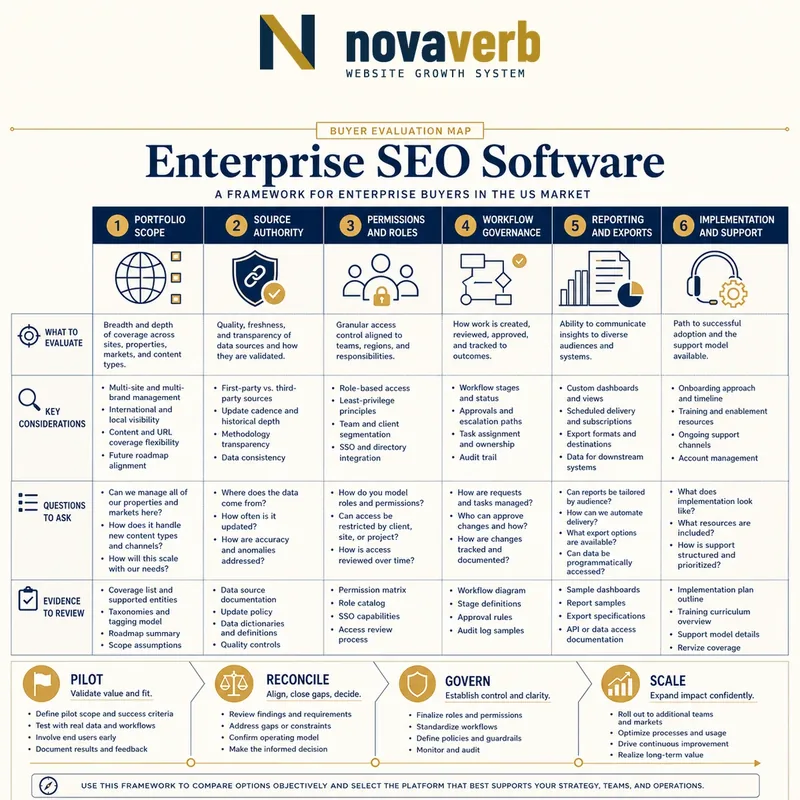
What Should Enterprise SEO Software Do for a Buyer?
Enterprise SEO software should support the buyer's portfolio scope, preserve source authority, enforce appropriate project access and connect governed work to evidence, reporting and rechecks.
- A platform can look powerful in one sample project yet fail when many properties, markets, roles, approval paths and evidence sources must remain understandable and separated.
- Start with the recurring decision, not the longest feature list.
- Require every important output to retain its source and scope.
- Write down the business decision.
- Name the evidence required.
- Map the owner and next action.
| Buyer question | Required capability | Decision test |
|---|---|---|
| What changed? | Comparable evidence over time | Can the team reproduce the observation? |
| What matters now? | Prioritization with scope | Can the team see affected pages or keywords? |
| What should happen next? | Action and ownership | Can one person take a defined next step? |
| Did it work? | Fresh verification | Can the same condition be checked again? |
Choose software that shortens the path from evidence to an owned and verifiable decision.
Which Business Problems Should Enterprise SEO Software Solve?
Enterprise SEO software should solve a defined operating problem rather than merely add another dashboard.
- Model properties, markets and page portfolios without mixing context.
- Keep observations attached to the system that produced them.
- Apply project and role permissions appropriate to the organization.
- Record ownership, review, approval and verification history.
- List the recurring work that currently needs manual assembly.
- Estimate who touches the work and where handoffs occur.
- Prioritize the problems that delay action or weaken reporting.
| Capability | Business use | Buying question |
|---|---|---|
| Portfolio scope | Model properties, markets and page portfolios without mixing context. | Will this reduce friction in the portfolio scope workflow? |
| Source authority | Keep observations attached to the system that produced them. | Will this reduce friction in the source authority workflow? |
| Access boundaries | Apply project and role permissions appropriate to the organization. | Will this reduce friction in the access boundaries workflow? |
| Workflow governance | Record ownership, review, approval and verification history. | Will this reduce friction in the workflow governance workflow? |
A strong buying case connects each feature to a recurring business decision and a clear owner.
Which Enterprise SEO Software Features Matter Most?
The most valuable features are the ones that preserve evidence, expose scope, guide action and support a later recheck.
- Portfolio scope: Model properties, markets and page portfolios without mixing context.
- Source authority: Keep observations attached to the system that produced them.
- Access boundaries: Apply project and role permissions appropriate to the organization.
- Workflow governance: Record ownership, review, approval and verification history.
- Separate must-have workflows from occasional analysis.
- Test each feature with a real project.
- Reject outputs that cannot be traced to evidence.
| Feature | Minimum acceptable behavior | Operational value |
|---|---|---|
| Portfolio scope | Model properties, markets and page portfolios without mixing context. | Turns analysis into a repeatable team workflow |
| Source authority | Keep observations attached to the system that produced them. | Turns analysis into a repeatable team workflow |
| Access boundaries | Apply project and role permissions appropriate to the organization. | Turns analysis into a repeatable team workflow |
| Workflow governance | Record ownership, review, approval and verification history. | Turns analysis into a repeatable team workflow |
Prioritize features by how reliably they move real work forward, not by how many menu items appear in the product.
How Should Buyers Evaluate Data and Evidence?
Buyers should verify that every important field comes from the source authorized to answer that question and remains labelled by scope and observation time.
- Site implementation should come from Project-scoped first-party crawls.
- Google performance should come from Each property's authorized Search Console.
- External market should come from Configured provider accounts.
- Business context should come from Buyer-owned portfolio inputs.
- Choose one real project and connect only sources you control.
- Open a metric and confirm its source, scope and date.
- Check that unavailable evidence stays unavailable instead of becoming a synthetic value.
| Question | Authoritative source | What it may support |
|---|---|---|
| Site implementation | Project-scoped first-party crawls | Current page and link evidence for each property |
| Google performance | Each property's authorized Search Console | Google-owned performance kept within verified boundaries |
| External market | Configured provider accounts | Provider-scoped rankings or links by required market |
| Business context | Buyer-owned portfolio inputs | Markets, page roles, priorities, teams and governance requirements |
Evidence quality is a product feature because every later priority, action and report depends on it.
What Workflow Should Enterprise SEO Software Support?
A practical platform should support the complete path from scoped evidence to action and fresh verification.
- Pilot: Choose representative sites, sources, roles and decisions.
- Reconcile: Compare sample records with each authoritative source.
- Govern: Define access, ownership, approvals and exceptions.
- Scale: Expand only after evidence and operating fit are verified.
- Run the workflow with one representative project.
- Record every export, handoff and manual join.
- Confirm that the final verification connects back to the original finding.
| Stage | Required behavior | Failure signal |
|---|---|---|
| Pilot | Choose representative sites, sources, roles and decisions. | The team must leave the workflow to reconstruct context |
| Reconcile | Compare sample records with each authoritative source. | The team must leave the workflow to reconstruct context |
| Govern | Define access, ownership, approvals and exceptions. | The team must leave the workflow to reconstruct context |
| Scale | Expand only after evidence and operating fit are verified. | The team must leave the workflow to reconstruct context |
The best workflow is the one your team can repeat without losing source, scope or ownership between stages.
How Can Enterprise SEO Software Create Business Value?
Business value comes from reducing decision friction, protecting trustworthy evidence and increasing the share of findings that become verified work.
- Portfolio visibility: Sites share a comparison model without losing scope
- Safer delegation: Roles and projects remain bounded
- Consistent operations: One evidence-to-action method is documented
- Defensible reporting: Sources and gaps stay visible
- Measure the current manual workflow before purchase.
- Define the operating change expected from the platform.
- Review adoption and verified outcomes after implementation.
| Value lever | Product behavior | Business interpretation |
|---|---|---|
| Portfolio visibility | Sites share a comparison model without losing scope | Leaders can review work across properties |
| Safer delegation | Roles and projects remain bounded | Teams access the context required for their work |
| Consistent operations | One evidence-to-action method is documented | Local execution can follow shared governance |
| Defensible reporting | Sources and gaps stay visible | Stakeholders can challenge conclusions without reconstructing data |
Model value from observable workflow changes rather than promising rankings, revenue or savings the software cannot guarantee.
Who Is Enterprise SEO Software Best For?
The best fit depends on team capacity, project complexity, required evidence and how much integration work the buyer can own.
- International brand: Markets, properties and local exceptions
- Marketplace: Large page portfolios and recurring crawl evidence
- Enterprise SaaS: Marketing sites, docs and product teams
- Regulated organization: Access, evidence and review history
- Identify the primary operator and decision owner.
- Choose a representative project and workflow.
- Confirm that plan limits match real usage before purchase.
| Buyer profile | Priority capability | Fit rationale |
|---|---|---|
| International brand | Markets, properties and local exceptions | Coordinate shared standards with local execution |
| Marketplace | Large page portfolios and recurring crawl evidence | Prioritize repeatable conditions |
| Enterprise SaaS | Marketing sites, docs and product teams | Connect distributed owners to one workflow |
| Regulated organization | Access, evidence and review history | Support internal governance requirements |
Fit is strongest when the product matches both the analytical need and the team that must operate it.
How Should Buyers Compare Price and Choose the Next Step?
Compare total operating cost, included evidence, usage limits and the work required to turn output into action before choosing a plan.
- Portfolio: Properties, projects and environments
- Evidence: Crawls, provider units and history
- People: Operators, reviewers and implementers
- Adoption: Migration, configuration, training and governance
- Run the relevant free check or product workflow.
- Compare plan limits against actual projects, users and cadence.
- Choose the smallest plan that supports the complete required workflow.
| Cost area | What to inspect | How to compare |
|---|---|---|
| Portfolio | Properties, projects and environments | Model the complete estate, including staging only when needed |
| Evidence | Crawls, provider units and history | Match refreshes to decision cadence |
| People | Operators, reviewers and implementers | Include occasional stakeholders |
| Adoption | Migration, configuration, training and governance | Compare implementation effort alongside license cost |
Make the buying decision from a real workflow, its evidence requirements and its full operating cost.