
The 5-Minute Takeaway
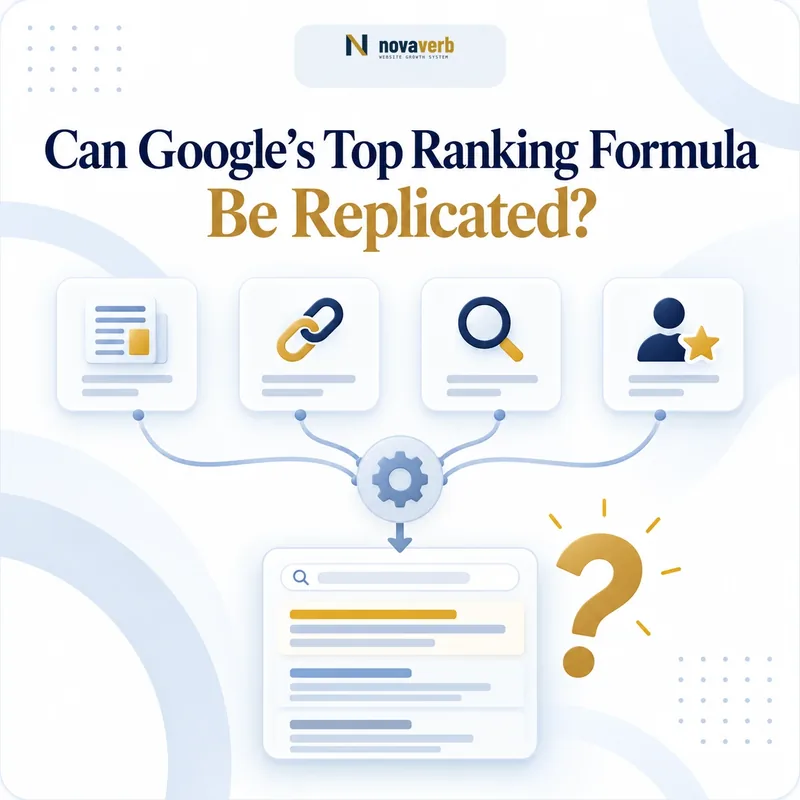
Can Google’s Top-Ranking Formula Be Replicated?
No one outside Google can replicate its exact top-ranking formula. Google Search uses multiple ranking systems and signals whose influence can change according to the query, search intent, freshness requirements, language, location, page type, available evidence, and competing results. What an SEO team can reproduce is a disciplined process for creating pages that are accessible, relevant, useful, trustworthy, and better aligned with a specific search task.
Ranking is not a fixed checklist in which every completed task adds a predictable number of points. A technically valid page may still perform poorly when it answers the wrong question, mixes several intents, lacks original information, provides weak evidence, or offers less value than the pages already available to the searcher.
The realistic objective is not to copy a secret algorithm. It is to identify controllable ranking conditions, convert observations into testable hypotheses, improve one URL deliberately, and measure whether the change produces more qualified search visibility and a better user outcome.
What SEO Teams Can Reproduce
- Technical accessibility: Googlebot can request the page, load essential resources, discover standard HTML links, and identify the intended canonical URL.
- Intent alignment: The URL serves one primary search task instead of combining unrelated informational, comparison, and transactional purposes.
- Original information value: The page adds first-hand experience, proprietary observations, practical examples, clearer explanations, or evidence competitors do not provide.
- Explicit content structure: Descriptive headings, concise paragraphs, lists, tables, entities, and clear section boundaries make the information easier to interpret.
- Proof near each important claim: Data, methodology, examples, screenshots, limitations, and source context appear close to the statements they support.
- Measurement and iteration: Changes are assessed through relevant queries, qualified clicks, engagement, lead events, conversions, and business outcomes.
What Cannot Be Replicated Exactly
- Google’s proprietary weighting: There is no public scoring table that reveals the precise value of every ranking signal for every query.
- Query-specific interactions: A local-service query, breaking-news query, product comparison, and technical tutorial may be evaluated through different combinations of systems and signals.
- Competitor movement: Rankings may change even when your page does not because other pages, links, sources, demand patterns, and result formats continue to evolve.
- Future system updates: Core ranking, spam detection, freshness, review quality, and other systems can alter how previously successful tactics are evaluated.
- Guaranteed AI citation: Clear answer blocks may improve interpretation, but no heading pattern, schema type, word count, or HTML template guarantees inclusion in an AI-generated answer.
The Replicable Part Is the SEO Experiment
A useful SEO process begins with a defined search problem and ends with measurable evidence - not with copying the visible features of a competing page.
- Define the search problem. Identify the query class, primary intent, main entity, expected user outcome, and one measurable next action for the URL.
- Capture the baseline. Record indexing status, relevant queries, impressions, clicks, conversions, internal links, content gaps, existing proof, and dominant result formats.
- Form one explicit hypothesis. State why a focused improvement - such as stronger proof, clearer intent alignment, better crawl access, or a more useful comparison - should improve performance.
- Verify and measure the change. Check the rendered page, wait for recrawling, compare equivalent query groups, and retain only changes that improve meaningful visibility or business outcomes.
Avoid false replication: copying a competitor’s word count, heading count, keyword frequency, backlink volume, or page layout reproduces visible characteristics - not the site history, source reputation, user satisfaction, topical relationships, or competitive context behind the ranking.
Key takeaway: Google’s exact ranking formula cannot be copied, but a rigorous ranking-improvement process can. Define the intent, make the page technically accessible, add original value, support important claims, connect the URL to a coherent topic and decision path, and measure whether the new version performs better than the previous one.
Decision Framework
Why Understanding This Matters
Understanding the difference between Google’s hidden ranking systems and the conditions an SEO team can control prevents false conclusions, wasted resources, and risky optimization decisions. Instead of copying the visible features of a top-ranking result, teams can investigate why the page satisfies the query, what evidence it provides, how easily search systems can access it, and whether it helps the user complete the intended task.
A top-ranking page may contain thousands of words, numerous headings, multiple media formats, structured data, and many referring domains. Those characteristics describe the page, but they do not reveal which elements contributed to its visibility or whether reproducing them will work for another domain, audience, query, or competitive environment.
The practical shift: stop asking, “What exact formula did this competitor use?” and start asking, “What user problem does this result solve, what uncertainty does it remove, what proof supports its claims, and what can our page improve?”
The Formula-Chasing Model
- Copies the word count of the highest-ranking result.
- Treats keyword frequency as a direct ranking score.
- Adds headings, FAQs, tables, videos, or schema because competitors use them.
- Assumes matching a competitor’s backlink count will produce the same position.
- Creates new URLs for every keyword variation without checking intent overlap.
- Measures success through one ranking position instead of qualified outcomes.
The Ranking-Conditions Model
- Defines the searcher’s primary question and expected outcome.
- Confirms that the correct URL is crawlable, indexable, renderable, and canonical.
- Identifies missing information, weak proof, and unresolved user objections.
- Uses page elements only when they improve understanding or task completion.
- Connects each URL to a coherent topic, entity, and decision path.
- Tests a stated hypothesis against search, engagement, and conversion evidence.
Four SEO Decisions This Understanding Improves
Example: Why Copying a Top Result Can Fail
Assume a leading competitor has 2,800 words, fifteen H2 headings, six images, a comparison table, and ninety referring domains. Reproducing those visible characteristics does not reproduce the conditions behind its performance.
| SEO decision | Evidence-based answer | Weak answer |
|---|---|---|
| Why should this URL exist? | It serves one distinct intent and one defined user outcome. | A competitor has a similar page. |
| Why add this section? | It resolves a documented question, objection, or evidence gap. | The top result has the same heading. |
| Why add this table or media element? | It makes a comparison, process, or decision easier to understand. | Other ranking pages include one. |
| Why add this internal link? | It defines, proves, compares, or advances the user’s next decision. | The page needs more internal links. |
| Why call the change successful? | Relevant visibility, qualified traffic, or business outcomes improved. | One keyword moved temporarily. |
Important: correlation is not causation. A feature shared by several ranking pages may be useful, incidental, industry-specific, or simply common among well-produced pages. Treat it as a hypothesis to investigate, not a universal ranking instruction.
Key takeaway: accepting that Google’s exact formula cannot be copied does not make SEO less systematic. It makes SEO more rigorous. The repeatable advantage comes from controlling technical access, matching intent, adding original value, supporting important claims, building coherent information paths, and measuring whether the page produces a better outcome.
Myth Correction
Correcting the Myth of Replication
The replication myth is the belief that copying the visible characteristics of top-ranking pages will reproduce their rankings. This is incorrect because a search result reflects far more than its word count, headings, links, schema, or layout. It also reflects query interpretation, source history, technical eligibility, information quality, competition, user context, and systems that are not publicly available as a reusable formula.
Competitive analysis is still valuable, but it must be used to discover user expectations and information gaps - not to manufacture a mechanical imitation. Observing that successful pages share a feature creates a hypothesis. It does not prove that the feature caused their rankings, that it has the same value for every query, or that duplicating it will produce the same outcome on another website.
The essential distinction: legitimate SEO studies what users need, what search results currently provide, and where a page can contribute more value. Manipulative SEO attempts to manufacture signals primarily to influence ranking systems without delivering equivalent value to the searcher.
The Replication Myth
- A top result has 3,000 words, so every competing page should also contain approximately 3,000 words.
- A competitor uses the primary keyword twelve times, so the same frequency should be reproduced.
- The first page contains FAQs, tables, videos, and schema, so every one of those elements must be added regardless of user need.
- A ranking URL has many backlinks, so acquiring the same number of links should produce the same position.
- A page ranks first today, so its visible structure represents a stable formula that will continue working after competitors and ranking systems change.
- One successful page template can be duplicated across hundreds of topics without conducting separate intent, evidence, or quality research.
The Evidence-Based Reality
- Page length should be determined by the information required to complete the searcher’s task, not by a competitor’s word count.
- Terms should appear where they improve clarity and accuracy, not according to a target density or mechanical repetition rule.
- Tables, FAQs, images, video, and structured data should be used only when they represent real content and help users understand or complete the task.
- Links must be evaluated by relevance, editorial context, source quality, and the value of the reference - not merely by volume.
- A ranking page provides a current observation of one result environment, not a permanent blueprint for all future queries.
- Every URL needs a defined intent, original contribution, evidence plan, technical validation, and measurable outcome.
Why the Replication Myth Persists
Why a Visible Feature Does Not Prove a Ranking Cause
When Replication Becomes Manipulation
Replace Replication With a Four-Step Investigation
- Identify the searcher’s decision. Determine what the user must understand, compare, verify, or complete. Separate the primary intent from adjacent questions that belong on supporting URLs.
- Analyze result patterns as evidence. Record recurring formats, entities, questions, proof types, source categories, and decision aids. Treat each pattern as an observation - not as a mandatory ranking factor.
- Find the information deficit. Look for unsupported claims, missing criteria, outdated examples, unclear definitions, absent limitations, weak methodology, or decisions the current results do not help users make confidently.
- Publish and test a stronger contribution. Improve the page with original evidence, clearer reasoning, better technical access, useful media, and a measurable next step. Evaluate performance after recrawling and sufficient data collection.
| SEO decision | Evidence-based use | Replication-driven use |
|---|---|---|
| Competitor word count | Estimate topic depth, then write only what the user’s task requires. | Match or exceed the number regardless of usefulness. |
| Competitor headings | Identify recurring questions, then organize a distinct and complete answer. | Copy the same headings and rewrite each paragraph. |
| Competitor backlinks | Study which assets earn references and create a genuinely useful alternative. | Reproduce link quantity through exchanges, placements, or artificial mentions. |
| Competitor schema | Use markup only when the corresponding visible content and page role exist. | Add every detected schema type in the hope that more markup improves ranking. |
| Competitor content format | Select the format that best helps the user understand or complete the task. | Duplicate the format because it appears on the current top result. |
Important boundary: reverse-engineering public pages for research is not automatically unethical or manipulative. The risk begins when observations are converted into deceptive, artificial, misleading, or low-value tactics designed primarily to influence ranking systems rather than help users.
Key takeaway: do not replicate the surface of a ranking page. Reconstruct the search problem it solves, the evidence it provides, the uncertainty it removes, and the next decision it enables. Then publish a better-supported answer and verify whether users and search performance improve.
Five-Minute Action
What Can Be Done in Five Minutes?
In five minutes, you can triage one URL and identify the single issue most likely to limit its search usefulness or prevent meaningful improvement. A five-minute review cannot reproduce Google’s ranking systems, complete a technical audit, or prove why a competitor ranks. It can confirm whether the page has a clear intent, a direct answer, accessible content, credible support, and an obvious next optimization step.
The purpose of a short review is prioritization, not completion. The reviewer should leave with one documented finding, one recommended action, and one baseline metric or observation that can be checked again after the change.
Scope boundary: review one canonical URL, one primary intent, and one decision outcome. Trying to audit an entire website, backlink profile, content cluster, analytics account, and technical stack in five minutes produces shallow findings rather than useful evidence.
The Five-Minute URL Triage
Use one minute for each decision below. Stop collecting observations when you have found a clear blocking issue that deserves immediate investigation.
Six Questions the Page Should Pass
| Check | Pass | Fail |
|---|---|---|
| Intent | One clear user outcome can be stated in a single sentence. | The page attempts to define, compare, sell, and support several unrelated offers. |
| Title, H1, and opening answer | All three communicate the same topic and outcome. | The title promises one subject while the H1 or content changes direction. |
| Main content accessibility | The primary answer and supporting information appear when the page loads. | Important content depends on a failed script, hidden state, login, or broken component. |
| Original contribution | The page contains information or analysis that can be identified and defended. | The page merely rewrites the same generic points already available elsewhere. |
| Proof | Claims are supported by relevant evidence, context, and limitations. | Strong claims rely only on promotional language or unsupported assertions. |
| Next action | The internal link or CTA matches the reader’s current decision stage. | The page uses generic links or pushes an unrelated conversion. |
The Required Output After Five Minutes
- One finding: describe the exact issue and the affected page element.
- One piece of evidence: record what was observed, not what is assumed.
- One prioritized action: define the smallest coherent fix that addresses the issue.
- One expected outcome: state what should improve for users, search visibility, or conversion.
- One verification method: decide what will be checked after implementation and recrawling.
What a Five-Minute Check Cannot Prove
Fix Issues in This Order
- Resolve access, response, canonical, rendering, or indexing conflicts.
- Correct a mismatched or mixed primary search intent.
- Strengthen the direct answer and information structure.
- Add original evidence or clarify unsupported claims.
- Improve the internal path and next decision step.
- Measure the result before making another major change.
Key takeaway: five minutes is enough to identify and document one high-priority weakness on one URL. It is not enough to complete the optimization or explain Google’s rankings. The value of the exercise comes from narrowing the problem, preserving evidence, assigning one action, and verifying the result after implementation.
URL-Level Workflow
How to Conduct a Quick SEO Check
A quick SEO check is a structured review of one canonical URL used to identify its most important technical, intent, content, evidence, or internal-navigation weakness. The process should produce a documented finding and a prioritized next action rather than a long list of generic recommendations.
The review begins with the page’s intended search task, not with a tool score. A page can receive a strong automated score and still fail because it answers the wrong question, lacks original value, uses unsupported claims, or directs readers toward an inappropriate next step.
Review scope: use one URL, one primary search intent, one main entity, and one expected user outcome. Record broader site-level issues separately instead of allowing them to dilute the immediate page diagnosis.
Six Steps for a Fast but Defensible Review
Complete the steps in order. A failure in access, canonicalization, or visible content should be investigated before minor copy or formatting improvements.
-
Choose the exact URL and define its responsibility.
State why the URL exists and what the searcher should achieve after using it. Avoid reviewing a keyword in isolation because several URLs may compete for the same phrase while serving different tasks.
- Record the preferred canonical URL.
- Define the primary query class.
- State the expected user outcome.
- Identify the primary conversion or next-step event.
-
Check technical eligibility before evaluating copy.
Confirm that the page returns the intended response, exposes its primary content, and does not show an obvious indexing or canonical conflict.
- The URL loads without an unexpected error or redirect.
- The canonical points to the intended indexable version.
- The page does not expose an unintended noindex directive.
- Important content and links are present after rendering.
-
Compare the title, H1, opening answer, and page purpose.
These elements should communicate the same topic, entity, audience, and outcome. A mismatch indicates that the search promise and the delivered answer are not aligned.
- The title accurately previews the page.
- The H1 expresses the primary subject once.
- The opening paragraph answers the main question directly.
- The body remains within the stated scope.
-
Evaluate usefulness, originality, and proof.
Identify what the page contributes beyond a generic restatement of other results. Then check whether its strongest claims are supported near the point where they appear.
- Definitions are clear and context-specific.
- Examples reflect real use cases.
- Comparisons use stated criteria.
- Claims include evidence, methods, or limitations.
-
Inspect links and the next decision step.
Each contextual link should help the reader define a concept, verify a claim, compare options, or take the next logical action. Generic links add little decision value.
- Anchor text describes the destination.
- Important internal links use standard HTML links.
- No essential destination returns an error.
- The CTA matches the reader’s current level of readiness.
-
Document one prioritized action and its verification method.
Convert the strongest finding into a task that another person can implement and verify without guessing.
- Describe the current issue.
- Record the supporting observation.
- Define the exact change.
- Assign an owner and expected outcome.
- Choose the metric or test used after implementation.
The Four Elements That Must Tell the Same Story
| Review area | Pass condition | Fail condition |
|---|---|---|
| URL responsibility | One primary intent and outcome are clearly assigned. | The page attempts to serve several conflicting tasks. |
| Technical access | The intended page loads, renders, and identifies the correct canonical. | The page redirects unexpectedly, hides main content, or points elsewhere. |
| Title and H1 alignment | Both describe the same topic and user expectation. | The title attracts one intent while the H1 introduces another. |
| Opening answer | The first meaningful paragraph directly addresses the main question. | The answer is delayed by generic background or promotional copy. |
| Original value | A distinct contribution can be identified and defended. | The page repeats generic information without added insight or evidence. |
| Proof | Important claims include relevant support and context. | Strong claims rely on unsupported marketing language. |
| Internal path | Links help the reader understand, verify, compare, or proceed. | Links are generic, broken, excessive, or unrelated to the current task. |
Prioritize Findings in This Order
- Page access, response, rendering, canonical, or indexing conflicts.
- Incorrect, mixed, or unclear primary search intent.
- A mismatch between title, H1, opening answer, and body content.
- Missing information, original contribution, or proof.
- Broken or poorly placed internal links and CTAs.
- Minor wording, formatting, and presentation refinements.
What to Record Before Making the Change
Exception: a quick URL check cannot diagnose every site-wide problem. JavaScript rendering failures, crawl traps, duplicate URL systems, server instability, large-scale internal-link issues, migrations, and backlink risks require broader evidence and should be escalated to a full audit.
Key takeaway: conduct a quick SEO check in a fixed sequence: define the URL’s responsibility, verify technical eligibility, confirm intent alignment, assess original value and proof, inspect the next decision path, and document one prioritized action. The result should be an implementable task - not an unranked list of observations.
Evidence and Measurement
Verification of SEO Practices
SEO verification is the process of confirming that an intended change was deployed correctly, became accessible to search systems, and produced the user or business outcome stated in the original hypothesis. A ranking movement alone does not prove that the change worked, and a lack of immediate movement does not automatically prove that it failed.
Reliable verification separates implementation evidence from performance evidence. First, confirm that the correct page, content, canonical, links, and tracking reached production. Then determine whether Google recrawled the page and whether relevant impressions, clicks, engagement, key events, leads, or revenue changed in the expected direction.
Verification rule: every SEO task should contain a baseline, an explicit change, an expected result, an observation window, and a decision rule. Without those five elements, reporting tends to confuse coincidence, seasonality, competitor movement, and normal data variation with the effect of the optimization.
The Four-Layer Verification Chain
How to Verify an SEO Change Step by Step
Complete the sequence below for one URL or one clearly defined group of equivalent pages. Do not mix unrelated templates, countries, devices, query classes, or search intents in the same conclusion.
-
Record the baseline before editing.
Save enough information to reconstruct the page and its performance before the change. A screenshot alone is insufficient when canonical, rendered HTML, structured data, tracking, or server behavior is involved.
- Canonical URL and indexing status.
- Relevant queries and current search visibility.
- Clicks, impressions, CTR, and average position by page.
- Engagement and key-event data for the landing page.
- Current title, H1, answer block, links, proof, and CTA.
-
State one falsifiable hypothesis.
Describe what is changing, why it should help, which users or queries should be affected, and which metric would indicate success.
- Weak: “Improve the page for better SEO.”
- Better: “Clarifying the title and answer should improve CTR for comparison queries.”
- Better: “Adding verified proof should increase qualified CTA engagement.”
-
Verify the production implementation.
Inspect the live page rather than assuming the CMS save operation was successful. Caching, templates, plugins, rendering logic, translation layers, or deployment pipelines may alter or suppress the intended change.
- Confirm the final URL and HTTP response.
- Check the visible page and rendered source.
- Verify canonical, robots directives, links, and structured data.
- Test that analytics and key events still fire correctly.
-
Confirm recrawling and search-system recognition.
A deployed edit cannot influence Google’s understanding until the relevant URL is retrieved and processed. Check whether Google has observed the new page state before judging search performance.
- Inspect the URL’s current crawl and indexing status.
- Confirm that the intended canonical remains selected.
- Verify that important updated content is present in rendered HTML.
- Allow normal recrawling and processing time before drawing conclusions.
-
Compare equivalent performance segments.
Evaluate the same URL, query class, country, device, search type, and comparable period. Site-wide totals can hide whether the intended page or audience actually improved.
- Use page-level rather than property-level data where appropriate.
- Separate branded and non-branded demand.
- Compare similar weekdays, seasons, campaigns, and market conditions.
- Review impressions and clicks before treating position as the main outcome.
-
Decide whether to keep, refine, revert, or test again.
Conclude using the prewritten decision rule. Do not preserve a change merely because it required effort, and do not revert it because one metric fluctuated for a few days.
- Keep changes that improve the intended outcome without harmful side effects.
- Refine changes when implementation passed but the hypothesis was only partly supported.
- Revert changes that create clear technical, relevance, or conversion harm.
- Extend observation when evidence is insufficient or heavily confounded.
Use Metrics According to the Question Being Tested
| SEO change | Primary verification | Supporting outcome | Misleading conclusion to avoid |
|---|---|---|---|
| Title rewrite | Correct title is live and visible to search systems. | CTR and clicks improve for the intended query group while impressions remain comparable. | “Average position rose, so the title caused the ranking gain.” |
| Answer-first rewrite | Direct answer appears below the relevant heading in rendered HTML. | More relevant queries, stronger engagement, or clearer task completion. | “The block guarantees a featured snippet or AI citation.” |
| Internal-link improvement | Crawlable contextual link points to the correct indexable destination. | Better discovery, user progression, assisted conversion, or destination-page visibility. | “More internal links automatically transfer a fixed amount of ranking power.” |
| Content update | Updated facts, proof, examples, and dates are live and internally consistent. | Improved query coverage, qualified clicks, engagement, leads, or assisted revenue. | “Changing the publication date alone made the page fresh.” |
| Technical indexing fix | Blocking directive, canonical conflict, response error, or rendering failure is resolved. | Intended URL becomes crawlable, indexable, or eligible to appear. | “Indexability guarantees indexing or ranking.” |
| CTA improvement | CTA is visible, functional, tracked, and appropriate to the page’s intent. | Higher qualified key-event rate, leads, purchases, or decision-stage progression. | “More clicks are better even when lead quality declines.” |
Use Different Verification Windows for Different Questions
Record Factors That Can Distort the Result
- Core ranking or spam-system updates
- Competitor content or pricing changes
- Seasonality and changing search demand
- Paid, email, social, or referral campaigns
- Website migrations or template releases
- Tracking failures or consent changes
- Stock, availability, or offer changes
- Brand events, PR, news, or offline activity
- Changes to multiple page elements at once
- Insufficient data or an observation period that is too short
Minimum SEO Change Log
Do not use bounce rate as a universal pass/fail metric. A visitor may obtain the answer from a single page and leave without indicating poor content. Evaluate engagement and exits in the context of the page’s intended task, tracking configuration, key events, and the user’s expected next action.
Key takeaway: verify SEO in sequence: baseline the page, state the hypothesis, confirm production implementation, confirm search-system access, compare equivalent segments, and judge the intended business outcome. A change is proven by a coherent chain of evidence - not by one ranking screenshot, one tool score, or one isolated metric.
Decision Criteria
Pass/Fail Criteria for SEO Checks
An SEO check passes only when the intended change is implemented correctly, the page remains technically eligible, and the predefined user or business outcome improves without creating a material regression. A ranking increase by itself is not sufficient proof, while unchanged rankings do not automatically mean that a technical or content correction failed.
Pass/fail criteria must be written before the change is evaluated. The criteria should identify the affected URL, query class, expected searcher outcome, implementation requirement, observation period, primary metric, guardrail metric, and action to take when the evidence is incomplete.
Use three outcomes - not two: mark the test as Pass when the evidence supports the hypothesis, Fail when the implementation or intended outcome clearly fails, and Inconclusive when recrawling, data volume, segmentation, or external conditions do not support a defensible conclusion.
The Three Valid Outcomes of an SEO Check
Pass
The change is live on the correct URL, Google can access the intended page state, the relevant metric moves in the expected direction, and no important technical, relevance, traffic-quality, or conversion guardrail is damaged.
Fail
The change was not deployed correctly, created a technical regression, weakened intent alignment, reduced the intended outcome beyond the accepted threshold, or produced evidence that contradicts the original hypothesis.
Inconclusive
The test lacks sufficient evidence because Google has not processed the change, the sample is too small, tracking is unreliable, several variables changed at once, or an external event prevents a fair comparison.
Evaluate the Change Across Four Layers
| Review area | Pass | Fail | Inconclusive |
|---|---|---|---|
| Production deployment | The exact intended change is visible and functional on the correct URL. | The change is missing, incomplete, overwritten, or deployed to the wrong page. | Caching, experiments, personalization, or regional variants prevent verification. |
| HTTP and page access | The URL loads with the intended response and exposes its primary content. | An error, redirect loop, blocked resource, or rendering failure prevents access. | Intermittent server behavior prevents a stable result. |
| Canonical and indexing | The intended canonical is consistent and the page has no accidental indexing block. | Canonical, noindex, robots, redirect, or duplicate signals conflict with the goal. | Google has not processed the updated signals or selected a stable canonical. |
| Search intent | Title, H1, opening answer, body, evidence, and next step serve one primary task. | The page mixes conflicting intents or delivers a different outcome from its promise. | Available query data is insufficient to identify the dominant intent. |
| Content usefulness | The page provides a direct answer, complete context, original contribution, and usable detail. | The page remains generic, incomplete, misleading, outdated, or unable to resolve the task. | The change is live, but user evidence is not yet sufficient. |
| Proof and trust | Important claims are supported by relevant evidence, methods, examples, or limitations. | Strong claims remain unsupported or contradict visible evidence. | Required proof exists but cannot yet be independently verified. |
| Internal links | Links are crawlable, descriptive, relevant, functional, and support the next decision. | Links are broken, generic, excessive, irrelevant, or point to the wrong destination. | The destination is temporarily unavailable or still being migrated. |
| Search visibility | Relevant impressions, clicks, CTR, or query coverage improve within the defined segment. | The intended segment declines beyond the accepted threshold without an external explanation. | Recrawling, sample size, seasonality, or external changes prevent comparison. |
| Business outcome | Qualified key events, leads, purchases, revenue, or assisted progression improve. | Visibility rises while lead quality, conversion, revenue, or intended progression declines materially. | Conversion volume is too low or tracking cannot be trusted. |
Define the Decision Rule Before Reviewing Results
Examples of Correct Pass, Fail, and Inconclusive Decisions
A title rewrite is deployed correctly, the page remains canonical and indexable, impressions for the intended query group remain stable, CTR and qualified clicks increase, and conversion quality does not decline.
Organic clicks increase after broadening the title, but most new queries are irrelevant and the qualified lead rate declines. The change increased volume while weakening the page’s commercial intent.
The content update is live, but Google has not recrawled the page, only a few impressions have occurred, and a seasonal demand spike began during the test. No defensible pass or fail decision can yet be made.
A Valid Pass Requires All of These Conditions
- The intended change was implemented on the correct URL.
- The page remains technically accessible and eligible for the intended search role.
- Google has had a reasonable opportunity to retrieve and process the new version.
- The comparison uses the intended page, query group, audience, and comparable period.
- The primary success metric improves or meets the predefined acceptance threshold.
- No important guardrail metric shows a material regression.
- The result is not better explained by tracking errors, seasonality, campaigns, competitor changes, or another major intervention.
- The evidence is strong enough to justify keeping the change rather than merely hoping it works.
Results That Should Not Automatically Be Marked as Pass
How to Close the SEO Check
- Assign the outcome. Mark the check as Pass, Fail, or Inconclusive and record the exact decision rule used.
- Attach implementation evidence. Save screenshots, rendered HTML checks, response data, tracking tests, and the deployed version.
- Attach performance evidence. Record the filtered page and query data, comparison window, key events, guardrails, and known confounding factors.
- Choose the next action. Keep the change, refine it, revert it, fix the implementation, extend the observation period, or design a cleaner test.
Do not mark “no ranking increase” as an automatic failure. A corrected canonical, restored crawl access, repaired broken link, clearer answer, or more accurate claim may be a successful implementation even when ranking impact is delayed, small, or masked by competition. Judge the change against the outcome it was designed to produce.
Key takeaway: a defensible SEO check uses three outcomes - Pass, Fail, and Inconclusive - and evaluates implementation, technical eligibility, search response, and business response separately. The goal is not to declare every change successful; it is to reach a decision that another reviewer can reproduce from the same evidence.
Measurement Exceptions
Exceptions to Consider
SEO results can change for reasons unrelated to the page improvement being tested. Algorithm updates, competitor changes, demand shifts, recrawling delays, tracking failures, search-result layout changes, and simultaneous website releases can distort the outcome. These exceptions should be documented before a change is marked as passed, failed, or ineffective.
An exception does not mean that SEO cannot be measured. It means the reviewer must separate what the team controlled from what changed outside the test, check whether the evidence remains comparable, and avoid assigning causation when another explanation is equally or more plausible.
Operating principle: when an unexpected result appears, verify implementation and data quality first, then investigate external conditions. Do not immediately rewrite the page, reverse the change, or attribute the movement to Google.
Separate Controllable Factors From External Factors
Factors the Team Can Control
- The exact production URL and canonical configuration.
- The title, H1, answer block, evidence, links, media, and CTA deployed.
- Robots directives, redirects, response codes, rendering, and tracking.
- The query segment, comparison period, success metric, and guardrail metric.
- Whether multiple changes were bundled into one release.
- Whether the test was documented before implementation.
Factors the Team Cannot Fully Control
- Google ranking-system changes and search-result redesigns.
- Competitor publishing, pricing, product, link, or brand changes.
- Seasonality, economic conditions, news cycles, and changing search demand.
- The timing of recrawling, indexing, processing, and canonical reassessment.
- Device, country, language, location, and personalized search context.
- External events that alter the meaning or urgency of the query.
Eight Exceptions That Can Distort an SEO Test
| Observed result | Possible exception | Verification action | Decision status |
|---|---|---|---|
| Impressions increased sharply | Search demand, seasonality, trending news, or wider query matching changed. | Compare query groups, prior-year patterns, and demand across related pages. | Do not credit the page change until the query mix is verified. |
| Average position improved but clicks fell | The SERP layout, query distribution, device mix, or ranking URLs changed. | Review clicks, impressions, CTR, queries, pages, countries, devices, and search appearance. | Treat the ranking movement as diagnostic, not as a pass. |
| Traffic increased but leads declined | New traffic may be informational, irrelevant, poorly qualified, or sent to the wrong next step. | Segment landing pages, queries, CTA events, lead sources, and lead quality. | Fail the business outcome if qualified conversion materially declined. |
| No visible change after publishing | Google may not have recrawled or processed the updated version. | Confirm live implementation, crawl status, rendered content, and canonical selection. | Mark inconclusive until the updated state is observed. |
| Many unrelated pages declined together | A site-wide release, technical incident, tracking issue, demand shift, or broader search change occurred. | Compare templates, directories, dates, server logs, releases, tracking, and unaffected control pages. | Escalate to a site-level diagnosis instead of editing one page. |
| Conversions changed while organic clicks stayed stable | Offer, pricing, stock, form behavior, sales operations, trust, or attribution changed. | Verify the funnel after the landing page and inspect business-side changes. | Do not attribute the outcome only to SEO. |
Choose the Correct Diagnosis Level
How to Handle an Exception Without Guessing
- Confirm the test was implemented correctly. Check the production URL, response, canonical, visible content, rendered HTML, internal links, tracking, and release date before investigating external causes.
- Identify the scope of the movement. Determine whether the change affects one query, one page, one template, one directory, the entire site, or the wider market.
- Segment the evidence. Separate branded and non-branded queries, devices, countries, pages, search appearances, new and returning users, and qualified and unqualified conversions.
- Review competing explanations. Compare seasonality, competitor activity, search-result changes, technical releases, tracking quality, offer changes, and business operations.
- Assign the appropriate status. Mark the test as Pass, Fail, or Inconclusive based on the original decision rule. Do not force a conclusion when the evidence cannot isolate the change.
- Define the next verification action. Extend the observation period, repair implementation, narrow the segment, add a control group, revert a harmful change, or escalate to a broader audit.
Stop the Test and Investigate Immediately When
- The intended URL becomes unavailable, redirected incorrectly, blocked, or non-indexable.
- The canonical changes to an unintended destination.
- Main content or internal links disappear from the rendered page.
- Tracking stops recording critical events or starts duplicating them.
- Qualified conversions fall materially after the release.
- Large groups of unrelated pages change at the same time.
- The test introduces inaccurate, misleading, duplicated, or unsupported content.
- A site-wide deployment creates technical instability or inconsistent page variants.
Minimum Exception Log
Key takeaway: an unexpected SEO result is not automatically proof that the optimization succeeded or failed. Verify implementation, determine the scope, segment the evidence, review external and internal exceptions, and use an inconclusive status when the effect cannot be isolated. Good SEO measurement protects the team from confident but unsupported conclusions.