
What Should SEO Broken Link Monitoring Software Do for a Buyer?
SEO broken link monitoring software should preserve source URL, anchor, destination, response and redirect evidence, then combine it with business priority before routing an action.
- A broken-link total is weak when buyers cannot identify the source page, repeated destination, external verification need, affected journey or owner responsible for repair.
- Start with the recurring decision, not the longest feature list.
- Require every important output to retain its source and scope.
- Write down the business decision.
- Name the evidence required.
- Map the owner and next action.
| Buyer question | Required capability | Decision test |
|---|---|---|
| What changed? | Comparable evidence over time | Can the team reproduce the observation? |
| What matters now? | Prioritization with scope | Can the team see affected pages or keywords? |
| What should happen next? | Action and ownership | Can one person take a defined next step? |
| Did it work? | Fresh verification | Can the same condition be checked again? |
Choose software that shortens the path from evidence to an owned and verifiable decision.
Which Business Problems Should SEO Broken Link Monitoring Software Solve?
SEO broken link monitoring software should solve a defined operating problem rather than merely add another dashboard.
- Retain source URL, anchor, destination and template.
- Store response, redirect chain and fetched time.
- Distinguish internal evidence from external observations needing review.
- Use page role and journey importance, then recrawl.
- List the recurring work that currently needs manual assembly.
- Estimate who touches the work and where handoffs occur.
- Prioritize the problems that delay action or weaken reporting.
| Capability | Business use | Buying question |
|---|---|---|
| Source context | Retain source URL, anchor, destination and template. | Will this reduce friction in the source context workflow? |
| Destination evidence | Store response, redirect chain and fetched time. | Will this reduce friction in the destination evidence workflow? |
| Verification controls | Distinguish internal evidence from external observations needing review. | Will this reduce friction in the verification controls workflow? |
| Priority and recheck | Use page role and journey importance, then recrawl. | Will this reduce friction in the priority and recheck workflow? |
A strong buying case connects each feature to a recurring business decision and a clear owner.
Which SEO Broken Link Monitoring Software Features Matter Most?
The most valuable features are the ones that preserve evidence, expose scope, guide action and support a later recheck.
- Source context: Retain source URL, anchor, destination and template.
- Destination evidence: Store response, redirect chain and fetched time.
- Verification controls: Distinguish internal evidence from external observations needing review.
- Priority and recheck: Use page role and journey importance, then recrawl.
- Separate must-have workflows from occasional analysis.
- Test each feature with a real project.
- Reject outputs that cannot be traced to evidence.
| Feature | Minimum acceptable behavior | Operational value |
|---|---|---|
| Source context | Retain source URL, anchor, destination and template. | Turns analysis into a repeatable team workflow |
| Destination evidence | Store response, redirect chain and fetched time. | Turns analysis into a repeatable team workflow |
| Verification controls | Distinguish internal evidence from external observations needing review. | Turns analysis into a repeatable team workflow |
| Priority and recheck | Use page role and journey importance, then recrawl. | Turns analysis into a repeatable team workflow |
Prioritize features by how reliably they move real work forward, not by how many menu items appear in the product.
How Should Buyers Evaluate Data and Evidence?
Buyers should verify that every important field comes from the source authorized to answer that question and remains labelled by scope and observation time.
- Link presence should come from A first-party crawl.
- Destination response should come from A crawler request.
- External cause should come from Verification of the destination's own state.
- Business importance should come from Buyer-owned context.
- Choose one real project and connect only sources you control.
- Open a metric and confirm its source, scope and date.
- Check that unavailable evidence stays unavailable instead of becoming a synthetic value.
| Question | Authoritative source | What it may support |
|---|---|---|
| Link presence | A first-party crawl | Observed source, anchor and destination |
| Destination response | A crawler request | Response and redirect chain received |
| External cause | Verification of the destination's own state | Do not assign cause from one failed fetch alone |
| Business importance | Buyer-owned context | Critical journey, page role, traffic importance and owner |
Evidence quality is a product feature because every later priority, action and report depends on it.
What Workflow Should SEO Broken Link Monitoring Software Support?
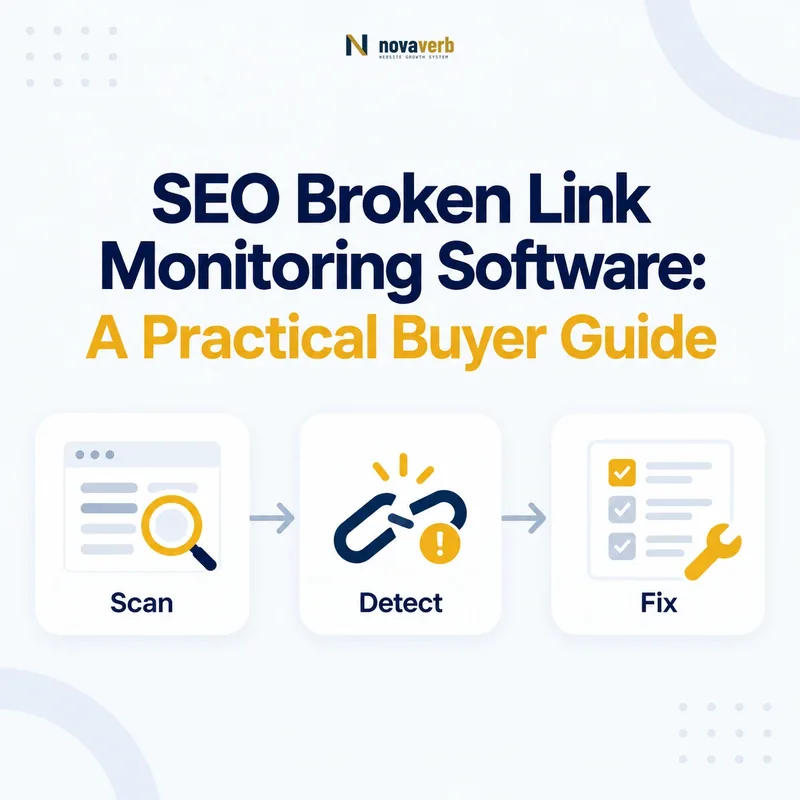
A practical platform should support the complete path from scoped evidence to action and fresh verification.
- Crawl: Discover links and preserve source context.
- Request: Fetch destinations and store observed responses.
- Prioritize: Verify important external cases and apply buyer context.
- Fix and recheck: Update, restore, redirect or remove, then recrawl.
- Run the workflow with one representative project.
- Record every export, handoff and manual join.
- Confirm that the final verification connects back to the original finding.
| Stage | Required behavior | Failure signal |
|---|---|---|
| Crawl | Discover links and preserve source context. | The team must leave the workflow to reconstruct context |
| Request | Fetch destinations and store observed responses. | The team must leave the workflow to reconstruct context |
| Prioritize | Verify important external cases and apply buyer context. | The team must leave the workflow to reconstruct context |
| Fix and recheck | Update, restore, redirect or remove, then recrawl. | The team must leave the workflow to reconstruct context |
The best workflow is the one your team can repeat without losing source, scope or ownership between stages.
How Can SEO Broken Link Monitoring Software Create Business Value?
Business value comes from reducing decision friction, protecting trustworthy evidence and increasing the share of findings that become verified work.
- Faster repair: Source and destination evidence stay connected
- Better prioritization: Critical journeys are explicit
- Fewer false causes: External observations require verification
- Observable closure: Fresh crawl evidence confirms the link state
- Measure the current manual workflow before purchase.
- Define the operating change expected from the platform.
- Review adoption and verified outcomes after implementation.
| Value lever | Product behavior | Business interpretation |
|---|---|---|
| Faster repair | Source and destination evidence stay connected | Owners can act without reconstructing context |
| Better prioritization | Critical journeys are explicit | Teams address meaningful failures first |
| Fewer false causes | External observations require verification | Reports stay bounded |
| Observable closure | Fresh crawl evidence confirms the link state | Done is not merely assigned |
Model value from observable workflow changes rather than promising rankings, revenue or savings the software cannot guarantee.
Who Is SEO Broken Link Monitoring Software Best For?
The best fit depends on team capacity, project complexity, required evidence and how much integration work the buyer can own.
- Ecommerce: Product, category and checkout links
- Publisher: Large editorial link graphs
- SaaS: Product and help journeys
- Agency: Client evidence and owners
- Identify the primary operator and decision owner.
- Choose a representative project and workflow.
- Confirm that plan limits match real usage before purchase.
| Buyer profile | Priority capability | Fit rationale |
|---|---|---|
| Ecommerce | Product, category and checkout links | Protect buyer journeys |
| Publisher | Large editorial link graphs | Maintain references |
| SaaS | Product and help journeys | Reduce dead ends |
| Agency | Client evidence and owners | Deliver accountable repairs |
Fit is strongest when the product matches both the analytical need and the team that must operate it.
How Should Buyers Compare Price and Choose the Next Step?
Compare total operating cost, included evidence, usage limits and the work required to turn output into action before choosing a plan.
- Pages: Source crawl volume
- Destinations: Internal and external requests
- Frequency: Monitoring cadence
- Workflow: Owners, alerts and rechecks
- Run the relevant free check or product workflow.
- Compare plan limits against actual projects, users and cadence.
- Choose the smallest plan that supports the complete required workflow.
| Cost area | What to inspect | How to compare |
|---|---|---|
| Pages | Source crawl volume | Test the full estate |
| Destinations | Internal and external requests | Include repeat verification |
| Frequency | Monitoring cadence | Match publishing and releases |
| Workflow | Owners, alerts and rechecks | Include repair operations |
Make the buying decision from a real workflow, its evidence requirements and its full operating cost.