
What Is SEO Software Change Management?
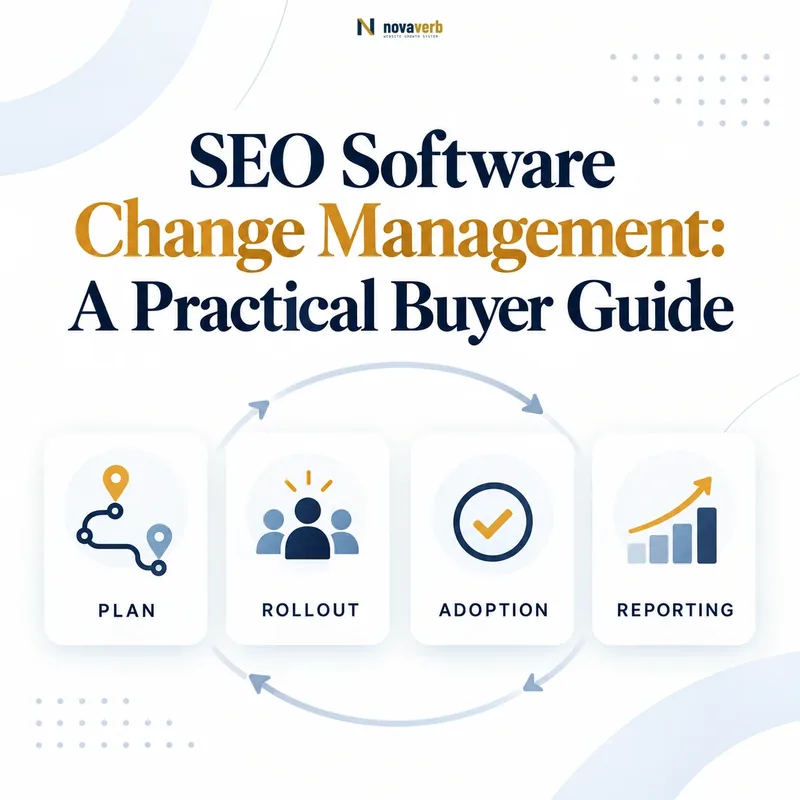
SEO software change management is the plan for moving people, workflows, evidence rules and governance from the current state to an operable future state. It begins during evaluation because product fit depends on what the organization can adopt and own.
- Defined current and future workflows
- Named roles, training and decision rights
- Evidence, governance and review conditions
- Document the current operating path.
- Design the smallest useful future state.
- Test adoption assumptions before purchase.
| Review area | Buyer question | Evidence to retain |
|---|---|---|
| Current | How work happens now | Observed workflow |
| Future | What changes with software | Tested design |
| Transition | How responsibility moves | Owned plan |
Change management makes the organizational work of adoption visible before it becomes an implementation surprise.
Which People and Roles Need to Be Involved?
Involve the people who provide sources, analyze evidence, decide priorities, implement changes, verify results, administer access and approve commercial terms. Each role needs a clear responsibility rather than a generic stakeholder label.
- Product or SEO owner with decision authority
- Analysts, implementers and reviewers
- Data, administration, procurement and legal roles as needed
- Map roles to workflow steps.
- Identify capacity and permission gaps.
- Assign one accountable owner per decision.
| Review area | Buyer question | Evidence to retain |
|---|---|---|
| Operate | Analyze and act | Workflow roles |
| Govern | Control access and evidence practice | Admin roles |
| Approve | Accept scope, cost and risk | Decision roles |
Role clarity prevents adoption work from disappearing between teams after the purchase is signed.
How Should Teams Map the Future Workflow?
Map the future workflow from trigger and source through diagnosis, priority, ownership, implementation and fresh verification, including every external tool and handoff. The map should reflect product behavior observed in a representative trial.
- Inputs, sources and authorized scope
- Steps, users and decision rights
- Outputs, handoffs and verification
- Run the current workflow and mark friction.
- Test the proposed sequence in the product.
- Document what changes and what remains outside.
| Review area | Buyer question | Evidence to retain |
|---|---|---|
| Input | Source and trigger | Connected scope |
| Decision | Evidence, priority and owner | Action record |
| Recheck | Fresh evidence after action | Verification record |
A future workflow is credible when intended users can reproduce it and the organization accepts its remaining manual work.
How Should Buyers Preserve Evidence and Governance?
Preserve source labels, property or market scope, observation time, affected entities, ownership and separate before-and-after records throughout the change. Governance should define who can connect sources, change configuration and approve actions.
- Appropriate source for each question
- Access and configuration responsibilities
- Retention of decisions and fresh verification
- Define evidence fields required at each step.
- Assign access and review rights.
- Test an unavailable or contradictory-source case.
| Review area | Buyer question | Evidence to retain |
|---|---|---|
| Source | Authority and observation context | Labeled evidence |
| Control | Who can change configuration | Role record |
| History | How decisions and rechecks persist | Separate observations |
The new process should improve operational clarity without weakening the evidence boundaries the team relies on.
What Training and Enablement Should the Plan Include?
Include role-specific training on real workflows, evidence interpretation, handoffs, administration and escalation, followed by representative practice. Training content should match the purchased configuration and the work each role will own.
- Analyst and owner workflow practice
- Reviewer and administrator responsibilities
- Help, documentation and internal operating notes
- Set readiness conditions by role.
- Practice with authorized project data.
- Record gaps and remediation ownership.
| Review area | Buyer question | Evidence to retain |
|---|---|---|
| Learn | Understand task and source | Role path |
| Practice | Complete representative work | Observed result |
| Sustain | Find help and govern change | Support path |
Enablement is sufficient when each required role can operate or has a documented plan to close a specific gap.
How Should Teams Track Adoption Without Invented Metrics?
Track adoption through clearly defined operational records such as required workflows completed, actions with owners and fresh verification, while stating exactly what each count includes. Avoid arbitrary adoption scores or unsupported links between software use and business outcomes.
- Named workflow and eligible user population
- Counted completion event and observation period
- Quality or evidence check attached to the task
- Define one observable completion per workflow.
- Declare the population and period.
- Review exceptions and missing evidence separately.
| Review area | Buyer question | Evidence to retain |
|---|---|---|
| Coverage | Eligible workflows with valid completion | Declared denominator |
| Quality | Completions meeting evidence conditions | Reviewed record |
| Gap | Required work not completed | Reason and owner |
Adoption evidence should show whether the operating process is being used as defined, not manufacture a favorable percentage.
Which Risks and Dependencies Need Owners?
Assign owners to source access, integrations, migration, role capacity, workflow interruption, commercial terms and transition dependencies. Each risk needs a practical response and evidence that shows whether the condition is resolved.
- Connection or data dependency
- People, training or implementation capacity
- Contract, support or exit dependency
- Name the affected workflow and failure mode.
- Assign prevention and response ownership.
- Define the evidence required to close the risk.
| Review area | Buyer question | Evidence to retain |
|---|---|---|
| Dependency | What the workflow requires | Named input |
| Risk | How it could fail | Scoped condition |
| Response | Who acts and verifies | Owned plan |
Owned risks make the proposed change reviewable; unassigned risks simply postpone the decision.
How Should Buyers Decide Whether the Change Is Feasible?
The change is feasible when mandatory workflows pass representative tests, required roles have capacity, evidence and governance remain sound, and implementation and commercial responsibilities are understood. Otherwise reduce scope, add an owned condition or select another approach.
- Tested future workflow and source handling
- Role readiness and implementation capacity
- Current plan, terms and review triggers
- Inspect the connected product and reports.
- Run a role-based change rehearsal.
- Approve only the smallest feasible operating scope.
| Review area | Buyer question | Evidence to retain |
|---|---|---|
| Feasible | Requirements and capacity align | Transition plan |
| Conditional | A resolvable gap remains | Owner and evidence |
| Not feasible | Critical responsibility is unsupported | Decision record |
A sound purchase follows a feasible change plan rather than assuming the organization will adapt after access is granted.