
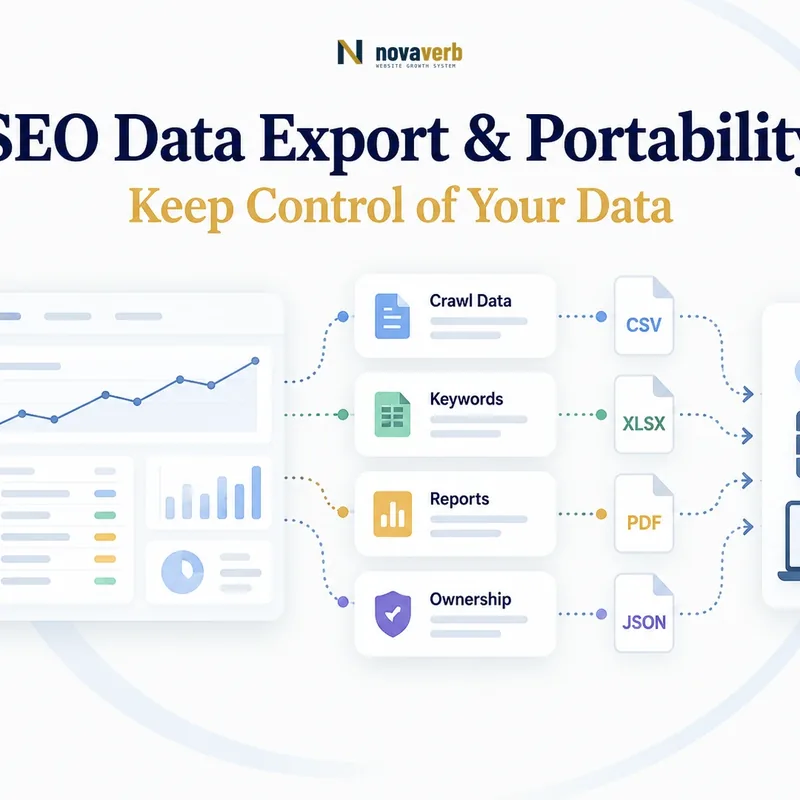
What Does Data Portability Mean in SEO Software?
Data portability means the buyer can retrieve usable records with enough structure and context to understand, retain or rebuild the workflow elsewhere. A download button alone does not establish a practical transition path.
- Documented records and field definitions
- Source, scope, timestamps and unavailable values
- Repeatable export and assigned ownership
- Define the workflows that must survive a move.
- List the records each workflow depends on.
- Test retrieval before contract approval.
| Review area | Buyer question | Evidence to retain |
|---|---|---|
| Records | Data needed for decisions | Export sample |
| Context | Source and observation conditions | Field documentation |
| Process | How and when retrieval works | Observed export |
Portability is proven by a usable, interpretable export and a known transition process, not by a generic promise.
Which Records Should Buyers Expect to Export?
Expect to export the records required to reproduce important decisions, including inputs, findings, affected entities, owners, status, source context and observation times. Derived scores without their supporting fields may not preserve the workflow.
- Projects, sites, URLs, queries and link records
- Issues, recommendations, assignments and status
- Source labels, filters, dates and unavailable inputs
- Inventory the current operating workflow.
- Trace each decision back to required records.
- Classify records as essential, useful or disposable.
| Review area | Buyer question | Evidence to retain |
|---|---|---|
| Evidence | Observed page, query or link facts | Raw or row-level export |
| Decision | Priority, owner and status | Workflow export |
| Configuration | Scope, filters and connections | Settings record |
The export inventory should follow the buyer's decisions and responsibilities rather than the vendor's navigation labels.
How Should Buyers Test Export Formats and Field Definitions?
Test each required export in its actual format and verify encoding, stable identifiers, field names, types, null handling, timestamps and pagination. A familiar file extension does not guarantee that the content is complete or reusable.
- CSV or spreadsheet delimiter and encoding behavior
- JSON structure, pagination and nested records
- Stable identifiers and documented null semantics
- Export a representative project with known records.
- Compare row and entity counts to the interface.
- Parse the file in the buyer's normal destination.
| Review area | Buyer question | Evidence to retain |
|---|---|---|
| Identity | Stable key for joining records | Repeat export comparison |
| Value | Type, unit and null meaning | Field definition |
| Coverage | Pagination, limits and exclusions | Count reconciliation |
An export format passes when the buyer can load it, reconcile it and explain every field needed for the downstream workflow.
How Should Buyers Preserve History and Observation Context?
Preserve history as dated observations rather than overwriting old facts with the newest value. Each record should retain the source, property, market, device, filters or crawl context needed to interpret what was observed.
- Observation timestamp and retrieval period
- Property, project, URL or query identity
- Source and collection conditions
- Select one record that changes over time.
- Export it across multiple observations.
- Confirm that old and new states remain distinguishable.
| Review area | Buyer question | Evidence to retain |
|---|---|---|
| Performance | Date range and dimensions | Dated source record |
| Crawl | Run identity and exact URL | Per-run observation |
| External | Market, device and provider context | Labeled provider record |
History remains useful only when changes can be interpreted without confusing different sources or observation conditions.
How Should Buyers Validate an Export Before Purchase?
Validate an export by reconciling expected entities, required fields, representative values, nulls and timestamps against the product view and source context. Record the test so it can be repeated after implementation.
- Row and entity coverage
- Required field completeness and type
- Representative value and timestamp accuracy
- Choose known records and edge cases.
- Export and reconcile them to the interface.
- Document discrepancies and vendor explanations separately.
| Review area | Buyer question | Evidence to retain |
|---|---|---|
| Coverage | Expected objects are present | Count and sample reconciliation |
| Accuracy | Values match the same scope | Side-by-side observation |
| Usability | Downstream tool reads the file | Import or parse test |
The export is acceptable when discrepancies are explained, limitations are owned and the required downstream use succeeds.
What Work Is Required to Rebuild a Workflow Elsewhere?
Rebuilding requires more than moving files: the buyer may need to recreate projects, identifiers, schedules, roles, integrations, reports and verification routines. Estimate this work from a small transition exercise rather than a feature comparison.
- Schema mapping and identifier reconciliation
- Schedules, roles, integrations and report recreation
- Parallel operation and result validation
- Select one critical workflow.
- Rebuild it from exported records in a test destination.
- Record manual steps, losses and validation work.
| Review area | Buyer question | Evidence to retain |
|---|---|---|
| Map | Translate fields and identifiers | Mapping document |
| Rebuild | Configure the destination workflow | Task and owner list |
| Verify | Compare representative outputs | Reconciliation record |
Transition effort is known only after the buyer tests the path from exported data to an operating replacement workflow.
Which Ownership, Retention and Deletion Terms Need Review?
Review the executed terms for data ownership, authorized access, export availability, retention, deletion responsibilities and access after termination. Product behavior and written commitments should be checked together without inferring protections that are not documented.
- Who controls source connections and uploaded records
- Retention during service and after termination
- Export window, deletion process and confirmation
- Assign product, data and legal reviewers.
- Match contract language to the tested configuration.
- Record unresolved responsibilities before signing.
| Review area | Buyer question | Evidence to retain |
|---|---|---|
| Ownership | Rights and responsibilities for records | Executed terms |
| Retention | How long records remain available | Policy and order form |
| Exit | Access, export and deletion sequence | Written transition terms |
The buyer should be able to state what can be retrieved, for how long and who is responsible at every stage of the relationship.
How Should Data Portability Affect the Buying Decision?
Treat portability as a mandatory condition when continuity, auditability or future transition matters to the business. Choose only after a representative export works and the remaining transition effort and terms are acceptable.
- Essential records are available in usable form
- Context and history remain interpretable
- Exit responsibilities and cost are understood
- Inspect the product and reporting workflow.
- Run and validate a representative export.
- Include portability findings in final approval.
| Review area | Buyer question | Evidence to retain |
|---|---|---|
| Accept | Required export and terms pass | Saved validation |
| Condition | A resolvable gap remains | Written commitment |
| Reject | Critical records or rights are unavailable | Decision record |
A practical buying decision values the ability to operate today and to leave later without losing essential evidence or decision context.