
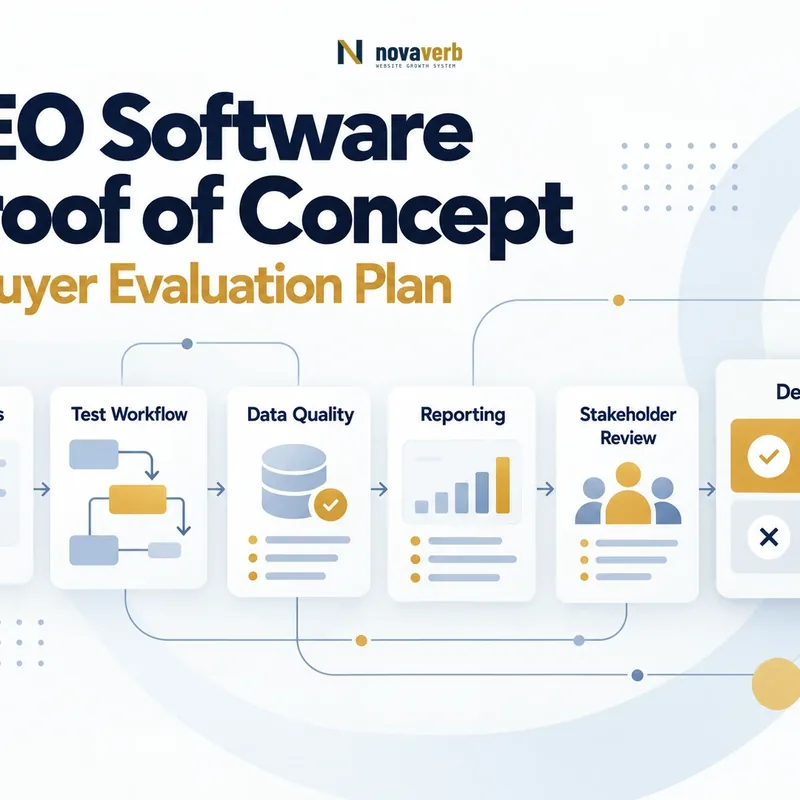
What Is an SEO Software Proof of Concept?
An SEO software proof of concept is a time-bounded evaluation that asks whether one product can complete the buyer's representative SEO workflows with inspectable evidence and acceptable operating effort. It tests a buying hypothesis; it is not a shortened implementation.
- One named business problem and decision owner
- A representative project the buyer is authorized to use
- Written acceptance conditions and unresolved-question fields
- State the buying hypothesis in operational language.
- Set the users, sources, tasks and review window.
- Keep observed behavior separate from vendor explanation.
| Review area | Buyer question | Evidence to retain |
|---|---|---|
| Decision scope | The workflow and users being evaluated | Approved POC brief |
| Evidence | What will demonstrate acceptable behavior | Saved output or reproducible observation |
| Boundary | What the POC does not establish | Explicit limitation note |
A POC is defensible when another reviewer can see what was tested, what was observed and what remains unknown.
Which Buyer Requirements Should the POC Test?
The POC should test requirements derived from recurring SEO decisions, not a broad inventory of features. Each requirement needs a user, an input, a task, acceptable evidence and a visible failure condition.
- Technical review that identifies affected pages and current conditions
- Demand or content research with market and source context
- Ownership, reporting and rechecking after a change
- List the decisions made during a normal operating cycle.
- Mark requirements as mandatory, important or optional.
- Translate each requirement into one observable task.
| Review area | Buyer question | Evidence to retain |
|---|---|---|
| Mandatory | The workflow cannot operate without it | Pass or fail |
| Important | It materially changes effort or decision quality | Comparative evidence |
| Optional | Useful but recoverable | Fit note and workaround |
A requirement belongs in the POC only when its result can change the purchase decision or the expected operating model.
Which Data Sources and Evidence Should Be Connected?
Connect only sources needed to answer the POC's defined questions, and keep every output labeled by source, property, scope and observation time. Missing access must remain visible instead of being replaced with synthetic certainty.
- Connected Search Console property for its own reported Search performance
- Fresh crawl or live response for current page conditions
- Provider observation labeled by market, device, query and run context
- Name the question before selecting its source.
- Authorize the smallest representative property and role.
- Reproduce one material result from the labeled source.
| Review area | Buyer question | Evidence to retain |
|---|---|---|
| Search performance | Connected Search Console property | Date range, dimensions and property |
| Page condition | Fresh crawl or response | Exact URL and observation time |
| External observation | Named provider run | Market, device and collection context |
The Search Console API reference documents what its services expose; it should support source interpretation, not claims about a live page.
How Should Buyers Design Representative Test Tasks?
Representative tasks should mirror normal work from input through diagnosis, ownership, action and recheck. Every shortlisted product should receive the same project, roles and task packet so the observations remain comparable.
- A known technical condition with affected-page scope
- A content or demand decision with a real market
- A handoff and recheck that exposes operational friction
- Prepare inputs and expected evidence before the trial.
- Run the task without vendor-specific shortcuts.
- Record blocked steps, manual joins and exports.
| Review area | Buyer question | Evidence to retain |
|---|---|---|
| Set up | Create scoped project and connections | Connection state and included records |
| Decide | Move from evidence to prioritized action | Source, owner and rationale |
| Verify | Run a fresh observation after change | Separate before-and-after records |
A test task is representative when it exposes the full path the team must operate after purchase, including the less polished handoffs.
How Should Teams Evaluate Workflow and Adoption?
Evaluate workflow by observing whether intended users can find evidence, understand its limits, assign the next action and return for verification. Adoption should be treated as an operating requirement with training and ownership, not as a promised outcome.
- Role-appropriate access and a clear first task
- Visible source, scope and freshness near the decision
- A defined owner for actions, questions and rechecks
- Have each intended role complete a normal task.
- Count handoffs and external tools needed to finish it.
- Document training and governance still required.
| Review area | Buyer question | Evidence to retain |
|---|---|---|
| Analyst | Inspect and qualify evidence | Reproducible finding |
| Owner | Prioritize and assign action | Named responsibility |
| Reviewer | Confirm completion and fresh evidence | Verification record |
Workflow fit is established by observed completion and understood responsibilities, not by interface preference alone.
How Should a POC Measure Operating Cost and Plan Fit?
Measure the subscription tier and all work required to operate the tested workflow, including usage units, seats, setup, manual joins, reporting and review. Use current commercial documents and observed effort without inventing future volume.
- Included capabilities, projects, users and history
- Credits, crawl units, tracked items and overage mechanics
- Implementation, integration and recurring manual work
- Map the normal test workload to current plan terms.
- Model one higher-usage case from a stated workload.
- Choose the smallest plan that completes the required workflow.
| Review area | Buyer question | Evidence to retain |
|---|---|---|
| Subscription | Required tier and billing cadence | Current pricing and order form |
| Usage | Units consumed by the tested work | Definitions and trial record |
| Operation | Human and integration effort | Observed handoffs and responsibilities |
Price becomes comparable only after the buyer knows which plan and operating effort the successful test actually requires.
What Acceptance Evidence Should Buyers Record?
Record acceptance at the level of each requirement with its result, evidence location, limitation, owner and decision effect. Roadmap statements and verbal explanations should remain separate from behavior observed in the test.
- Pass, conditional pass, fail or not tested
- Saved output or steps another reviewer can reproduce
- Open condition, responsible owner and due date
- Review every mandatory requirement with its owner.
- Resolve contradictions against the primary source or written term.
- Sign off the record before commercial approval.
| Review area | Buyer question | Evidence to retain |
|---|---|---|
| Pass | Required behavior was observed | Reproducible evidence |
| Conditional | Behavior works with a known dependency | Condition and owner |
| Not tested | No valid conclusion is available | Reason and next action |
An acceptance record should make uncertainty explicit so a missing test cannot quietly become a favorable assumption.
How Should Buyers Decide What to Purchase After the POC?
Buy the smallest current plan that satisfies every mandatory tested workflow with acceptable evidence, operating effort and commercial terms. Preserve the POC record as the baseline for implementation and later review.
- Resolve mandatory gaps and contract dependencies
- Confirm the ordered configuration matches the tested configuration
- Define ownership for setup, adoption and evidence review
- Run a public check to inspect output style.
- Review the connected product and current plan scope.
- Approve, negotiate or decline from the completed record.
| Review area | Buyer question | Evidence to retain |
|---|---|---|
| Approve | Mandatory tests pass and terms align | Implementation baseline |
| Negotiate | A resolvable term or scope gap remains | Written required change |
| Decline | A mandatory need remains unmet | Recorded reason and alternative |
The final decision should be reproducible from requirements, observations, current terms and owned next steps rather than presentation quality.