
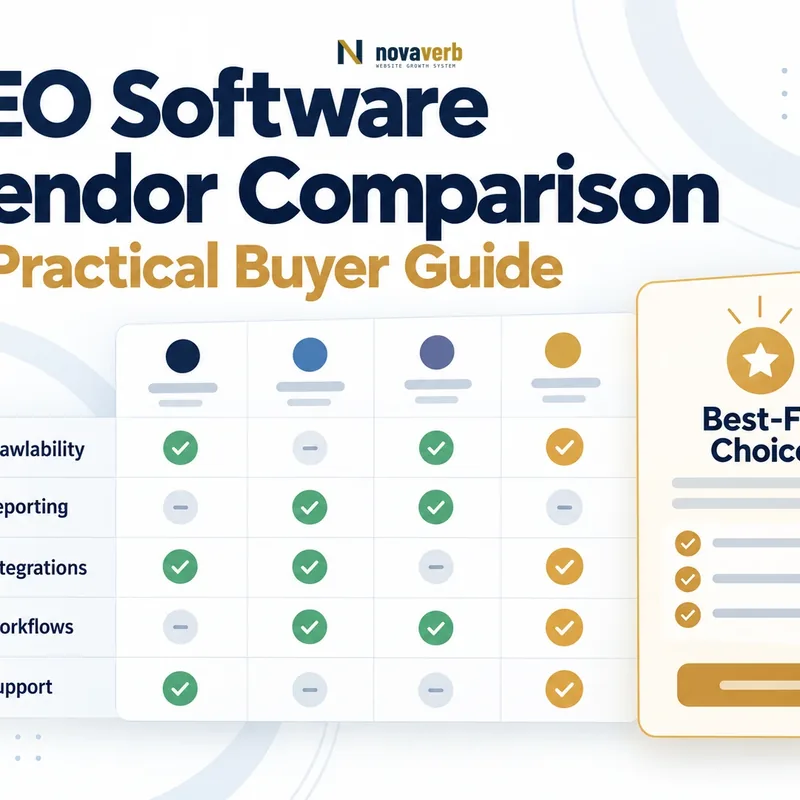
What Is an SEO Software Vendor Comparison Matrix?
An SEO software vendor comparison matrix is a decision record that evaluates every shortlisted product against the same requirements, evidence and commercial questions. It turns a broad feature comparison into an auditable buying process.
- One decision owner, business problem and target workflow
- The same representative site, task set and evidence request for every vendor
- Separate fields for workflow fit, data authority, operating cost and risk
- Written gaps and unresolved questions instead of assumed capabilities
- State the buying decision and the operational problem it must solve.
- Separate mandatory requirements from useful but optional capabilities.
- Complete each cell from a product test, written term or named source.
| Matrix record | What to capture | Why it matters |
|---|---|---|
| Business need | The recurring decision or workflow | Prevents feature-led scope drift |
| Vendor claim | The capability as the vendor describes it | Keeps marketing language identifiable |
| Observed evidence | What the buyer saw in a trial or document | Makes the comparison reviewable |
| Open gap | What remains unavailable or unverified | Stops missing information becoming an assumption |
The matrix is useful only when every conclusion can be traced to a requirement, observation or written term.
Which Requirements Should the Matrix Include?
The matrix should include only requirements that support a real SEO decision, recurring workflow or governance need. Feature names belong underneath those requirements, not in place of them.
- Crawl and indexability review for the pages the team actually manages
- Keyword, content and link research tied to a defined market and scope
- Ownership, prioritization and rechecking after an SEO change
- Reporting that preserves source, date, filters and unavailable evidence
- List the decisions the team makes during a normal operating cycle.
- Name the source and operator needed for each decision.
- Convert the workflow into testable acceptance questions.
| Workflow | Buyer question | Minimum evidence | Failure signal |
|---|---|---|---|
| Technical review | Which affected URLs need action? | Fresh crawl plus affected-page scope | Only an unexplained issue total |
| Demand research | Which page and intent should the team pursue? | Query, market and source context | A keyword list without decision context |
| Link review | What source, destination and relationship exist? | Inspectible link records and destination status | A score without a verifiable link |
| Performance review | What changed in the connected source? | Date range, dimensions and source label | A blended metric with no authority |
A requirement is strong when a buyer can run it as a task and recognize both a passing result and a meaningful gap.
How Should Buyers Weight Comparison Criteria?
Buyers should weight criteria by business importance and use pass-or-fail treatment for conditions that cannot be traded away. A polished optional feature should never cancel a missing source, unusable workflow or unacceptable term.
- Mandatory: the product must satisfy the requirement to remain on the shortlist
- High priority: material to frequent work or an important stakeholder
- Standard priority: useful but recoverable through a practical workaround
- Informational: recorded for context without affecting the decision
- Assign an owner to each criterion before reviewing vendors.
- Label priority before a demo so presentation quality cannot move the bar.
- Record the evidence behind every result and review disagreements explicitly.
| Criterion type | Evaluation method | Evidence expected | Decision effect |
|---|---|---|---|
| Mandatory | Pass or fail | Observed workflow or written commitment | Failure removes the option |
| High priority | Comparative judgment | Same test performed across vendors | Meaningfully separates fit |
| Standard priority | Fit note | Demonstrated behavior and workaround cost | Informs operating effort |
| Informational | Record only | Vendor documentation | Preserves context without inflating fit |
Publish the evaluation method before the trial so the matrix measures fit rather than whichever demonstration felt most persuasive.
How Should Buyers Verify Data Sources and Evidence?
Buyers should require every important output to identify its authoritative source, property or project scope, observation period and unavailable inputs. Different sources may describe different realities and should not be blended into one unsupported conclusion.
- Use connected Search Console evidence for what that property reported about Google Search performance.
- Use a fresh crawl or live response for what the website exposed at the time of inspection.
- Keep provider-observed rankings and AI-answer observations labelled by provider, market and run context.
- Require missing connections to remain visibly unavailable instead of becoming synthetic values.
- Write the exact question the field is expected to answer.
- Identify the source authorized to answer that question.
- Reproduce one important result using the same scope, date and filters.
| Claim | Authoritative evidence | Verification question | Interpretation limit |
|---|---|---|---|
| Google Search performance | Connected Search Console property | Can the buyer reproduce the date range and dimensions? | Does not prove the current rendered page state |
| On-page condition | Fresh response, rendered page or crawl | Can the exact URL and observation time be opened? | Does not prove how Google processed the page |
| Observed ranking | Provider result with market, device and time | Are location and collection conditions visible? | Is not a universal position |
| AI-answer citation | Recorded provider run with prompt and time | Can the captured answer and cited URL be inspected? | One run does not represent every answer |
The official Search Console API reference documents the Search Analytics, Sitemaps, Sites and URL Inspection services; use it to verify what that source can actually provide.
How Should Teams Run a Fair Vendor Trial?
A fair vendor trial uses the same representative project, user roles, source connections and task sequence for every shortlisted product. The goal is to observe the complete path from evidence to a verified next action.
- A real project the buyer is authorized to connect and inspect
- A known technical condition, content decision and reporting need
- The same operators or clearly comparable user roles
- A record of manual joins, exports, blocked steps and missing evidence
- Prepare one test packet with inputs, tasks and expected evidence.
- Run the packet without vendor-specific shortcuts that other products do not receive.
- Save outputs, questions and handoffs directly in the comparison matrix.
| Trial stage | Shared input | Task | Evidence to retain |
|---|---|---|---|
| Set up | Same site and authorized connections | Create the project and confirm scope | Connection state and included records |
| Diagnose | Same known condition | Find affected pages and supporting evidence | Source, affected scope and observation time |
| Act | Same ownership scenario | Assign or export the next action | Owner, instructions and handoff count |
| Verify | Same changed or rechecked URL | Run a fresh observation | Before-and-after evidence kept separate |
A trial is comparable when every vendor receives the same task and the buyer records what was observed rather than what was promised.
How Should Buyers Compare Pricing and Operating Cost?
Buyers should compare the total operating cost of the required workflow, including subscription price, usage units, seats, implementation, integrations, manual work and exit needs. The lowest headline price may not support the complete job.
- Billing cadence, included users, projects and product capabilities
- Credits, crawl units, tracked items, history and overage mechanics
- Implementation, migration, training and integration work owned by the buyer
- Recurring exports, spreadsheet joins, report preparation and transition effort
- Map the buyer's normal workload to each vendor's published units.
- Review a higher-usage scenario without inventing growth assumptions.
- Choose the smallest plan that supports the full required workflow and acceptable operating effort.
| Cost area | Buyer question | Evidence | Common comparison error |
|---|---|---|---|
| Subscription | Which required capabilities and seats are included? | Current pricing page and order form | Comparing plan names instead of included scope |
| Usage | Which actions consume credits or tracked units? | Usage definitions and current limits | Assuming unlimited operation |
| Implementation | Who connects, migrates and validates data? | Trial notes and implementation scope | Treating buyer labor as free |
| Ongoing operation | Which manual joins and exports remain? | Observed trial workflow | Ignoring recurring coordination effort |
Compare price only after the matrix shows which plan, usage pattern and operating work are required to complete the buyer's actual workflow.
Which Risks and Contract Terms Need Review?
The review should cover access, exports, retention and deletion, support boundaries, renewal and cancellation mechanics, service dependencies and the practical transition path. The executed terms must match the product configuration the buyer tested.
- Data ownership, authorized access, export format, retention and deletion responsibilities
- Support channels, hours, response commitments and exclusions as actually written
- Renewal date, notice process, price-change process and cancellation path
- Final exports, parallel operation and responsibilities if the buyer moves later
- Assign product, operations, procurement and legal questions to named owners.
- Reconcile the trial configuration with the order form and incorporated documents.
- Record unresolved risks and required changes before the buying decision.
| Risk area | Question to resolve | Primary evidence | Review owner |
|---|---|---|---|
| Data lifecycle | What can be accessed, exported, retained and deleted? | Product behavior and written terms | Data or operations owner |
| Support | Which help is included and which is excluded? | Support schedule and order form | Product owner |
| Renewal | When and how can terms or service change? | Executed agreement | Procurement or legal owner |
| Transition | What is required to preserve continuity? | Buyer transition plan plus written terms | Operations owner |
Risk review is complete only when the buyer knows what is provided, what remains their responsibility and what happens when the relationship changes.
How Should a Buyer Choose the Best-Fit SEO Platform?
Choose the platform whose tested workflow satisfies the required use cases with inspectable evidence, acceptable operating effort, understood pricing and manageable risk. Preserve the matrix so the decision can be reviewed after implementation.
- Resolve every mandatory gap before approving the vendor.
- Separate observed product behavior from roadmap statements and sales explanations.
- Start with the smallest plan that supports the complete required workflow.
- Define how the team will recheck adoption, evidence quality and unresolved friction.
- Run a public tool on a real URL to understand the output style and evidence shown.
- Explore the connected product workflow and compare current plan availability.
- Make the selection from the completed matrix, not a feature-count total.
| Fit signal | Publicly described behavior | Buyer action | Boundary to retain |
|---|---|---|---|
| Connected workflow | Crawl, keywords, backlinks, content, AI visibility and reporting share one workspace | Review the SEO Tools system | Confirm the specific capability needed in the chosen plan |
| Source context | Connected sources remain labelled and unavailable evidence remains unavailable | Test one source-dependent result | Do not treat one source as proof of another |
| Free starting point | Public checkers and generators can be tried without a paid plan | Run a representative public check | A public result is not a full workspace trial |
| Plan fit | The pricing page lists current availability and included usage | Map real workload to the current plan | Recheck current terms before purchase |
The strongest buying decision is the one a second reviewer can reproduce from requirements, evidence, observed workflow, current commercial terms and documented risk.