
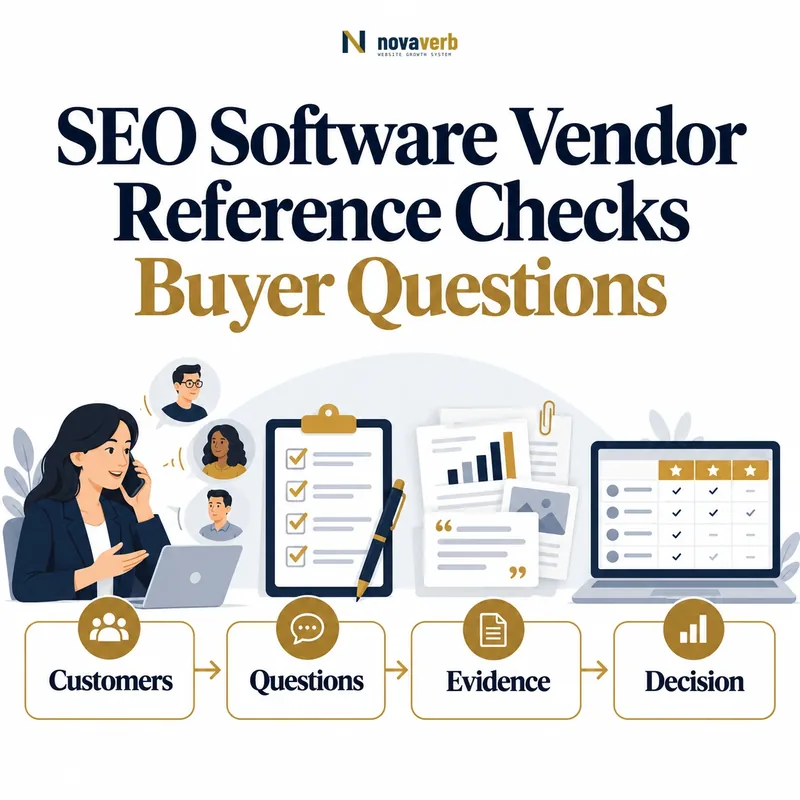
What Is an SEO Software Vendor Reference Check?
A vendor reference check is a structured conversation with a current or former customer about how the product operates in a defined context. It supplies scoped experience, not universal proof of product quality or future results.
- Comparable team, workflow and implementation stage
- Questions prepared from unresolved buying risks
- Notes that separate experience from buyer inference
- State the decision the call must inform.
- Share the context needed for useful answers.
- Verify material vendor claims elsewhere.
| Review area | Buyer question | Evidence to retain |
|---|---|---|
| Context | Who used what and when | Reference profile |
| Experience | What the reference observed | Attributed notes |
| Inference | What the buyer concludes | Separate decision record |
A reference call is credible when its context and limitations remain attached to every insight.
Which Reference Customers Should a Buyer Request?
Request references whose team size, SEO workflow, data connections, operating maturity and purchase scope resemble the intended use. One carefully matched reference can be more informative than several high-profile but unrelated accounts.
- Similar users, governance and internal resources
- Comparable technical, content or reporting workflow
- Relevant plan, implementation stage and source connections
- List the buyer's highest-risk assumptions.
- Define matching characteristics for each assumption.
- Ask the vendor for references that cover the gaps.
| Review area | Buyer question | Evidence to retain |
|---|---|---|
| Workflow | Same recurring job | Comparable operating account |
| Stage | Implementation or mature use | Relevant timing |
| Constraint | Similar team or integration limit | Transferable friction |
Reference selection should follow the buyer's unanswered questions, not the prestige of the customer name.
What Workflow Questions Should Buyers Ask?
Ask the reference to describe one recurring task from trigger through evidence, decision, handoff and recheck. Concrete sequences reveal manual work and ownership more reliably than general satisfaction questions.
- Inputs, source connections and first operator
- Steps inside and outside the product
- Output, owner, recheck and unresolved friction
- Choose a workflow central to the purchase.
- Ask for the most recent representative example.
- Probe where the process leaves the platform.
| Review area | Buyer question | Evidence to retain |
|---|---|---|
| Start | What triggers the task | Input and owner |
| Operate | Which steps and tools are used | Actual sequence |
| Finish | How action and verification occur | Output and recheck |
A useful workflow answer allows the buyer to compare the reference's real operating path with the proposed internal process.
How Should Buyers Ask About Evidence Quality?
Ask how users identify the source, scope, freshness and limitations behind important outputs, and what they do when evidence is missing or contradictory. Reference experience should not replace inspection of the buyer's own connected sources.
- Source label and property or project scope
- Observation time, filters and affected entities
- Unavailable evidence and conflict resolution
- Select one decision-critical output.
- Ask how the reference verifies it.
- Repeat that verification in the buyer's trial.
| Review area | Buyer question | Evidence to retain |
|---|---|---|
| Authority | Which source answers the question | Named source |
| Context | Scope and observation conditions | Visible fields |
| Conflict | How disagreement is resolved | Primary evidence path |
References can expose evidence practices, but the buyer must still verify the product against authorized data and representative tasks.
What Should Buyers Learn About Adoption and Change?
Learn which roles use the product, what training and governance were required, which tasks moved into the system and which remained elsewhere. Adoption is context-dependent and should not be converted into a promised rate or outcome.
- Initial users and role expansion
- Training, ownership and operating cadence
- Workarounds, abandoned features and change friction
- Ask who used the product first.
- Trace one behavior that changed and why.
- Compare required resources with the buyer's capacity.
| Review area | Buyer question | Evidence to retain |
|---|---|---|
| Role | Who performs the task | Reference organization |
| Enablement | Training and governance needed | Observed effort |
| Friction | What still happens outside | Workaround and reason |
Adoption evidence is useful when it clarifies responsibilities and effort the buyer must plan, not when it is treated as transferable success.
What Support Questions Should Buyers Ask References?
Ask references about the support channel, issue type, response sequence, escalation and resolution they actually experienced under their plan. Compare that experience with the current written support scope because service terms can differ.
- Plan, channel and operating hours
- Representative issue and information requested
- Escalation, resolution and remaining responsibility
- Choose support scenarios material to the workflow.
- Ask for a recent specific example.
- Verify current commitments in commercial documents.
| Review area | Buyer question | Evidence to retain |
|---|---|---|
| Access | How support was contacted | Channel and plan |
| Process | What happened after contact | Specific sequence |
| Boundary | What remained with the customer | Responsibility split |
Reference experience can reveal the shape of support, while only current written terms define what the buyer is purchasing.
How Should Buyers Interpret Reference Limitations?
Interpret every reference as one account observed under particular users, configuration, timing and commercial terms. Look for patterns across independent evidence, and never turn an anecdote into a metric, causal claim or security assurance.
- Selection bias in vendor-provided references
- Different plans, versions, data and operating maturity
- Unverified causality between product use and business result
- Attach context to every note.
- Mark claims that require product or document verification.
- Keep contradictory accounts visible.
| Review area | Buyer question | Evidence to retain |
|---|---|---|
| Direct observation | What the reference personally experienced | Use with context |
| Vendor claim | What the reference was told | Verify independently |
| Outcome claim | What changed alongside product use | Do not infer causality |
A limitation is not a reason to discard the call; it is the information needed to use the account responsibly.
How Should References Affect the Final Buying Decision?
Use references to update specific risks and implementation assumptions, then decide from the full record of trial evidence, source checks, current terms, operating effort and price. References should inform the decision without controlling it.
- Confirm or reopen named assumptions
- Add implementation tasks and owners
- Preserve unresolved questions and evidence needs
- Review products and reports directly.
- Reconcile reference notes with trial evidence.
- Approve only when mandatory gaps are resolved.
| Review area | Buyer question | Evidence to retain |
|---|---|---|
| Confirmed | Independent evidence aligns | Reduce named uncertainty |
| Contradicted | Accounts or trial differ | Investigate before approval |
| Unresolved | Evidence remains insufficient | Assign next action |
The strongest reference check produces a smaller, clearer set of verified risks rather than a general vote for or against the vendor.