What Is URL Discovery in SEO?
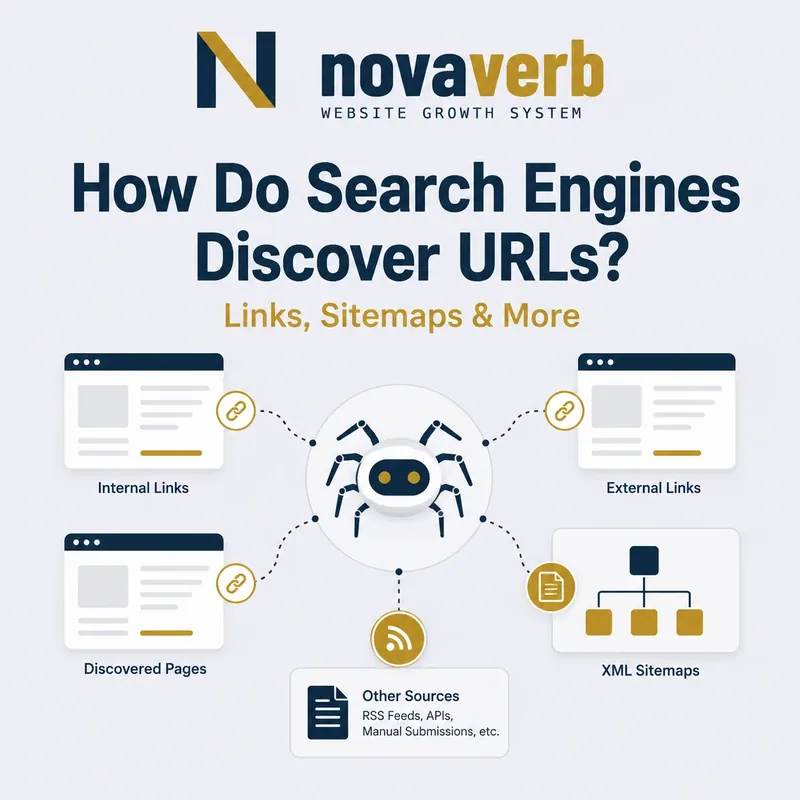
URL discovery in SEO is the process through which a search system becomes aware that a web address exists. A URL can be discovered through internal links, external links, XML sitemaps, redirects, feeds, metadata references, previously known addresses, and other supported sources.
Discovery occurs before or independently of crawling. Once the system knows the address, it may normalize the URL, compare it with existing candidates, add it to a crawl frontier, defer it, classify it as a duplicate, or decide not to request it. Becoming known does not create a guaranteed crawl obligation.
“The Web is a system of interlinked hypertext documents and resources.” Wikipedia - World Wide Web
For Google specifically, new pages may be found when links from already known pages expose a new address, while sitemaps can tell Google about new or updated pages. These discovery systems complement each other, but neither guarantees index inclusion.
Core URL Discovery Sources
| Discovery source | How the URL becomes known | SEO role | What it does not prove |
|---|---|---|---|
| Internal link | A known page contains a crawlable reference to another URL. | Connects URL discovery with site architecture, page relationships, and user navigation. | That the destination will be crawled immediately or treated as important. |
| External link | A resource on another host references the URL. | Can expose pages that have not yet been discovered through the site itself. | That the external reference is current, relevant, followed, or trusted. |
| XML sitemap | The website declares the URL in a machine-readable sitemap. | Helps expose new, deep, media, or weakly linked canonical URLs. | That the URL was crawled, indexed, selected as canonical, or ranked. |
| Redirect | A requested source URL returns a destination address. | Connects an old, alternate, or migrated URL with another location. | That the destination is relevant or that the relationship will be consolidated as intended. |
| Canonical or hreflang reference | Metadata on a known page declares a preferred or alternate address. | Exposes related URL candidates and intended relationships. | That the declared canonical or language relationship will be accepted. |
| Feed | A public RSS, Atom, product, news, or other supported feed exposes the address. | Can support discovery of recent or structured resources. | That every crawler supports or processes that feed. |
| Historical record | The crawler remembers the address from an earlier crawl or system record. | Allows removed, redirected, or updated URLs to be revisited. | That the URL remains linked, current, or eligible for future crawling. |
| Submitted source | A supported platform, inspection system, feed, sitemap submission, or API supplies the URL. | May notify a search system that an address exists or changed. | That the system will crawl or index the URL on demand. |
Discovery Is Not a Quality or Indexing Decision
- Known URL: The search system has encountered the address.
- Queued URL: The address may be waiting for crawl evaluation.
- Crawlable URL: The relevant crawler can request the resource under the applicable conditions.
- Crawled URL: A request has occurred or been attempted.
- Indexable URL: The page does not present an obvious technical exclusion from index consideration.
- Indexed URL: A representation has been selected and stored for retrieval.
- Ranking URL: The indexed representation is selected for a particular query and context.
Use Crawl Explorer to inspect which URLs your own site crawl can discover through links, redirects, sitemaps, canonicals, and other references. The Sitemap Checker can verify whether a sitemap is reachable and structurally able to expose its declared URL set.
How Does URL Discovery Work?
URL discovery works when a search system encounters a web address in a source it can inspect, normalizes the address, compares it with URLs it already knows, and decides whether to add it to a crawl frontier for possible retrieval.
- A known resource is inspected. This may be an HTML page, XML sitemap, redirect response, feed, structured file, or historical crawl record.
- A URL reference is extracted. The system reads a link destination, sitemap location, redirect target, canonical value, hreflang value, or other supported reference.
- The address is resolved. Relative references are converted into complete URLs using the source document and applicable base URL.
- The URL is normalized. The system interprets scheme, host, path, capitalization, encoding, parameters, and fragments.
- The candidate is compared with known URLs. Exact duplicates, previously crawled addresses, and likely variants may be recognized.
- The relationship is recorded. The system may preserve which source exposed the URL and what kind of reference connected them.
- The URL enters policy evaluation. Crawl permission, host state, duplicate likelihood, priority, and available resources can be considered.
- A later action is selected. The URL may be crawled, deferred, revisited, consolidated, ignored, or retained as a known address.
Discovery Inputs and Possible Outcomes
| Discovery stage | Input | Possible output | Important limitation |
|---|---|---|---|
| Extraction | A known document or response containing a URL reference. | A raw URL candidate. | Malformed or unsupported references may not become usable candidates. |
| Resolution | A relative, absolute, encoded, or parameterized address. | A complete resolved URL. | Incorrect base URLs can create unintended destinations. |
| Normalization | The resolved address. | A standardized candidate suitable for comparison. | Different systems may normalize some URL patterns differently. |
| Deduplication | The candidate and existing URL records. | New URL, known URL, or likely duplicate variant. | URL deduplication is not the same as canonical selection. |
| Scheduling | Known status, discovery source, host state, and crawl policy. | Crawl, defer, revisit, or ignore decision. | A known URL has no guaranteed crawl date. |
URL Discovery vs Crawling, Indexing, and Ranking
URL discovery makes an address known, crawling requests its resource, rendering constructs a processed page state, indexing stores a selected representation, and ranking orders eligible results for a specific query and context.
| Stage | Primary question | Supporting evidence | What success does not guarantee |
|---|---|---|---|
| Discovery | Does the search system know this URL exists? | Links, sitemap entries, redirects, feeds, metadata references, or historical records. | That a request has occurred. |
| Crawling | Can the crawler request the URL and receive a response? | Server logs, crawl records, status, headers, timing, and response body. | Rendering or index inclusion. |
| Rendering | Can meaningful content and links be constructed from the fetched resources? | Rendered DOM, loaded resources, visible content, and script execution. | Canonical selection or indexing. |
| Canonicalization | Which URL should represent related or duplicate content? | Redirects, canonical tags, content similarity, internal links, sitemaps, and other signals. | Ranking or traffic. |
| Indexing | Was a representation selected and stored for retrieval? | Search-engine inspection and index coverage evidence. | Visibility for a particular query. |
| Ranking | Where is the result selected for a query, user, device, market, and time? | Search performance, observed rankings, and SERP captures. | Clicks, conversions, revenue, or AI citation. |
Diagnose the Earliest Missing Stage
A URL cannot be accurately diagnosed by beginning with ranking alone. Confirm that the address is discoverable before investigating crawl access. Confirm crawl access before interpreting rendering, canonicalization, indexing, and retrieval outcomes.
How Do Internal Links Help Search Engines Discover URLs?
Internal links help search engines discover URLs by exposing destination addresses within pages the crawler already knows and can inspect. They also connect discovery to site structure, page roles, topical relationships, and user navigation.
For dependable discovery, important links should normally use standard HTML anchor elements with usable href destinations. Google states that it can reliably crawl links when they use an <a> element with an href attribute.
| Link property | Discovery effect | Good implementation | Weak implementation |
|---|---|---|---|
| Source-page accessibility | The crawler must first reach the source page to inspect its links. | Place important links on accessible hubs and related pages. | The only source page is blocked, orphaned, broken, or inaccessible. |
| HTML link format | A standard destination can be extracted directly. | Use an anchor element with a direct href destination. | Use a span, button, or script event without a crawlable address. |
| Destination URL | Determines which exact variant becomes known. | Link to the approved live canonical URL. | Link through redirects, tracking parameters, or duplicate variants. |
| Rendered availability | Determines whether script-generated links become visible after processing. | Make essential links available reliably without custom interaction. | Create links only after scrolling, clicking, login, or failed API requests. |
| Architecture depth | Influences how many successful transitions are required to reach the destination. | Provide coherent, short paths to important destinations. | Require many low-value intermediary pages or endless pagination. |
| Relationship context | Shows why the destination belongs within the current journey or topic. | Connect pages through a useful decision or information path. | Add repeated sitewide links without a meaningful relationship. |
Internal Links Should Declare the Preferred URL Set
If the site links inconsistently to HTTP and HTTPS versions, uppercase and lowercase paths, tracking URLs, redirected addresses, or duplicate parameters, each variation may become part of the discovered URL space. Internal links should consistently reference the intended live destination.
Use the Decision Ladder to connect internal links by page role and next-step purpose rather than by raw link quantity.
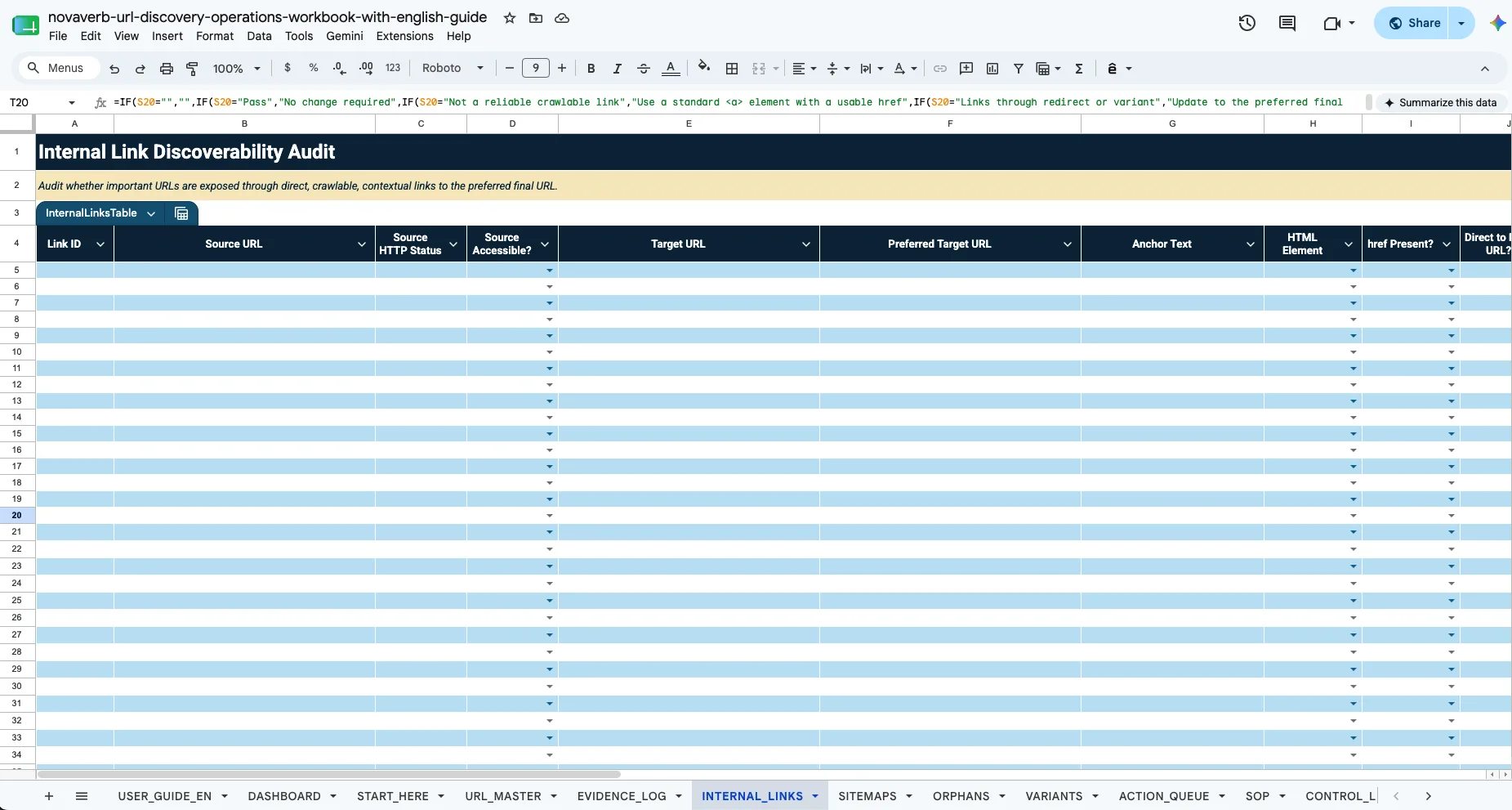
For a reliable internal discovery path, inspect the actual source-to-target relationship - not just the visible menu label. Record the HTML element, usable href, redirect behavior, target response, canonical match, initial HTML, rendered DOM, and any interaction dependency.
A link may look functional to a user while still producing a weak or unstable extraction path. The audit therefore checks what appears in the rendered document and which exact URL the link exposes.
How Do External Links Expose New URLs?
External links expose new URLs when a crawler inspecting another website encounters a link pointing to an address on your site. This can introduce pages that have not yet been discovered through your internal links or sitemap.
New-Site Discovery
An external reference may expose a new domain, subdomain, hostname, or page before the search system has encountered it elsewhere.
Deep-Page Discovery
A direct external link can reveal a page that is several layers deep or missing from the current internal architecture.
Historical URL Rediscovery
Old backlinks can continue exposing redirected, removed, parameterized, or obsolete URLs after the website stops linking to them.
Alternate Variant Discovery
External sites may link to HTTP, uppercase, trailing-slash, tracking, or hostname variants that differ from the preferred address.
Resource Discovery
External links can expose PDFs, images, downloads, feeds, tools, API documentation, and other non-HTML resources.
Relationship Evidence
The source page and surrounding context may help search systems understand how the referenced resource relates to the wider web.
External Discovery Does Not Replace Internal Architecture
A page that is known only because another website links to it may still be an internal orphan. External discovery does not provide users with a path from your own website, and it does not ensure that your sitemap, canonical signals, or internal links support the same URL.
How Do XML Sitemaps Support URL Discovery?
XML sitemaps support URL discovery by providing search crawlers with a machine-readable declaration of the URLs the website wants them to know about. They are particularly useful for new pages, deep pages, large inventories, media resources, and URLs that are not encountered quickly through ordinary links.
What a Sitemap Can Support
- Expose preferred page URLs
- Organize large URL sets into sitemap files and indexes
- Declare image, video, or news resources where supported
- Help search systems find recently created pages
- Support comparison between declared and crawled inventories
- Provide modification information when it is accurate
What a Sitemap Cannot Guarantee
- That every URL will be crawled
- That a listed URL is indexable
- That the listed URL will be selected as canonical
- That the page will be indexed
- That the page will rank
- That weak internal architecture is repaired
Keep Sitemap Declarations Consistent
A sitemap should normally declare the preferred live URL set. Redirecting, blocked, noncanonical, duplicated, private, staging, error, and intentionally noindexed URLs create conflicting discovery signals unless their inclusion serves a specific supported purpose.
Google describes sitemaps as a way to provide information about pages, videos, and other files, but submission remains a hint rather than a guarantee that listed URLs will be crawled or indexed.
Use the Novaverb Sitemap Checker to inspect sitemap reachability, document structure, sitemap indexes, declared locations, and URL-level consistency.
How Do Redirects Help Search Engines Find URLs?
Redirects help search engines discover destination URLs when a crawler requests one address and the server responds with another location. This is useful when pages move, domains change, URL formats are consolidated, or obsolete addresses need to lead users and crawlers to a replacement.
| Redirect situation | Discovery role | Preferred implementation | Discovery risk |
|---|---|---|---|
| Page migration | Exposes the replacement destination when the old URL is requested. | One direct redirect to the closest relevant live destination. | The destination may be too broad, irrelevant, or unavailable. |
| Protocol or hostname consolidation | Connects alternate hosts or schemes to the preferred origin. | Apply a consistent one-hop sitewide rule. | Mixed redirect logic creates loops or inconsistent final URLs. |
| URL-format normalization | Maps alternate casing, slash, extension, or path formats to one destination. | Redirect variants while internal links use only the preferred form. | The site continues generating and rediscovering unnecessary variants. |
| Campaign or tracking URL | May expose the underlying destination after the tracked address is requested. | Control public tracking URLs and avoid using them in permanent internal links. | Large numbers of parameterized variants enter the known URL space. |
| Removed content | Can expose a true replacement where one exists. | Redirect only when the destination satisfies the original user need. | Mass redirection to a homepage or category obscures genuine removal. |
Redirect Discovery Should Be Temporary During Migration
Once a destination is established, update internal links, sitemaps, canonicals, hreflang references, and templates to point directly to it. The redirect can remain for old external and historical references, but the current site should stop rediscovering the obsolete source URL.
Can Canonical and Hreflang References Expose URLs?
Yes. Canonical and hreflang references can expose URL candidates because they contain addresses that a search system may record and inspect. However, these declarations communicate relationships rather than replacing ordinary navigation links.
Canonical Reference
A canonical tag declares which URL the publisher prefers as the representative for the current page or related duplicate set.
Hreflang Reference
An hreflang value declares a language or regional alternate that belongs to a related page cluster.
HTTP Header Reference
Canonical and other relationships may also appear in HTTP headers for supported non-HTML or document resources.
Sitemap Relationship
Hreflang alternate references may be declared through XML sitemaps when implemented consistently.
Relationship Declarations Can Conflict
A canonical or hreflang target may be discovered but still present conflicting evidence: it may redirect, return an error, be blocked, declare another canonical, lack reciprocal hreflang, use a different protocol, or receive no internal links. Search systems evaluate declarations alongside other signals.
Google describes canonical tags, redirects, and sitemap inclusion as canonicalization signals rather than absolute commands, and conflicting signals can lead Google to select a different canonical.
How Do Feeds and Other Machine-Readable Sources Support Discovery?
Feeds and other machine-readable sources can support discovery by exposing structured URL lists, recent entries, resource identifiers, or update records that participating crawlers can process. Their usefulness depends on crawler support and the accuracy of the published data.
| Machine-readable source | Possible discovery role | Useful for | Limitation |
|---|---|---|---|
| RSS or Atom feed | Exposes recent article or update URLs. | Blogs, publications, podcasts, and frequently updated content. | The feed may contain only recent entries and not the full site inventory. |
| Product feed | Provides product URLs and associated commercial data. | Shopping, marketplaces, catalogs, and availability systems. | Feed acceptance and downstream use vary by platform. |
| News feed | Exposes recent publication URLs and timestamps. | Timely editorial and news content. | Eligibility and format requirements may be strict. |
| API response | Returns addresses or resources through a public endpoint. | Applications, documentation, structured catalogs, and integrations. | Search crawlers may not discover or process arbitrary APIs automatically. |
| Structured data | Contains identifiers, related URLs, media URLs, and entity references. | Clarifying relationships and machine-readable page meaning. | Structured data is not a substitute for crawlable navigation or a sitemap. |
| Indexing or submission API | Supplies eligible URLs or update notifications to a supported system. | Specific documented content types and platform workflows. | Availability does not mean every ordinary page is eligible. |
Can Search Engines Discover URLs Without Links?
Yes. Search engines may discover URLs without current crawlable links through XML sitemaps, redirects, feeds, submitted sources, historical crawl records, external references, canonical declarations, hreflang references, and previously known addresses.
Sitemap-Only Discovery
A URL may appear in a sitemap even when no internal page currently links to it.
Historical Discovery
A search system may retain an old URL after the site removes every current internal link.
External Discovery
Another website may expose the URL even when the page is absent from the site’s own navigation.
Redirect Discovery
An old source URL may reveal a new destination through its redirect response.
Metadata Discovery
A canonical, hreflang, image, structured-data, or resource reference may expose another address.
Platform Submission
A supported inspection, feed, or submission system may supply a URL directly.
Known Without Links Is Still an Architecture Problem
A known URL without internal links may be crawlable and even indexed, but users cannot reach it through the website’s intended journey. Search systems also receive less internal evidence about where the page belongs and how it relates to other resources.
What Makes a URL Easy to Discover?
A URL is easy to discover when it is exposed through direct crawlable links from known pages, included in the correct sitemap, uses a stable preferred format, and does not depend on fragile scripts, user interactions, or hidden application states.
Direct Internal Link
The preferred destination appears in a standard HTML link from an accessible and relevant source page.
Coherent Site Placement
The page belongs to an understandable hub, category, topic, product, or decision journey.
Accurate Sitemap Inclusion
The live canonical URL appears in the correct sitemap without conflicting status or directive signals.
Stable URL Format
The site consistently references one scheme, hostname, path format, casing policy, and parameter state.
Low Crawl Depth
Priority pages can be reached through a short and meaningful sequence of successful links.
Reliable Rendered Output
Essential links do not disappear when scripts, APIs, cookies, or user interactions fail.
Consistent Relationships
Internal links, redirects, canonicals, hreflang references, and sitemaps support the same intended URL.
No Duplicate Expansion
Filters, search pages, tracking values, session IDs, and route states do not generate uncontrolled alternatives.
What Is an Undiscovered URL?
An undiscovered URL is an address that a particular search system has not encountered through its known links, sitemaps, redirects, feeds, submissions, historical records, or other supported discovery sources.
Undiscovered status is difficult to prove universally because website owners cannot inspect every internal search-system record. In practice, SEO teams usually identify a URL as undiscovered within a bounded evidence set, such as an audit crawl, sitemap comparison, server-log period, or search-engine inspection report.
Why a URL May Remain Undiscovered
- The page has no internal links.
- The page is omitted from all submitted or discoverable sitemaps.
- The only links require unsupported JavaScript or interaction.
- The URL exists only inside a private CMS or database.
- The page is created dynamically but never exposed as a stable address.
- The source page containing the link cannot be crawled.
- The destination is hidden behind authentication or an application state.
- The page is extremely new and discovery has not yet occurred.
- The search system does not support the feed, API, or reference format used.
Undiscovered Does Not Mean Low Quality
A valuable page may remain undiscovered because the architecture failed to expose it. Conversely, a low-value page can be discovered repeatedly through uncontrolled parameters, filters, or template links.
What Is an Orphan URL?
An orphan URL is a page address that has no discovered crawlable internal link from the selected website crawl, even though the URL may be known through a sitemap, analytics, Search Console, backlinks, redirects, feeds, or historical records.
| URL state | Internal-link condition | Possible external evidence | Appropriate response |
|---|---|---|---|
| Intentional orphan | No public internal links by design. | Campaign, utility, test, private, or temporary workflow records. | Confirm that public discovery and indexing are not required. |
| Accidental orphan | A valuable page lost its internal links during publishing, redesign, or migration. | Sitemap, analytics, backlinks, or search impressions. | Add a meaningful link from the correct hub or related page. |
| Historical orphan | The site no longer links to an old resource. | Backlinks, logs, old sitemaps, and historical crawl records. | Redirect, restore, remove, or return an intentional status according to current purpose. |
| False orphan | The audit did not extract an existing link. | Rendered DOM, navigation interaction, alternate crawl settings, or source inspection. | Recheck rendering, robots rules, crawl seeds, and link extraction. |
| Duplicate orphan | The exact variant lacks links while another equivalent variant is linked. | Sitemap, canonical, redirect, analytics, or backlinks. | Consolidate variants and reference the preferred URL consistently. |
Orphan Status Depends on the Crawl Boundary
A URL may appear orphaned when the crawl excludes JavaScript, pagination, subdomains, parameter states, protected areas, or specific seed URLs. Record the crawler settings and discovery sources used before classifying the page.
How Do Parameters and Duplicate URLs Affect Discovery?
Parameters and duplicate URL formats expand the discovered URL space by creating multiple addresses that may lead to the same or substantially similar content. Search systems must classify, crawl, compare, canonicalize, or ignore these variants.
| Variant source | Example behavior | Discovery impact | Control approach |
|---|---|---|---|
| Tracking parameters | Campaign values create many URLs for one landing page. | Links and external campaigns expose repeated variants. | Avoid permanent internal tracking URLs and keep canonical signals consistent. |
| Sorting parameters | The same products appear in different orders. | Every sort state may become a crawl candidate. | Decide whether sort states need crawlable URLs and link to them selectively. |
| Faceted filters | Color, size, brand, price, and feature combinations generate large URL sets. | Combinatorial expansion may create an effectively infinite space. | Allow only useful indexable combinations and constrain the rest. |
| Session identifiers | A unique value is attached to each visit or user state. | Crawlers may encounter many unique addresses for one page. | Do not expose session IDs in public crawlable URLs. |
| Case and slash differences | Uppercase, lowercase, slash, and no-slash forms coexist. | Each form can be discovered separately. | Select one format, redirect alternatives, and update all internal sources. |
| Calendar and search pages | Arbitrary dates or query strings generate new results pages. | Links can expose unlimited future, past, or empty states. | Bound navigation and prevent low-value states from generating crawlable paths. |
Google specifically warns that URL parameters can create duplicate content and unnecessarily large URL spaces.
How Does JavaScript Affect URL Discovery?
JavaScript affects URL discovery when links or route states are created only after script execution, API responses, user interaction, scrolling, hydration, or client-side navigation. A crawler may need rendering support before those addresses become visible.
Reliable Discovery Patterns
- Anchor elements with usable href destinations
- Links present in the initial or reliably rendered HTML
- Direct URLs that load correctly without prior application state
- Pagination with stable addresses
- Links that do not require clicks or form submissions to exist
Fragile Discovery Patterns
- Buttons or spans acting as links through event handlers
- Destinations stored only inside JavaScript objects
- Links loaded after unsupported interaction
- Infinite scroll without crawlable paginated URLs
- Client routes that fail on direct request
Rendering Dependencies
- Required scripts must be accessible
- Public APIs must return the necessary data
- Execution must complete within practical limits
- Errors must not remove essential navigation
- Consent behavior must not hide public links improperly
Verification Requirements
- Compare source HTML and rendered DOM
- Inspect actual anchor destinations
- Review failed scripts and API requests
- Test direct access to discovered routes
- Crawl with and without rendering where appropriate
Google’s JavaScript SEO documentation states that links are reliably discoverable when they are HTML anchor elements with href attributes; script-only elements may not expose URLs in the same dependable way.
How Do You Verify How a URL Was Discovered?
Verify URL discovery by reconciling internal crawl sources, XML sitemaps, redirects, canonicals, hreflang references, feeds, analytics, backlinks, server logs, and search-engine inspection evidence. No single source reveals every possible discovery path.
- Start with the exact URL. Include scheme, host, path, case, slash behavior, and parameters.
- Search the internal link graph. Identify every crawlable source page linking to the exact destination.
- Inspect rendered links. Check whether JavaScript creates additional sources not visible in the initial HTML.
- Search XML sitemaps. Confirm whether the exact URL or an alternate variant is declared.
- Trace redirects. Identify source URLs that expose the destination through response headers.
- Inspect canonical and hreflang references. Find metadata that declares the address as preferred or alternate.
- Review backlinks. Determine whether an external website exposes the URL or one of its variants.
- Compare analytics and Search Console inventories. Locate active URLs missing from the ordinary site crawl.
- Review server logs. Confirm whether verified crawlers requested the URL and when.
- State the evidence boundary. Record whether the discovery source is proven, likely, or unknown.
Discovery Evidence Pack
- Exact URL and preferred canonical format
- Internal inlink sources
- Rendered-link sources
- Sitemap membership
- Redirect sources
- Canonical and hreflang references
- External backlinks
- Feed or structured-source references
- Analytics or Search Console presence
- Verified server-log requests
- Evidence timestamp and crawl configuration
Use Crawl Explorer to inspect inlinks, redirects, sitemap sources, canonical references, depth, and URL-level discovery evidence.
What Are Common URL Discovery Mistakes?
Common URL discovery mistakes include relying only on sitemaps, publishing orphan pages, linking through redirects, exposing duplicate parameters, hiding links behind interactions, generating infinite URL spaces, and assuming that discovery guarantees crawling or indexing.
| Mistake | Why it fails | Better practice |
|---|---|---|
| Relying only on a sitemap | The page has no meaningful relationship within the internal architecture. | Add relevant crawlable links and keep the sitemap as a supporting declaration. |
| Publishing orphan pages | Users and crawlers lack a path from the intended site journey. | Connect each important page to the correct hub, category, or related resource. |
| Linking through redirects | The site repeatedly exposes obsolete source URLs. | Update controlled links to the final live destination. |
| Using script-only navigation | The destination may not exist as an extractable URL before interaction. | Use standard anchor links with direct destinations. |
| Generating uncontrolled parameters | The discovered URL set expands far beyond useful content states. | Govern filters, sorting, tracking, sessions, calendars, and internal search URLs. |
| Mixing preferred URL formats | HTTP, HTTPS, host, path, case, and slash variants are exposed separately. | Choose one format and reference it consistently. |
| Listing noncanonical URLs in sitemaps | The sitemap declares URLs that other signals reject or replace. | Include the preferred live canonical set. |
| Assuming known means crawled | A discovered URL may remain deferred or unrequested. | Verify crawling separately through logs or appropriate engine evidence. |
| Assuming an audit crawler found everything | The crawl may exclude rendering, subdomains, feeds, external links, or historical URLs. | Reconcile several inventories and document the crawl boundary. |
| Creating fake modification signals | Changing timestamps without substantive updates reduces signal reliability. | Publish accurate modification data tied to meaningful changes. |
Frequently Asked Questions About URL Discovery
URL discovery is the stage in which a search system becomes aware that a web address exists.
What is URL discovery in SEO?
URL discovery is the process through which a search system encounters and records a web address from a link, sitemap, redirect, feed, metadata reference, historical record, or supported submission source.
Is URL discovery the same as crawling?
No. Discovery makes an address known. Crawling occurs when a crawler sends a request to the URL and receives or attempts to receive a response.
Does discovery guarantee indexing?
No. The URL must still be selected for crawling, processed, canonicalized, evaluated, and accepted for index storage.
How do search engines usually discover pages?
Common sources include internal links, external links, XML sitemaps, redirects, feeds, canonical references, hreflang values, structured resources, and previous crawl records.
Can a sitemap help a new page get discovered?
Yes. A sitemap can expose the page address, but it does not force a crawler to request or index the page.
Are internal links better than sitemap-only discovery?
Internal links provide both discovery and architectural context. Sitemaps support discovery but do not replace a meaningful user pathway.
Can an external backlink expose an orphan page?
Yes. A page may be known through external links even when no current internal page links to it.
Can redirects expose new URLs?
Yes. When a crawler requests a source URL, the redirect response can expose the destination address.
Can canonical tags help search engines find URLs?
Canonical references can expose URL candidates, but they communicate a preferred relationship and do not replace internal links or guarantee canonical selection.
Can hreflang expose alternate URLs?
Yes. Hreflang declarations contain alternate language or regional URLs that a search system may inspect.
Can search engines discover a page without any links?
Yes. Sitemaps, submissions, historical records, redirects, feeds, metadata references, and external sources may expose the address.
What is an orphan URL?
An orphan URL has no discovered crawlable internal inlinks within the selected crawl, although it may be known through other sources.
Can JavaScript prevent URL discovery?
Yes. Links may be missed when destinations depend on unsupported events, failed scripts, private APIs, login state, scrolling, or custom interactions.
Why are URL parameters a discovery problem?
Parameters can create many distinct addresses for identical, similar, filtered, sorted, tracked, or session-based content states.
How can I find undiscovered pages?
Compare a rendered site crawl with sitemaps, analytics, Search Console, backlinks, CMS exports, redirects, feeds, and server logs.
Does a crawl tool show how Google first discovered a URL?
Not necessarily. It proves how that tool discovered the URL under its settings, not which source Google encountered first.
Should every discovered URL be indexable?
No. Redirects, removed pages, resources, utility routes, parameters, and intentionally excluded states may still be discovered.
What is the best discovery path for an important page?
Use a direct internal link from a relevant accessible page, consistent sitemap inclusion, and one stable preferred URL format.
Make Every Important URL Discoverable Through a Clear Path
Every important page should have a direct, crawlable internal path from a relevant known page, use one stable preferred URL format, and appear consistently in the sitemap and relationship signals. Discovery should expose the URLs that matter without generating uncontrolled parameter, tracking, filter, session, or duplicate variants.
Compare your internally discovered URL set with sitemaps, redirects, canonicals, analytics, backlinks, and server evidence. Investigate important pages missing from the link graph and remove discovery paths that continually generate low-value URL variants.
Continue the SEO Foundations sequence with What Is Crawlability in SEO? Explore the connected crawl, technical SEO, and search visibility system from Novaverb.