
What Is a Crawl Path in SEO?
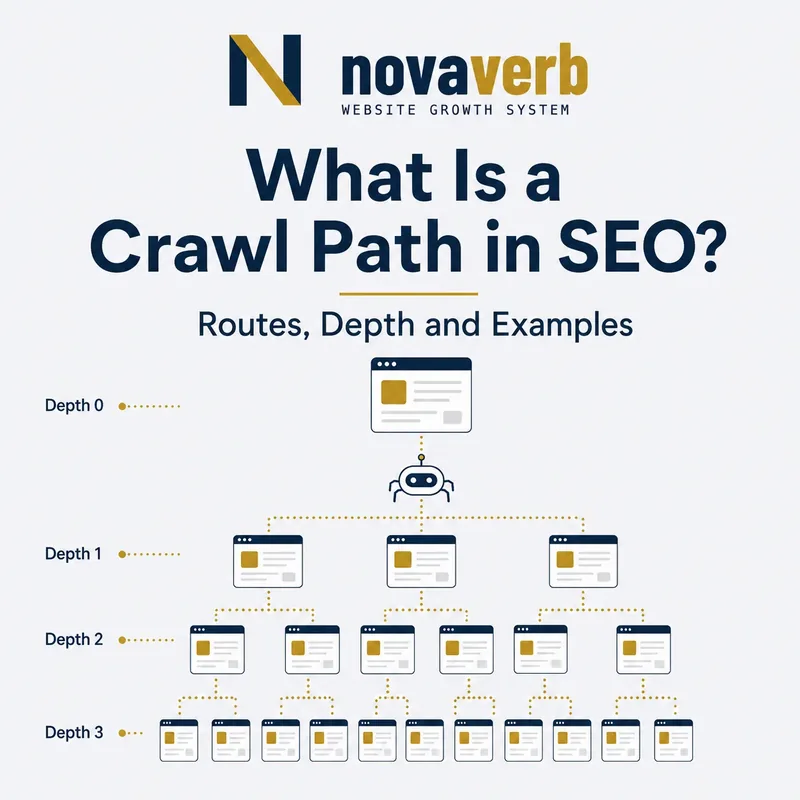
A crawl path in SEO is an observed sequence of crawlable links or transitions through which a crawler moves from a known starting URL to a destination URL. The path may begin at a homepage, category page, XML sitemap seed, external URL, or another supplied starting point.
A crawl path describes how the destination was reached within a defined crawl. It does not describe every possible path on the website, and it does not prove that a search engine used the same source page, sequence, or priority.
“These hyperlinks may also be followed automatically by programs.” Wikipedia - Hyperlink
When a crawler retrieves a page, extracts a hyperlink, requests the linked page, and repeats the process, each successful source-to-destination transition becomes an edge in the observed crawl graph. The complete sequence from the selected seed to the target is a crawl path.
Core Components of a Crawl Path
| Component | Operational meaning | SEO example | What it does not prove |
|---|---|---|---|
| Starting URL | The seed or previously known page from which path calculation begins. | Homepage, category hub, sitemap URL, or supplied crawl seed. | That every search crawler begins from the same URL. |
| Source page | A retrieved page containing a reference to another address. | A category page links to a product or article. | That the source page is indexed or highly ranked. |
| Link or transition | The connection that exposes the next URL in the sequence. | HTML link, redirect destination, pagination link, or rendered route. | That every transition has equal value or reliability. |
| Destination URL | The next address selected from the extracted reference. | A canonical article URL reached from a topic hub. | That the destination returns a usable response. |
| Response result | The status and resource received when the destination is requested. | 200 HTML, redirect, 404, 403, timeout, or server error. | That the page is indexable or indexed. |
| Path length | The number of successful transitions from the selected start to the target. | Homepage to category to article equals two link transitions. | That fewer steps automatically produce better rankings. |
| Observed crawl depth | The shortest path length found by the configured crawler from its starting set. | A page discovered at depth three in a site crawl. | That all crawlers assign the same depth. |
| Alternate path | Another sequence that reaches the same target URL. | The article is linked from a hub, related article, and breadcrumb. | That every path should be retained. |
| Path evidence | The source URLs, link targets, statuses, and crawl records supporting the path. | Crawler inlink report and URL-level parent relationship. | That a search engine used the identical sequence. |
A Crawl Path Is Relative to the Crawl Configuration
- Seed URLs: Changing the starting set can change the shortest observed path.
- Rendering: JavaScript-enabled crawling may reveal links absent from an HTML-only crawl.
- Robots rules: Blocked source pages or destinations interrupt possible paths.
- Redirect handling: Following or excluding redirects changes the recorded sequence.
- Subdomain scope: Excluding another hostname may remove valid cross-host paths.
- Pagination limits: A shallow crawl may not reach pages exposed through long pagination chains.
- URL normalization: Parameters and duplicate variants can create different path records.
Crawl Path Does Not Equal Page Importance
A short crawl path can improve practical accessibility, but path length alone does not prove business priority, search demand, relevance, quality, indexability, or ranking potential. A legal notice may be linked directly from every page, while an important specialist resource may legitimately sit deeper within a focused topic structure.
Use Crawl Explorer to inspect source pages, destination URLs, crawl depth, redirects, status codes, internal links, and URL-level path evidence.
How Does a Crawl Path Work?
A crawl path works when a crawler starts from a known URL, retrieves that page, extracts a crawlable reference, requests the next URL, and repeats the process until it reaches a destination or the path is interrupted.
- Select a starting URL. The crawl begins from a homepage, hub, sitemap URL, external page, or another configured seed.
- Request the source page. The crawler checks access rules and attempts to retrieve the resource.
- Parse the returned document. Links, redirects, canonicals, resources, and other supported references are extracted.
- Resolve the destination. Relative links are converted into complete URLs and normalized.
- Evaluate the candidate. The crawler checks scope, robots permission, duplication, host rules, and scheduling policy.
- Request the next URL. A successful request extends the observed path.
- Record the parent-child relationship. The source URL, destination URL, link type, status, and depth are stored.
- Continue or stop. The process repeats until the crawler reaches the target, a crawl limit, a block, an error, or a terminal page.
A Path Requires Successful Transitions
A link can expose a destination without producing a complete crawl path. If the source is inaccessible, the destination is disallowed, the redirect loops, the server fails, or the crawler excludes the URL from scope, the observed path ends at that point.
Crawl Path vs Crawl Depth
A crawl path is the actual sequence of URLs and transitions used to reach a destination, while crawl depth is the number of transitions in the shortest observed path from the selected starting set.
| Concept | What it measures | Example | Diagnostic use |
|---|---|---|---|
| Crawl path | The sequence of source pages and transitions leading to a target. | Homepage → Category → Guide → Product. | Shows where the path succeeds, redirects, breaks, or becomes dependent on rendering. |
| Crawl depth | The minimum number of transitions from a configured seed to the target. | The product is depth three from the homepage. | Helps identify deeply buried or unreachable pages. |
| Alternate path | Another route reaching the same destination. | Homepage → Search Tools → Product. | Shows redundancy and architectural resilience. |
| Path length | The number of transitions in one specific path. | A five-step route exists even though a two-step route also exists. | Separates an inefficient path from the shortest path. |
One URL Can Have Several Paths but One Reported Depth
A crawler may find the same page through navigation, breadcrumbs, related content, pagination, and a contextual link. The reported crawl depth is commonly based on the shortest path found under that crawl configuration.
Crawl Path vs URL Discovery and Crawlability
URL discovery makes an address known, crawlability determines whether the crawler can request it, and a crawl path records the sequence through which the crawler reached it from a defined starting point.
| Concept | Primary question | Evidence | Failure example |
|---|---|---|---|
| URL discovery | How did the system learn that the address exists? | Link, sitemap, redirect, feed, backlink, or historical record. | The page exists only in a CMS database. |
| Crawlability | Can the crawler reach and request the resource? | Robots permission, DNS, HTTPS, status, body, and infrastructure logs. | The URL is known but disallowed or blocked. |
| Crawl path | Which observed sequence led from the seed to the destination? | Parent URL, child URL, link type, path sequence, and depth. | A source link points to a redirect loop. |
| Crawl completion | Did the crawler successfully reach the intended final resource? | Final URL, status, response body, and crawl record. | The path ends at a timeout or server error. |
What Elements Can Form a Crawl Path?
A crawl path can be formed by HTML links, navigation links, breadcrumbs, pagination, redirects, rendered links, image links, cross-host links, and other transitions the crawler is configured to follow.
Contextual HTML Links
Links inside page content connect related topics, products, definitions, evidence, and next-step resources.
Primary Navigation
Header and menu links create recurring routes to major sections and commercial pages.
Breadcrumb Links
Breadcrumbs connect a page with its parent levels and provide reverse paths toward broader hubs.
Pagination Links
Pagination exposes additional archive, category, product, or listing pages through ordered transitions.
Related-Content Links
Related articles or products can create lateral paths within a topic or decision cluster.
Image Links
An image wrapped in a valid anchor can provide a crawlable transition to another resource.
Redirects
A redirect creates a server-level transition from a requested source URL to another destination.
Rendered Links
JavaScript may create links after rendering when the crawler supports and completes the required execution.
Cross-Subdomain Links
Links can connect documentation, applications, language hosts, media hosts, and other approved subdomains.
External Links
An external source can act as the beginning of a path to a page that lacks an internal route.
How Do Internal Links Create Crawl Paths?
Internal links create crawl paths by connecting a retrievable source page to another address within the website’s controlled URL space. Every successful link transition adds an edge to the crawler’s observed site graph.
A Strong Internal-Link Transition Usually Has
- An accessible source: the page containing the link can itself be crawled.
- A valid destination: the link contains a complete or resolvable URL.
- A direct final target: the link avoids unnecessary redirects and obsolete variants.
- A meaningful relationship: the destination continues the topic, task, or decision journey.
- A usable anchor: the link explains what the destination provides.
- A stable rendered state: the link does not disappear when scripts or APIs fail.
- A successful response: the destination returns the intended resource.
Internal Links Can Create Multiple Paths
A single page may be reached from a category hub, a related article, a breadcrumb, a product page, and a footer resource. These alternate routes can improve resilience when they serve real user needs, but unnecessary repetition can also create clutter and dilute architecture.
The Decision Ladder can help define which source page should connect to which next-step destination.
How Do Navigation and Breadcrumbs Affect Crawl Paths?
Navigation and breadcrumbs create persistent crawl paths between major sections, parent pages, and deeper destinations. They can reduce practical depth and make the site’s hierarchy easier to traverse when their destinations are accurate and relevant.
| Navigation element | Path role | Useful implementation | Risk |
|---|---|---|---|
| Primary menu | Connects major site sections to a common starting layer. | Link to high-level destinations with stable ownership. | Overloaded menus create many weak or repeated transitions. |
| Secondary navigation | Connects pages within a section, product, or documentation area. | Use links relevant to the current page family. | Template links remain active on unrelated page types. |
| Breadcrumbs | Provide reverse routes from a detail page to broader parent levels. | Reflect a coherent user and taxonomy hierarchy. | Breadcrumb labels and URLs conflict with canonical ownership. |
| Footer navigation | Provides persistent access to utility, legal, company, and selected key pages. | Keep the set limited and useful. | Large keyword-heavy footers create repeated low-value paths. |
| Mobile menu | Exposes navigation in responsive layouts. | Keep destinations available in crawlable HTML or reliable rendering. | Links exist only after unsupported interaction or failed scripts. |
How Do Pagination and Faceted Navigation Affect Crawl Paths?
Pagination extends crawl paths across ordered listing pages, while faceted navigation can create many alternate routes through filters, sorting states, and parameter combinations. Both systems require deliberate URL and linking governance.
Healthy Pagination Paths
- Each page has a stable URL
- Next and previous pages use crawlable links
- Items remain accessible without infinite scrolling alone
- Page sequences do not create loops
- Deep items have alternative contextual or hub links where appropriate
Pagination Risks
- Long chains increase practical path length
- Broken next links interrupt deeper discovery
- Infinite scroll hides stable page states
- Duplicate sorting creates parallel paths
- Empty pages remain crawlable indefinitely
Useful Faceted Paths
- The combination serves a defined user need
- The page has distinct inventory or content value
- The URL is stable and internally supported
- Canonical and index decisions are consistent
- The allowed facet set is intentionally limited
Faceted-Navigation Risks
- Combinatorial URL expansion
- Repeated equivalent inventories
- Sorting and tracking parameters
- Zero-result and thin states
- Infinite filter loops and calendar spaces
How Do Redirects Affect Crawl Paths?
Redirects add server-level transitions to crawl paths by moving the crawler from a requested source URL to another destination. A necessary redirect may preserve an old path, but unnecessary redirect hops make the path longer and more fragile.
| Redirect pattern | Path effect | Appropriate use | Risk |
|---|---|---|---|
| Single direct redirect | Adds one controlled transition to the final destination. | Page migration, domain move, or permanent URL replacement. | The destination may be irrelevant or unavailable. |
| Redirect chain | Adds multiple sequential hops before reaching the resource. | Usually temporary during incomplete migrations. | Longer paths, greater latency, and more failure points. |
| Redirect loop | Prevents the crawler from reaching a terminal destination. | None. | The path fails entirely. |
| Conditional redirect | Different crawlers, devices, regions, or cookies may receive different destinations. | Limited legitimate localization or application handling. | Inconsistent path evidence and unintended crawler destinations. |
| Internal links to redirected URLs | The current site keeps rediscovering obsolete addresses. | None after the destination is established. | Persistent inefficient paths and conflicting URL ownership. |
How Does JavaScript Affect Crawl Paths?
JavaScript affects crawl paths when links, routes, pagination, or navigation elements appear only after rendering, API responses, hydration, or user interaction. An HTML-only crawl and a rendered crawl may therefore produce different path graphs.
Links Added After Rendering
The initial HTML contains no destination, but script execution inserts a crawlable anchor into the DOM.
Client-Side Routes
Application navigation creates route URLs that must also return a valid resource when requested directly.
Interaction-Dependent Links
Links appear only after a click, hover, scroll, filter selection, or form event that a crawler may not perform.
API-Dependent Navigation
Menu items or related links disappear when the supporting endpoint fails, requires credentials, or is blocked.
Infinite Scroll
Additional items load visually without stable paginated URLs or crawlable next links.
Rendered Path Differences
Different crawlers may execute scripts with different timing, resources, and capabilities.
Compare HTML and Rendered Graphs
Run both nonrendered and rendered crawls where JavaScript influences navigation. Compare discovered URLs, parent pages, depth, failed resources, and direct route responses.
What Is the Shortest Crawl Path?
The shortest crawl path is the observed route with the fewest successful transitions between the configured starting set and a destination URL. Its transition count commonly becomes the reported crawl depth.
The same target may also have a longer route through several related articles. The crawler normally reports the shorter observed path for depth while preserving additional inlinks separately.
Why the Shortest Path Matters
A short path can make priority pages easier to discover and revisit. It can also expose architecture errors when an important page requires many transitions despite belonging to a major section.
Why the Shortest Path Is Not Always the Best User Path
A direct sitewide footer link may create a short crawler route without providing the best context. A slightly longer path through a relevant category and guide may better support user understanding.
What Is a Broken Crawl Path?
A broken crawl path is a route that cannot reach its intended destination because one or more transitions fail. The source page may be inaccessible, the link may be invalid, or the destination may return a block, error, loop, timeout, or unusable response.
| Break point | Observed condition | Evidence | Typical repair |
|---|---|---|---|
| Source unavailable | The page containing the link cannot be crawled. | Source status, robots result, and server logs. | Restore access or move the link to a valid source. |
| Malformed link | The destination cannot be resolved correctly. | HTML source and extracted href value. | Correct the URL syntax and destination. |
| Blocked destination | The target is disallowed or denied. | Robots rule, WAF event, or 403 response. | Confirm intent and adjust the narrowest responsible rule. |
| Redirect loop | The path repeats without reaching a final resource. | Complete redirect trace. | Correct redirect conditions and update internal links. |
| Missing destination | The target returns 404 or 410. | Final status and response body. | Restore, replace, redirect, or remove the link. |
| Server failure | The target times out or returns persistent 5xx errors. | Repeated crawl tests and server monitoring. | Stabilize application and infrastructure delivery. |
What Is a Circular Crawl Path?
A circular crawl path is a sequence of links or transitions that eventually returns to a URL already present earlier in the route. Cycles are normal in connected websites, but harmful implementations can create repeated low-value traversal or endless URL generation.
Normal Cycles
Breadcrumbs, category links, related articles, and navigation naturally create cycles. A crawler recognizes previously seen URLs and does not need to request them indefinitely.
Problematic Cycles
Redirect loops, session parameters, endlessly changing sort orders, rotating calendars, and script-generated states can create apparently new URLs on every pass. These patterns expand the crawl space instead of merely reconnecting known pages.
What Is an Orphan Page in a Crawl Path?
An orphan page is a URL that has no observed crawlable internal path from the selected starting set, even though the page may be known through a sitemap, backlink, analytics record, redirect, feed, or historical crawl.
True Internal Orphan
No crawlable internal source links to the page within the audited site graph.
Sitemap-Only Page
The page is declared in a sitemap but lacks an internal path for users and crawlers.
Externally Discovered Orphan
A backlink exposes the page even though the site does not connect to it internally.
False Orphan
The crawler missed an existing link because rendering, scope, robots rules, or configuration prevented extraction.
Historical Orphan
The URL once had internal links but lost them during a redesign, migration, or content update.
Intentional Orphan
A temporary, campaign, utility, private, or operational page is deliberately absent from public navigation.
Important Orphans Need a Meaningful Source
Do not solve orphan status by adding a random footer link. Place the page within the correct topic, product, category, or decision path so the relationship is useful to users.
How Do You Find Crawl Paths to a URL?
Find crawl paths by running a controlled crawl from defined seeds, opening the target URL’s inlink and parent records, reconstructing source-to-destination transitions, and comparing alternate routes, redirects, depth, rendering, and access conditions.
- Record the exact target URL. Include hostname, path, case, slash, and parameters.
- Define the starting set. Choose the homepage, section hubs, sitemap URLs, or another documented seed set.
- Run an HTML crawl. Capture direct links, statuses, redirects, parent URLs, and depth.
- Run a rendered crawl where needed. Compare script-generated links and route states.
- Open the target’s inlink report. Identify every source page and link type exposing the destination.
- Trace each parent backward. Continue until the route reaches a seed URL.
- Record the shortest path. Note the transition count and any alternate paths.
- Inspect every hop. Check robots state, response status, redirects, canonicals, and body identity.
- Compare sitemap and external discovery. Determine whether the page is internally reached or known only from another source.
- Document the crawl boundary. Record scope, rendering, robots handling, subdomains, and date.
Minimum Crawl-Path Evidence
- Starting URL or seed set
- Exact target URL
- Ordered source-to-destination sequence
- Link or transition type at each step
- Status and final URL for every hop
- Shortest observed path length
- Alternate inlink paths
- Rendered versus nonrendered differences
- Robots and scope limitations
- Crawl timestamp and settings
Use Crawl Explorer to inspect inlinks, parent URLs, depth, redirects, statuses, and URL-level path evidence.
How Do You Improve Crawl Paths?
Improve crawl paths by linking important pages from relevant accessible sources, removing broken transitions, updating redirected links, shortening unnecessary sequences, and controlling duplicate URL routes.
| Observed issue | Improvement | Expected path result | Guardrail |
|---|---|---|---|
| Important page has no inlinks | Add a contextual link from the correct hub or related page. | The target gains a meaningful internal route. | Do not add irrelevant sitewide links. |
| Long pagination path | Create stronger category, subcategory, or contextual routes to valuable deep pages. | Priority destinations become reachable through fewer meaningful steps. | Do not flatten the hierarchy so far that navigation becomes confusing. |
| Internal links redirect | Update links to the final live destination. | Redirect hops disappear from controlled routes. | Keep historical redirects for external and old references. |
| Broken destination | Restore, replace, redirect, or remove the link according to page purpose. | The route reaches a valid terminal resource. | Do not redirect unrelated removals to a generic page. |
| Script-only navigation | Expose stable anchor links and direct route responses. | The route becomes available without fragile interaction. | Preserve progressive enhancement and user functionality. |
| Duplicate parameter paths | Limit link generation to useful states and normalize preferred URLs. | The graph contains fewer redundant branches. | Retain filters that satisfy real search and user demand. |
Prioritize Pages by Role
Improve paths first for canonical products, category hubs, core guides, important tools, and high-value conversion pages. A deep utility page may not require the same treatment as a core commercial destination.
What Are Common Crawl Path Mistakes?
Common crawl path mistakes include treating crawl depth as a ranking score, linking through redirects, hiding routes behind interactions, relying only on sitemaps, creating orphan pages, and flattening the architecture without regard to page relationships.
| Mistake | Why it fails | Better practice |
|---|---|---|
| Assuming low depth guarantees rankings | Depth does not prove relevance, quality, indexability, or demand. | Use depth as architecture evidence only. |
| Adding every page to the main menu | The menu becomes cluttered and relationships lose meaning. | Use hubs, contextual links, and section navigation. |
| Linking through redirects | Each controlled path contains unnecessary hops. | Update internal links to final URLs. |
| Relying only on a sitemap | The page remains outside the user-facing link graph. | Create a meaningful internal route. |
| Using interaction-only links | The crawler may not trigger the required state. | Expose stable anchor destinations. |
| Ignoring alternate paths | A page may appear healthy through one route while other paths are broken or misleading. | Review all important inlinks and transition types. |
| Generating unlimited filter paths | The crawl graph expands into low-value combinations. | Limit path generation to useful states. |
| Calling a page orphaned after one incomplete crawl | Scope, rendering, subdomains, or robots settings may hide existing paths. | Document the crawl boundary and reconcile other inventories. |
Frequently Asked Questions About Crawl Paths
A crawl path is the observed sequence through which a crawler reaches a URL from a defined starting set.
What is a crawl path in SEO?
A crawl path is a sequence of crawlable links or transitions connecting a known starting URL to a destination.
Is a crawl path the same as crawl depth?
No. The path is the complete route, while depth is the number of transitions in the shortest observed route.
Can one URL have several crawl paths?
Yes. A page may be reached through navigation, breadcrumbs, related content, pagination, and contextual links.
What is the shortest crawl path?
It is the observed route with the fewest successful transitions from the configured seed set to the target.
Does a shorter crawl path improve rankings?
Not automatically. A shorter path may improve accessibility, but it does not prove quality, relevance, indexability, or ranking.
Can redirects form part of a crawl path?
Yes. A redirect is a server-level transition, although controlled internal links should normally point directly to the final destination.
What is a broken crawl path?
It is a route interrupted by an inaccessible source, malformed link, block, error, timeout, missing page, or redirect loop.
What is a circular crawl path?
It is a route that returns to a URL already present earlier in the sequence.
Are cycles always bad?
No. Navigation and related links naturally create cycles. The problem is endlessly generating new URL states or redirect loops.
Can JavaScript create crawl paths?
Yes, when rendered output contains stable crawlable links and the crawler supports the required execution.
Can JavaScript break crawl paths?
Yes. Links may disappear when scripts, APIs, interaction states, or client-side routes fail.
Does a sitemap create a crawl path?
A sitemap can expose a URL as a crawl candidate, but it does not create a user-facing internal link path.
What is an orphan page?
An orphan page has no observed crawlable internal path from the selected starting set.
Can an orphan page still be indexed?
It may be known through sitemaps, backlinks, redirects, feeds, or historical records, but internal architecture remains weak.
How do pagination links affect crawl paths?
They extend paths to deeper listing pages and items, but long or broken sequences can reduce practical accessibility.
How do I find a crawl path?
Run a controlled crawl, open the target’s inlinks, and trace parent URLs backward to the defined seed set.
Why do two crawl tools show different paths?
They may use different seeds, scopes, rendering, robots settings, link extraction, redirect handling, and URL normalization.
What is the best crawl path for an important page?
Use a short, direct, relevant route from an accessible hub or related page without redirects or fragile interaction dependencies.
Build Clear Crawl Paths to Every Important Page
Every important page should be reachable through a direct, meaningful, and technically reliable internal route. The source should be accessible, the link should expose the final preferred URL, and every destination should return the intended resource without a block, loop, or avoidable redirect.
Start with pages that own important products, categories, tools, definitions, and conversion journeys. Compare their shortest paths, alternate inlinks, redirect hops, status codes, rendering dependencies, and orphan risk.
Continue the SEO Foundations sequence with What Is Crawl Depth in SEO? Explore the connected crawl and search-visibility system from Novaverb.