
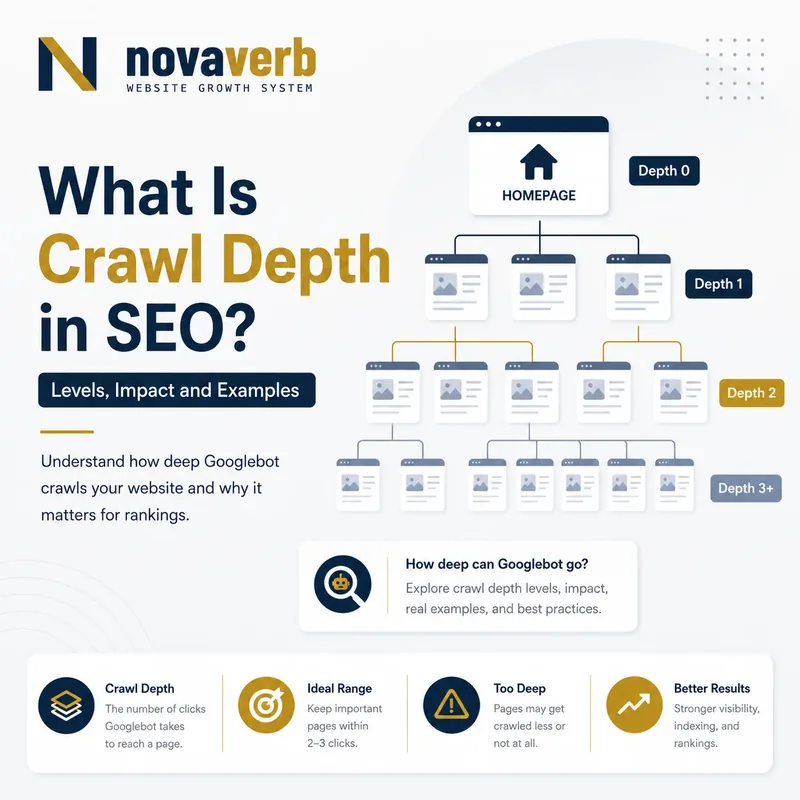
What Is Crawl Depth in SEO?
Crawl depth in SEO is the minimum number of observed link or crawl transitions required for a configured crawler to reach a URL from its defined starting set. A seed URL is normally recorded at depth zero. A page linked directly from that seed is at depth one, and each additional transition increases the observed depth by one.
Crawl depth is calculated from the shortest route the crawler finds, not from every possible route. A page may be accessible through a five-step sequence and also through a direct link from a section hub. In that crawl, the shorter route normally determines the page’s reported depth.
“The distance between two vertices in a graph is the number of edges in a shortest path.” Wikipedia - Distance in graph theory
A website can be modeled as a directed graph in which URLs act as nodes and crawlable links or transitions act as edges. Crawl depth describes the shortest observed distance from the selected seed set to a destination within that graph.
Core Crawl-Depth Terms
| Term | Operational meaning | Example | What it does not prove |
|---|---|---|---|
| Seed URL | A URL supplied as a starting point for the crawl. | The homepage or a section hub begins at depth zero. | That a search engine begins from the same URL. |
| Depth zero | The URL is part of the configured starting set. | The homepage entered directly as the crawl seed. | That the page is the most important URL on the site. |
| Depth one | The crawler reaches the URL through one transition from a seed. | A product hub linked directly from the homepage. | That the link receives user clicks or search value. |
| Deep URL | A URL requires more observed transitions than nearby or comparable priority pages. | A core product page found only after several archive and pagination pages. | That every high-depth URL has an SEO problem. |
| Shortest path | The route with the fewest successful transitions found by the crawler. | Homepage → Products → Product page. | That the route is the best user journey. |
| Alternate path | Another route that reaches the same destination. | A product page is also reached from a related guide. | That all paths contribute equal context or reliability. |
| Unreachable URL | No valid path is found from the selected starting set. | A sitemap URL with no crawlable internal inlinks. | That no external crawler has ever discovered the address. |
| Observed depth | The depth produced by one crawler under documented settings. | Depth four in an HTML-only crawl from the homepage. | That another crawler will report the same value. |
| Weighted importance | A separate assessment of page role, demand, revenue, or business value. | A depth-three product page may be more important than a depth-one legal page. | That depth should be ignored. |
Crawl Depth Depends on Crawl Configuration
- Starting set: Adding section hubs as seeds can lower the reported depth of their descendants.
- Crawl scope: Excluding subdomains, parameters, directories, or external hosts changes possible routes.
- Rendering: JavaScript-enabled crawling may reveal shorter or additional paths.
- Robots handling: Blocked source pages can remove routes that would otherwise exist.
- Redirect handling: Tools may count, collapse, or report redirect transitions differently.
- URL normalization: Duplicate variants may be merged or recorded as separate nodes.
- Crawl limits: Maximum depth, URL count, time, or pagination limits can leave deeper pages undiscovered.
Crawl Depth Is Not a Direct Ranking Score
A low-depth URL is not automatically relevant, authoritative, indexable, or valuable. Global footer and legal links can place low-priority pages near the crawl root, while specialized resources may reasonably sit deeper inside a focused hierarchy. Depth becomes useful when it is interpreted against page role and intended user journey.
Use Crawl Explorer to inspect URL-level depth, internal links, parent pages, redirects, statuses, and alternate crawl paths. Review sitewide depth patterns with the Site Health Audit.