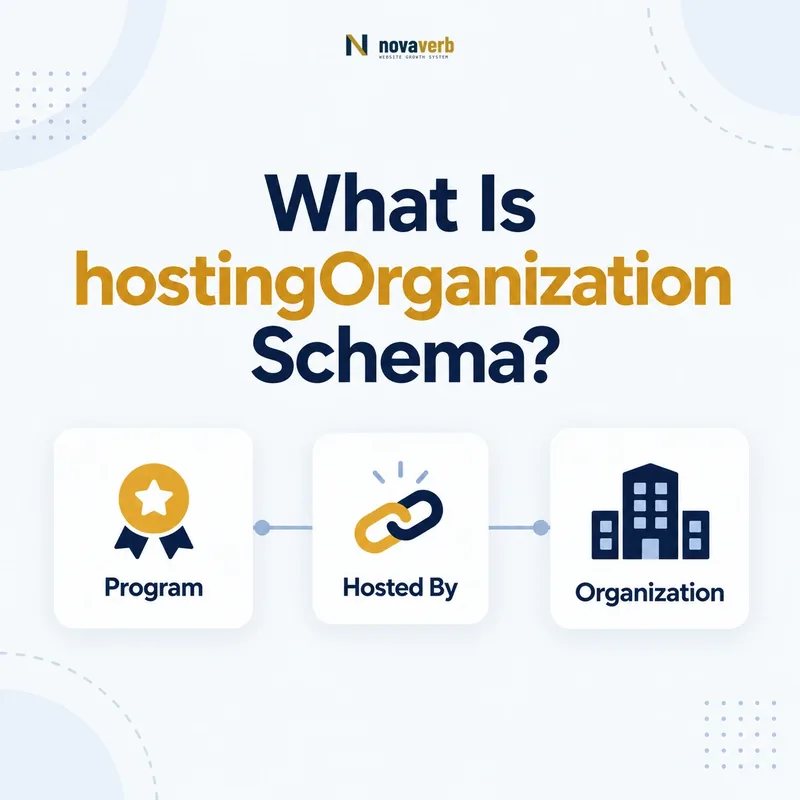
What Is hostingOrganization Schema?
hostingOrganization is the Schema.org property that identifies the Organization offering a MemberProgram or governing a ProgramMembership.
It answers a narrow ownership question: which legal or operating organization stands behind this program relationship? That distinction matters when a loyalty program name differs from the retailer, airline, hotel group, marketplace, or parent brand that actually operates it. The value should be an Organization entity with a stable identity, not a slogan, membership tier, payment card, or generic text label. Clear ownership helps machines connect a program, its memberships, and the business responsible for them without guessing from page design.
- Use an Organization node as the value.
- Give that organization a stable @id across relevant pages.
- Keep the program name on MemberProgram rather than using it as the host.
- Identify the exact page, asset, entity or relationship described in this section.
- Inspect the live implementation and retain the observed evidence.
- Compare the observation with the intended meaning and its primary specification.
- Correct any mismatch, then retest the live result.
- Record the accountable owner and review date.
| Question | Correct entity | Why |
|---|---|---|
| Who offers the program? | Organization | Defines accountable ownership |
| What is offered? | MemberProgram | Describes the loyalty program |
| Who belongs? | ProgramMembership | Describes the member relationship |
Primary specification: Schema.org definition for hostingOrganization.
hostingOrganization should name the accountable program host, while other entities describe the program and membership.
Where Can hostingOrganization Be Used?
hostingOrganization can be used on both MemberProgram and ProgramMembership, but each placement expresses a different scope.
On MemberProgram, it states who offers the program as a whole. On ProgramMembership, it states which organization governs that particular membership record. Many sites only need the program-level statement because individual memberships inherit the same owner conceptually. Membership-level markup becomes useful when an account page combines memberships from multiple companies, imported partner programs, or white-label services. Do not add the property everywhere merely to increase markup volume; add it where the page visibly establishes the relationship.
- Mark the program host on the canonical program page.
- Add it to membership records when the page represents a specific account relationship.
- Reuse the same Organization @id when the owner is unchanged.
- The exact page, asset, entity or relationship covered by this section
- The live implementation rather than an editor-only preview
- The primary specification or first-party record defining the expected behavior
- The validation result, accountable owner and review date
| Placement | Meaning | Best page |
|---|---|---|
| MemberProgram | Organization offering the whole program | Program overview |
| ProgramMembership | Organization governing one membership | Account or membership detail |
| Both | Explicit ownership at both levels | Multi-program account hub |
Choose placement from the page’s real subject and reuse one organization identity wherever ownership is the same.
How Does hostingOrganization Relate to hasMemberProgram?
hostingOrganization and hasMemberProgram describe the same business relationship from opposite directions and should agree.
An Organization can use hasMemberProgram to point to its MemberProgram, while that MemberProgram can use hostingOrganization to point back to the Organization. This reciprocal graph is especially useful when the corporate page and loyalty-program page are separate URLs. It is not mandatory to force both properties onto one page, but disagreement is a serious data-quality problem. If a brand page names one program while the program identifies another host, crawlers must reconcile conflicting ownership claims.
- Create a stable Organization node.
- Connect Organization to MemberProgram with hasMemberProgram.
- Connect MemberProgram back with hostingOrganization.
- Validate that both references use the same @id.
- The exact page, asset, entity or relationship covered by this section
- The live implementation rather than an editor-only preview
- The primary specification or first-party record defining the expected behavior
- The validation result, accountable owner and review date
| Direction | Property | Expected value |
|---|---|---|
| Organization → program | hasMemberProgram | MemberProgram |
| Program → organization | hostingOrganization | Organization |
| Membership → organization | hostingOrganization | Organization |
Treat the two properties as a consistency pair: one program, one authoritative host identity, two compatible directions.
Which Organization Should Host the Program?
The host should be the organization that offers and is accountable for the membership program, not whichever logo is most prominent on the page.
Start with the terms, enrollment agreement, account issuer, and customer-service responsibility. A parent corporation is not automatically the right answer if a consumer-facing subsidiary runs the program. Likewise, a brand is not automatically wrong: if the brand is the organization customers contract with, its Organization node may be the clearest host. Use the entity that can consistently own enrollment, benefits, member data, and program policies across the site.
- Review the program terms and enrollment language.
- Identify who can change benefits or terminate membership.
- Confirm which entity handles member support and data rights.
- Choose the narrowest accurate Organization and document its @id.
- The exact page, asset, entity or relationship covered by this section
- The live implementation rather than an editor-only preview
- The primary specification or first-party record defining the expected behavior
- The validation result, accountable owner and review date
| Candidate | Use as host? | Decision signal |
|---|---|---|
| Operating brand | Often | Runs enrollment and benefits |
| Parent company | Sometimes | Directly owns the program contract |
| Vendor platform | Rarely | Only if it truly offers the program |
| Card network | Sometimes | Only for its own membership program |
The best host is the organization with real program authority, not the most recognizable name.
How Does hostingOrganization Work on ProgramMembership?
On ProgramMembership, hostingOrganization identifies the organization responsible for that specific member relationship.
This is different from the program property, which identifies the MemberProgram the person or organization belongs to. A membership may also include a membershipNumber and validForMemberTier, but none of those replaces ownership. Account dashboards should only expose data users can actually see and should never place sensitive member identifiers into public markup. Public explanatory pages can model example memberships without copying real account numbers.
- Reference the MemberProgram through program.
- Reference the owner through hostingOrganization.
- Use validForMemberTier for the applicable tier.
- Keep private membership numbers out of public HTML.
- Identify the exact page, asset, entity or relationship described in this section.
- Inspect the live implementation and retain the observed evidence.
- Compare the observation with the intended meaning and its primary specification.
- Correct any mismatch, then retest the live result.
- Record the accountable owner and review date.
| Membership field | Value type | Purpose |
|---|---|---|
| program | MemberProgram | Names the joined program |
| hostingOrganization | Organization | Names the governing host |
| validForMemberTier | MemberProgramTier | Names the member’s tier |
| membershipNumber | Text | Account identifier; protect when private |
A clean ProgramMembership separates program identity, organizational ownership, tier status, and private account data.
How Do Multi-Brand and Marketplace Programs Work?
Multi-brand and marketplace programs need one host per program unless the business truly operates distinct programs under separate organizations.
A shared rewards program spanning several storefronts may still have one central host. In that case, connect every relevant page to the same MemberProgram and Organization @id rather than minting a new program for each brand. If each marketplace seller runs its own loyalty offer, the marketplace should not claim to host all of them. Model only relationships supported by visible terms and program pages, and avoid confusing program participation with program ownership.
- Map every brand, seller, and program before writing markup.
- Separate participation from ownership.
- Consolidate duplicate nodes that describe the same host.
- Create separate programs only when rules or accountable organizations differ.
- The exact page, asset, entity or relationship covered by this section
- The live implementation rather than an editor-only preview
- The primary specification or first-party record defining the expected behavior
- The validation result, accountable owner and review date
| Business model | Likely host | Modeling choice |
|---|---|---|
| One group-wide program | Central operating organization | One shared program @id |
| Independent brand programs | Each brand organization | Separate program nodes |
| Seller loyalty offers | Individual sellers | Do not assign marketplace ownership |
| White-label program | Contracting consumer-facing organization | Vendor remains a service provider |
Model the real operating structure: shared programs stay shared, while independent programs keep distinct hosts.
How Do Card Partners and Third-Party Operators Affect Ownership?
Card partners and technology operators should not replace the hostingOrganization unless they actually offer and govern the membership program.
Co-branded experiences can display several organizations: a retailer, issuing bank, card network, and loyalty platform. Their commercial roles are not interchangeable. The program terms usually reveal whether the retailer’s rewards program, the bank’s cardmember program, or a jointly governed entity is the subject. A software provider that stores points or powers the portal is usually a vendor, not the membership host. When ownership is genuinely joint but the vocabulary cannot express every contractual nuance cleanly, prefer the clearest accountable entity and describe partners elsewhere on the page.
- Do not infer ownership from logo order.
- Distinguish issuer, network, operator, and program host.
- Use visible legal and customer-support evidence.
- Recheck ownership after partnership or card portfolio changes.
- Identify the exact page, asset, entity or relationship described in this section.
- Inspect the live implementation and retain the observed evidence.
- Compare the observation with the intended meaning and its primary specification.
- Correct any mismatch, then retest the live result.
- Record the accountable owner and review date.
| Party | Typical role | Usually hostingOrganization? |
|---|---|---|
| Retailer | Rewards sponsor | Often |
| Issuing bank | Card account owner | Only for its program |
| Card network | Payment network | Rarely |
| Loyalty platform | Technology operator | Usually no |
Partner visibility is not proof of ownership; select the entity that truly offers and governs the program.
What hostingOrganization Mistakes Are Common?
The most common errors are using text instead of Organization, assigning the wrong corporate entity, and creating conflicting owner nodes.
Teams also confuse a tier, program name, or service vendor with the organization host. Another frequent problem appears after acquisitions: old pages retain the former company @id while new pages create a replacement, splitting one active program across two owners. Validation can catch wrong value types, but it cannot determine contractual truth. That requires comparing markup with current terms, organization pages, enrollment flows, and account experiences.
- Using a plain string where an Organization node is expected.
- Pointing to MemberProgram instead of Organization.
- Creating a different host @id on every page.
- Leaving legacy owners after a merger or rebrand.
- Marking a vendor as host because it powers the portal.
- Identify the exact page, asset, entity or relationship described in this section.
- Inspect the live implementation and retain the observed evidence.
- Compare the observation with the intended meaning and its primary specification.
- Correct any mismatch, then retest the live result.
- Record the accountable owner and review date.
| Error | Impact | Fix |
|---|---|---|
| Text-only value | Weak entity connection | Reference an Organization node |
| Wrong value type | Invalid relationship | Replace with Organization |
| Duplicate owner @ids | Fragmented graph | Choose one canonical @id |
| Stale company | Incorrect ownership | Update all program surfaces |
Technical validity is only the floor; accurate, current, and consistent ownership is the real standard.