
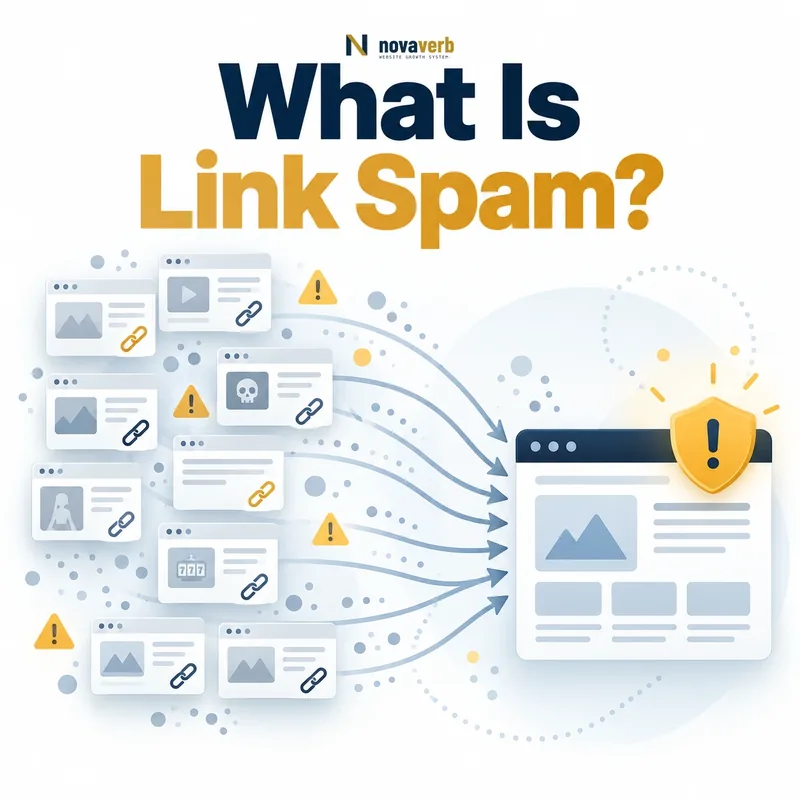
What Is Link Spam?
Spam can involve inbound or outbound links, automated placements, deceptive networks, hidden exchanges or campaigns designed around controlled anchors and destinations. The visible format can imitate editorial content, directories, comments, widgets or partner pages.
An unsolicited scraper link is not automatically evidence that the destination participated in link spam. Separate the source’s behavior from the target organization’s actions and preserve uncertainty when ownership or acquisition records are unavailable.
- Controlled creation or placement
- Primary purpose of manufacturing signals
- Little independent audience justification
- Repeated campaign or network patterns
- Destination or anchor coordination
- Material relationship evidence
- Clear separation from unrequested noise
- Frame the decision raised by What Is Link Spam.
- Inspect its context, anchor, destination and redirects.
- Compare the observation with relationship evidence.
- Classify the pattern before assigning any repair.
- Recheck the live source after the action is complete.
| Definition element | Question | Evidence |
|---|---|---|
| Control | Who created or requested the link? | Account or campaign record |
| Purpose | Why was placement made? | Terms and content context |
| Scale | Is behavior repeated? | Pattern grouping |
| Beneficiary | Which target receives value? | Destination overlap |
| Audience | Does the link help real users? | Live source review |
| Confidence | Is the conclusion proven? | Corroborated facts |
Link spam is a behavior and relationship conclusion supported by control and purpose evidence, not a synonym for every weak-looking backlink.
What Are Common Types of Link Spam?
A format does not determine intent by itself. A paid sponsorship can be transparent and useful, a reciprocal link can reflect a real partnership and a directory can serve qualified customers. Spam arises when the relationship and execution are designed deceptively to manufacture link signals.
Classify the actual campaign rather than assigning guilt by source type. Record who controlled the placement, what was exchanged, which destinations and anchors were specified and whether real audience value explains the link.
- Undisclosed paid placements
- Automated comment or forum links
- Bulk profile creation
- Private blog networks
- Irrelevant directory submissions
- Coordinated reciprocal exchanges
- Widget or badge link requirements
- Low-value guest article campaigns
- Hidden or injected links
- Frame the decision raised by What Are Common Types of Link Spam.
- Inspect its context, anchor, destination and redirects.
- Compare the observation with relationship evidence.
- Classify the pattern before assigning any repair.
- Recheck the live source after the action is complete.
| Pattern | Potential spam behavior | Legitimate alternative |
|---|---|---|
| Paid article | Placement sold as independent | Disclosed sponsorship |
| Directory listing | Bulk irrelevant submission | Audience-focused business listing |
| Reciprocal links | Large coordinated exchange | Real partner references |
| Widget link | Forced keyword destination | Useful transparent attribution |
| Guest content | Article built around self-serving link | Expert contribution |
| Comments | Automated anchor placement | Genuine community participation |
Judge the controlling purpose and relationship because legitimate and manipulative links can share the same visible format.
Link Spam vs Low-Quality Backlinks
Provider spam or toxicity scores are estimates based on proprietary observations. They can prioritize review but cannot prove who acquired a link, whether a payment occurred or what a search account experienced.
Use precise labels such as irrelevant, inactive, copied, unrequested, controlled or confirmed paid. This keeps operational decisions honest and prevents a broad score from replacing source and campaign evidence.
- Source quality is not acquisition control
- Appearance is not relationship proof
- Metrics are review filters
- Unrequested links require separate treatment
- Polished publishers can host paid schemes
- Exact factual labels improve decisions
- Frame the decision raised by Link Spam vs Low-Quality Backlinks.
- Inspect its context, anchor, destination and redirects.
- Compare the observation with relationship evidence.
- Classify the pattern before assigning any repair.
- Recheck the live source after the action is complete.
| Classification | What it states | Evidence needed |
|---|---|---|
| Low relevance | Source and target topics do not fit | Page context |
| Low audience value | Source serves little useful purpose | Live source review |
| Unrequested | Target did not control acquisition | Account and campaign records |
| Suspicious | Several signals need review | Pattern evidence |
| Confirmed spam | Manipulative control and purpose proven | Direct corroborated records |
| Provider risk score | Third-party estimate | Provider methodology |
Keep source quality, acquisition control, provider estimates and confirmed manipulation as separate fields in every audit.
What Are Link Spam Warning Signs?
Sudden growth can reflect publicity, sitewide templates or provider rediscovery. Shared infrastructure can reflect common hosting. Exact-match anchors can be product names. Treat signals as prompts for investigation instead of automatic verdicts.
The strongest cases connect live source patterns with invoices, vendor messages, submission accounts, contractual requirements or internal campaign instructions. Document alternative explanations and confidence.
- Repeated controlled commercial anchors
- Many irrelevant sources added together
- Same beneficiaries across apparent publishers
- Shared ownership or account artifacts
- Template placements with no user purpose
- Required exchanges or hidden fees
- Known vendor or submission records
- Network-wide changes
- Frame the decision raised by What Are Link Spam Warning Signs.
- Inspect its context, anchor, destination and redirects.
- Compare the observation with relationship evidence.
- Classify the pattern before assigning any repair.
- Recheck the live source after the action is complete.
| Warning sign | Why review it | Possible false positive |
|---|---|---|
| Anchor repetition | May reflect campaign control | Brand or product name |
| Aligned first-seen dates | May reflect deployment | Provider recrawl |
| Shared targets | May reflect coordination | Popular destination |
| Shared hosting | May connect operators | Common platform |
| Thin placement pages | May exist for links | New or neglected site |
| Large loss event | May reveal network removal | Source migration |
Signals become persuasive only when several independent facts point toward the same controlled placement system.
Can Spam Backlinks Be Unrequested?
This distinction changes the response. A company should stop and document its own manipulative campaign, while unfamiliar unrequested noise often begins with monitoring, source verification and checks for direct account evidence.
Do not manufacture certainty about hostile intent. Many strange links arise from copying, abandoned software or provider discovery. Record what is live, what the organization controlled and which explanations remain unproven.
- Content scrapers
- Automated aggregators
- Bot-created profiles
- Compromised websites
- Unrequested negative activity
- Provider historical records
- Copied or syndicated pages
- Abandoned domain reuse
- Frame the decision raised by Can Spam Backlinks Be Unrequested.
- Inspect its context, anchor, destination and redirects.
- Compare the observation with relationship evidence.
- Classify the pattern before assigning any repair.
- Recheck the live source after the action is complete.
| Source situation | Control evidence | Default posture |
|---|---|---|
| Known vendor campaign | Confirmed target control | Stop and investigate |
| Internal bulk submission | Confirmed target control | Preserve and remediate |
| Unfamiliar scraper pages | No target control found | Monitor |
| Copied article network | Control uncertain | Find original and group |
| Compromised legitimate site | Third-party incident | Verify and monitor |
| Provider-only historical row | No live link | Document stale evidence |
A target should be judged by its own verified actions and records rather than by every link another party can create toward it.
What Risks Can Link Spam Create?
Controlled campaigns may disappear in clusters, concentrate destinations and anchors, conceal vendor spending or trigger direct account concerns. Exact search consequences should be stated only from first-party account evidence, not inferred from a provider score.
Overreaction has costs too. Broad removal or disavowal decisions made from weak labels can consume resources and damage legitimate relationships. Use evidence thresholds appropriate to the severity and reversibility of the action.
- Direct account concern
- Coordinated link loss
- Vendor and budget exposure
- Misleading acquisition reporting
- Brand association with deceptive sources
- Destination and anchor concentration
- Time lost to false positives
- Damage from unnecessary intervention
- Frame the decision raised by What Risks Can Link Spam Create.
- Inspect its context, anchor, destination and redirects.
- Compare the observation with relationship evidence.
- Classify the pattern before assigning any repair.
- Recheck the live source after the action is complete.
| Risk | What can be verified | What not to assume |
|---|---|---|
| Search account | Message or manual record | Penalty from score alone |
| Financial | Invoice and spend | Value from link count |
| Operational | Network-wide changes | Cause from timing alone |
| Reputation | Live brand placement | Audience perception without evidence |
| Reporting | Earned versus paid mismatch | Editorial status from appearance |
| Response | Action and outcome | Benefit of blanket removal |
Risk decisions should weigh confirmed controlled behavior and direct outcomes against the cost of acting on uncertain third-party signals.
How Do You Analyze Link Spam?
Use backlink audit, link velocity and PBN backlink workflows for event and network context. Verify exact referring pages rather than judging domains from totals.
Group thousands of template, scraper or network rows into underlying events. Maintain columns for observed facts, target control, alternative explanations, confidence, risk, owner and next action.
- Lock provider, target scope and date
- Group sources by domain, anchor and destination
- Compare first-seen and loss timing
- Open representative live referring pages
- Identify templates, copies and shared beneficiaries
- Check internal vendor and campaign records
- Review direct search account evidence
- Test legitimate alternative explanations
- Grade confidence and control
- Assign proportionate action
- Evidence for How Do You Analyze Link Spam: the live referring page and surrounding context
- The anchor, destination and complete redirect path
- Disclosure or relationship evidence where one exists
- Repeated patterns across sources, anchors and destinations
- A timestamped recheck before assigning an action
| Analysis layer | Question | Output |
|---|---|---|
| Observation | What links are live? | Verified source set |
| Pattern | Which rows share a cause? | Grouped events |
| Control | Did the target create or buy them? | Ownership evidence |
| Purpose | Why were placements made? | Relationship classification |
| Account | Is there direct search evidence? | First-party status |
| Confidence | What remains uncertain? | Graded conclusion |
| Action | What is proportionate? | Owned next step |
A reliable analysis connects live source patterns to control, purpose and first-party evidence while preserving uncertainty.
What Should You Do About Link Spam?
Start with Backlink Checker for discovery and Backlinks Explorer for grouping sources, anchors and changes. Use the toxic backlink framework to keep provider labels separate from action evidence.
Connect investigation, outreach, removals and review dates through the SEO tools system. Preserve exact sources, internal authorization, vendor records, account messages, action history and verified outcomes.
- Confirm target control and relationship
- Stop active manipulative campaigns
- Preserve contracts, invoices and messages
- Separate confirmed cases from uncertain noise
- Request source removal when justified
- Document responses and failures
- Follow direct account instructions when present
- Monitor unrequested links
- Retest source and account state
- Update acquisition governance
- Evidence for What Should You Do About Link Spam: the live referring page and surrounding context
- The anchor, destination and complete redirect path
- Disclosure or relationship evidence where one exists
- Repeated patterns across sources, anchors and destinations
- A timestamped recheck before assigning an action
| Evidence condition | Proportionate response | Success evidence |
|---|---|---|
| Confirmed controlled scheme | Stop and remediate | Campaign ended and records retained |
| Vendor behavior uncertain | Audit contract and sources | Control clarified |
| Unrequested spam noise | Monitor first | No unsupported escalation |
| Legitimate relationship mislabeled | Correct classification | Evidence attached |
| Direct account message | Use scoped process | Account status documented |
| Provider score only | Investigate, not verdict | Live facts collected |
Start with a relevant Backlink Checker, continue the evidence workflow in Backlinks Explorer, and review pricing when comparing continuous monitoring with a one-time manual review.
The best response removes confirmed controlled manipulation while avoiding severe action against sources the organization neither created nor authorized.