
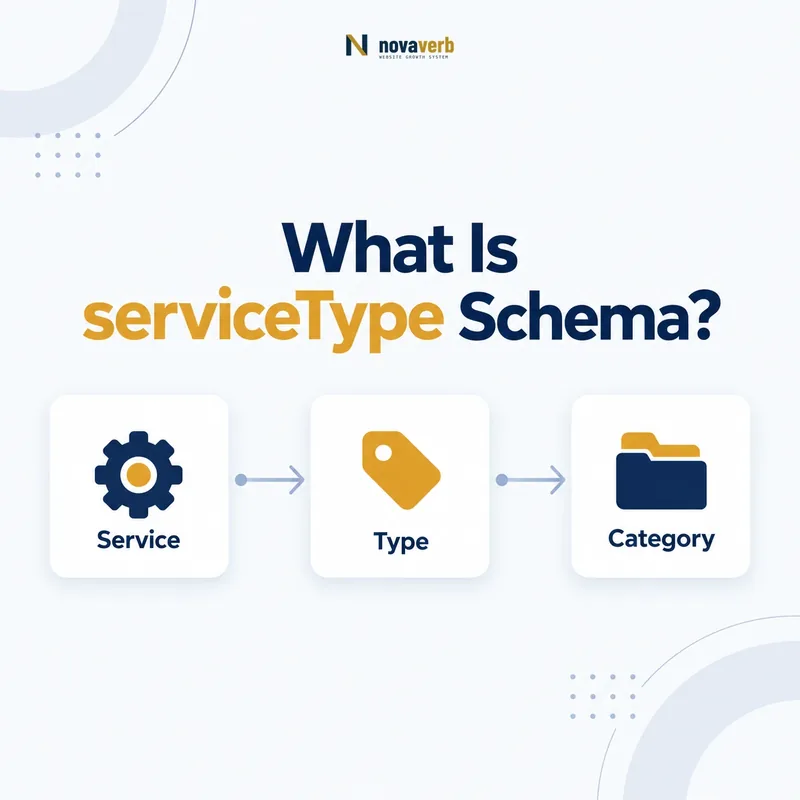
What Is serviceType Schema?
The serviceType schema property identifies the type of service being offered on a Service entity, usually with a clear Text value such as “Technical SEO Audit” or “Emergency Plumbing.”
It answers what kind of service the entity represents. The value should match the service visitors can see and understand on the page, not a hidden keyword list or a broad company industry. Schema.org also permits GovernmentBenefitsType for relevant government-benefit services.
serviceType belongs on Service. It does not replace the Service entity, its name, provider, offer, audience or areaServed. Together, those fields can say what the service is, who provides it, where it is available, who it targets and how it can be purchased.
- Frame the decision raised by What Is serviceType Schema.
- Confirm its value type and the object it describes.
- Compare the markup with visible page information.
- Correct the source data or template without inventing values.
- Validate the rendered result and monitor future changes.
| Element | Question answered | Example |
|---|---|---|
| Service | What service entity exists? | A technical SEO engagement |
| name | What is this service called? | Enterprise Technical SEO |
| serviceType | What kind of service is it? | Technical SEO Consulting |
| provider | Who provides it? | Named Organization |
| areaServed | Where is it provided? | United States |
- Use a factual service category.
- Match visible page language.
- Keep other service facts in their own properties.
serviceType should identify the real service class without trying to describe the entire commercial offer.
Where Is serviceType Allowed?
Use serviceType on a Service entity; its expected value is Text or, in the relevant government-benefit context, GovernmentBenefitsType.
Do not place serviceType directly on Organization, LocalBusiness, Product, Offer or WebPage. Those entities may connect to Service, but the property’s subject remains the service being described. A LocalBusiness can be the provider of a Service, and an Offer can reference that Service through itemOffered.
Page templates often blur these layers by placing every field on one Organization node. Separate entity roles before adding the label. This preserves the difference between the company, the service, the commercial terms and the page itself.
- Evidence for Where Is serviceType Allowed: the live structured-data entity and property relationship
- The expected value type and any nested object
- Visible page information that supports the structured value
- Related offer or catalog fields needed for interpretation
- A fresh validation result after the page changes
| Placement | Meaning | Decision |
|---|---|---|
| Service.serviceType | Type of service offered | Correct |
| Organization.serviceType | Attempts to label company | Use Service node instead |
| Offer.itemOffered → Service | Offer for the service | Good relationship |
| WebPage.serviceType | Attempts to label page | Wrong subject |
- Identify the Service entity.
- Connect its provider and Offer separately.
- Add serviceType to Service.
- Verify the page describes that service.
Correct subject placement keeps a service category from becoming an inaccurate company or page label.
How Is serviceType Different From Service?
Service is the entity representing an activity or benefit provided by an organization, while serviceType is one property that classifies what kind of service that entity is.
The relationship resembles Product and category: the entity carries multiple facts, while a classification supplies one descriptive dimension. A Service can have a name, description, provider, offers, areaServed, audience, hoursAvailable and serviceType. A serviceType string alone cannot express those relationships.
Do not use a generic Organization node with serviceType as a shortcut for Service markup. Creating the Service node makes the graph extensible and gives every claim a clear subject.
- Frame the decision raised by How Is serviceType Different From Service.
- Confirm its value type and the object it describes.
- Compare the markup with visible page information.
- Correct the source data or template without inventing values.
- Validate the rendered result and monitor future changes.
| Layer | Role | Example |
|---|---|---|
| Organization | Provider entity | SEO agency |
| Service | Service entity | Site migration consulting |
| serviceType | Service classification | Technical SEO Consulting |
| Offer | Commercial availability | Fixed-price audit package |
- Model the service as an entity.
- Use serviceType only as its classification.
- Connect provider and offer through their proper properties.
Service supplies the entity structure; serviceType supplies one readable classification inside it.
How Is serviceType Different From category?
serviceType states the type of service being offered, while category can classify many kinds of items and supports Text, URL, Thing or CategoryCode values.
For a Service page, the two may overlap. “Technical SEO Consulting” can be an appropriate serviceType, while category might place it inside a broader taxonomy such as “Marketing Services.” Use both only when each communicates a real distinct level.
Do not duplicate the same keyword phrase across name, serviceType and category solely for repetition. Choose labels based on information architecture and visible content. If there is no maintained taxonomy, serviceType may be sufficient.
- Evidence for How Is serviceType Different From category: the live structured-data entity and property relationship
- The expected value type and any nested object
- Visible page information that supports the structured value
- Related offer or catalog fields needed for interpretation
- A fresh validation result after the page changes
| Property | Purpose | Example |
|---|---|---|
| name | Specific service name | Enterprise Crawl Recovery |
| serviceType | Kind of service | Technical SEO Consulting |
| category | Broader classification | Digital Marketing Services |
| description | Explains scope and outcome | Visible summary of engagement |
- Identify the specific service name.
- Select a factual serviceType.
- Add category only for a real taxonomy level.
- Remove redundant keyword repetition.
serviceType classifies the service itself, while category should add broader taxonomy rather than duplicate the same phrase.
How Do You Write a Clear serviceType Value?
Write serviceType as a concise, recognizable noun phrase that describes the service class, using the same terminology visitors see on the page and avoiding locations, superlatives or calls to action.
Strong values include “Roof Repair,” “Estate Planning,” “Technical SEO Audit” and “Managed Backlink Monitoring.” They describe activities customers can purchase or receive. “Best affordable Dallas roofers” combines a claim, price positioning, location and provider category rather than naming a service.
Keep geographic coverage in areaServed, intended customers in audience, price and availability in Offer, and provider identity in provider. This keeps serviceType stable even when commercial conditions change.
- Frame the decision raised by How Do You Write a Clear serviceType Value.
- Confirm its value type and the object it describes.
- Compare the markup with visible page information.
- Correct the source data or template without inventing values.
- Validate the rendered result and monitor future changes.
| Candidate value | Assessment | Reason |
|---|---|---|
| Technical SEO Audit | Strong | Recognizable service class |
| Best SEO Service USA | Poor | Claim plus location keywords |
| Marketing | Weak | Too broad for a specific page |
| 24/7 Emergency Plumbing | Mixed | Type plus availability; separate hours if possible |
- Use a noun phrase.
- Prefer customer-recognizable terminology.
- Separate location, price and availability.
A strong serviceType value names the work being offered without becoming an SEO headline.
Can One Service Have Multiple serviceType Values?
A Service can carry repeated values when it genuinely spans multiple closely related types, but separate Service entities are clearer when each service has different scope, pricing, provider, audience or area.
A managed SEO engagement combining technical consulting and content optimization may justify two classifications if the page presents one integrated service. A company page listing audits, link analysis and local SEO should usually model separate Service entities rather than one oversized serviceType list.
Granularity should follow how customers understand and buy the work. If each item has its own landing page or offer, separate entities make internal linking, auditing and commercial relationships easier to maintain.
- Evidence for Can One Service Have Multiple serviceType Values: the live structured-data entity and property relationship
- The expected value type and any nested object
- Visible page information that supports the structured value
- Related offer or catalog fields needed for interpretation
- A fresh validation result after the page changes
| Situation | Model | Reason |
|---|---|---|
| One integrated engagement | One Service, limited type values | Single commercial unit |
| Different landing pages | Separate Services | Distinct page intent |
| Different prices or regions | Separate Service/Offer structures | Preserve commercial differences |
| Long keyword list | Remove unrelated types | Avoid taxonomy stuffing |
- Identify the purchasable service unit.
- Compare scope, price and audience.
- Split entities when those facts differ.
- Keep only supported classifications.
Multiple serviceType values should describe one coherent service, not replace a proper service catalog.
How Does serviceType Support Local SEO Pages?
On local service pages, serviceType clarifies what work is offered while areaServed, provider and Offer separately define where it is available, who performs it and under what commercial terms.
A page for “Foundation Repair in Phoenix” can model Service with serviceType “Foundation Repair,” areaServed City “Phoenix,” and a LocalBusiness provider. Keeping the location outside serviceType makes the service classification reusable and reduces keyword-heavy strings.
Do not create structured services for location pages that merely swap city names while the business cannot serve those areas. Every local entity should match real operational coverage and visible page content.
{
  "@type": "Service",
  "name": "Phoenix Foundation Repair",
  "serviceType": "Foundation Repair",
  "areaServed": {"@type": "City", "name": "Phoenix"},
  "provider": {"@type": "LocalBusiness", "name": "Example Provider"}
}- Frame the decision raised by How Does serviceType Support Local SEO Pages.
- Confirm its value type and the object it describes.
- Compare the markup with visible page information.
- Correct the source data or template without inventing values.
- Validate the rendered result and monitor future changes.
| Local fact | Property | Subject |
|---|---|---|
| Work performed | serviceType | Service |
| City served | areaServed | Service |
| Business identity | provider | Service → Organization |
| Price/availability | offers | Service → Offer |
- Separate service and location terms.
- Use real coverage evidence.
- Connect the actual local provider.
Local service markup is strongest when serviceType names the work and other properties carry the local commercial facts.
What serviceType Mistakes Are Common?
Common serviceType mistakes include placing it on Organization, copying page titles into the value, stuffing locations and modifiers, combining unrelated services and leaving labels stale after service changes.
Because Text is flexible, almost any phrase can pass basic validation. A passing parser cannot determine whether “best nationwide affordable SEO” is a useful service type or whether the business actually provides the service. Evidence and entity review remain essential.
Another risk is template inheritance. One default serviceType may appear across dozens of specialty pages, erasing their distinctions. Or location templates may inject city names into the classification even though areaServed already models geography.
- Evidence for What serviceType Mistakes Are Common: the live structured-data entity and property relationship
- The expected value type and any nested object
- Visible page information that supports the structured value
- Related offer or catalog fields needed for interpretation
- A fresh validation result after the page changes
| Mistake | Impact | Repair |
|---|---|---|
| serviceType on Organization | Wrong subject | Create Service entity |
| Full SEO title as value | Promotional and unstable | Use factual service phrase |
| City stuffed into type | Classification mixes geography | Use areaServed |
| Unrelated services merged | Unclear entity | Create separate Services |
| Old offering retained | False availability | Sync with service catalog |
- Confirm the property subject.
- Compare the label with visible service copy.
- Remove promotional and location modifiers.
- Trace repeated errors to templates.
A valid serviceType must be structurally placed, editorially clear and commercially current.