Answer First
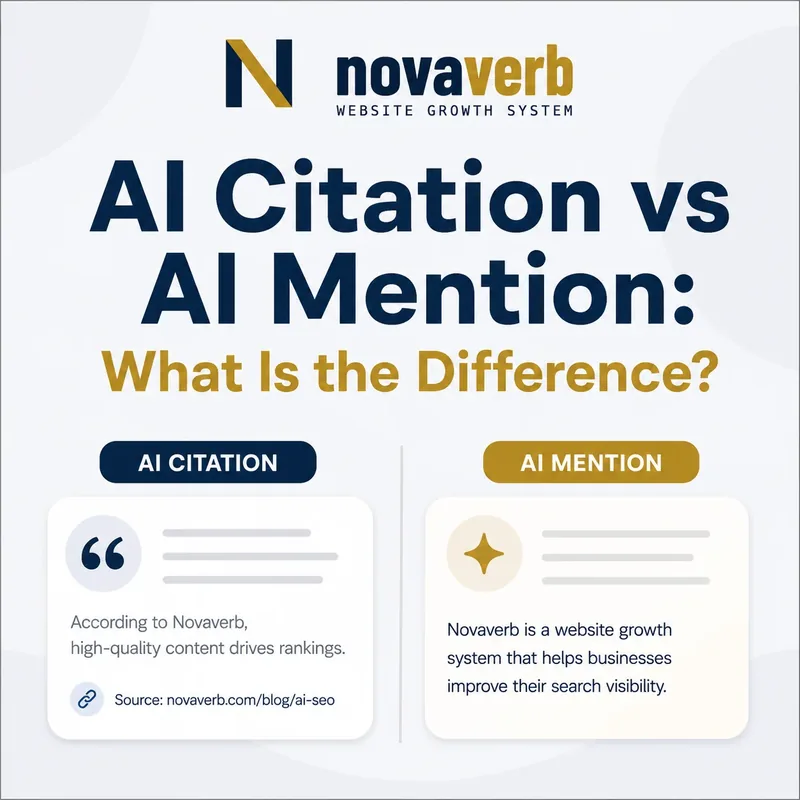
An AI mention occurs when a generated answer names a brand, product, person or organization. An AI citation occurs when the answer visibly attributes supporting information to an identifiable source or URL. A mention can appear without a citation, and a citation can point to a page without prominently naming the publisher in the answer.
The answer contains the tracked entity’s name, even when no owned URL or supporting source is displayed.
The answer or its source interface connects information to a page, domain, document or other inspectable source.
Use the AI Citation Tracker to record whether a brand is cited, missing or replaced for specific questions. For the wider optimization discipline, read What Is GEO?.
What Is an AI Mention?
An AI mention is the observable appearance of a named entity in an AI-generated answer. The entity may be a company, brand, product, person, framework, location or organization. A mention does not require a link, citation marker or proof that the system retrieved information from the entity’s own website.
Mentions measure whether an entity appears in the answer’s language. They are useful for tracking brand presence, but they should not be interpreted as proof that the brand supplied the underlying information.
The answer explicitly names a company or brand, such as “Novaverb.”
The answer names a specific product, feature, tool or service.
The answer identifies an author, founder, researcher, executive or practitioner.
The answer refers to a named process, framework, standard or methodology.
The entity appears as text, but the interface provides no link to an owned or third-party source.
The entity is named in a recommendation, comparison, explanation, warning or example.
“Tools such as Novaverb can help SEO teams examine AI-search visibility.”
The brand appears in the answer, but this sentence alone does not establish that a Novaverb page was retrieved or linked as a source.
A mention can be positive, neutral or negative. It can also be inaccurate, outdated or based on a third-party source. For that reason, serious monitoring should store the full answer context rather than count the entity name alone.
What Is an AI Citation?
An AI citation is an observable attribution that connects generated information to an identifiable source. Depending on the answer engine, the citation may appear as an inline marker, a linked page title, a source card, a footnote or an entry in a separate sources panel.
A citation is stronger evidence of source attribution than a mention because the user can usually inspect the source associated with the answer. It still does not prove how much of the source was used, whether the source caused the conclusion or whether the user clicked the link.
A citation marker or linked reference appears beside the sentence or claim it supports.
The interface displays a title, publisher, domain or preview connected to the generated answer.
The answer lists supporting pages in a dedicated section rather than in the answer body.
The cited source is a page on the tracked organization’s own domain.
The cited source is an independent publication, review, directory or research page discussing the entity.
A rival’s page is used to support the answer or occupy the source role the tracked brand wanted.
Novaverb separates citation readiness from observed citations so a technical score is not presented as source attribution that never appeared.
AI Citation vs AI Mention: The Main Differences
The primary difference is attribution: an AI mention identifies an entity, while an AI citation identifies a source. A mention answers “Did the brand appear?” A citation answers “Was an identifiable source connected to the answer?”
| Dimension | AI mention | AI citation |
|---|---|---|
| Observable object | Brand, product, person, organization or named entity. | URL, domain, page, document or source record. |
| Attribution required | No. | Yes, an identifiable source must be exposed. |
| Link opportunity | Usually absent, although the name may be clickable in some interfaces. | Usually stronger because a source page or domain is available for inspection. |
| Proof of source use | Weak. The name may come from general model knowledge or another source. | Stronger, but it does not reveal the complete retrieval or generation process. |
| Brand visibility | Direct: the entity name appears in the answer. | May be direct or indirect depending on whether the publisher is named. |
| Traffic potential | Limited when no source link exists. | Potentially higher when the source can be opened. |
| Best metric | Mention rate across a documented prompt set. | Citation coverage and owned-source share. |
| Main reporting risk | Counting any brand appearance as an owned citation. | Assuming every citation generated a click or commercial result. |
Can ChatGPT Mention a Brand Without Citing It?
Yes. ChatGPT can name a brand, product or person without displaying a source owned by that entity. The answer may contain the entity from general model knowledge, retrieved third-party material or another context that does not expose an attributable owned URL.
“Common AI-search visibility platforms include Novaverb and several enterprise SEO suites.”
Common mention-without-citation cases include:
- The answer names a well-known product from model knowledge without running web search.
- The brand is mentioned, but a third-party publication is cited as the supporting source.
- The answer lists several options without attaching a source to every option.
- The brand appears in a summary, while citations support only broader industry claims.
- The interface provides no source links for the specific answer experience.
Can a Website Be Cited Without Its Brand Being Mentioned?
Yes. An answer engine can cite a page title, domain or URL without naming the publisher prominently in the generated text. This creates source attribution and a possible click path, but it may deliver less direct brand recall than a result that combines a citation with a clear entity mention.
“A crawl block can prevent an answer engine from requesting the page, but it does not by itself explain every missing citation.”
“Can AI Search Cite Your Page? Check in 5 Minutes” - novaverb.com
In this example, the Novaverb page receives an owned citation even though the answer sentence does not say “Novaverb.” The source may still create authority, referral or discovery value, but brand presence should be recorded separately.
Use descriptive title elements and consistent entity signals across the homepage, article, author and organization data. For a page-level readiness check, review Can AI Search Cite Your Page?.
What Is the Difference Between Retrieval and Citation?
Retrieval is the process or event of selecting information that may help answer a question; citation is the visible attribution of generated information to a source. A page may be retrieved without receiving a visible citation, and an external observer usually cannot prove private retrieval solely from the final wording.
This sequence is not a guaranteed linear funnel. A result can skip stages visible to the observer. For example, an answer may cite a page without naming its publisher, or mention a brand without exposing any source.
Novaverb’s GEO framework similarly distinguishes retrieval, understanding, synthesis and citation instead of treating them as one event. Read the GEO definition and workflow.
Examples of AI Mentions and Citations
AI visibility results should be classified by both entity presence and source attribution. The six scenarios below show why a single “visibility” field cannot accurately represent mentions, citations and competitor replacement.
1. Brand mentioned, no source displayed
“Novaverb is one platform used to evaluate AI-search visibility.”
2. Brand mentioned, competitor cited
The answer names Novaverb, but the supporting source card links to a competitor’s comparison article.
3. Owned page cited, brand absent from answer
The generated text gives a technical explanation, while the sources panel links to a Novaverb guide.
4. Brand mentioned and owned page cited
The answer recommends Novaverb and links to its AI Citation Tracker product page.
5. Third-party page cited about the brand
The brand appears, but the citation points to an independent review or publication rather than the brand’s domain.
6. Brand omitted, rival owns the answer
A competitor is recommended and cited while the tracked brand is absent.
The sixth state is commercially important because the answer exists and cites a source, but another brand occupies the position. Novaverb calls this a replaced result rather than merely “not visible.”
Wikipedia
Which Metric Matters More: AI Mentions or Citations?
Neither metric is universally more important because they answer different business questions. Mentions measure entity presence and potential brand awareness. Citations measure observable source attribution and may create a direct route to the publisher’s page.
Prioritize mentions when you need to measure
- Whether the brand enters relevant recommendations.
- How often products or executives are named.
- Brand presence across category and comparison prompts.
- Sentiment, positioning and factual representation.
- Share of named entities relative to competitors.
Prioritize citations when you need to measure
- Whether owned pages are used as visible sources.
- Which URLs support definitions, facts or recommendations.
- Whether independent publications validate the brand.
- Which competitors occupy source positions.
- Which answer states can create referral opportunities.
The correct reporting hierarchy is therefore not “mentions versus citations.” It is:
Relevant prompt coverage → entity presence → source attribution → referral behavior → business outcome.
How Should You Measure AI Visibility?
AI visibility should be measured through a documented prompt set, explicit entity matching, inspectable source URLs and separate post-click outcomes. Every aggregated metric should retain the provider, question, answer, timestamp and supporting evidence beneath it.
| Metric | Suggested formula | What it reveals | Important limitation |
|---|---|---|---|
| Mention rate | Prompts containing the tracked entity ÷ prompts tested | How often the entity appears in observed answers. | Does not prove source attribution. |
| Citation coverage | Prompts citing any tracked source ÷ prompts tested | How often owned or earned sources appear. | Does not prove traffic or conversion. |
| Owned citation rate | Prompts citing an owned domain ÷ prompts tested | Direct source visibility for pages controlled by the brand. | Can miss valuable third-party validation. |
| Earned citation rate | Prompts citing independent sources about the brand ÷ prompts tested | External authority and third-party representation. | The cited page may contain outdated or inaccurate information. |
| Competitor replacement rate | Prompts where a target role is occupied by a rival ÷ eligible prompts | Where another brand owns the answer or source position. | Requires a clearly defined target role and competitor set. |
| Citation source share | Tracked citations ÷ all recorded citations in the prompt set | Relative source presence across tested answers. | Depends heavily on prompt selection and provider behavior. |
| Referral sessions | Recorded sessions attributed to supported AI referrers | Observable visits after source exposure. | Misses no-click visibility and untracked transitions. |
| Assisted conversion | Conversions with documented AI referral or assist evidence | Potential commercial contribution after exposure. | Attribution models can overstate or understate influence. |
Use the Novaverb AI Citation Tracker to preserve these observed answer states instead of relying on a single unexplained visibility score.
Why AI Visibility Scores Can Be Misleading
An AI visibility score can be misleading when it combines different observations, hides the tested prompt set or presents inferred readiness as actual answer-engine performance. The number is useful only when its inputs, weighting, evidence and limitations are disclosed.
A brand name and an owned source link are treated as equivalent outcomes.
The report does not disclose which questions, stages or markets produced the score.
Different answer engines and experiences are averaged into one number despite different behavior.
Page structure, schema or crawler access is reported as though a live citation occurred.
The score cannot show whether the brand controls the cited page or relies on third-party representation.
No answer capture, source URL, timestamp or provider record supports the result.
Broad informational prompts count the same as high-intent comparisons or purchase questions.
A single observation is presented as permanent ownership of an answer.
How to Track AI Mentions and Citations Separately
Track mentions as entity-level observations and citations as source-level observations within the same answer record. This preserves the relationship between what the answer said, which entities appeared and which pages received attribution.
- Define the decision topics. Group prompts by problem, category, comparison, use case, pricing or purchase decision.
- Create a fixed prompt set. Store the exact wording instead of testing loosely related questions each cycle.
- Record the answer environment. Capture the provider, product experience, model when available, language, market and date.
- Save the full answer. Retain enough context to evaluate how the brand or source was represented.
- Extract mentioned entities. Record exact and accepted variant names for brands, products, people and methods.
- Extract all cited sources. Save the full URL, domain, title and source position where available.
- Classify source ownership. Mark each citation as owned, earned, competitor, neutral reference or unknown.
- Assign the result state. Use cited, mentioned-only, missing or replaced without merging their meanings.
- Compare against the target role. Identify which page or entity should have supported the answer and what the selected source did better.
- Recheck on a documented cadence. Preserve earlier answers so volatility and trend can be separated.
A minimum record can use fields like these:
provider
answer_experience
prompt_id
prompt_text
intent_stage
tested_at
language
market
answer_text
brand_mentioned
products_mentioned
cited_urls
owned_citation
earned_citation
competitor_citation
result_state
evidence_location
next_actionThe AI Citation Tracker operationalizes this mention-versus-citation model across supported answer engines.
How Do Third-Party Citations Affect Brand Visibility?
A third-party citation can strengthen brand visibility when an independent source accurately explains, evaluates or recommends the entity. It can also create risk when the cited page is inaccurate, outdated, negative or controlled by a competitor or affiliate.
Potential value
- Independent validation rather than brand self-description.
- Visibility on trusted publications and comparison pages.
- Representation for prompts where answer engines prefer external sources.
- Additional pathways for discovery and referral.
- Reinforcement of product, author or organization entities.
Potential risk
- Incorrect pricing, features, ownership or availability.
- Old reviews that no longer reflect the product.
- Affiliate pages with undisclosed incentives.
- Competitor-controlled comparisons.
- A cited source that frames the brand negatively or ambiguously.
Do not treat all external citations as automatically beneficial. Citation quality, factual accuracy and source role matter as much as raw citation count.
AI Citation vs AI Mention Checklist
Use this checklist to prevent mentions, citations, retrieval readiness and post-click outcomes from being combined into one ambiguous visibility claim.
Answer evidence
- The provider and answer experience are recorded.
- The exact prompt is preserved.
- The date, language and market are documented.
- The full answer or sufficient context is stored.
Entity matching
- The official brand name is defined.
- Accepted name variants are documented.
- Product and person entities are stored separately.
- Ambiguous names are manually reviewed.
Source extraction
- Every visible source URL is captured.
- Redirected and canonical destinations are normalized.
- Owned, earned and competitor sources are separated.
- The source role within the answer is understood.
Result classification
- Mentioned-only is not labeled cited.
- Owned and third-party citations are distinguished.
- Missing and replaced are not treated as identical.
- One result is not generalized across all prompts.
Business measurement
- Referral sessions are measured separately.
- Conversions are not inferred from source presence.
- Prompts are weighted by commercial relevance.
- Trends retain the underlying answer evidence.
Improvement action
- The intended page or entity is identified.
- The selected competitor source is inspected.
- One evidence-backed content or authority gap is chosen.
- The result is retested after the change.
Frequently Asked Questions About AI Citations and Mentions
Is an AI mention the same as an AI citation?
Does a brand mention prove the AI used the brand’s website?
Can a citation appear without a clickable link?
Can an owned page be cited without the brand name appearing?
Is a third-party citation valuable?
Does an AI citation guarantee referral traffic?
Does an AI mention improve SEO rankings?
What does “replaced” mean in AI citation tracking?
Should mentions and citations be combined into one score?
How often should AI mentions and citations be checked?
What evidence should an AI citation report retain?
How can I improve an owned citation rate?
Track Where AI Mentions and Cites Your Brand
Do not stop at a visibility score. Record which questions mention the brand, which answers cite an owned or third-party source, where competitors replace the intended page and how those states change over time.
The Novaverb AI Citation Tracker asks supported answer engines the questions your customers ask and classifies the observed outcome as cited, mentioned, missing or replaced. Each result remains tied to its provider, prompt, answer and source evidence.
Novaverb connects page readiness with observed AI-answer results so SEO teams can identify whether the problem is access, answer quality, entity visibility, source attribution or competitor replacement.