What Is Google AI Overview?
Google AI Overview is an AI-generated response that synthesizes information from multiple sources and displays supporting links within or beside the answer. Its purpose is to help searchers understand a complex question faster and then explore relevant sources when they need more detail.
The feature is officially called AI Overviews. It is part of Google Search, not a separate chatbot, ranking penalty, manual review system, or replacement for the entire organic results page.
Google says its generative Search features are grounded in information retrieved from the Search index. The system may run several related searches, identify useful passages, generate a response, and attach links that support different parts of the answer.
For website owners, the practical change is significant: a page can now compete for an organic ranking, an AI citation, or both. That is why Generative Engine Optimization focuses on whether an answer engine can retrieve, understand, quote, and attribute a page - not merely whether the page contains a target keyword.
Primary source: Google Search Central’s guidance on AI features.
The Five-Minute Takeaway
Google AI Overview does not simply read, compare, or critique the top three organic results. It may retrieve information through multiple related searches and cite pages that rank below the top three - or pages that do not appear on the visible first page for the original query.
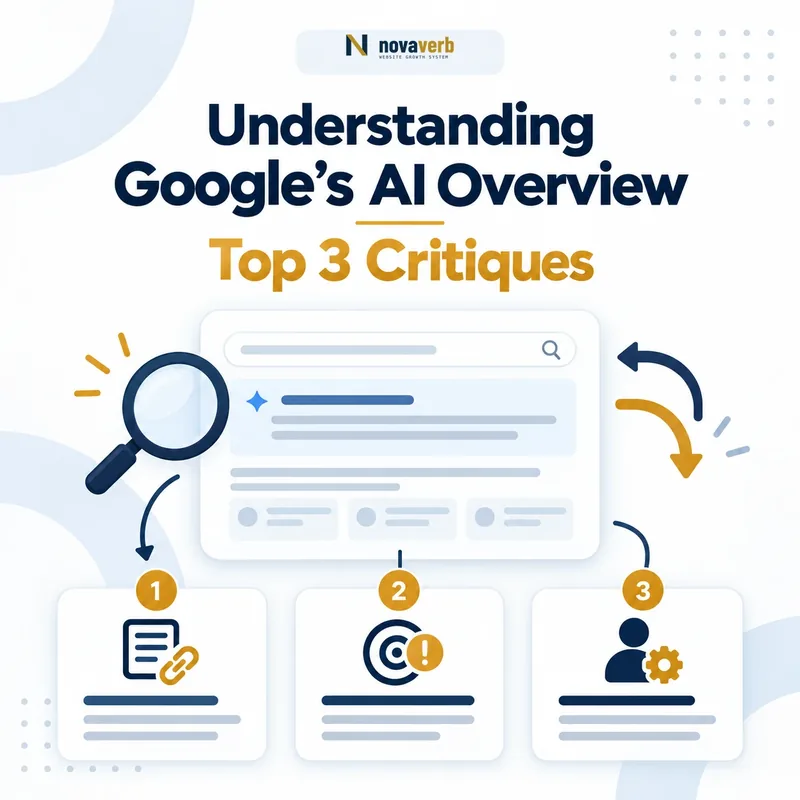
The three critiques worth understanding are:
- Accuracy: Does every generated claim accurately reflect the cited sources?
- Traffic: Does the complete answer reduce the searcher's need to click through to publishers?
- Attribution and control: Are original sources credited clearly, and can publishers control how their content is used without sacrificing normal Search visibility?
Your five-minute SEO action is not to guess how the model works. Choose one important query and record:
- Whether an AI Overview appears.
- Which pages it cites.
- Which claims each citation actually supports.
- Whether your page ranks organically but is absent from the citations.
- What information your page lacks compared with the cited sources.
Do not treat one search as universal evidence. AI Overviews can vary by wording, country, language, device, time, and personalization. Record the exact query and timestamp before drawing a conclusion.
For a broader view of search and AI visibility in one workflow, visit Novaverb.
Does AI Overview Critique the Top Three Results?
No verified Google documentation says that AI Overview takes the top three organic results and critiques them. That interpretation confuses traditional ranking positions with the separate process used to retrieve supporting information for a generated answer.
The myth
- Google selects positions one, two, and three.
- The AI compares those three pages.
- It decides which page is correct.
- It rewards or penalizes those rankings.
What Google describes
- The system may issue several related searches.
- It retrieves passages from relevant indexed pages.
- It generates an answer grounded in retrieved information.
- It displays links that support different parts of the response.
A page can therefore rank number one and receive no AI citation. Another page may rank lower yet supply the clearest definition, comparison, statistic, procedural step, or firsthand evidence needed for one part of the generated answer.
This does not mean organic rankings are irrelevant. Google states that its AI features remain rooted in core Search ranking and quality systems. It means only that citation selection and conventional position are related but not identical outcomes.
The better SEO question is not, “How do I make AI critique the top three?” It is, “For which specific claim, sub-question, or decision step is my page the strongest supportable source?”
How Google Builds an AI Overview
Google describes AI Overviews as a retrieval-and-generation process grounded in its Search index. The exact models and serving systems can change, but the documented workflow includes retrieval-augmented generation and query fan-out.
This explains why optimizing only for one exact-match keyword is incomplete. A broad question can generate several hidden retrieval needs. For example, a search for “best CRM for a small agency” may lead to sub-questions about pricing, seat limits, integrations, reporting, onboarding, and migration risk.
SEO implication: A page does not need to contain every possible answer. It needs a clear role in the information set: definition, evidence, comparison, procedure, limitation, or decision support.
Primary source: Google’s guide to generative AI features on Search.
Why AI Citations May Differ from Organic Rankings
Organic ranking asks which pages should be ordered for a search result; AI citation selection asks which sources or passages help support the generated answer. These processes can overlap without producing the same list.
| Signal or outcome | Traditional organic result | AI Overview citation |
|---|---|---|
| Primary unit | A ranked URL for the query | A source or passage supporting part of a generated response |
| Query scope | The visible query entered by the user | The visible query plus possible fan-out sub-queries |
| Page role | May satisfy the query broadly | May support one definition, fact, comparison, or step |
| Possible outcome | Rank high but remain uncited | Be cited without ranking in the visible top three |
A 2026 measurement preprint reported that nearly 30% of domains cited in its AI Overview sample did not appear among the co-displayed first-page organic results. That result should not be treated as a permanent ranking formula, but it strongly challenges the idea that citations are copied mechanically from the top three listings.
Useful conclusion: Ranking remains important for eligibility, discovery, and authority, but citation visibility must be measured separately. Do not use rank position alone as proof that a page is - or should be - an AI source.
Research source: Measuring Google AI Overviews: Activation, Source Quality, Claim Fidelity, and Publisher Impact. The paper was published as a preprint, so its findings should be interpreted as empirical evidence rather than an official explanation of Google’s system.
Critique #1: Accuracy and Claim Fidelity
The first major critique is not simply that an AI Overview can be wrong; it is that a generated sentence may appear supported even when the cited page supports only part of the claim. This is a claim-fidelity problem.
Several distinct errors can occur:
- Unsupported addition: The generated answer adds a condition, number, benefit, or conclusion that the cited page never states.
- Scope expansion: Evidence from one location, population, product, or time period is presented as universally applicable.
- Source blending: One sentence combines claims from several sources, but the displayed citation appears to support the whole sentence.
- Outdated synthesis: A page was accurate when crawled, but the generated answer no longer reflects the current rule, price, specification, or policy.
- Lost qualification: Important words such as “may,” “in some cases,” or “for eligible users” disappear during summarization.
SEO lesson: Make claims difficult to misquote. Keep the fact, scope, date, method, limitation, and supporting evidence close together. A vague paragraph gives a model more room to infer than a clearly bounded evidence block.
Accuracy cannot be solved by adding more keywords. It requires editorial discipline, visible sourcing, precise entities, updated facts, and sentences that remain true when extracted from their surrounding paragraph.
How to Fact-Check an AI Overview in One Minute
Fact-check an AI Overview by breaking one sentence into individual claims and testing whether the cited page supports each claim explicitly. Do not evaluate the paragraph only by whether it “sounds reasonable.”
- Copy one generated sentence. Choose a sentence containing a number, recommendation, comparison, condition, or factual conclusion.
- Split it into atomic claims. A sentence such as “Product A is cheaper, faster, and best for agencies” contains at least three separate claims.
- Open the citation attached to that sentence. Search the page for the exact entity, number, criterion, or conclusion.
- Check the scope. Confirm the date, country, plan, sample, product version, population, and exceptions.
- Grade the support. Mark each claim as fully supported, partly supported, unsupported, outdated, or impossible to verify.
Pass: A reasonable reader can find clear evidence for the complete claim on the cited page without making an additional inference.
If the source supports only one part of a generated sentence, record the problem precisely. “Citation attached” is not the same as “claim fully supported.”
For your own content, reverse the same process before publishing: identify the claim you want an AI system to extract, then verify that its proof and qualification remain visible in the same content block.
Critique #2: Fewer Clicks to Publishers
The second critique is that a sufficiently complete AI answer can satisfy the searcher before the searcher visits the websites that supplied the information. The publisher may receive an impression or citation while losing the click that historically funded advertising, subscriptions, leads, or sales.
These figures came from U.S. browsing behavior collected in March 2025. They do not prove that every industry, country, query class, or AI Overview produces the same result. They do show why ranking stability alone is no longer enough to explain organic traffic.
Google presents a different perspective. It says AI features encourage more complex queries, expose users to a wider range of websites, and may send visitors who spend more time on the destination page. Both claims can be true in different contexts: total clicks may fall for simple informational queries while the remaining clicks carry stronger intent.
Do not report “AI killed our traffic” from a single chart. Separate demand changes, ranking changes, SERP layout changes, seasonality, brand demand, and AI click substitution before assigning a cause.
Research source: Pew Research Center’s analysis of clicks on Google AI summaries.
How to Diagnose AI Overview Click Loss
Suspect AI click displacement when impressions and ranking remain relatively stable while click-through rate falls on queries that consistently trigger AI Overviews. Even then, treat the pattern as evidence for investigation - not automatic proof of causation.
| Observed pattern | More likely explanation | What to check next |
|---|---|---|
| Impressions stable, position stable, CTR down | SERP layout change, AI answer, stronger feature, or new ads | Record live SERPs for the affected queries |
| Impressions down and position down | Ranking or demand loss is more likely | Compare competitors, updates, intent, and indexing |
| Clicks down but conversions stable | Lower-volume traffic may be better qualified | Compare conversion rate and revenue per organic visit |
| Rank stable but cited competitor changes | AI source selection changed independently of position | Compare your missing evidence with the newly cited page |
| Only simple “what is” queries decline | Zero-click satisfaction is plausible | Expand toward comparison, action, tools, and original evidence |
Use page-and-query data rather than sitewide averages. A site may lose informational clicks while gaining branded searches, assisted conversions, AI citations, or commercial-query visibility.
Measurement rule: Track rankings, AI appearances, citations, clicks, conversions, and revenue as separate metrics. Combining them into one “AI visibility score” can conceal the actual business outcome.
Novaverb’s Search and AI visibility workflow is designed to keep traditional search evidence and AI-answer evidence visible without pretending they are the same metric.
Critique #3: Attribution and Publisher Control
The third critique is that publishers help create the information ecosystem used by AI Overviews but may have limited practical control over reuse without also restricting their visibility in ordinary Google Search.
Publisher concerns
- The generated answer can compete directly with the source article.
- A citation may be visually less prominent than the synthesized answer.
- Traffic and advertising revenue may decline even when content remains useful to Google.
- There may be no clean, AI-Overview-only opt-out that preserves every traditional Search benefit.
- Attribution may not communicate which source supports each exact claim.
Controls Google documents
nosnippetcan prevent a textual snippet from being shown.max-snippetcan limit the amount of text used in a Search preview.data-nosnippetcan exclude selected page sections from snippets.noindexremoves the page from Search eligibility.- Google-Extended controls some separate AI training and grounding uses, not the core Google Search experience.
The core dispute is therefore not whether controls exist. It is whether those controls offer a commercially meaningful choice. Restricting snippets or indexing may also reduce ordinary Search visibility, which is why publisher groups have argued that the available options force an unfair tradeoff.
Important distinction: A legal or competition complaint is an allegation, not a final ruling. Present the publisher argument, Google’s response, and the current technical controls separately.
Sources: Google’s documented Search preview controls and Reuters’ report on the publisher antitrust complaint.
What Google Says in Response
Google argues that AI Overviews are designed as a starting point for exploration, not a closed answer that removes the web. Its public guidance emphasizes clickable links, broader source diversity, more complex searches, and potentially higher-quality visits.
Google also states that no special AI schema, AI text file, or exclusive technical markup is required. A page must be indexed, snippet-eligible, technically accessible, and compliant with the same foundational Search policies used elsewhere.
The correct editorial position is neither “AI Overviews destroy every website” nor “AI Overviews have no downside.” Their effect varies by query class, business model, source visibility, user intent, and whether the destination offers value beyond the generated summary.
A practical SEO strategy should therefore test both sides of the equation: whether AI visibility is increasing and whether that visibility produces clicks, brand demand, assisted conversions, or revenue.
What AI Overviews Actually Change for SEO
AI Overviews do not make SEO irrelevant; they add a second visibility outcome on top of conventional ranking. A search team must now distinguish being indexed, ranking, being mentioned, being cited, receiving a click, and generating a business result.
A page may perform well in one layer and poorly in another. For example, it may rank number two, be absent from the AI citations, lose clicks, but still generate conversions from the smaller number of users who need more depth.
Measurement rule: Never replace all six outcomes with one blended number. A score can prioritize work, but the underlying evidence must remain inspectable.
What Determines Eligibility for an AI Overview Citation?
Google states that a supporting page must be indexed and eligible to appear in Search with a snippet. There is no separate submission process, guaranteed inclusion method, special AI schema type, or required “AI.txt” file.
- Googlebot can access the URL and required resources.
- The page is indexable and has a coherent canonical URL.
- Important information is available as visible text.
- The content satisfies a real search intent.
- Claims are helpful, reliable, and properly qualified.
- Internal links make the page discoverable in context.
- Structured data matches the visible page content.
- Images and videos add value where the query benefits from them.
- The page provides information beyond generic restatement.
- The source remains current enough for the claim being made.
Eligibility is only the first gate. It does not guarantee retrieval, citation, ranking, or traffic. Google’s systems still decide whether an AI Overview is useful for the query and which sources best support the generated answer.
Avoid false guarantees: No checklist can promise an AI citation. An audit can confirm readiness signals and identify barriers, but actual inclusion must be observed in the live answer experience.
See Novaverb’s practical guide to optimizing content for AI answer engines for the content and technical checks that can be verified without pretending to know Google’s private scoring.
Use Answer-First Content Without Creating Thin Answers
Answer-first content places a self-contained response immediately below the relevant heading, then supplies context, proof, limitations, and a next step. It is not a license to reduce every topic to a generic two-sentence summary.
Weak: “AI Overview is an AI answer in Google.”
Better: “Google AI Overview is a generated response that synthesizes information retrieved from multiple sources and presents supporting links. It can appear above ordinary listings when Google determines that a synthesized answer adds value to the query.”
The better version remains concise but defines the entity, explains the source model, gives the serving condition, and avoids claiming that every search produces an AI answer.
Place the core answer in static, crawlable HTML. Do not require a click, tab change, modal, or client-side interaction before the primary response becomes visible to Googlebot and users.
Build Proof, Entity Clarity, and Source Quality
A source becomes easier to retrieve and safer to quote when it identifies the subject precisely, states a bounded claim, and places verifiable evidence beside that claim. Generic confidence language is not proof.
For example, “AI Overviews reduce clicks” is too broad. A stronger claim is: “In Pew’s March 2025 U.S. browsing sample, users clicked a traditional result on 8% of visits where an AI summary appeared, compared with 15% of visits without one.”
Extraction test: Copy the sentence into a blank document. Can a reader still identify who measured what, when, where, and under which limitations? When the answer is no, the claim needs more context.
Use Internal Links to Support AI Visibility
Internal links help search systems discover related pages, understand their roles, and move from a broad topic to the evidence needed for a specific claim. The objective is not to insert the largest possible number of links.
For example, this article explains the criticism surrounding AI Overviews. A reader who wants to understand the broader optimization discipline can move to the GEO definition. A reader who wants to evaluate a page can use the free GEO Checker.
Avoid anchors such as “click here,” “read more,” or “this page.” Use an anchor that remains meaningful outside the sentence and accurately predicts the destination.
Quick rule: If removing the link makes no difference to the reader’s next decision, the link may be decorative rather than useful.
See why internal-link quality matters more than raw quantity before adding sitewide links purely to increase link counts.
How to Run a Five-Minute AI Overview Audit
A five-minute AI Overview audit captures one query, one generated answer, its citations, your organic position, and the most actionable source gap. It is a triage process, not a complete causal analysis.
Required output: Query + timestamp + AI Overview present/absent + cited URLs + your rank + source gap + proposed fix + recheck date.
Use the Novaverb GEO Checker to review page-level retrieval and citation-readiness signals. The result measures observable readiness; it cannot guarantee that Google will generate or cite the page in a future AI Overview.
AI Overview Audit Scorecard: Pass or Fail
A page passes a basic AI Overview readiness audit when it is technically eligible, answers a defined question clearly, supports its claims, and provides information that a generated answer can attribute safely.
| Audit item | Pass | Fail |
|---|---|---|
| Index and snippet eligibility | Indexed, canonical, snippet-eligible | Noindex, blocked, wrong canonical, or unavailable |
| Core answer | Direct answer immediately follows the relevant heading | Answer is vague, buried, or dependent on earlier context |
| Entity clarity | Subject, location, version, and scope are explicit | Ambiguous entity or mixed meanings |
| Claim support | Proof appears beside the claim | Unsupported superlatives or remote evidence |
| Source quality | Primary or clearly attributable evidence | Copied summaries citing other summaries |
| Information gain | Original test, experience, data, framework, or synthesis | Commodity rewrite of existing results |
| Internal discovery | Contextual links from related pages | Orphaned or linked only through generic archives |
| Measurement | Rank, citations, clicks, and conversions tracked separately | One blended score with no inspectable evidence |
A pass means the page has removed obvious readiness barriers. It does not mean the page will be selected. Citation behavior remains query-, model-, location-, and time-dependent.
For repeated question-level checks, use the AI Citation Tracker to distinguish a brand mention from a page-level citation and preserve the provider, question, and timestamp behind each observation.
Frequently Asked Questions About Google AI Overviews
Does Google AI Overview critique the top three search results?
No official Google documentation describes that process. Google says AI features can use retrieval-augmented generation and query fan-out to find supporting information across multiple searches and sources.
Does a page need to rank in the top three to receive a citation?
No confirmed top-three requirement exists. A page must be indexed and snippet-eligible, but citation selection may differ from the visible organic ranking order.
Can a page rank first and still be absent from the AI Overview?
Yes. A high-ranking page may answer the query broadly while another source supplies a clearer passage, statistic, comparison, or firsthand detail for the generated response.
Is AI Overview part of Google’s ranking algorithm?
AI Overviews are a Search presentation and answer feature rooted in Google’s Search index and quality systems. A citation should not be interpreted as a separate ranking penalty or guaranteed organic-position change.
Do AI Overviews always reduce organic traffic?
No. Click effects vary by query and intent. Simple informational searches may experience more zero-click behavior, while complex or commercial searches can still generate valuable visits.
Are AI Overview citations always accurate?
No generated system should be assumed perfectly accurate. Verify whether each cited page supports the complete claim, its scope, date, qualifications, and conclusion.
Does structured data guarantee an AI Overview citation?
No. Structured data can help Google understand page content when it accurately matches the visible page, but Google states that no special AI schema is required and no markup guarantees selection.
Do I need an AI.txt or LLMs.txt file for Google AI Overviews?
Google says no new machine-readable AI file is required to appear in AI Overviews or AI Mode. Standard crawlability, indexing, snippet eligibility, and Search best practices remain the foundation.
Can publishers opt out of AI Overviews?
Google documents Search preview controls such as nosnippet, max-snippet, data-nosnippet, and noindex. These controls can also affect ordinary Search previews or eligibility, which is central to the publisher-control debate.
How can I measure AI Overview performance?
Track AI appearances and citations alongside rankings, Search Console impressions, clicks, landing-page engagement, conversions, brand queries, and revenue. Do not infer citation performance from ranking alone.
Does Search Console report AI Overview data?
Google historically included AI-feature performance within Web search reporting. In June 2026, Google announced dedicated generative AI performance reports for a subset of sites, including views by page, country, device, and date.
What is the fastest improvement I can make?
Choose one important question and rewrite its answer block so the definition, scope, evidence, limitation, and next step are explicit. Then verify that the content appears in rendered HTML and is reachable through a meaningful internal link.
Measure, Improve, and Recheck
The correct response to AI Overviews is not panic, speculation, or a one-time content rewrite. Build a repeatable loop that observes the live answer, identifies the missing evidence, improves the relevant page, and checks the same query again.
Novaverb’s GEO & AEO Readiness workflow audits observable page-level signals such as crawlability, textual answers, structured data, and question coverage. Its AI Citation Tracker then checks whether selected answer engines actually mention or cite the brand for a defined question.
No readiness score guarantees inclusion. No single citation proves universal visibility. The defensible workflow keeps every conclusion tied to the page, query, source, provider, and time at which it was observed.