
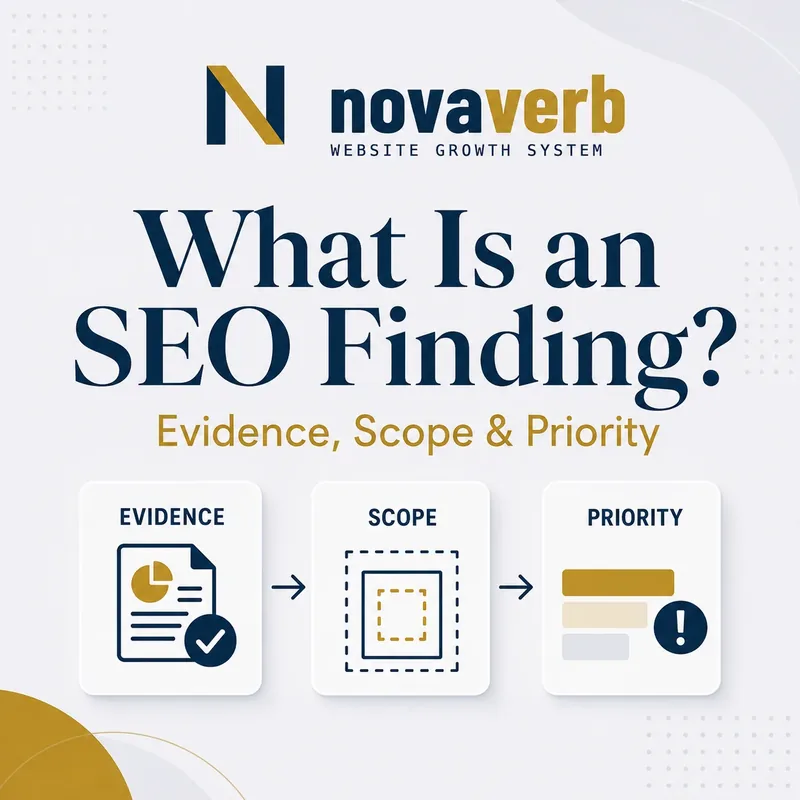
What Is an SEO Finding?
An SEO finding is an evidence-backed statement describing a search-related condition within a defined scope and against an explicit criterion. It identifies what was observed, where the condition exists, why it matters, how confident the team should be, what the evidence cannot establish, and which decision should follow.
A finding is not merely a warning copied from an SEO tool. A crawler may report missing titles, redirect chains, conflicting canonicals, thin internal-link paths, or inaccessible resources. These observations become findings only after the team verifies the condition, defines the affected scope, applies the relevant rule, and determines whether the issue or opportunity has enough decision value.
“A finding is the act or process of determining, from evidence, what the facts are.” Wikipedia - Finding
In SEO operations, a finding creates the boundary between evidence collection and accountable action. It allows the team to distinguish a real condition from an extraction error, an isolated URL from a template-wide pattern, a technical defect from a business priority, and a verified fact from a suspected cause.
Core Components of an SEO Finding
| Finding component | Question answered | SEO example | Risk when missing |
|---|---|---|---|
| Observed condition | What was actually detected or measured? | Twenty-eight internal links resolve through two avoidable redirect hops. | The finding becomes a vague label such as “redirect problem.” |
| Evidence source | Where did the observation come from? | A fresh production crawl and direct HTTP response-path verification. | The team cannot reproduce or validate the claim. |
| Criterion | Why is the observed condition considered defective, risky, or valuable? | Priority internal links should resolve directly to their approved canonical destinations. | A tool preference may be mistaken for an operational requirement. |
| Affected scope | Which URLs, templates, queries, markets, assets, or workflows are affected? | Twenty-eight links across twelve commercial pages in one navigation component. | One sample may be generalized incorrectly to the entire site. |
| Impact | What user, search, business, quality, or delivery condition may be affected? | The paths add avoidable requests to high-value commercial journeys and preserve obsolete URLs internally. | Severity becomes disconnected from actual decision value. |
| Confidence | How certain is the team that the condition and scope are correct? | High confidence because all affected links were reproduced in rendered production HTML. | Suspected patterns may be reported as verified facts. |
| Cause status | Is the cause verified, suspected, or unknown? | The links originate from a shared navigation configuration; the reason the configuration remained outdated is still unknown. | A guessed explanation may drive the wrong correction. |
| Evidence boundary | What does the finding not establish? | The evidence proves redirect-chain exposure but does not prove a specific ranking or revenue loss. | The finding expands into unsupported causal claims. |
| Decision | What should happen next? | Create a bounded task to replace the affected internal destinations and verify the full component scope. | The finding remains an audit note without an operational destination. |
A Finding Does Not Automatically Require a Fix
- Fix: The condition is verified, harmful enough, and has a known corrective action.
- Investigate: The observation is valid, but the cause, scope, or decision value remains uncertain.
- Monitor: The condition is real but does not currently justify active intervention.
- Accept: The condition is an intentional trade-off or accepted limitation.
- Defer: The finding is valid but lower priority than existing work.
- Experiment: The opportunity or proposed solution requires a hypothesis test.
- Invalidate: Fresh evidence shows that the original condition no longer exists or was misclassified.
- Archive: The finding has no current decision value but should remain available as historical evidence.
Once validated, the finding may become an accountable task, an investigation, a KPT Problem, a monitoring rule, or an SEO experiment. It should not enter the backlog automatically merely because a tool assigned a warning or severity score.
Why Is an SEO Finding More Than a Tool Warning?
An SEO finding is more than a tool warning because it has been validated against the live system, interpreted through an explicit criterion, bounded to an affected scope, and connected to impact, confidence, limitations, and a decision. A warning is an automated or manual signal that something may require attention. It is evidence to inspect, not a conclusion the team must automatically accept.
Tool Warning
- Generated from a predefined rule
- May rely on incomplete crawl coverage
- May not understand page purpose
- May classify intentional behavior as an error
- May use generic severity labels
- Does not automatically establish business value
Validated SEO Finding
- Reproduced through inspectable evidence
- Uses a documented operational criterion
- Defines all known affected units
- Explains relevant search or user impact
- States confidence and evidence limits
- Ends with an explicit decision destination
How a Warning Becomes a Finding
| Validation question | Tool warning | Finding requirement |
|---|---|---|
| Does the condition exist now? | The previous crawl recorded an error. | A fresh production check reproduces the condition or records that it no longer exists. |
| Is the rule appropriate? | The tool applies its default criterion. | The team confirms that the criterion applies to this page type, workflow, or business requirement. |
| What is affected? | The report lists discovered examples. | The finding defines the full known set, a defensible sample, or the discovery limitation. |
| Is the condition intentional? | The tool may not know why the configuration exists. | The team checks product, technical, legal, editorial, and governance context. |
| Why does it matter? | A generic severity score may be shown. | Impact is connected to page role, user journey, search eligibility, business value, or operational risk. |
| How certain is the conclusion? | The warning may appear definitive. | Confidence reflects evidence quality, coverage, reproducibility, and unresolved uncertainty. |
| What should happen next? | The warning may recommend a generic fix. | The team chooses to fix, investigate, monitor, accept, defer, experiment, invalidate, or archive. |
Examples of Warnings That May Not Become Findings
- A missing meta description on a utility page where a custom snippet is not required.
- A noindex directive on an intentional account, filter, staging, or internal-search page.
- A canonical pointing away from a duplicate URL according to the approved ownership rule.
- A long title that remains accurate, differentiated, and effective for its query cohort.
- A low word count on a page that fully completes a narrow user task.
- A redirect that is intentional, direct, relevant, and part of an approved migration state.
- A page excluded from a sitemap because it is not intended to be a canonical search destination.
SEO Finding vs Evidence, Issue, Recommendation, and Task
Evidence records what was observed, a finding interprets that evidence against a criterion, an issue is a finding classified as undesirable, a recommendation proposes a response, and a task assigns the selected response as accountable work. Keeping these layers separate prevents tools or consultants from prescribing work before the condition and decision have been validated.
| Term | Primary purpose | SEO example | Required context | What it does not establish |
|---|---|---|---|---|
| Evidence | Record an inspectable observation. | A rendered crawl shows that twelve commercial pages contain links to redirected URLs. | Source, timestamp, collection method, scope, and limitations. | Whether the condition is important enough to act on. |
| Finding | Interpret evidence against a criterion and scope. | Twelve commercial pages contain twenty-eight avoidable redirected internal links in a shared navigation component. | Criterion, affected scope, impact, confidence, and evidence boundary. | Which specific intervention should be selected. |
| Issue | Classify a finding as an undesirable defect, risk, or constraint. | The outdated navigation component creates avoidable redirect hops on priority journeys. | Severity, value, risk, and accepted operating standard. | That immediate remediation outranks all other work. |
| Opportunity | Classify a finding as a potentially valuable improvement. | High-impression Orient pages have no contextual path to relevant comparison content. | Audience need, page role, evidence, and expected mechanism. | That the proposed opportunity will produce the expected outcome. |
| Recommendation | Propose a course of action for consideration. | Replace redirected navigation destinations with their approved canonical URLs. | Options considered, expected benefit, risk, effort, and dependencies. | That the recommendation has been approved or assigned. |
| Task | Assign the approved intervention as bounded work. | Update the shared navigation configuration and verify all twenty-eight affected links. | Action, scope, owner, Definition of Done, KPI, guardrails, and review date. | That the expected outcome occurred. |
| Experiment | Evaluate a hypothesis when the preferred response or expected outcome remains uncertain. | Add a contextual proof link to ten comparison pages and measure qualified progression. | Hypothesis, baseline, treatment, comparison, KPI, guardrails, and decision rule. | That the result will generalize beyond the tested cohort. |
One Finding Can Produce Different Decisions
A finding that commercial pages lack proof links does not automatically require one universal linking task. The team might investigate user objections, monitor a low-volume cohort, create a direct implementation task where the next step is obvious, or run an experiment when the best destination and expected effect remain uncertain.
What Should an SEO Finding Contain?
An SEO finding should contain the observed condition, evidence source, applicable criterion, affected scope, impact, confidence, cause status, evidence boundary, current state, and next decision. These fields make the finding reproducible, prioritizable, and suitable for conversion into accountable work when action is justified.
Finding Statement
Describe the condition in observable language without embedding a solution or unsupported cause.
Evidence Source
Name the live response, rendered page, crawl, report, log, analytics event, business record, or manual review.
Collection Time
Record when the source was captured and whether later changes may have made it stale.
Applicable Criterion
State the policy, requirement, expected relationship, or accepted threshold used to interpret the observation.
Affected Scope
List or define the relevant URLs, templates, assets, markets, queries, page roles, events, or workflows.
Impact
Explain the plausible user, search, business, technical, content, governance, or delivery consequence.
Confidence
Rate confidence according to source fitness, coverage, reproducibility, freshness, and unresolved uncertainty.
Cause Status
Label the cause as verified, suspected, disputed, unknown, or outside the current investigation.
Evidence Boundary
State which related ranking, indexing, citation, conversion, or causal claims the evidence does not establish.
Decision and Status
Record whether to fix, investigate, monitor, accept, defer, experiment, invalidate, or archive, with an accountable owner.
Reusable SEO Finding Template
Finding: [Observed condition] affects [defined scope], based on [evidence source and timestamp].
Criterion: The expected condition is [rule, relationship, or threshold].
Impact: This may affect [user, search, business, quality, or delivery outcome].
Confidence: [High, medium, or low] because [coverage, reproducibility, and limitations].
Cause status: [Verified, suspected, unknown, or disputed].
Evidence boundary: The evidence supports [bounded conclusion] but does not establish [unsupported conclusion].
Decision: [Fix, investigate, monitor, accept, defer, experiment, invalidate, or archive].
How Do You Write an Observable SEO Finding?
Write an observable SEO finding by naming the affected object, current condition, relevant scope, evidence source, collection time, and criterion without using vague quality labels or unverified causal explanations. A reviewer should be able to reproduce the observation and decide whether the statement is accurate.
[Number or defined set of objects] currently [observable condition], based on [source and timestamp], while the accepted criterion requires [expected condition].
- Name the object. Identify the URL, page set, template, query cohort, internal-link path, event, schema block, or workflow state.
- Describe the current condition. Use verbs such as returns, contains, omits, redirects, declares, links, triggers, ranks, records, or exceeds.
- Quantify the known scope. State the number, percentage, set, sample, or explicit discovery limitation.
- Name the source and time. Preserve the crawl, report, rendered check, request, log, or manual review date.
- State the expected condition. Identify the criterion that creates the gap.
- Remove the proposed solution. Keep the finding independent from the intervention selected later.
- Separate suspected cause. Put explanatory hypotheses in a separate field.
- State the evidence boundary. Clarify which broader search or business result remains unproven.
Weak and Observable Finding Statements
| Weak statement | Why it is weak | Observable finding |
|---|---|---|
| The website has bad canonicals. | No affected URLs, current values, criterion, or source are defined. | Thirty-two product URLs currently declare category pages as canonical in served and rendered HTML, while the approved ownership map assigns each product URL to itself. |
| Internal linking is weak. | Weakness is not translated into a page-role or path criterion. | Fourteen high-impression Orient pages contain no contextual link to an eligible Choose-stage destination in the current rendered crawl. |
| The content is thin. | Word count is implied without identifying which user need is incomplete. | Eight comparison pages omit pricing scope, exclusions, and evidence sources required by the approved Choose-page brief. |
| The developer broke redirects. | Blames a person and assumes cause. | Twenty migration sources currently pass through two redirects before reaching their mapped canonical destinations. |
| Google does not like this page. | Search-engine preference and cause cannot be observed directly from the available evidence. | The page recorded no impressions in the selected Search Console window, while current index inclusion remains unverified. |
| Schema is wrong. | The statement does not identify syntax, type, property, or visible-content inconsistency. | The rendered Product markup on twelve pages contains price values that differ from the visible current price. |
| AI cannot understand the brand. | The claim generalizes from an unspecified answer set. | The brand was described inconsistently across six captured answers using the fixed prompt set, and four answers cited no first-party source. |
How Do You Define the Affected Scope?
Define the affected scope by identifying every known unit that satisfies the finding criterion, the discovery method used to locate those units, and any areas the evidence could not inspect. Scope should distinguish confirmed affected items, checked unaffected items, excluded items, and unknown coverage.
Confirmed Affected
- Units that reproduce the condition
- Attached URL or object list
- Shared rule or template where known
- Evidence and collection timestamp
Checked Unaffected
- Comparable units that pass the criterion
- Control or reference cohort
- Template states without the defect
- Useful boundary for diagnosis
Explicitly Excluded
- Intentional exceptions
- Unsupported environments
- Noncanonical or retired units
- Out-of-scope markets or systems
Unknown Coverage
- Blocked or inaccessible areas
- JavaScript states not rendered
- Unlinked or undiscovered URLs
- Missing integrations or evidence
Scope Dimensions for SEO Findings
| Scope dimension | Questions to answer | Example |
|---|---|---|
| URL scope | Which exact source and destination URLs satisfy the criterion? | Thirty-two canonical product URLs across one category branch. |
| Template scope | Does the condition follow a shared template, component, or rendering state? | Every page rendered through the legacy product template variant. |
| Page-role scope | Which Orient, Choose, Prove, Rate, Act, utility, or hub pages are affected? | Choose pages that lack an eligible Prove-stage destination. |
| Query scope | Which query classes, intent groups, brand segments, or markets show the condition? | Non-brand commercial queries on mobile in the United States. |
| Technical scope | Which status, canonical, directive, hreflang, link, schema, or rendering states apply? | Pages where rendered canonicals differ from served canonicals. |
| Journey scope | Which user paths, navigation components, forms, CTAs, or conversion steps are affected? | The comparison-to-proof path in the primary article template. |
| Time scope | When did the condition begin, and is it persistent, intermittent, or historical? | Observed in three consecutive production crawls after the July release. |
| Evidence scope | What could the collection method discover, and what remained inaccessible? | Public canonical URLs discovered from internal links and sitemaps; unlinked URLs remain unknown. |
Use Sampling Carefully
Sampling may be appropriate for a large, consistent template population, but the finding should record how the sample was selected, which risk groups were represented, how many units were checked, and whether the statement applies to the sample or the inferred population.
How Do You Evaluate Impact, Severity, and Confidence?
Evaluate impact by identifying what could be affected, severity by estimating the consequence and urgency of the current condition, and confidence by rating the strength of the evidence. These dimensions should remain separate because a high-impact possibility with weak evidence requires a different response from a verified critical defect.
Impact
Describes the search, user, business, technical, trust, content, or operational outcome that the condition may influence.
Severity
Describes the magnitude, reach, reversibility, urgency, and current harm associated with the finding.
Confidence
Describes how strongly the source, coverage, freshness, reproducibility, and criterion support the finding.
Impact Dimensions
| Dimension | Evaluation questions | Example evidence | Interpretation caution |
|---|---|---|---|
| Search eligibility | Does the condition affect retrieval, crawlability, indexability signals, canonical ownership, or structured eligibility? | Noindex directives on intended canonical pages. | Technical eligibility does not prove actual index inclusion or ranking. |
| Search demand | Does the affected scope serve meaningful qualified queries or markets? | Search Console impressions for the verified URL and query cohort. | Demand alone does not prove the finding caused current performance. |
| User journey | Does the condition interrupt discovery, comparison, proof, pricing, or action? | Broken Choose-to-Prove links on comparison pages. | A broken path may not affect every user equally. |
| Business outcome | Does the scope support qualified leads, revenue, retention, registration, or another meaningful action? | Verified CRM outcomes associated with affected landing pages. | Business value should not be inferred only from estimated traffic. |
| Trust and accuracy | Does the condition expose users or answer systems to incorrect, unsupported, stale, or contradictory claims? | Visible pricing differs from structured or comparison data. | Risk may be high even when traffic volume is low. |
| Technical reach | Is the condition isolated, template-wide, sitewide, or inherited across markets? | A shared canonical component affects several page classes. | Reach should be verified rather than assumed from one sample. |
| Reversibility | Can the condition or correction be reversed safely and quickly? | A configurable title test versus a destructive URL migration. | Low reversibility increases governance needs. |
| Urgency | Is harm active, escalating, deadline-bound, security-related, or tied to a launch? | A production noindex regression after migration. | Urgency should not replace evidence validation. |
Confidence Levels
| Confidence | Typical evidence state | Appropriate action |
|---|---|---|
| High | Fresh primary evidence, reproducible condition, complete or defensible scope, and an applicable criterion. | Fix, accept, monitor, or prioritize based on impact and effort. |
| Medium | The condition is reproduced, but coverage, cause, impact, or current scope contains material uncertainty. | Investigate, sample further, run a bounded test, or apply a cautious mitigation. |
| Low | The signal is stale, indirect, estimated, thin, contradictory, or difficult to reproduce. | Collect better evidence before committing consequential work. |
How Do You Separate Facts From Suspected Causes?
Separate facts from suspected causes by recording the observable condition first, then labeling each explanation as verified, supported, plausible, disputed, or unknown. A finding may be valid even when its cause has not been established, and delaying corrective action is not always necessary when the immediate defect is clear.
Observed Fact
What the source directly shows within its scope, such as a status, directive, value, omission, relationship, or measured result.
Cause Hypothesis
A proposed explanation that may account for the condition and requires its own supporting evidence or investigation.
Unresolved Unknown
A missing mechanism, dependency, scope boundary, or external influence that the current evidence cannot determine.
Fact and Cause Examples
| Observed finding | Possible cause | Cause status | Next evidence needed |
|---|---|---|---|
| Two hundred forty pages emit fallback canonicals. | A shared template branch uses an outdated fallback rule. | Verified when code and rendered output reproduce the relationship. | Template logic, release record, and affected-state test. |
| Qualified CTR declined for ten pages. | Displayed titles became less differentiated. | Suspected unless snippet captures and controlled comparison support it. | Query-level evidence, displayed-title observations, SERP changes, and competitor context. |
| Search Console clicks and analytics sessions diverge. | Consent, attribution, time-zone, or tracking changes created the difference. | Unknown until definitions and implementation are reconciled. | Measurement contract, event tests, consent state, filters, and time zones. |
| AI answers describe the product inconsistently. | First-party pages use conflicting entity and product language. | Plausible when visible content conflicts, but answer variability may also contribute. | Prompt captures, cited URLs, entity statements, structured data, and page comparisons. |
| Ready cards repeatedly return for clarification. | Entry criteria do not require scope, evidence, or completion fields. | Supported when returned cards consistently lack those fields. | Card history, return reasons, task class, and workflow policy. |
Use Explicit Cause Labels
Verified cause means the mechanism has been reproduced or directly traced. Supported cause means several relevant sources are consistent with the explanation. Plausible cause means the explanation is reasonable but not yet well tested. Disputed cause means credible evidence supports competing explanations. Unknown cause means the current evidence does not establish the mechanism.
What Evidence Should Support an SEO Finding?
An SEO finding should be supported by the source that directly observes the claimed condition, supplemented only by evidence that clarifies scope, impact, cause, or priority. The evidence pack should preserve source, collection time, filters, method, affected units, and known limitations.
| Finding type | Primary evidence | Supporting evidence | Insufficient evidence alone |
|---|---|---|---|
| Status or redirect finding | Fresh direct HTTP responses and complete response paths. | Crawl inventory, internal-link sources, sitemap entries, and server logs. | An old screenshot or configuration statement. |
| Canonical finding | Served and rendered canonical values on affected pages. | Status, robots, sitemap, hreflang, link, and ownership evidence. | A CMS field or plugin setting. |
| Indexability finding | Fresh directives, response status, canonical relationship, and appropriate search-engine evidence where available. | Crawl eligibility, sitemap membership, impressions, and logs. | A crawler’s indexable label alone. |
| Content finding | Visible page content compared with a defined brief, claim source, or page-role criterion. | Query evidence, user feedback, competitor context, and conversion behavior. | Word count or a generic content score alone. |
| Internal-link finding | Rendered source links, destination responses, anchors, and page-role relationship. | Crawl depth, discovery, internal clicks, and journey evidence. | A raw link count without context. |
| Search-performance finding | Defined Search Console cohort with preserved pages, queries, dates, markets, devices, and search appearance. | Ranking observations, SERP captures, deployment records, and analytics guardrails. | A sitewide average or third-party estimate alone. |
| Conversion finding | Verified analytics, CRM, transaction, or qualified-action records. | Landing-page paths, CTA events, sales review, and consent context. | Traffic, ranking, or button clicks alone. |
| AI-answer finding | Captured prompts, answers, models or systems, dates, citations, and source URLs. | Entity consistency, extractability, crawl access, claim structure, and page evidence. | One AI-readiness score or one missing citation. |
| Workflow finding | Card history, blocked time, QA returns, aging, WIP, and decision records. | Participant notes, task-class analysis, and dependency evidence. | A general complaint that the team is slow. |
Minimum Finding Evidence Pack
- The exact finding statement
- Source or system name
- Collection date and relevant time window
- Request, crawl, report, or review settings
- Affected scope or attached inventory
- Applicable criterion
- Reproduction steps
- Evidence limitations
- Confidence and cause status
- Decision owner and next review date
For the broader evidence model, review what SEO evidence is and how source, scope, timestamp, collection method, limitations, and decision relationship should remain connected.
How Do You Prioritize SEO Findings?
Prioritize SEO findings by comparing decision value, verified impact, confidence, urgency, strategic relevance, affected scope, effort, dependency, reversibility, and opportunity cost. A tool’s severity label may inform the review, but it should not replace the organization’s own priority model.
Priority = decision value × impact × confidence × urgency × strategic fit, adjusted for effort, dependency, risk, reversibility, and opportunity cost.
| Priority factor | Question | High-priority signal | Caution |
|---|---|---|---|
| Decision value | Will resolving this finding materially change what the team does? | The answer determines whether to launch, rollback, migrate, invest, or stop. | Interesting information may have low operational value. |
| Impact | Which search, user, business, trust, or technical outcome may be affected? | Priority canonical pages, qualified actions, or critical user paths are involved. | Potential impact should not be reported as confirmed loss. |
| Confidence | How strongly does the evidence establish the condition and scope? | Fresh, reproducible, source-fit evidence covers the full affected set. | Low confidence may justify investigation rather than remediation. |
| Urgency | Is active harm increasing or tied to a deadline, launch, or incident? | A current migration, noindex regression, broken conversion path, or security-related condition. | Stakeholder pressure alone is not urgency evidence. |
| Strategic fit | Does the finding constrain an active Objective, Key Result, page role, or business responsibility? | The affected scope supports the current acquisition or product priority. | Not every technically valid finding supports the active strategy. |
| Scope | How many high-value units are affected? | A shared template or critical path has broad verified reach. | Large raw counts may include low-value or intentional pages. |
| Effort | How much implementation, review, coordination, and monitoring are required? | A high-impact correction has a safe, bounded, low-effort implementation. | Easy work should not displace more valuable necessary work. |
| Dependency | What access, approval, platform, team, or prerequisite controls execution? | The work is ready and the responsible owner is available. | Blocked findings may require escalation rather than active WIP. |
| Reversibility | Can the intervention be reversed safely if the result is harmful? | A controlled change with rollback evidence. | Low reversibility requires more evidence and governance. |
| Opportunity cost | What more valuable work will be delayed? | The selected finding dominates available alternatives on decision value. | Every accepted task consumes finite review and measurement capacity. |
Priority Is Not the Same as Severity
A severe finding may remain blocked by missing access or require immediate containment rather than a normal backlog task. A moderate finding may become the highest priority when it affects an active launch, is highly certain, and can be corrected safely with little effort. A low-impact but recurring defect may justify a workflow Try if it creates substantial cumulative rework.
What Decisions Can Follow an SEO Finding?
An SEO finding may lead to a fix, investigation, experiment, monitoring rule, accepted exception, deferral, escalation, invalidation, consolidation, or archive decision. The correct destination depends on evidence quality, impact, uncertainty, reversibility, dependencies, and opportunity cost.
Correct a Verified Defect
Use when the condition is sufficiently certain, undesirable, valuable to resolve, and supported by a known safe intervention.
Resolve Important Uncertainty
Use when the observation is valid but the cause, complete scope, impact, or appropriate response remains unclear.
Test an Uncertain Intervention
Use when the opportunity is meaningful but the proposed mechanism or expected outcome requires evidence.
Watch for Material Change
Use when the condition is real but current impact or urgency does not justify active implementation.
Record an Intentional Trade-Off
Use when the condition is understood and accepted because another product, legal, security, cost, or user requirement is more important.
Retain for Later Priority
Use when the finding is valid but lower value than current work or dependent on a future release, owner, or capability.
Move to the Correct Authority
Use when resolution requires platform, security, legal, executive, product, or client authority outside the current team.
Reject the Original Finding
Use when fresh evidence shows the condition was resolved, misclassified, duplicated, intentionally excluded, or never present.
Consolidate a Shared Cause
Use when several findings represent the same template, configuration, policy, or evidence problem.
Preserve Without Active Work
Use when the finding has no current decision value but remains useful as historical evidence or prior learning.
Every Decision Needs a Reason
Record the selected decision, accountable owner, supporting rationale, date, and review trigger. An accepted or deferred finding should not disappear silently. It should remain traceable so future teams understand whether the condition was intentional, blocked, low priority, invalid, or scheduled for later review.
SEO Finding Examples for Technical, Content, and AI Search
Strong SEO findings describe the verified condition, affected scope, criterion, impact, confidence, evidence boundary, and next decision. They avoid converting technical eligibility, search visibility, user behavior, and business performance into one unsupported claim.
| Finding type | Observable finding | Impact and confidence | Evidence boundary | Decision |
|---|---|---|---|---|
| Canonical | Thirty-two product URLs declare category pages as canonical in both served and rendered HTML, contrary to the approved ownership map. | High confidence; intended product-page ownership may be weakened across a priority commercial cohort. | Does not prove which canonical Google selected or quantify traffic loss. | Fix the shared canonical rule and verify every affected template state. |
| Redirect chain | Twenty migration sources reach their mapped destinations through two permanent redirects. | High confidence; adds avoidable requests and preserves obsolete mappings. | Does not establish a specific ranking or revenue effect. | Update the redirect map and affected internal links. |
| Robots directive | Twelve intended canonical pages contain a rendered noindex directive after the latest template release. | High confidence and critical severity because the condition affects active search destinations. | Does not prove whether every page has already been removed from an index. | Contain immediately, verify the release scope, and monitor recovery evidence. |
| Internal journey | Fourteen high-impression Orient pages contain no contextual link to an eligible Choose-stage destination. | Medium confidence that the journey is incomplete; page-role and rendered-link evidence are strong. | Does not prove that adding links will increase rankings or conversion. | Run a bounded Choose-link experiment on a coherent cohort. |
| Content accuracy | Eight pricing comparison pages display package limits that conflict with the current product source. | High confidence and high trust risk because visible commercial claims are outdated. | Does not establish how many users relied on the incorrect values. | Correct immediately and add source and freshness ownership. |
| Search CTR | Five commercial pages have qualified mobile CTR below their matched cohort while their differentiators appear after likely truncation. | Medium confidence; the condition and display pattern are observed, but causation remains unverified. | Does not prove title length caused the CTR gap. | Design a title experiment rather than applying a sitewide rewrite. |
| Structured data | Twelve rendered Product markup blocks contain prices that differ from visible page prices. | High confidence and meaningful accuracy risk. | Does not prove an enhancement was displayed or withheld because of the conflict. | Fix the source synchronization and add visible-content QA. |
| AI citation | The page was not cited in ten captured comparison answers across the fixed prompt and system set, while three competitors were repeatedly cited. | Medium confidence for the observed answer set; first-party evidence structure is incomplete. | Does not prove universal AI invisibility or a single cause. | Investigate cited-source patterns and test a source-backed comparison structure. |
| Entity consistency | The company’s product category is described differently across the homepage, product page, structured data, and captured AI answers. | High confidence that first-party statements conflict; external interpretation impact remains uncertain. | Does not prove the conflict alone caused AI answer inconsistency. | Define and deploy an approved entity statement across first-party surfaces. |
| Workflow | Forty percent of content cards returned from QA because source, page role, or internal-link destination was missing from the brief. | High confidence across the reviewed task class and period. | Does not establish individual performance failure. | Add entry criteria and test the revised brief process. |
How Does an SEO Finding Become a Task or Experiment?
An SEO finding becomes a task when the team selects a known intervention, and it becomes an experiment when the proposed mechanism or expected outcome still requires testing. Both paths must preserve the original evidence, affected scope, decision rationale, owner, completion standard, KPI, guardrails, and review point.
| Decision condition | Use a task when | Use an experiment when |
|---|---|---|
| Problem certainty | The undesirable condition and applicable criterion are clear. | The condition is clear, but the proposed opportunity or response remains uncertain. |
| Intervention certainty | A known corrective action should restore the accepted condition. | Several plausible interventions exist or the mechanism requires testing. |
| Outcome uncertainty | The goal is technical correction, compliance, risk control, or required maintenance. | The team needs to evaluate whether the change influences a search, user, or business outcome. |
| Comparison need | Live before-and-after verification is sufficient to prove implementation. | A treatment, baseline, control, matched cohort, staged rollout, or decision threshold is needed. |
| Example | Remove an unintended noindex directive from intended canonical pages. | Test whether adding a proof block improves qualified progression. |
Finding-to-Task Requirements
The task should name the action, object, scope, selection rule, owner, reviewer, dependencies, Definition of Done, execution KPI, outcome KPI where relevant, guardrails, deployment evidence, and review date.
Finding-to-Experiment Requirements
The experiment should add a hypothesis, experimental unit, treatment and comparison scope, preserved baseline, primary KPI, observation window, stop conditions, confounder record, result classifications, and KPT handoff.
Review what an SEO task is when the response is known and accountable, or use the SEO experiment framework when the intervention must produce evidence before it becomes a standard.
When Should an SEO Finding Be Closed or Invalidated?
An SEO finding should be closed when its selected decision has been completed and fresh evidence confirms the resulting state. It should be invalidated when new evidence shows that the original statement was false, misclassified, duplicated, intentionally exempt, outside scope, or no longer applicable.
| Finding status | Required condition | Evidence to preserve |
|---|---|---|
| Resolved | The corrective task passed its Definition of Done and the finding criterion no longer applies to the verified scope. | Before-and-after evidence, deployment date, QA result, reviewer, and fresh recheck. |
| Accepted | An authorized owner accepts the condition and associated risk or trade-off. | Reason, authority, scope, limitations, review trigger, and expiration where relevant. |
| Monitoring | The condition remains valid but does not currently justify active intervention. | Monitoring source, threshold, owner, cadence, and escalation rule. |
| Deferred | The finding remains valid but is scheduled behind higher-value work or a dependency. | Priority rationale, blocker, target review, owner, and freshness requirement. |
| Invalidated | Fresh evidence contradicts or removes the original finding. | Invalidation reason, replacement evidence, reviewer, and date. |
| Duplicate or merged | The finding is represented more accurately by a parent or shared-cause record. | Link to the surviving finding and preserved original evidence. |
| Obsolete | The affected page, system, product, market, or requirement no longer exists. | Retirement evidence and relationship to any migration or replacement. |
| Experiment completed | The related experiment has been classified and a next decision has been recorded. | Result, evidence boundary, KPT output, rollout, rollback, or follow-up. |
Finding Closure Checklist
- Was the original affected scope rechecked?
- Does the current evidence use an appropriate source?
- Did the selected task pass its Definition of Done?
- Were exceptions and residual affected items recorded?
- Were relevant regressions or guardrails checked?
- Is the closure reason different from outcome success where necessary?
- Has a monitoring or outcome-review owner been assigned?
- Can another reviewer reconstruct why the status changed?
Do Not Close a Finding When a Ticket Is Merely Shipped
A development merge, CMS update, publication event, stakeholder approval, or changed configuration does not prove that the finding was resolved. Closure requires a fresh check of the condition represented by the original finding.
What Are Common SEO Finding Mistakes?
Common SEO finding mistakes include copying tool warnings, embedding solutions in the statement, using stale evidence, overstating scope, confusing suspected causes with facts, relying on generic severity, and sending every observation into the backlog.
| Mistake | Why it fails | Better practice |
|---|---|---|
| Copying a tool warning as the finding | The live condition, criterion, scope, impact, and decision remain unvalidated. | Reproduce the condition and write an independent observable statement. |
| Embedding the solution | The team may skip alternative responses and preserve an unsupported tactic. | Describe the condition first, then evaluate fix, investigation, monitoring, acceptance, or experiment options. |
| Using vague adjectives | Bad, weak, thin, broken, and unoptimized cannot be inspected consistently. | Use observable values, states, omissions, relationships, and criteria. |
| Using stale evidence as current | The condition may have changed after a release or update. | Preserve the historical record and revalidate before action. |
| Claiming sitewide scope from one sample | The page may be an exception or one template state. | Define complete coverage, a defensible sample, or unknown scope. |
| Presenting a cause as verified | The wrong mechanism may drive the wrong correction. | Separate the observation from verified, supported, plausible, disputed, or unknown causes. |
| Using generic severity as priority | The score may ignore business value, confidence, urgency, effort, and dependencies. | Prioritize findings against the active operating context. |
| Converting every finding into a task | The backlog fills with low-value, duplicate, uncertain, and intentional conditions. | Choose among fix, investigate, monitor, accept, defer, experiment, invalidate, merge, and archive. |
| Claiming ranking or revenue loss without evidence | A technical defect does not quantify its downstream effect automatically. | State the plausible impact and preserve the evidence boundary. |
| Using zero for unavailable evidence | Zero is a measured result; unavailable means the source cannot provide one. | Keep unavailable, disconnected, unobserved, and insufficient states explicit. |
| Closing from task status | Delivered work may not have resolved the original condition. | Run a fresh verification against the finding criterion. |
| Never invalidating old findings | Reports accumulate obsolete defects and duplicate work. | Revalidate, merge, invalidate, close, or archive findings with a recorded reason. |
SEO Finding Quality Check
- Is the finding observable and solution-neutral?
- Can the evidence source be inspected again?
- Is the collection time visible?
- Does the criterion apply to this page or system?
- Is the affected scope justified?
- Are impact and confidence separated?
- Is the cause status explicit?
- Does the evidence boundary prevent overclaiming?
- Is the decision destination recorded?
- Will fresh evidence determine closure?
A strong finding reduces uncertainty before capacity is committed. It does not create artificial certainty merely to make the audit appear decisive.
Frequently Asked Questions About SEO Findings
An SEO finding converts inspectable evidence into a bounded statement that can be validated, prioritized, and assigned the correct decision.
What is an SEO finding?
An SEO finding is an evidence-backed statement describing a search-related condition within a defined scope and against an explicit criterion.
Is an SEO finding the same as an audit warning?
No. An audit warning is a signal generated by a rule. It becomes a finding only after the condition, criterion, scope, impact, confidence, and decision value have been validated.
What is the difference between SEO evidence and a finding?
Evidence records what was observed. A finding interprets that evidence against a criterion and affected scope.
What is the difference between a finding and a task?
A finding describes the current condition. A task assigns the bounded intervention selected in response to that condition.
What is the difference between a finding and a recommendation?
A finding states what exists and why it matters. A recommendation proposes what the team might do about it.
Does every SEO finding need to be fixed?
No. A finding may lead to a fix, investigation, experiment, monitoring rule, accepted exception, deferral, escalation, invalidation, merge, or archive decision.
How should an SEO finding be written?
Write the affected object, observable condition, scope, source, timestamp, criterion, impact, confidence, cause status, evidence boundary, and decision.
Should the solution appear inside the finding?
No. Keep the finding solution-neutral so the team can compare remediation, investigation, monitoring, acceptance, and experiment options independently.
How do you measure confidence in a finding?
Confidence depends on source fitness, freshness, coverage, reproducibility, criterion clarity, consistency, and unresolved uncertainty.
Can a finding be valid when the cause is unknown?
Yes. The observable condition may be established even when the mechanism remains unknown. Record the cause status separately.
How fresh should an SEO finding be?
It should be recent enough to represent the condition at the time of the decision. Revalidate after relevant page, template, tracking, platform, or market changes.
Can a screenshot support an SEO finding?
Yes, when it preserves the relevant URL, state, source, time, filters, and context. Source-level exports or reproducible live checks are generally stronger.
Can an SEO finding prove ranking loss?
Only when the evidence design supports that narrow claim. A technical defect may be relevant without proving a specific ranking or traffic loss.
How should sitewide scope be verified?
Use complete coverage or a documented discovery and sampling method. Do not infer sitewide impact from one page or one template state.
When should a finding become an experiment?
Use an experiment when the condition is meaningful but the proposed mechanism, intervention, or expected outcome remains uncertain.
When should a finding be closed?
Close it when the selected decision has been completed and fresh evidence confirms the resulting state across the required scope.
When should a finding be invalidated?
Invalidate it when fresh evidence shows that the statement was false, obsolete, duplicated, intentionally exempt, outside scope, or no longer applicable.
Where should SEO findings be stored?
Store each finding with its evidence, criterion, scope, impact, confidence, decision, owner, related tasks or experiments, and closure evidence.
Turn a Verified SEO Finding Into the Right Next Action
A finding creates value only when it improves the next decision. Validate the live condition, define the affected scope, separate impact from confidence, preserve the evidence boundary, and choose whether the finding should become a fix, investigation, experiment, monitoring rule, accepted exception, deferral, escalation, invalidation, or archive record.
Use Site Health Audit to evaluate site conditions against defined criteria and reopen regressions. Connect approved work to the operational framework for tasks, KPIs, OKRs, Kanban, evidence, and post-launch review.
This evidence-to-decision workflow is part of the connected search operations system developed by Novaverb.