
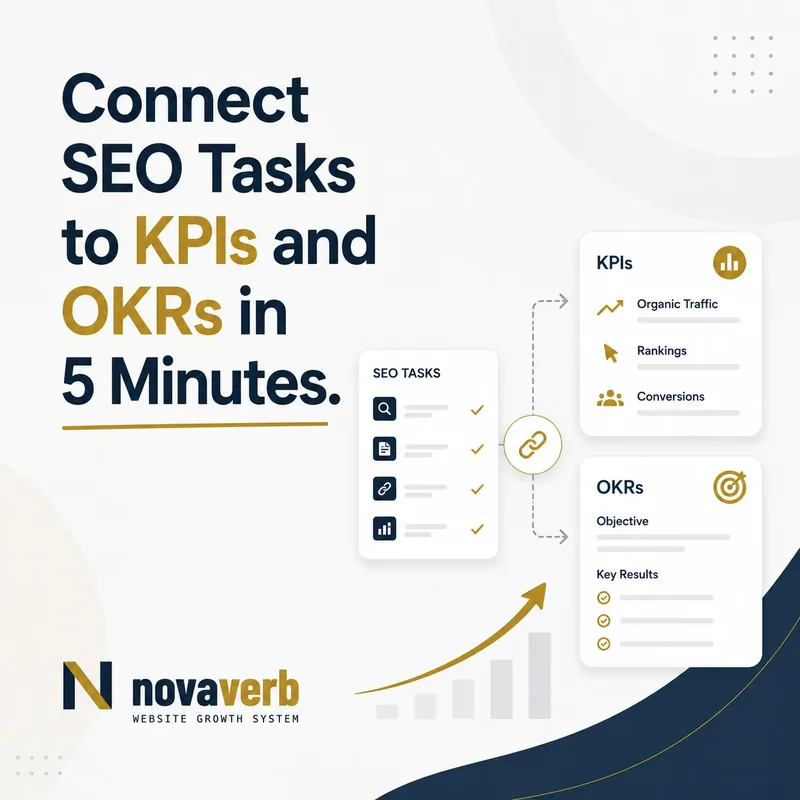
What Is an Accountable SEO Task?
An accountable SEO task is a specific unit of work with a defined owner, completion standard, execution measure, expected outcome, and review point. It tells the team what must be changed, why the work matters, how completion will be verified, and which result will determine whether the action was useful.
The important distinction is that a task is not an OKR. Updating ten title tags is work. Improving qualified organic traffic is an outcome. The task should support the outcome without pretending that completing the work automatically produces the result.
A usable task should answer five questions:
- What: What exactly must be changed?
- Where: Which pages, queries, templates, or projects are included?
- Who: Who owns the work and the handoff?
- Done: What evidence proves implementation is complete?
- Outcome: Which measurable result should change afterward?
This evidence-to-action approach is central to Novaverb: identify a supported finding, turn it into accountable work, and verify the result with fresh evidence instead of assuming the fix worked.
The Five-Minute SEO Task Framework
You can turn a vague SEO request into an accountable task in five minutes by completing five fields in the correct order. The five minutes are for defining the work clearly, not for completing the optimization itself.
- State the intended outcome. Identify the business or user behavior that should improve.
- Select the current KPI. Record the metric that shows the present state.
- Write the task. Specify the action, object, scope, and selection criteria.
- Define completion. Describe the evidence required before implementation is considered complete.
- Set the review point. Decide when the outcome will be measured and classified.
Start With the Outcome, Not the Output
A Key Result should describe a measurable change, while a Kanban task describes the work intended to cause that change. Confusing these two levels makes an SEO team appear productive even when visibility, activation, or revenue remains unchanged.
“OKR is a goal-setting framework used by individuals, teams, and organizations to define measurable goals and track their outcomes.”
Source: Wikipedia - Objectives and key results .
- Publish 100 articles.
- Run 10,000 audits.
- Track 3,000 keywords.
- Create 500 briefs.
Increase the number of commercial pages receiving qualified organic traffic from 30 to 55.
The outputs may still belong in the delivery plan. They simply should not be used as proof that the strategic result has been achieved.
Separate the Task KPI From the OKR Outcome
The task KPI confirms that the agreed work was completed, while the OKR outcome metric determines whether the work produced a valuable change. Both are necessary, but they answer different questions.
| Measurement layer | Question answered | Example |
|---|---|---|
| Execution KPI | Did the team complete and verify the intended work? | 10 target URLs updated and QA passed. |
| Search KPI | What changed in search visibility or user behavior? | CTR increased from 1.7% to 2.2%. |
| OKR Key Result | Did the initiative move the strategic outcome? | Qualified commercial pages increased from 30 to 55. |
Use Rank Monitor to inspect query and page movement, then connect that search evidence with engagement and conversion data in Audience Analytics. Ranking alone cannot show whether the visitor clicked, engaged, signed up, or activated a workspace.
How to Write a Clear Kanban Task
A strong Kanban task contains an action, a defined object, a limited scope, selection criteria, and the measurement it is expected to influence. Another qualified team member should be able to execute it without asking what the request means.
Action verb + specific object + defined scope + selection criteria + expected metric.
Too vague: Improve organic CTR.
Rewrite the title tags and meta descriptions for ten commercial pages with high impressions and CTR below the median of their query group.
The improved version defines:
- The work: Rewrite titles and meta descriptions.
- The object: Commercial pages.
- The scope: Ten URLs.
- The selection rule: High impressions and below-median CTR.
- The metric to observe: Organic CTR.
Use Content Categories as a Governance Layer, Not an Outcome Metric
Content categories help an SEO team organize work by stable areas of responsibility, but they do not prove that the work produced a meaningful result. Categories such as Technical SEO, On-Page SEO, Keyword Research, and 5 Minute SEO can group related pages, tasks, owners, templates, and reporting views.
Defines where the work belongs.
Defines what must be completed.
Measures the current state of performance.
Determines whether the underlying business or search outcome improved.
Categories create a consistent governance layer for planning, ownership, templates, and reporting. They should not be treated as evidence that visibility, engagement, leads, or revenue improved.
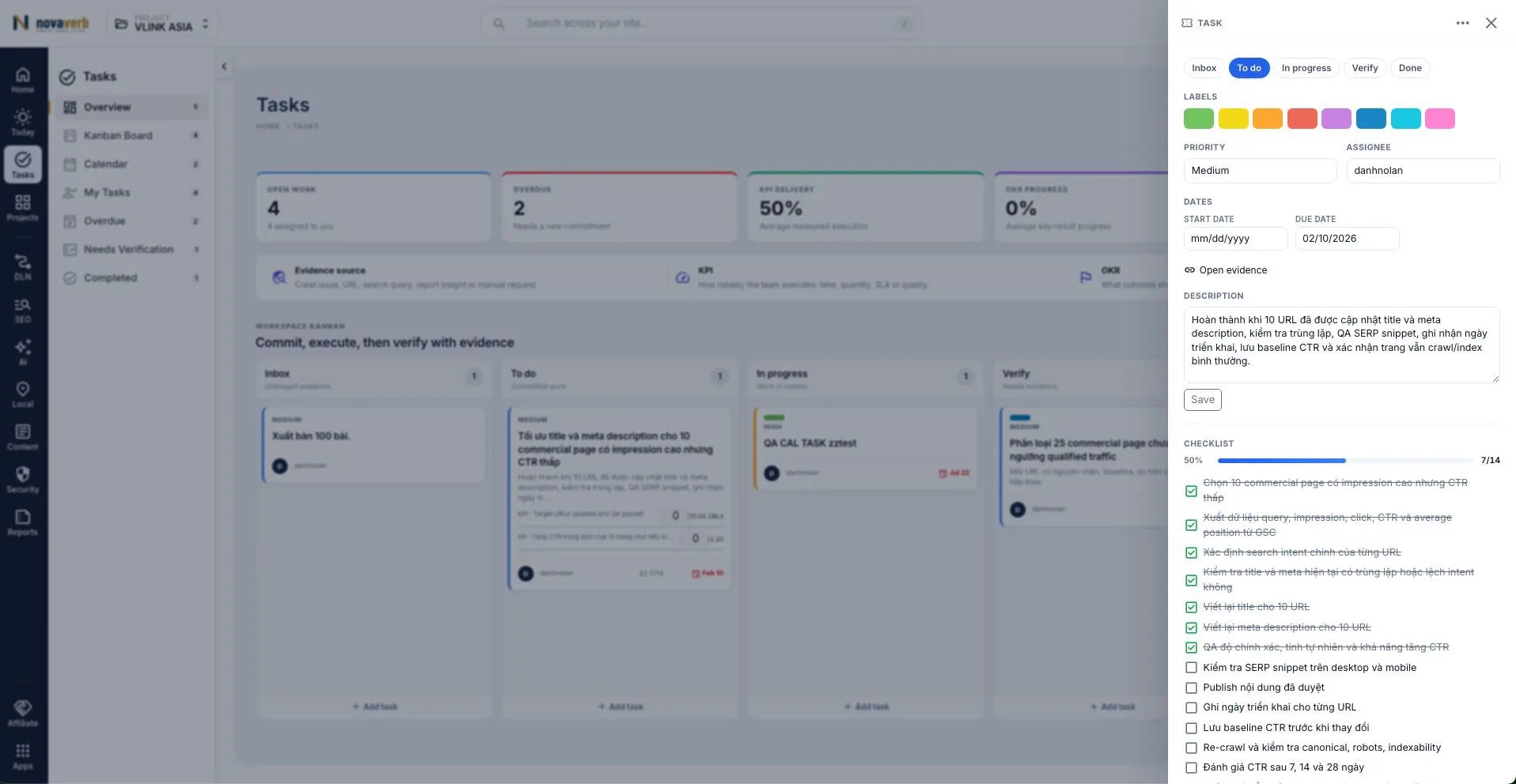
A useful category system should remain stable enough to support reporting and ownership without becoming a substitute for measurement. Publishing twenty articles under a category is still an output. The team must separately verify whether those pages earned qualified impressions, clicks, citations, signups, or revenue. This separation prevents a well-organized content library from being mistaken for a successful SEO program.
Build a Definition of Done That Can Be Audited
Definition of Done should describe observable evidence, not a subjective judgment such as “optimized,” “improved,” or “SEO-ready.” It should allow a reviewer to verify implementation without relying on the assignee’s memory.
All ten URLs have updated title tags and meta descriptions, duplicate checks are complete, SERP snippets have been reviewed, deployment dates are recorded, baseline CTR is saved, and crawlability, canonicalization, and indexability remain valid.
A practical checklist could include:
- Select the ten qualifying URLs.
- Export baseline clicks, impressions, CTR, and position.
- Confirm the primary intent for each page.
- Rewrite the title and meta description.
- Check duplication across the selected pages.
- Publish and record the deployment date.
- Re-crawl the URLs and verify technical eligibility.
- Schedule outcome reviews after 7, 14, and 28 days.
The free Meta Tag Checker can verify the live title, meta description, heading, canonical, robots directive, and structured data detected in the initial HTML. The check proves what is present; it does not guarantee how Google will rewrite or display the final snippet.
Complete SEO Task Example: Title and Meta CTR Test
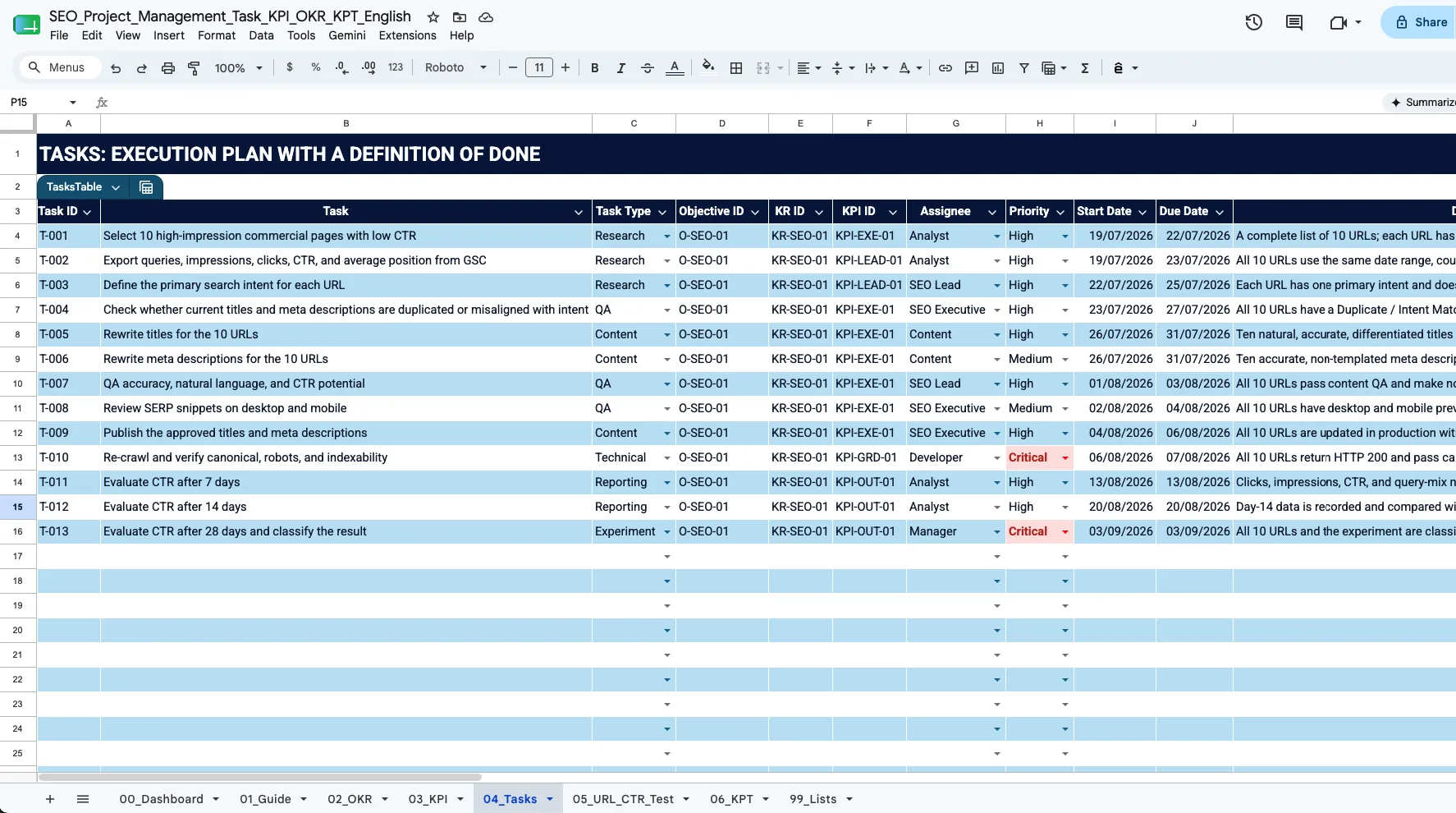
A complete SEO task connects a specific implementation action to a verifiable completion standard, an execution KPI, a strategic objective, a measurable Key Result, and scheduled review dates. This separation prevents the team from treating deployment as proof of impact and makes it possible to evaluate whether the title and meta changes actually improved organic search performance.
- Task
- Rewrite the title tags and meta descriptions for ten commercial pages with high impressions and low organic CTR.
- Definition of Done
- Ten URLs updated, duplication checked, SERP snippets reviewed, deployment date recorded, baseline CTR saved, and technical QA passed.
- Execution KPI
- 10 target URLs updated and QA passed.
- Objective
- Increase qualified organic traffic from commercial pages.
- Key Result
- Increase the average organic CTR of the ten selected pages from 1.7% to at least 2.2% within 28 days.
- Review Dates
- Review after 7, 14, and 28 days using the same page group, query scope, country, device assumptions, and comparison window.
The task is complete when the changes are implemented and verified, but the experiment is successful only when the agreed measurement shows a meaningful improvement. Keeping those two conditions separate gives the team an honest basis for deciding whether to retain the changes, revise the hypothesis, or run a different test.
Do Not Move an SEO Experiment Straight to Done
An SEO experiment should not move directly from implementation to Done because publishing the change proves only that the work was shipped, not that the intended result occurred. The task should remain in a measurement state until the agreed observation window closes and the evidence is strong enough to classify the outcome.
At the end of the measurement period, classify the Try before opening a new experiment:
- Won: The agreed metric improved enough to support adoption or expansion.
- Lost: The expected result did not occur or the change caused a negative effect.
- Inconclusive: The evidence is insufficient or too noisy for a defensible conclusion.
- Not executed: The intended change was not implemented according to the task definition.
The experiment is complete only when the team records what happened, what the evidence supports, and what decision follows. This keeps KPT reviews focused on accumulated learning rather than producing another list of untested ideas.
Six Measurement Mistakes to Avoid
The most damaging SEO measurement mistakes occur when teams track visible activity instead of the search, user, or business outcome the work was intended to change. A defensible measurement system keeps outputs, rankings, traffic, citations, conversions, and implementation evidence separate so each result can be interpreted accurately.
- Using output as a Key Result. Article count, audit count, keyword count, and brief count describe production volume. They confirm that work was produced, but they do not prove that search visibility, qualified traffic, activation, or revenue improved.
- Measuring ranking alone. Position can improve without producing more clicks, qualified sessions, signups, or revenue. Ranking should therefore be interpreted alongside impressions, CTR, landing-page engagement, and conversion data.
- Measuring traffic alone. Informational visits may grow while commercial-page engagement and activated workspaces remain unchanged. Traffic quality, landing-page intent, and downstream actions must be reviewed separately.
- Combining brand mentions with citations. An AI answer mentioning a brand without linking to its URL is different from using the site as a cited source. Keep these fields separate when reviewing AI Citation Tracker evidence.
- Starting a new Try before reviewing the previous one. Every experiment should end with Won, Lost, Inconclusive, or Not executed. Opening another Try before recording the result prevents the team from building a reliable body of evidence.
- Reducing SEO to one composite score. A single score is convenient for summaries but weak for diagnosis. Preserve separate dimensions and allow reviewers to open the underlying evidence behind each finding.
The Website SEO Checker follows this evidence-first approach by separating crawl coverage, technical indexability, and internal linking instead of presenting an unsupported traffic or ranking estimate.
A useful SEO measurement system should make it possible to trace every conclusion back to a specific metric, scope, time window, implementation record, and source of evidence. When these dimensions remain separate, the team can identify what changed, determine why it changed, and choose the next action without mistaking activity for progress.
Your Five-Minute SEO Task Checklist
A five-minute SEO task check should confirm that the work has a clear action, defined scope, accountable owner, observable completion evidence, measurable target, strategic purpose, and scheduled review point. If any of these fields requires interpretation or guesswork, the task is not ready to enter the Kanban workflow.
- The Task begins with a specific action verb.
- The affected URL, page group, template, or query set is defined.
- The selection criteria explain why these items were chosen.
- One person owns the task.
- The deadline is explicit.
- Definition of Done contains observable evidence.
- The execution KPI has a target and unit.
- The Objective describes a valuable outcome.
- The Key Result contains a baseline, target, and time window.
- The post-launch measurement date is scheduled.
- The Try will end as Won, Lost, Inconclusive, or Not executed.
A task that passes this checklist is ready for execution because ownership, scope, evidence, measurement, and review are already defined. This reduces clarification cycles, prevents incomplete handoffs, and gives the team a consistent basis for deciding whether the work was merely delivered or produced a meaningful result.
What Must a Measurable SEO Key Result Include?
A measurable SEO Key Result defines one meaningful outcome change through a fixed scope, baseline, target, owner, data source, and review window. It tells the team what must improve and by how much without turning the implementation checklist into the result itself.
The task describes the implementation work. The Key Result describes the measurable change expected from that work. The second statement can be evaluated against a known starting point, a defined page group, a specific target, and a clear deadline.
A Key Result is ready only when another reviewer can reproduce the measurement and reach the same conclusion from the same scope, baseline, data source, and time window. This standard keeps OKRs focused on verified progress rather than completed activity.
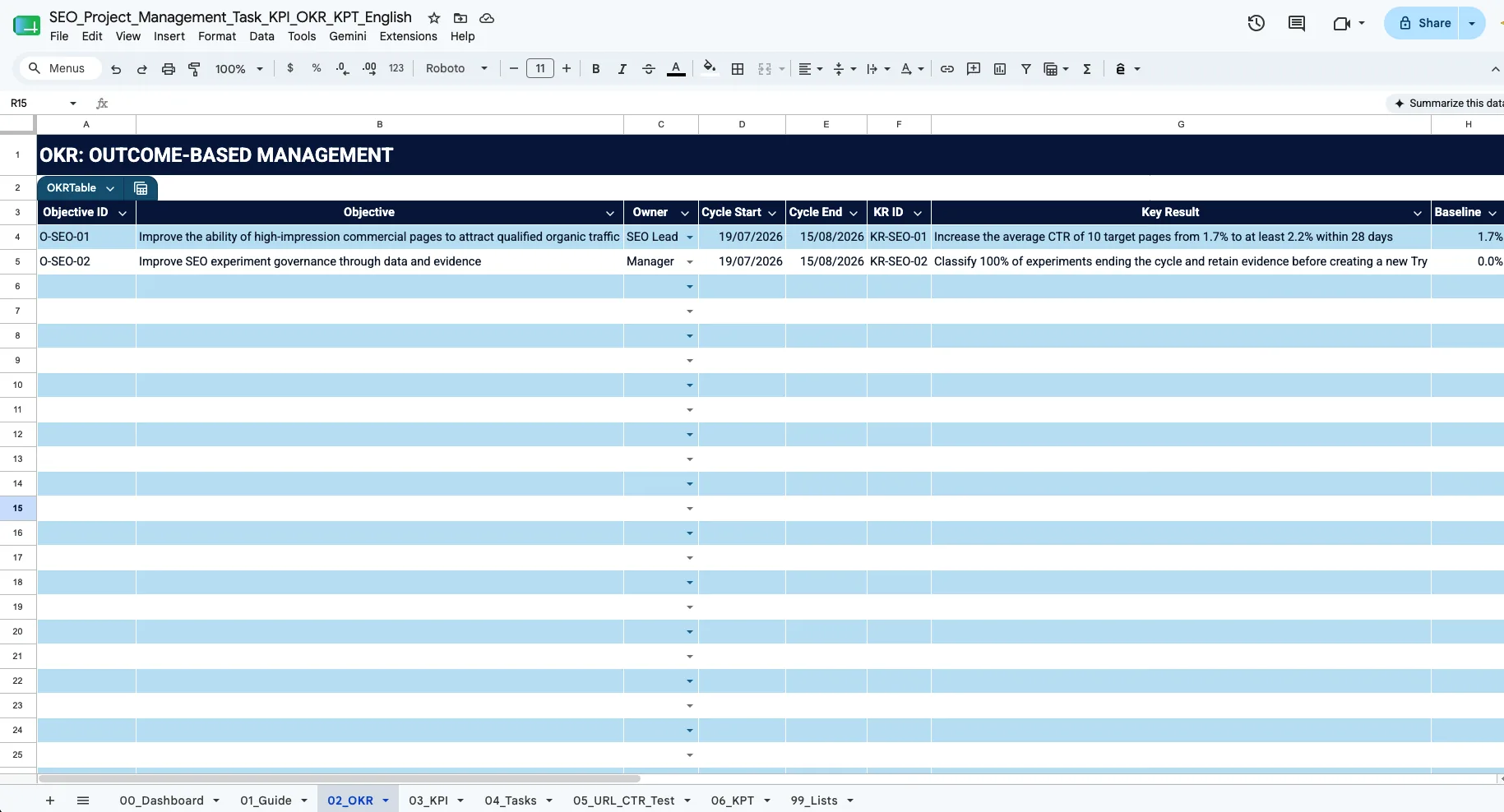
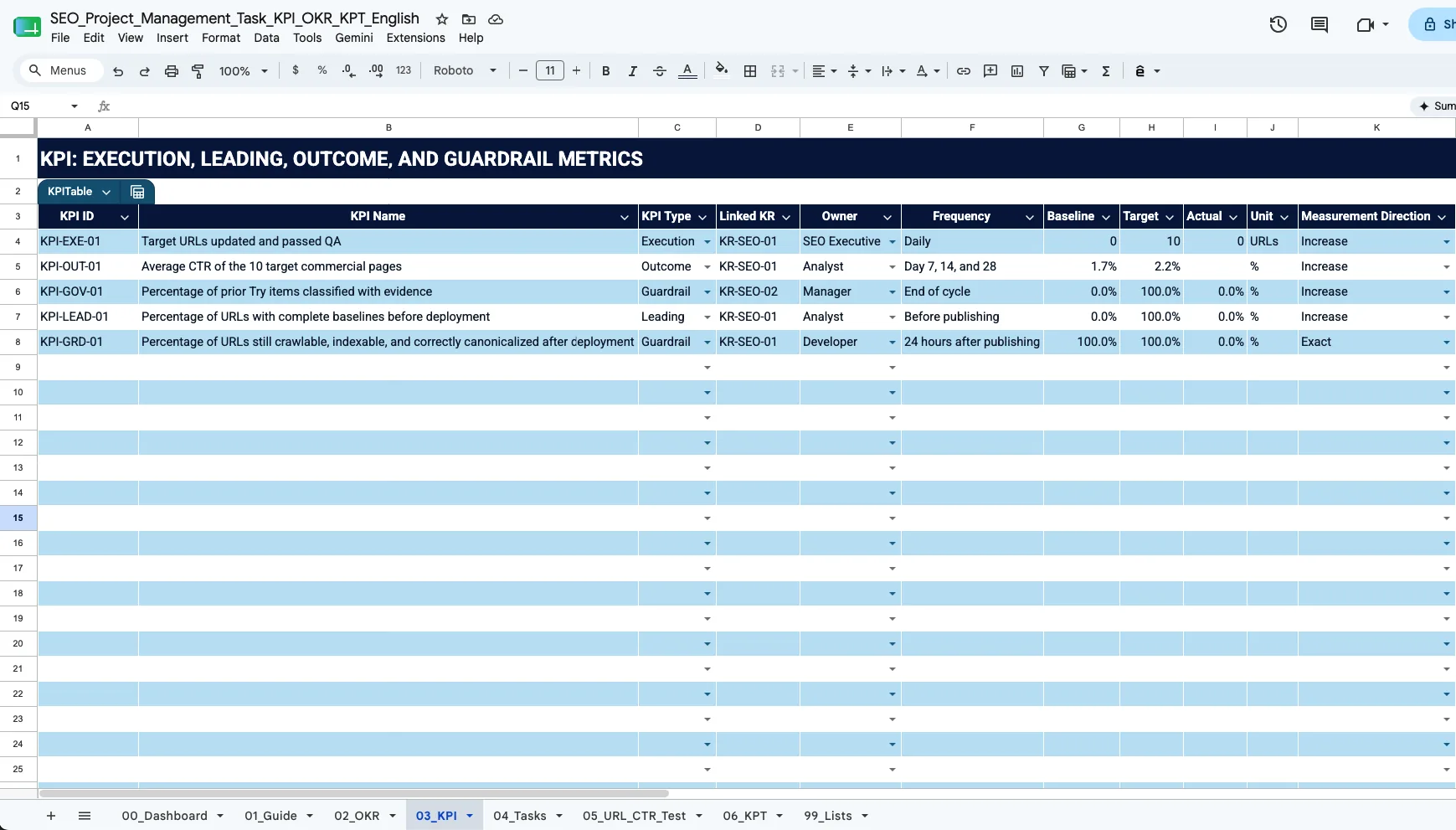
An SEO measurement system should separate execution, leading, outcome, and guardrail KPIs because each layer answers a different management question. Combining them into one metric hides whether the team completed the work, whether the conditions for success existed, whether the desired result changed, and whether the implementation introduced new risk.
The OKR, KPI, and task views above should therefore remain connected without becoming interchangeable. The task records the action, the KPI layers diagnose progress and risk, and the Key Result determines whether the intended outcome was achieved within the agreed scope and review window.
- Execution KPI: Confirms that the agreed work was completed, deployed, documented, and passed the required QA checks.
- Leading KPI: Confirms that prerequisites such as baselines, tracking, page eligibility, crawl access, and measurement readiness are in place.
- Outcome KPI: Measures the search, user, activation, lead, or revenue change the work was expected to influence.
- Guardrail KPI: Verifies that crawlability, indexability, canonicalization, content quality, conversion performance, or governance did not deteriorate during the experiment.
A reliable SEO review reads these four KPI layers together rather than declaring success from one favorable number. The work is strategically useful only when implementation is complete, measurement conditions are valid, the intended outcome improves, and no critical guardrail is breached.
Download the SEO Task–KPI–OKR–KPT Workbook
Turn this framework into an operating system your SEO team can use. The editable English Excel workbook helps you define accountable tasks, separate execution KPIs from outcome-based Key Results, and review every experiment with evidence.
- Task and Definition of Done
- Execution, outcome and guardrail KPIs
- OKR baseline, target and progress
- URL-level CTR tracking
- Day 7, 14 and 28 reviews
- Won, Lost, Inconclusive or Not executed
Created for evidence-led SEO workflows by Novaverb.
How Novaverb Connects Evidence, Tasks, and Outcomes
The best SEO workflow preserves the connection between the original evidence, the assigned work, the implementation proof, and the observed result. Without that chain, reports show activity but cannot explain what caused the change.
Explore the connected SEO tools or use Reports to keep source data, delivery status, and reviewable outcomes together.
Frequently Asked Questions
Is an SEO task the same as a Key Result?
No. A task describes work to perform. A Key Result describes the measurable outcome that indicates progress toward an Objective.
Can “publish ten articles” be a KPI?
Yes, as an execution or production KPI. It should not automatically be treated as proof that visibility, leads, activation, or revenue improved.
What should go in Definition of Done?
Include observable implementation evidence such as updated URLs, QA status, crawl verification, tracking validation, screenshots, deployment dates, or saved baselines.
Should ranking be the main SEO Key Result?
Ranking can be a useful visibility indicator, but it should usually be connected to clicks, qualified traffic, conversion, activation, or revenue.
When should a task move to Done?
The implementation task can be marked complete after its Definition of Done passes. The related experiment should remain in Measuring until the result is classified.
How long should an SEO experiment be measured?
Use a window appropriate to the available impressions, crawl frequency, seasonality, page type, and expected effect. The example in this article uses 28 days, but that is not a universal rule.
What happens when there is not enough data?
Classify the Try as Inconclusive. Do not force a Won or Lost result when the sample, tracking, or observation window cannot support the conclusion.
Should brand mentions and AI citations share one KPI?
No. A brand mention without a linked source and a citation to a specific URL are different observations and should remain separate in the data model.
Is one overall SEO score enough?
No. A composite score may summarize status, but the team still needs separate dimensions and access to the original evidence to decide what to fix.
Turn the Next SEO Finding Into Accountable Work
Do not leave the next audit finding inside a report. Give it an owner, scope, Definition of Done, execution KPI, linked outcome, and review date. Then verify the implementation and record what the team learned.