
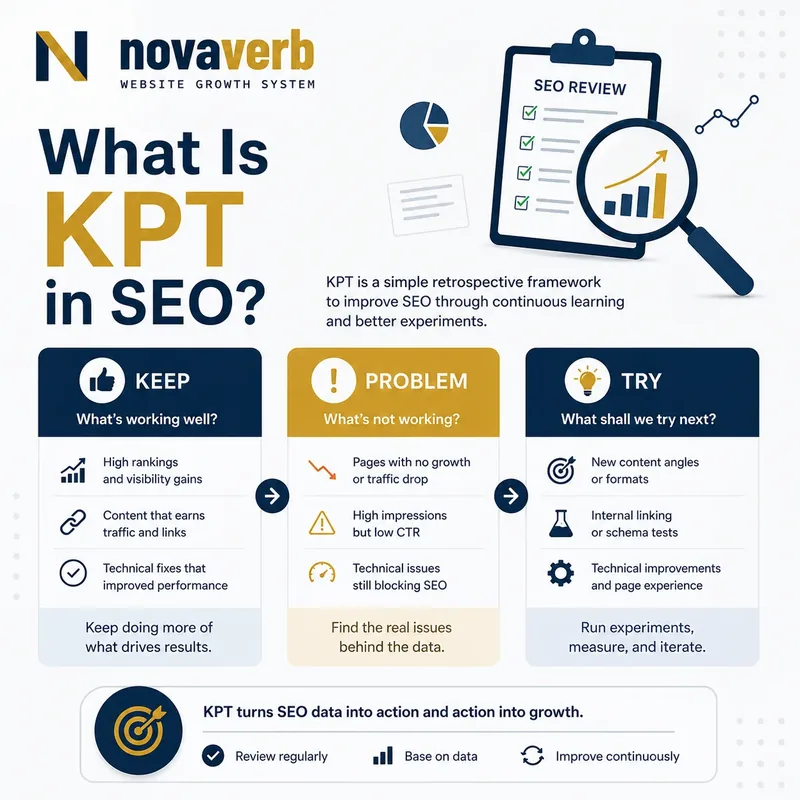
What Is KPT in SEO?
KPT in SEO is an evidence-based retrospective framework that organizes verified learning into three categories: Keep, Problem, and Try. Keep identifies practices worth preserving, Problem defines unresolved constraints or evidence gaps, and Try converts the most valuable learning into a bounded next experiment.
KPT is not a progress report, a team-performance score, or an unrestricted brainstorming session. It should occur after the team has reviewed implementation evidence, KPI movement, guardrails, limitations, and relevant changes in the search or business environment.
“A retrospective is a look back at events that took place, or works that were produced, in the past.” Wikipedia - Retrospective
In an SEO operating system, KPT connects a completed review with the next management decision. It prevents useful findings from remaining inside dashboards, meeting notes, or individual memory after a task has passed QA and its result has been measured.
What Each KPT Category Produces
| KPT category | Management question | Evidence requirement | SEO example | Expected operational output |
|---|---|---|---|---|
| Keep | What produced useful results or protected quality and should continue? | Repeatable positive evidence, valid implementation, acceptable guardrails, and a defined scope. | The intent-and-differentiator title pattern improved qualified CTR across the tested commercial-page cohort without reducing conversion rate. | A retained standard, reusable checklist, template, policy, workflow rule, or broader rollout candidate. |
| Problem | What unresolved constraint, failure, risk, or evidence gap still prevents the desired outcome? | A specific observed condition supported by a source, affected scope, timestamp, and stated limitation. | Mobile CTR remained below the accepted range even though desktop CTR improved after the title update. | A defined finding requiring investigation, prioritization, mitigation, or additional evidence. |
| Try | What bounded intervention should the team test next to address the selected Problem or expand a supported opportunity? | A plausible mechanism, fixed scope, baseline, owner, Definition of Done, KPI, guardrails, and review date. | Test shorter mobile-focused title wording on five stable high-impression pages while preserving the same query and conversion cohort. | An accountable experiment or task that can enter the SEO Kanban backlog. |
KPT Should Follow Evidence, Not Memory
- Keep should not mean “the team liked this approach.” It should identify a practice supported by useful and repeatable evidence.
- Problem should not mean “someone performed poorly.” It should describe an observable constraint in the system, workflow, implementation, evidence, or outcome.
- Try should not mean “add another idea to the backlog.” It should define a limited intervention that can be implemented, measured, and reviewed.
- Not every positive result becomes Keep. A one-time increase with weak evidence, changed cohorts, or strong confounders may require another Try before standardization.
- Not every Problem requires immediate action. The team should compare decision value, severity, confidence, effort, dependency, and opportunity cost.
- Not every Try must succeed. A well-designed Try can create valuable learning even when the expected KPI does not improve.
A complete KPT output should improve the next operating cycle. A Keep may update the team’s Definition of Done. A Problem may create a new investigation. A Try may become an experiment card with an owner, scope, baseline, KPI, guardrails, and scheduled review.
What Do Keep, Problem, and Try Mean?
Keep identifies an evidence-supported practice worth preserving, Problem identifies a specific unresolved constraint, and Try defines the next bounded intervention selected to improve the system. The three categories convert past work into an operational decision rather than a general discussion.
Preserve Verified Value
A Keep records a behavior, method, checklist, template, policy, or workflow condition that produced useful results or protected an important guardrail.
- Supported by observable evidence
- Bounded to a defined scope
- Repeatable by another owner
- Safe enough to retain
- Connected to a future standard
Name the Remaining Constraint
A Problem records an unresolved condition in the website, evidence, workflow, capacity, user journey, or measurement system.
- Describes a condition, not a person
- Names the affected scope
- Preserves the evidence source
- States business or user impact
- Separates fact from explanation
Create the Next Testable Action
A Try proposes one limited intervention that can be implemented, verified, measured, and reviewed against a stated hypothesis.
- Addresses one selected Problem
- Uses a bounded cohort
- Has one accountable owner
- Defines KPI and guardrails
- Includes a review point
How the Three Categories Differ
| Category | Evidence question | Weak statement | Stronger SEO statement | Operational destination |
|---|---|---|---|---|
| Keep | What should continue because the evidence supports its value? | Keep writing better titles. | Keep the intent-and-differentiator title template for comparable commercial pages because the tested cohort improved qualified CTR without reducing conversion rate. | Standard, checklist, template, policy, training material, or broader rollout. |
| Problem | What condition remains unresolved or prevents the intended outcome? | The writer made titles too long. | Six of ten mobile search snippets truncate the verified differentiator before it appears, and mobile CTR remains below the accepted range. | Investigation, risk record, backlog finding, dependency, or constraint. |
| Try | What bounded action should be tested next? | Try improving titles again. | Test shorter title variants on five stable high-impression pages, preserving the same query cohort, conversion guardrail, and 28-day review window. | Experiment card, task, hypothesis test, or time-bounded process change. |
KPT Is Not a Forced One-to-One Sequence
A KPT review does not require every Keep to produce a Problem or every Problem to produce an immediate Try. Several rules help preserve decision quality:
- One Keep may be supported by several successful tasks or experiments.
- One Problem may require investigation before the team is ready to define a Try.
- Several Problems may compete for one limited Try during the next cycle.
- One Try should normally address one primary hypothesis even when several KPIs are monitored.
- A positive result with weak evidence may remain a candidate Keep rather than becoming a standard immediately.
- A Problem with low decision value may be documented without entering the active backlog.
Why Does an SEO Team Need KPT?
An SEO team needs KPT to convert completed work and measured outcomes into reusable organizational learning. Without a structured retrospective, teams may repeat ineffective tactics, lose successful methods when people change roles, and fill the backlog with new ideas before understanding the previous cycle.
Preserve What Works
KPT turns successful execution patterns into standards, templates, QA criteria, reusable briefs, release policies, and training resources.
Expose Remaining Constraints
The Problem category prevents favorable headline metrics from hiding technical regressions, weak segments, evidence gaps, or unresolved user friction.
Control the Next Experiment
Try limits the next response to a defined hypothesis, cohort, owner, KPI, guardrail, and review date instead of opening an unlimited idea list.
Separate Learning From Blame
The review examines process, evidence, dependencies, criteria, capacity, and system behavior rather than using missed targets as personal accusations.
Improve Backlog Quality
Only selected Problems and well-formed Tries become actionable work, reducing duplicates, stale tasks, unsupported requests, and reactive prioritization.
Close the Measurement Loop
KPT gives every completed initiative a decision destination: standardize, investigate, retry, reverse, stop, or classify as inconclusive.
Operational Problems KPT Helps Prevent
| SEO operating problem | What happens without KPT | How KPT changes the response |
|---|---|---|
| Successful tactic remains undocumented | The result depends on the memory of one strategist and may not survive a team or client transition. | Keep converts the verified practice into a reusable standard with a defined scope. |
| Outcome target is missed | The team may blame execution, abandon the strategy, or repeat the same task without diagnosing the cause. | Problem separates implementation failure, measurement failure, dependency, hypothesis failure, and external interference. |
| Dashboard shows mixed results | A favorable aggregate metric may hide a weak market, device group, page role, or conversion segment. | KPT records the positive pattern as Keep while preserving the weaker segment as Problem. |
| Backlog grows after every meeting | Every idea becomes a task, active capacity is diluted, and priorities become unstable. | Try requires evidence, scope, mechanism, owner, and reviewability before entering active work. |
| SEO and development disagree | Each team defends its own interpretation of whether the work was completed or useful. | The review separates Definition of Done evidence from post-launch outcome evidence. |
| Experiment produces no clear result | The team may label it a failure or ignore it entirely. | KPT can identify a measurement Problem and define a new Try that improves the evidence design. |
| Recurring defect reappears | The team repeatedly closes individual tickets without changing the process that created them. | Keep and Problem can update release QA, template governance, monitoring, or ownership policies. |
KPT vs KPI, OKR, Kanban, and a Status Report
KPT reviews learning, KPI measures a defined condition, OKR sets a strategic result, Kanban manages work flow, and a status report communicates current progress. These tools should connect, but none should be used as a substitute for another.
| Management tool | Primary question | Typical time orientation | SEO example | Common misuse |
|---|---|---|---|---|
| KPT | What should we retain, which constraint remains, and what should we test next? | Past evidence translated into the next decision. | Keep the page-role brief; Problem: proof links remain weak; Try: test one Prove link on ten comparison pages. | Using KPT as an unstructured complaint or idea session. |
| KPI | What is the current measured condition, movement, or risk? | Continuous or repeated observation. | Qualified CTR, eligible canonical rate, lead acceptance rate, or card cycle time. | Tracking every available number without defining a management purpose. |
| OKR | What valuable condition should change, and what measurable results define progress? | A defined strategic cycle. | Improve qualified commercial acquisition with measurable Key Results and guardrails. | Using task volume or production quotas as Key Results. |
| Kanban | Where is the work, what is blocking it, and what must happen before it advances? | Current execution flow. | Backlog, Ready, In Progress, QA, Measuring, and Learned. | Treating a visual board as a simple to-do list without policies or WIP limits. |
| Status report | What happened, what is currently happening, and what requires attention? | Current reporting period. | Tasks completed, tasks blocked, KPI movement, risks, and upcoming work. | Confusing progress communication with retrospective learning or strategy selection. |
| Definition of Done | What evidence must pass before the implementation is accepted? | Task completion boundary. | Full scope deployed, live output verified, technical checks passed, and reviewer acceptance recorded. | Using a later ranking or traffic outcome as immediate completion evidence. |
How the Tools Work Together
An OKR may define an outcome such as improving qualified acquisition. KPIs diagnose the current gap and measure later movement. Kanban controls the work selected to influence the result. The status report communicates execution and current observations. KPT interprets the completed evidence and changes the next cycle.
What Evidence Should Be Reviewed Before KPT?
Before running KPT, review the agreed objective, implementation evidence, KPI baseline and current value, guardrails, scope changes, blockers, exceptions, and important external factors. The retrospective should begin from a shared evidence set rather than competing memories.
- Restate the intended outcome. Confirm which Objective, Key Result, operational responsibility, or user problem the reviewed work was intended to support.
- Verify the implementation. Check whether the full task scope passed its Definition of Done and whether any exception, rollback, or partial deployment remains.
- Review the KPI contract. Confirm the source, formula, cohort, baseline, target, review period, and guardrails used for evaluation.
- Inspect the result by relevant segment. Review page role, device, market, query class, template, traffic source, or conversion quality where aggregation may hide important differences.
- Review Kanban and delivery evidence. Examine blocked time, rework, QA failures, dependencies, WIP, aging, and handoff delays that influenced execution.
- Record concurrent changes. Identify campaigns, releases, migrations, demand changes, competitor activity, SERP changes, tracking changes, or policy decisions that may affect interpretation.
- Preserve unavailable evidence. Missing analytics, insufficient sample size, delayed reporting, disconnected sources, or unverified index evidence should remain explicit.
- Separate observation from explanation. Agree first on what happened before debating why it happened or what the team should do next.
KPT Evidence Pack
| Evidence layer | Required information | KPT decision supported | Risk when missing |
|---|---|---|---|
| Objective and scope | Intended outcome, affected pages or systems, exclusions, owner, and review cycle. | Determines whether the work addressed the right problem. | The team reviews activity without strategic context. |
| Original finding | Source, timestamp, criteria, affected scope, and evidence limitation. | Confirms which Problem the task was intended to resolve. | The review may compare the result with a different or stale problem. |
| Definition of Done | Acceptance criteria, live verification, technical checks, exceptions, and reviewer approval. | Separates execution quality from hypothesis quality. | A failed implementation may be mistaken for a failed strategy. |
| Primary KPI | Baseline, target, current value, source, cohort, filters, and observation period. | Shows whether the intended outcome moved. | Keep or Try decisions may be based on incompatible measurements. |
| Guardrails | Technical, quality, conversion, trust, or governance metrics that must not deteriorate. | Prevents a favorable result from becoming Keep when it created hidden harm. | The team may standardize a locally successful but globally damaging practice. |
| Flow evidence | Cycle time, blocked time, QA failure, rework, handoffs, and unresolved dependencies. | Identifies process Problems and future workflow Tries. | Only page performance is reviewed while delivery defects repeat. |
| Segment evidence | Relevant breakdown by device, market, page role, query class, audience, or conversion quality. | Allows a practice to be kept only where it actually worked. | Sitewide averages hide weak or harmed segments. |
| External context | Concurrent releases, seasonality, campaigns, SERP changes, competitors, and product changes. | Calibrates confidence in causal explanations. | Temporal sequence is reported as proof of causation. |
The evidence may be organized in Reports, but the review should retain direct access to the underlying URL, crawl, search, analytics, task, and business records.
How Do You Write a Useful Keep?
Write a useful Keep by naming the practice, the scope in which it worked, the evidence supporting it, the guardrails that remained acceptable, and the operational form in which it should be preserved. A Keep should be repeatable rather than merely positive.
Keep [specific practice] for [defined scope] because [verified result] improved or remained protected, supported by [evidence source], while [guardrails] stayed acceptable. Preserve it as [standard, checklist, template, policy, training, or rollout].
- Name the practice precisely. Identify the template, review method, release control, content structure, link pattern, meeting rule, or technical configuration that should continue.
- State where it worked. Preserve page type, market, query class, device, team, template, risk level, or workflow context.
- Attach the evidence. Identify the implementation proof, KPI movement, guardrails, comparison period, and relevant limitations.
- Check repeatability. Determine whether another qualified owner can apply the practice consistently from documented instructions.
- Choose the preservation mechanism. Convert the Keep into a checklist, Definition of Done criterion, template, policy, playbook, automation, training note, or rollout task.
- Set a revalidation condition. Define when the Keep should be reviewed again because the site, product, market, platform, or evidence source may change.
Weak and Strong Keep Statements
| Weak Keep | Why it is weak | Stronger Keep | Preservation action |
|---|---|---|---|
| Keep writing answer-first content. | No page role, evidence, quality standard, or result is defined. | Keep the answer-first introduction pattern on Orient pages because the tested cohort improved qualified query coverage and next-step progression without increasing unsupported claims. | Add the pattern to the Orient-page brief and editorial QA checklist. |
| Keep doing technical QA. | The actual review behavior and prevented risk are unclear. | Keep the post-release rendered canonical check for shared templates because it detected production-only conflicts that staging validation missed. | Add it to the high-risk template Definition of Done. |
| Keep short meetings. | Meeting length alone does not show whether decision quality improved. | Keep the pre-read evidence pack and 30-minute decision agenda because the team completed reviews without reopening source and scope disputes. | Standardize the KPT agenda and evidence-readiness checklist. |
| Keep internal linking. | Internal links vary by source role, destination, anchor, and user need. | Keep one contextual Choose-to-Prove link on comparison pages where the tested destination answered the dominant trust objection and increased qualified progression. | Update the page-role internal-link standard. |
| Keep the successful title. | A single title result may not transfer to other pages. | Keep the intent-plus-differentiator title pattern for commercial pages with the same query class, while retaining page-specific wording and conversion guardrails. | Create a bounded title template and a separate expansion test. |
How Do You Define a Problem Without Blaming People?
Define a KPT Problem as an observable gap between the intended condition and the actual condition, supported by evidence and bounded to the affected system or workflow. Describe the process, dependency, rule, capacity, implementation, or measurement failure without converting the finding into a judgment about a person’s character.
[Observed condition] affected [defined scope] during [time or workflow stage], supported by [source]. It created [user, search, business, quality, or delivery impact]. The cause is [verified, suspected, or still unknown].
Blame Language vs System Language
| Blame-based statement | Why it is harmful | Evidence-based Problem | Possible system response |
|---|---|---|---|
| The writer forgot the internal links. | Focuses on an individual while hiding whether the brief, template, review, or publishing workflow required the links. | Eighteen published comparison pages lacked the required Prove-stage link because the content brief and editorial QA checklist contained no destination field. | Add the field to the brief and Definition of Done, then backfill the affected pages. |
| The developer broke canonical tags. | Assumes intent and cause before reviewing template logic, requirements, test coverage, and deployment conditions. | The shared template emitted fallback canonicals for 240 pages after release, and production rendered-output QA did not cover that template state. | Repair the rule, expand test coverage, and add a release guardrail. |
| The SEO team chose bad keywords. | Combines research quality, product fit, landing-page role, and demand changes into one accusation. | Thirty selected queries produced impressions but low qualified progression because the assigned landing pages answered informational rather than commercial intent. | Reclassify intent, remap landing pages, and test a smaller cohort. |
| The analyst reported the wrong number. | Does not identify whether the source, metric definition, filters, time zone, or data contract caused the discrepancy. | The weekly report used sessions while the KPI contract defined Search Console clicks, causing two incompatible totals to be compared. | Standardize the KPI definition and report source label. |
| The client delayed everything. | Creates conflict without identifying the approval dependency, expected response time, or escalation policy. | Six Ready cards exceeded their aging threshold because legal approval had no named owner, response target, or escalation route. | Create an approval policy and separate blocked time from active cycle time. |
Keep Accountability Without Personal Blame
- Name the accountable role for the next action.
- Record which agreed process or requirement was not followed.
- Distinguish a one-time execution error from a repeated system pattern.
- Identify missing training, access, capacity, review, or decision authority.
- Preserve consequential individual responsibility where it genuinely exists, but avoid unsupported motives or character judgments.
- Design a correction that changes the probability of recurrence rather than merely assigning fault.
How Do You Turn a Try Into an SEO Experiment?
Turn a Try into an SEO experiment by connecting one evidence-backed Problem with a plausible mechanism, bounded intervention, fixed scope, baseline, Definition of Done, KPI, guardrails, and review decision. A Try becomes operational only when the team can implement and evaluate it.
- Select one primary Problem. State the observed condition, affected scope, evidence source, and decision value.
- Write the hypothesis. Explain why the proposed intervention may influence the Problem or intended outcome without presenting the explanation as fact.
- Bound the test. Define the pages, queries, templates, market, device, audience, or workflow group included and excluded.
- Preserve the baseline. Save the pre-change KPI, source, filters, period, relevant segments, and known anomalies.
- Write the implementation task. Specify the action, object, scope, owner, dependencies, reviewer, and Definition of Done.
- Define the outcome measurement. Choose the primary KPI, expected direction or target, observation window, and evidence threshold.
- Add guardrails. Identify technical, quality, conversion, trust, or governance conditions that must not deteriorate.
- Predefine the review decisions. State what would cause the team to keep, expand, revise, reverse, stop, or classify the Try as inconclusive.
Worked Try: Mobile Title Experiment
KPT Examples for Technical SEO, Content, and Conversion
A useful SEO KPT example preserves the relationship between the reviewed evidence, the retained practice, the unresolved constraint, and the next bounded intervention. The Try should not simply repeat the original task with more volume.
| SEO context | Evidence reviewed | Keep | Problem | Try |
|---|---|---|---|---|
| Canonical template repair | All selected URLs passed post-release canonical QA, but a second template produced similar conflicts during the next crawl. | Keep the served-and-rendered canonical check for every shared-template release. | Canonical test coverage is tied to known templates and does not discover newly introduced template variants. | Add automated template-state discovery to the pre-release audit for the next two releases. |
| Redirect migration | Approved mappings passed, but 14 internal links still pointed to redirected sources after launch. | Keep the complete source-to-destination mapping and one-hop response verification. | Internal-link reconciliation was performed after release rather than before deployment. | Require a pre-launch internal-link replacement export and block QA when mapped sources remain linked internally. |
| Content refresh | Qualified impressions and clicks improved for updated pages, but assisted progression remained unchanged. | Keep the source-validation and answer-first refresh process. | Updated pages answer the query but still lack an appropriate path to proof or commercial evaluation. | Add one page-role-specific next-step block to ten refreshed pages and measure qualified progression. |
| New topic cluster | Orient pages gained visibility, while comparison and proof pages received little internal traffic. | Keep the definition-first structure for entry queries. | The cluster contains strong Orient coverage but an incomplete Choose-to-Prove path. | Map each high-impression Orient page to one comparison and one proof destination using the Decision Ladder. |
| Title optimization | Desktop CTR improved, mobile CTR remained weak, and conversion quality stayed stable. | Keep the verified differentiator and intent language. | The differentiator frequently appears after mobile truncation. | Test shorter titles that move the differentiator earlier on five stable pages. |
| Conversion-page redesign | Form completion increased, but lead acceptance rate declined. | Keep the simplified form interaction and improved error handling. | The revised page removed qualification context users previously reviewed before submitting. | Restore concise fit and exclusion criteria above the form while retaining the simpler interaction. |
| Internal-link rollout | Destination discovery improved, but several anchors were generic and internal click behavior did not change. | Keep the page-role source and destination mapping. | Anchor text does not explain why the proof page is the relevant next step. | Test claim-specific contextual anchors on ten comparison pages. |
| Structured-data implementation | Markup passed syntax and visible-content checks, but no enhancement was observed. | Keep the visible-content consistency review and duplicate-markup check. | The team lacks sufficient evidence to determine whether the absence is eligibility, processing, competition, or display discretion. | Extend observation and compare representative eligible pages without adding unsupported properties. |
| AI citation monitoring | The brand gained citations for definition prompts but remained absent from comparison prompts. | Keep concise source-backed definitions and explicit entity relationships. | Comparison pages lack consistent criteria, limitations, and evidence close to claims. | Rewrite one comparison cohort using stable criteria and recapture the same prompt set. |
| SEO reporting workflow | Clients understood outcome reporting better, but reviews repeatedly stopped to reconcile source differences. | Keep the separation of execution, outcome, and guardrail KPIs. | Metric sources, filters, and reconciliation notes are not visible beside the reported values. | Add a compact evidence contract to every KPI section in the next report cycle. |
How Should KPT Connect to the SEO Kanban Backlog?
KPT should update the SEO operating system without sending every retrospective note directly into the active backlog. Keeps should update standards, Problems should become validated findings or investigations, and selected Tries should become prioritized Kanban cards with explicit completion and measurement requirements.
| KPT output | Default destination | Required transformation | When it may enter active work |
|---|---|---|---|
| Keep: useful content pattern | Brief, template, checklist, or content standard. | Define applicable page roles, evidence, exceptions, owner, and revalidation condition. | Only when implementation work is required to update existing pages or systems. |
| Keep: successful technical control | Definition of Done, release policy, automated check, or QA runbook. | Document the trigger, covered scope, pass criteria, and responsible reviewer. | When a rollout, automation, or process-change task must be delivered. |
| Problem: verified defect | Evidence-backed backlog finding. | Add source, affected scope, severity, decision value, freshness, and dependency. | After prioritization and task preparation are complete. |
| Problem: unknown cause | Investigation candidate. | Define the question, evidence needed, investigation scope, owner, and stop condition. | When resolving the uncertainty has enough decision value. |
| Problem: external dependency | Risk, blocker, escalation, or dependency record. | Name the resolver, response expectation, impact, age, and escalation route. | It may remain a blocker rather than becoming implementation work. |
| Try: optimization experiment | Experiment backlog. | Add hypothesis, scope, baseline, owner, Definition of Done, KPI, guardrails, and review date. | After it passes priority and readiness criteria and WIP capacity exists. |
| Try: workflow change | Process-improvement backlog. | Define the behavior being changed, process KPI, affected roles, pilot scope, and review. | After the team identifies an owner and avoids disrupting critical delivery. |
| Low-value note | Archive or retrospective record. | Retain context without creating a task. | Only if future evidence changes its decision value. |
Minimum Fields for a Try Card
Before moving a Try from the retrospective record into Ready, require the following fields: Problem, evidence source, hypothesis, action, scope, exclusions, owner, reviewer, dependencies, Definition of Done, execution KPI, outcome KPI, guardrails, deployment date, and review point.
The detailed implementation model is available in Connect SEO Tasks to KPIs and OKRs in 5 Minutes.
When Should an SEO Team Run a KPT Review?
An SEO team should run KPT when a meaningful body of implementation and outcome evidence is ready for a decision. The cadence may be recurring, milestone-based, experiment-based, release-based, or incident-based depending on how the work and evidence mature.
Recurring Review
Use a weekly, monthly, or quarterly cadence for a stable stream of SEO operations, experiments, reporting, and process improvement.
Experiment Review
Run KPT when the predefined observation window and evidence threshold allow the Try to be classified.
Release or Migration Review
Review after the implementation is stable enough to evaluate defects, flow, monitoring, user impact, and recovery controls.
Incident Review
Run KPT after containment and evidence preservation, focusing on recurrence prevention rather than immediate fault assignment.
Strategic Cycle Review
Use KPT before rewriting the next OKR so the new cycle reflects verified practices, remaining constraints, and evidence gaps.
Repeated Workflow Failure
Trigger a review when cards repeatedly block, fail QA, age beyond policy, return for rework, or reach Measuring without a decision.
Example KPT Cadences
| Review cadence | Best fit | Evidence expected | Primary KPT output |
|---|---|---|---|
| Weekly | Fast-moving operational teams, launches, incidents, or active experiment portfolios. | Implementation state, blockers, QA failures, leading KPIs, and early guardrails. | Workflow Keep, delivery Problem, and immediate bounded Try. |
| Monthly | Most ongoing SEO programs with enough search and behavior evidence to detect patterns. | Completed tasks, mature KPI observations, cohort results, and repeated process signals. | Standard updates, prioritized Problems, and next experiment set. |
| Quarterly or cycle-end | OKR review, portfolio decisions, strategic resource allocation, and broader standardization. | Key Result progress, outcome and guardrail trends, initiative reviews, and business impact. | Strategic Keeps, major constraints, retired initiatives, and next-cycle Tries. |
| After an experiment | Metadata, content, internal-link, conversion, or process tests with a defined review point. | Definition of Done, primary KPI, guardrails, segments, and confounders. | Adopt, expand, revise, reverse, stop, or rerun. |
| After a migration | Domain, platform, URL, taxonomy, template, analytics, or rendering migration. | Launch checklist, defects, crawl and search evidence, user impact, incidents, and recovery actions. | Migration runbook improvements, unresolved risks, and follow-up work. |
| After a serious incident | Indexability loss, widespread errors, tracking failure, security issue, or critical conversion defect. | Timeline, system state, detection, containment, root-cause evidence, impact, and recovery. | Controls to Keep, structural Problems, and recurrence-prevention Tries. |
Who Should Participate in an SEO KPT?
An SEO KPT should include the people who can explain the evidence, implementation, user or business impact, dependencies, and next decision. Attendance should follow the reviewed system rather than automatically including every stakeholder or limiting the session to the SEO team.
Facilitator
Maintains the evidence-first sequence, separates observation from explanation, prevents personal blame, manages time, and records decisions.
Evidence Owner
Explains source definitions, scope, filters, baseline, current values, missing data, reconciliation, and limitations.
Implementation Owner
Explains what was delivered, which dependencies changed, what passed the Definition of Done, and which exceptions remained.
Reviewer or QA Owner
Provides an independent view of implementation quality, failed criteria, rework, regressions, and acceptance decisions.
Business or Product Owner
Interprets lead quality, revenue, product fit, user value, commercial trade-offs, and whether the next Try deserves capacity.
Dependency Owner
Joins when engineering, content, legal, analytics, design, security, sales, or client approval materially affected the outcome.
Participation by Review Type
| KPT review type | Core participants | Optional specialists | Decision owner |
|---|---|---|---|
| Content experiment | SEO strategist, writer or editor, evidence owner, and reviewer. | Subject-matter expert, brand, legal, product, or conversion specialist. | Content or growth owner with authority over the next test. |
| Technical fix | Technical SEO, developer, QA reviewer, and evidence owner. | Platform, infrastructure, security, analytics, or product owner. | Technical or release owner. |
| Migration | Migration owner, SEO, engineering, analytics, QA, and business representative. | Infrastructure, design, content, legal, support, and client stakeholders. | Named migration authority with rollback power. |
| Conversion review | SEO, analytics, product, conversion, and sales or CRM representative. | Design, copy, legal, privacy, and customer-success specialists. | Growth or product owner. |
| Workflow KPT | People who perform, review, hand off, and prioritize the work. | Tool administrator, finance, client owner, or resource manager. | Team or operations lead. |
| Executive cycle review | SEO lead, evidence owner, business owner, and accountable executive. | Product, engineering, sales, finance, or client leadership. | Executive owner of the Objective and resources. |
What Are Common KPT Mistakes?
Common KPT mistakes include reviewing from memory, writing vague Keeps, blaming people in Problems, turning every idea into a Try, and failing to assign an owner or review point. These mistakes produce a retrospective record without improving the next operating cycle.
| Mistake | Why it fails | Better practice |
|---|---|---|
| Running KPT from memory | Recent, emotional, or highly visible events dominate the review while contrary evidence is ignored. | Prepare a shared evidence pack before the meeting. |
| Writing “keep doing SEO” | The retained practice, scope, evidence, and preservation mechanism remain undefined. | Name the repeatable behavior and convert it into a standard, checklist, or rollout. |
| Using Problem to blame a person | The team may hide mistakes, avoid participation, and fail to change the system that allowed recurrence. | Describe the observable condition, affected scope, process gap, impact, and accountability. |
| Writing a presumed cause as fact | The review may design the wrong correction before the mechanism is verified. | Separate observed condition, suspected explanation, and required investigation. |
| Turning every Problem into a Try | Capacity is overwhelmed and low-value issues receive the same attention as strategic constraints. | Prioritize by impact, confidence, urgency, effort, dependency, and opportunity cost. |
| Using Try as an activity quota | “Publish 50 pages” or “build 100 links” defines output without a testable result. | Add a hypothesis, bounded scope, KPI, guardrails, and review decision. |
| Keeping a tactic after one weak result | A thin sample, changed cohort, or strong confounder may create a misleading success. | Use a candidate Keep or expansion Try until repeatability is supported. |
| Ignoring negative guardrails | A traffic or CTR gain may conceal weaker lead quality, indexability, trust, or conversion. | Review primary and guardrail KPIs together. |
| Mixing observations and ideas immediately | Participants defend solutions before the team agrees on what happened. | Review evidence, classify observations, then generate and prioritize Tries. |
| Creating Tries without owners | The output remains a meeting note and does not enter accountable execution. | Assign one owner, reviewer, readiness criteria, and review date. |
| Repeating the same KPT every cycle | Problems remain open and Tries are proposed without evaluating previous decisions. | Begin each session by reviewing the previous Keeps, Problems, Tries, and their outcomes. |
| Using KPT as a performance evaluation | Participants optimize for appearing successful rather than surfacing uncertainty and failure. | Use KPT for system learning; manage individual expectations through separate processes. |
| Keeping too many practices | The operating standard becomes large, contradictory, and difficult to follow. | Retain only practices with clear value, ownership, scope, and maintenance logic. |
| Never archiving old Problems | The retrospective record accumulates obsolete issues, duplicates, and conditions that no longer apply. | Close, merge, invalidate, or archive Problems with a documented reason. |
KPT Quality Check
- Did the review begin with verified implementation and outcome evidence?
- Does every Keep state its scope, supporting evidence, and preservation mechanism?
- Does every Problem describe an observable system condition rather than a personality judgment?
- Are verified causes separated from suspected causes?
- Does every selected Try address one primary Problem?
- Does each Try have a hypothesis, owner, scope, Definition of Done, KPI, guardrails, and review point?
- Were low-value outputs archived rather than converted automatically into tasks?
- Did the team review the previous cycle’s KPT decisions?
- Can the resulting changes be inspected in the next review?
- Did the session produce a clear decision rather than only discussion?
A mature KPT process makes uncertainty safer to report and unsupported certainty harder to preserve.
Frequently Asked Questions About KPT in SEO
KPT converts reviewed SEO evidence into decisions about what to preserve, which constraint remains, and what bounded intervention should be tested next.
What does KPT mean in SEO?
KPT means Keep, Problem, and Try. It is a retrospective structure used to preserve effective practices, define unresolved constraints, and select the next evidence-backed experiment or process change.
What is a Keep in SEO?
A Keep is a specific practice, control, workflow, template, or method supported by useful evidence and acceptable guardrails. It should be preserved through a standard, checklist, policy, template, training resource, or controlled rollout.
What is a Problem in SEO KPT?
A Problem is an observable unresolved condition affecting search, users, business outcomes, evidence, workflow, quality, capacity, or risk. It should identify the source, scope, impact, and level of causal certainty.
What is a Try in SEO?
A Try is a bounded intervention selected to address one primary Problem or test an opportunity. It should include a hypothesis, scope, owner, Definition of Done, KPI, guardrails, and review point.
Is KPT the same as KPI?
No. KPI is a defined measurement used to monitor or evaluate performance. KPT is a retrospective decision framework that interprets implementation and KPI evidence.
Is KPT the same as an OKR review?
No. An OKR review evaluates progress toward Objectives and Key Results. KPT may be used inside or after that review to decide what to retain, which constraint remains, and what to test during the next cycle.
Should KPT happen before or after KPI measurement?
Outcome-focused KPT should occur after the required KPI and guardrail evidence is ready. A workflow or incident KPT may occur earlier when delivery evidence already supports an immediate process decision.
Can a KPT review include failed experiments?
Yes. A correctly implemented Try that fails to improve the expected result may reveal an invalid hypothesis, insufficient scope, weak measurement, hidden dependency, or a more important Problem.
Does every Problem need a Try?
No. A Problem may require investigation, evidence collection, escalation, monitoring, acceptance, or archival. Only selected Problems with sufficient value and a plausible response should produce active Tries.
Does every Keep become a permanent standard?
No. A Keep should preserve its evidence boundary. A positive result with a small sample, short observation window, or limited cohort may remain a candidate Keep and require an expansion Try.
How many Tries should a team select?
Select only the number the team can prepare, execute, verify, measure, and review within available capacity. A long Try list recreates the backlog problem KPT is meant to reduce.
Who should facilitate an SEO KPT?
The facilitator should be able to separate evidence, interpretation, and decisions; prevent blame; maintain the agenda; and ensure every selected output has an owner and destination.
How often should an SEO team run KPT?
The cadence depends on evidence maturity and work type. Teams may use weekly operational KPTs, monthly experiment reviews, cycle-end strategic KPTs, and event-based reviews after migrations or incidents.
Can KPT be used for technical SEO?
Yes. Technical KPT can preserve effective QA controls, identify recurring template or release Problems, and define bounded Tries for monitoring, testing, automation, or process changes.
Can KPT be used for content SEO?
Yes. Content KPT can review intent alignment, evidence, query coverage, internal progression, page role, editorial workflow, qualified traffic, conversion, and AI citation observations.
Should KPT be used to evaluate employee performance?
KPT is better suited to system learning and team improvement. Individual expectations, conduct, or performance concerns should be handled through an appropriate separate management process.
Where should KPT outputs be stored?
Store the evidence, Keep, Problem, Try, owner, decision, and follow-up links with the reviewed project or experiment. Standards should move into the relevant checklist or policy, while selected Tries should become accountable Kanban cards.
Turn SEO Results Into the Next Evidence-Backed Try
KPT is complete only when the reviewed evidence changes the next operating cycle. Preserve supported practices as Keeps, convert unresolved constraints into reviewable Problems, and allow only prioritized, measurable Tries to enter active work.
Before activating the next Try, require a defined Problem, evidence source, hypothesis, scope, owner, Definition of Done, execution KPI, outcome KPI, guardrails, and review date. This keeps learning connected to delivery instead of allowing retrospective ideas to disappear into an unmanaged backlog.
Use Reports to preserve the reviewed evidence and decision record, or explore the wider search operations system from Novaverb.