
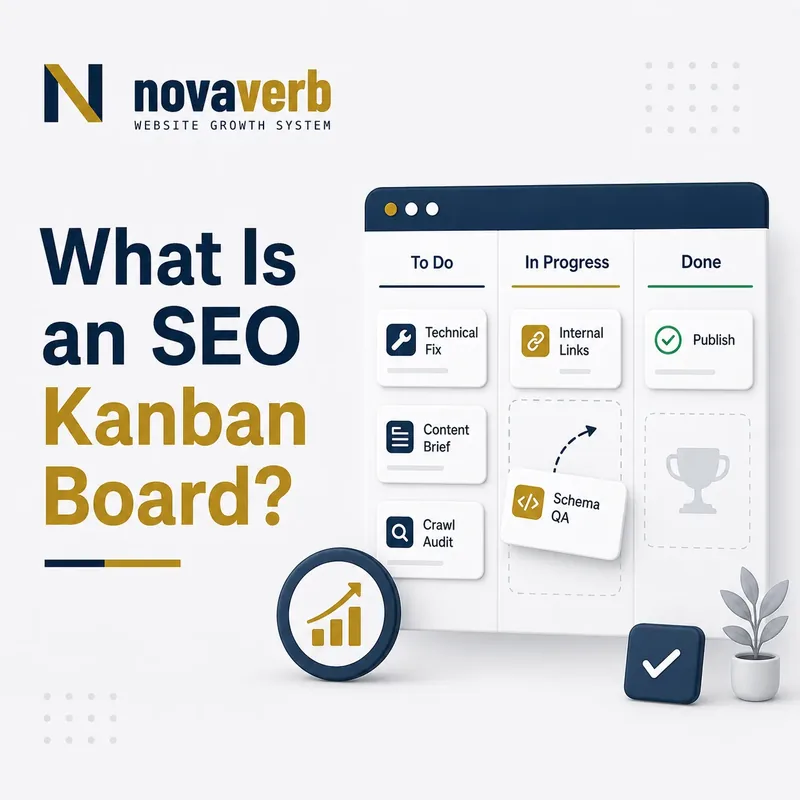
What Is an SEO Kanban Board?
An SEO Kanban board is a visual workflow system used to manage search work from an evidence-backed backlog through prioritization, implementation, quality assurance, measurement, and documented learning. It shows where each task is located, what evidence supports it, who owns it, what is blocking it, and what must happen before it can move forward.
Unlike a basic task list, an SEO Kanban board represents the lifecycle of work rather than merely recording whether an item is open or closed. It separates selecting the work, performing the change, verifying the live implementation, observing the result, and deciding what the team learned.
“Kanban is a scheduling system for lean manufacturing and just-in-time manufacturing.”
Wikipedia - Kanban
In an SEO context, the units moving through the system may include technical repairs, content updates, internal-link changes, redirect implementations, metadata experiments, structured-data corrections, crawl investigations, reporting tasks, or measurement reviews.
What an SEO Kanban Board Makes Visible
| Board element | Management function | SEO example | Risk when missing |
|---|---|---|---|
| Card | Represents one bounded unit of accountable work. | Rewrite metadata for ten high-impression commercial URLs with below-median CTR. | Large projects become vague requests with unclear ownership or completion. |
| Column or state | Shows the current lifecycle position of the work. | Ready, In Progress, QA, Measuring, or Learned. | Published work may be mistaken for verified success. |
| Entry criteria | Defines what must be true before a card enters a state. | A task cannot enter Ready until its URL scope, owner, evidence, and Definition of Done are documented. | Unclear work enters production and creates avoidable questions or rework. |
| Exit criteria | Defines the evidence required before a card advances. | A redirect task cannot leave QA until status, destination, hop count, canonical signals, and internal links are verified. | Cards move based on opinion, urgency, or meeting pressure rather than evidence. |
| WIP limit | Restricts how many items can occupy an active state. | Only three tasks may be In Progress for a two-person implementation team. | Work starts faster than it finishes, creating queues, context switching, and delayed QA. |
| Blocked indicator | Shows that a task cannot progress and identifies the dependency. | Waiting for CMS access, engineering deployment, analytics connection, legal approval, or client evidence. | Blocked work looks active and silently consumes capacity. |
| Evidence attachment | Preserves the source that justified the task and proves completion. | Crawl export, Search Console view, affected URL list, live-page screenshot, deployment record, and fresh recheck. | The team cannot distinguish an assumption from an observed finding. |
| Measurement review | Determines whether the expected outcome changed after implementation. | Compare the same page and query cohort after the defined observation window. | The team reports output without learning whether the action was useful. |
An SEO Kanban board is therefore not simply a visual design for project management. It is a governance layer that connects findings, priorities, owners, implementation standards, performance measurements, and learning decisions.
How Is an SEO Kanban Board Different From a To-Do List?
A to-do list records work that should be completed, while an SEO Kanban board manages how work enters, moves through, and leaves a controlled workflow. A list emphasizes individual items. A Kanban system emphasizes flow, capacity, evidence, bottlenecks, and explicit completion rules.
A to-do list can be sufficient for a small personal action such as checking one page title. It becomes inadequate when work requires several owners, dependencies, technical QA, deployment, measurement, or post-launch review.
| Management dimension | To-do list | SEO Kanban board | Why the distinction matters |
|---|---|---|---|
| Primary purpose | Remember individual actions. | Control the flow of work through a defined system. | SEO work often requires more than remembering what to do. |
| Workflow state | Usually open or completed. | Backlog, Ready, In Progress, QA, Measuring, and Learned. | Implementation and outcome verification remain separate. |
| Capacity | New work can be added without limit. | Active columns use work-in-progress limits. | The team finishes existing work before starting more. |
| Evidence | Evidence may be stored elsewhere or omitted. | Each card retains its finding, source, affected scope, implementation proof, and recheck. | The decision remains traceable to inspectable evidence. |
| Ownership | Responsibility may be implied. | Each active card has one accountable owner and, where needed, a reviewer. | Handoffs and delays become visible. |
| Definition of Done | The person may mark the item complete based on personal judgment. | Exit criteria define observable evidence required for completion. | Quality does not depend on who closes the item. |
| Blocked work | A blocked item may remain indistinguishable from an active one. | A visible blocker identifies the dependency, owner, and next escalation point. | Hidden waiting time no longer appears to be productive work. |
| Measurement | The item may disappear after publication or deployment. | The card can enter Measuring until the agreed result is observable. | The team preserves the learning cycle. |
| Process improvement | Provides limited information about systemic delay. | Shows queues, aging work, repeated blockers, rework, and state-level bottlenecks. | The team can improve the workflow rather than only push individual tasks. |
The Same Request in Two Systems
To-do list item
Improve internal links.
- No affected URL set
- No evidence source
- No defined page role
- No completion test
- No expected KPI
- No review date
SEO Kanban card
Add one contextual Choose-to-Prove link to twenty comparison pages that currently have no verified path to supporting evidence.
- Source crawl and page-role map attached
- Twenty URLs fixed as the scope
- Owner and reviewer assigned
- Destinations must return 200 and remain canonical
- Execution and progression KPIs defined
- Fresh crawl and outcome review scheduled
The visual board is not the defining feature by itself. A collection of cards arranged in columns remains a to-do list when the states lack policies, active work has no limits, and cards can be closed without evidence.
What States Should an SEO Kanban Board Include?
An SEO Kanban board should include enough states to distinguish unprioritized evidence, executable work, active implementation, quality verification, outcome measurement, and completed learning. The board should not contain so many states that team members cannot explain the difference between adjacent columns.
A practical baseline is: Inbox, Backlog, Ready, In Progress, QA, Measuring, and Learned. Teams may rename the states, but each state should represent a meaningful change in responsibility, evidence, or decision status.
| State | Purpose | Typical SEO content | Required movement condition |
|---|---|---|---|
| Inbox | Capture raw findings, requests, ideas, incidents, and stakeholder input before commitment. | Crawl warning, traffic anomaly, client request, ranking change, broken-page report, or content idea. | The item must be validated, merged, rejected, or converted into a supported backlog candidate. |
| Backlog | Store validated but uncommitted work that may support an Objective, KPI, risk, or operational responsibility. | Confirmed canonical conflict, internal-link gap, content refresh opportunity, reporting defect, or measurement need. | Decision value, evidence freshness, affected scope, effort, risk, and dependencies must be sufficient for prioritization. |
| Ready | Hold prioritized tasks that are fully prepared for execution. | A specific task with owner, scope, Definition of Done, baseline, and required access. | Capacity must become available and the accountable owner must pull the card. |
| In Progress | Represent work that is actively being implemented. | Metadata rewriting, template repair, internal-link update, redirect deployment, content revision, or data connection. | The implementation must be complete and the required evidence submitted for review. |
| QA | Verify that the intended change is live, correct, complete, and free from unacceptable regressions. | Rendered HTML check, crawl validation, event test, canonical review, status verification, link test, or content approval. | Every Definition of Done requirement must pass, or the card returns to In Progress. |
| Measuring | Observe the expected KPI after implementation while monitoring guardrails and evidence quality. | CTR test, ranking observation, crawl recheck, engagement review, lead-rate analysis, or citation monitoring. | The defined observation window and evidence threshold must support a result classification. |
| Learned | Record the outcome, limitations, decision, and reusable learning produced by the work. | Won, lost, inconclusive, not executed, invalidated, adopted, reversed, or scheduled for a broader rollout. | The result, evidence boundary, decision rationale, and next action are documented. |
Use Blocked as a Flag
A blocker normally describes a condition affecting a card, not a productive lifecycle stage.
- Identify the dependency
- Name the person who can resolve it
- Record when it became blocked
- Define the escalation point
- Keep the card visible in its actual state
Use Archived as a Record State
Rejected, duplicated, obsolete, or intentionally canceled work should not remain mixed with active priorities.
- Record the rejection reason
- Preserve useful evidence
- Identify duplicate cards
- Document changed assumptions
- Prevent accidental re-creation
Some teams may add specialist states such as Editorial Review, Engineering Review, Deployment Scheduled, or Client Approval. These states are useful only when they represent real queues that the team intends to manage and improve.
Why Should Measuring Be a Separate Kanban State?
Measuring should be a separate Kanban state because implementation completion and outcome verification answer different questions, occur at different times, and require different evidence. QA determines whether the intended change was delivered correctly. Measuring determines whether the expected search, user, technical, or business condition changed afterward.
Implementation Complete
- The approved change is live.
- The defined scope is complete.
- Technical QA has passed.
- Tracking remains functional.
- No unacceptable regression is visible.
- The deployment date is recorded.
Outcome Evaluated
- The observation window has matured.
- The baseline remains comparable.
- The same cohort and filters are used.
- Primary and guardrail KPIs are available.
- Confounders are documented.
- A decision is recorded.
Implementation Evidence vs Outcome Evidence
| SEO change | QA proves | Measuring evaluates | Possible final decision |
|---|---|---|---|
| Metadata update | The approved title and description are present in the live HTML without duplication or indexability regression. | Qualified CTR, clicks, query mix, conversion guardrails, and search appearance after the observation window. | Keep, expand, revise, reverse, or mark inconclusive. |
| Internal-link update | The intended links exist, use valid destinations, and do not create broken or redirected paths. | Crawl depth, destination discovery, internal progression, qualified clicks, and page performance. | Scale the pattern, change anchors, change destinations, or stop. |
| Redirect cleanup | The source returns the intended status and destination without avoidable hops. | Whether crawl errors, wasted requests, broken journeys, or migration inconsistencies decline. | Close the pattern, expand cleanup, or investigate remaining causes. |
| Content refresh | The approved content, headings, proof, links, schema, and tracking are live. | Relevant query coverage, qualified clicks, engagement, progression, leads, citations, or other defined outcomes. | Retain, broaden, narrow, merge, rewrite, or retire. |
| Structured-data repair | The markup is syntactically valid, matches visible content, and appears in the rendered page. | Eligibility or enhancement evidence where available, without assuming that valid markup guarantees display. | Maintain, extend, correct the content relationship, or stop unsupported markup. |
The Measuring state should not become an indefinite parking area. Each card needs a measurement owner, next review date, minimum evidence requirement, and result classification. Low-volume outcomes may require a longer window, a grouped cohort, or an explicit inconclusive result.
Use Reports when the review requires source, timeframe, current value, baseline, limitations, and next decision to remain together in the same evidence record.
How Do You Define Entry and Exit Criteria for Each State?
Define entry and exit criteria by stating the observable conditions, required evidence, accountable role, and decision that allow a card to enter or leave each Kanban state. A policy should be clear enough that two qualified reviewers reach the same conclusion when they inspect the same card.
Entry criteria protect the next state from receiving work that is incomplete or premature. Exit criteria protect the system from advancing cards that have not met the required quality or evidence standard.
- Identify the state’s purpose. Define the management question the state answers, such as whether work is executable, actively implemented, technically verified, or ready for outcome review.
- Identify the accountable role. State who owns the card while it occupies the state and who is authorized to approve its movement.
- Define mandatory inputs. List the evidence, scope, access, dependencies, approvals, and baseline information required before work enters.
- Define observable outputs. State what must exist, pass, or be documented before the card can leave.
- Specify failure handling. Explain whether a failed card returns to the previous state, becomes blocked, is split, or is removed from the active system.
- Add an aging expectation. Define when a card should be reviewed or escalated if it remains in the state longer than expected.
- Test the policy with real cards. Apply the rules to recent SEO tasks and rewrite criteria that require interpretation or repeatedly create exceptions.
Example Entry and Exit Policies
| State | Entry criteria | Exit criteria | Evidence retained |
|---|---|---|---|
| Backlog | The finding has a named source, timestamp, affected scope, and plausible decision value. | The item is rejected, merged, archived, or selected for preparation. | Original observation, affected URL set, source, freshness, and reason for retention. |
| Ready | The task has one owner, bounded scope, dependencies, Definition of Done, baseline, expected KPI, and available access. | The owner pulls the card after active capacity becomes available. | Task brief, acceptance criteria, priority rationale, and measurement plan. |
| In Progress | The owner accepts the task and has the required inputs, access, and capacity. | The full intended scope is implemented and submitted with review evidence. | Change log, files, affected URLs, notes, and unresolved implementation risks. |
| QA | The implementation is live or available in the required test environment. | Every Definition of Done condition passes and no unresolved critical regression remains. | Live checks, crawl evidence, screenshots, rendered output, validator results, and reviewer approval. |
| Measuring | QA passed, the deployment date is recorded, the baseline is preserved, and tracking is verified. | The observation window and evidence threshold support an outcome classification. | Fresh KPI values, guardrails, filters, limitations, and confounders. |
| Learned | The implementation and outcome evidence have been reviewed. | The classification, decision, reusable learning, and next action are documented. | Won, lost, inconclusive, not executed, invalidated, or adopted result with rationale. |
Entry criteria are sometimes called a Definition of Ready, while exit criteria for implementation are often represented by a Definition of Done. The labels matter less than whether the conditions are visible, consistently applied, and attached to real evidence.
How Do WIP Limits Improve SEO Delivery?
Work-in-progress limits improve SEO delivery by restricting how many tasks may occupy an active state at the same time. The purpose is to finish valuable work, expose bottlenecks, reduce context switching, and prevent implementation from moving faster than review or measurement capacity.
A WIP limit is not a productivity quota and should not be used to punish a team. It is a system-level constraint that makes excess demand visible. When the limit is reached, the team should help complete, review, unblock, or split existing work before starting another item.
Without WIP Limits
- Many tasks start
- Few tasks finish
- QA becomes a queue
- Owners switch context
- Blocked work stays hidden
- Measurement is forgotten
With WIP Limits
- Priority becomes explicit
- Existing work receives attention
- Review capacity is protected
- Blockers surface earlier
- Cycle time becomes visible
- Completion becomes more reliable
When a Limit Is Reached
- Stop pulling new work
- Help the oldest active card
- Resolve dependencies
- Perform QA
- Split oversized tasks
- Escalate structural capacity gaps
Example WIP Policies
| Workflow state | Example limit | Reason for the limit | Team response when full |
|---|---|---|---|
| Ready | A small queue covering the next few available tasks. | Prevents the team from preparing a large inventory that becomes stale before execution. | Do not refine more backlog items until Ready capacity is used. |
| In Progress | Approximately one active card per available owner, adjusted for pairing and task size. | Reduces multitasking and makes ownership visible. | Finish, pair, unblock, or return work that is not genuinely active. |
| QA | Limited by real reviewer capacity. | Prevents implementation from overwhelming technical, editorial, or analytics review. | Implementation owners help prepare evidence or resolve failed checks. |
| Measuring | Limited by the team’s ability to maintain baselines, review dates, and outcome interpretation. | Prevents experiments from entering a forgotten observation queue. | Complete overdue reviews before launching more experiments. |
When QA repeatedly reaches its limit, the answer may not be to increase the limit. The board may be revealing insufficient review capacity, poor task preparation, excessive batch size, unclear acceptance criteria, or repeated implementation defects.
What Information Should an SEO Kanban Card Contain?
An SEO Kanban card should contain enough evidence and instruction for a qualified owner to understand why the work exists, what must change, which scope is affected, how completion will be verified, and when the result will be reviewed. The card should remain concise enough to scan but complete enough to prevent critical context from living only in meetings or private messages.
| Card field | Purpose | Example |
|---|---|---|
| Title | Summarizes one bounded action using an explicit verb and object. | Rewrite metadata for ten low-CTR commercial URLs. |
| Evidence source | Identifies where the finding originated and whether it can be inspected again. | Search Console page-and-query export plus current live-page crawl. |
| Finding | States the observed condition without assuming the solution. | Ten commercial URLs have high impressions but CTR below the median of comparable query groups. |
| Decision value | Explains why the work matters now. | The pages support a Key Result for qualified commercial acquisition. |
| Scope | Defines included URLs, templates, queries, markets, devices, or content units. | Ten listed English commercial URLs targeting the United States. |
| Exclusions | Prevents uncontrolled expansion. | Brand queries, pricing URLs, blog posts, and pages below the impression threshold are excluded. |
| Owner | Names the one person accountable for moving the task through the workflow. | Content SEO owner. |
| Reviewer | Identifies the role responsible for independent acceptance. | Technical SEO reviewer for live metadata and indexability QA. |
| Dependencies | Lists access, approvals, releases, evidence, or upstream work required. | CMS access, approved query map, and deployment permission. |
| Definition of Done | Defines observable implementation evidence. | Ten URLs updated, unique metadata confirmed, live HTML verified, and canonical or indexability unchanged. |
| Execution KPI | Confirms that the agreed work was completed. | Ten target URLs updated and QA passed. |
| Outcome KPI | Defines the performance result expected to change. | Qualified CTR and clicks for the unchanged URL and query cohort. |
| Guardrails | Detects harmful trade-offs. | No material decline in conversion rate, indexability, or intended landing-page ownership. |
| Review date | Prevents the result from being forgotten after deployment. | Review on the scheduled observation dates using the same filters. |
| Final decision | Records the learning and next action. | Adopt, expand, revise, reverse, stop, or classify as inconclusive. |
Worked SEO Kanban Card
Improve qualified CTR for selected commercial pages
The connected SEO Tools workspace is the relevant internal resource when crawl, search, content, ranking, and reporting evidence need to remain attached to the work they generate.
How Do You Prioritize an SEO Kanban Backlog?
Prioritize an SEO Kanban backlog by evaluating verified impact, confidence, urgency, effort, dependency, risk, and strategic relevance rather than relying only on audit severity or stakeholder pressure. The purpose is to select the next best use of constrained team capacity, not to create a permanent numerical ranking for every possible task.
- Validate the finding. Confirm that the issue still exists, affects the stated live scope, and comes from an appropriate and sufficiently fresh source.
- Identify the responsible outcome. Connect the work to an active Objective, KPI gap, critical risk, user journey, contractual requirement, or operational responsibility.
- Estimate affected scope. Determine whether the finding affects one low-value page, a priority page cohort, a sitewide template, or a critical conversion path.
- Estimate impact. Evaluate the possible effect on crawlability, indexability, qualified visibility, user comprehension, conversion, trust, revenue, or risk.
- Evaluate confidence. Separate observed evidence from assumptions and determine whether the proposed action has a plausible relationship to the intended result.
- Estimate effort and dependency. Include implementation time, QA, coordination, release constraints, evidence collection, rollback preparation, and measurement burden.
- Apply risk overrides. Security exposure, production failure, destructive migration error, or widespread indexability loss may require immediate action even when a normal score is incomplete.
- Pull only within capacity. Move the highest-value prepared task to Ready or In Progress only when WIP policy permits.
Priority signal = (Expected impact × Evidence confidence × Time sensitivity) ÷ Total effort
This is a decision aid, not objective truth. Critical risk, mandatory work, dependencies, and strategic sequence may override the calculated order.
Evidence-Aware Priority Factors
| Factor | High-priority signal | Low-confidence signal |
|---|---|---|
| Evidence quality | The issue is reproduced on live URLs with a named source, timestamp, and affected scope. | The item comes from a generic checklist, stale report, or unexplained score. |
| Page value | The affected pages support qualified acquisition, conversion, contractual delivery, or critical navigation. | The pages have no defined role, demand, user value, or strategic relationship. |
| Scope | A shared template or rule affects many eligible priority URLs. | The issue is isolated to an obsolete or intentionally excluded URL. |
| Severity | The condition blocks access, breaks conversion, exposes risk, or invalidates important measurement. | The issue is cosmetic, theoretical, or labeled severe without outcome context. |
| Confidence | The cause and proposed action are supported by inspectable evidence or a bounded test. | The solution is assumed before the finding is validated. |
| Effort | A limited template or configuration change can resolve a broad verified problem. | The task requires extensive work with unclear benefit and no rollback or measurement plan. |
| Urgency | The impact is currently expanding, time-bound, release-dependent, or commercially critical. | The deadline exists only because every stakeholder request is labeled urgent. |
| Learning value | A bounded intervention can resolve an important uncertainty and inform future work. | The task repeats activity without preserving evidence or producing reusable learning. |
Use Site Health Audit when technical findings need to remain connected to severity, affected URLs, criteria, and a fresh verification rather than being reduced to a generic score.
How Do SEO Tasks, KPIs, OKRs, and Kanban Connect?
SEO OKRs define the outcome to pursue, KPIs show the current condition and later result, tasks define the bounded work, and Kanban controls how that work moves from evidence to verified learning. Each layer solves a different management problem and should remain visible throughout the operating cycle.
| Management layer | Question answered | Example | Role on the Kanban board |
|---|---|---|---|
| Objective | What valuable condition should improve? | Improve qualified organic acquisition from priority commercial pages. | Provides the strategic reason for prioritizing related cards. |
| Key Result | What measurable change would demonstrate progress? | Increase qualified non-brand clicks to the selected cohort by 20% during the cycle. | Defines the outcome relationship and cycle-level success condition. |
| KPI diagnosis | What current condition reveals the constraint or opportunity? | Ten pages have strong impressions but below-median qualified CTR. | Provides the evidence supporting the card and its priority. |
| Task | What work should the team perform next? | Rewrite metadata for the ten qualifying URLs. | Becomes the bounded card moving through the workflow. |
| Definition of Done | What proves the implementation is complete? | All ten updates deployed, unique, verified in live HTML, and free from indexability regression. | Controls the card’s exit from QA. |
| Execution KPI | Did the team complete the intended work? | Ten target URLs updated and QA passed. | Confirms delivery but does not close the outcome review. |
| Outcome KPI | Did the expected performance condition change? | Qualified CTR and clicks for the preserved cohort. | Controls the card’s exit from Measuring. |
| Learning decision | What should the team do next? | Adopt, expand, revise, reverse, stop, or classify as inconclusive. | Completes the Learned record and may generate new backlog evidence. |
How the Decision Ladder Adds Journey Context
The same management loop becomes more useful when every page and task also has a decision role. An Orient page explains, a Choose page supports comparison, a Prove page supplies evidence, a Rate page clarifies cost, and an Act page enables conversion.
A Kanban card can therefore identify both its strategic outcome and its journey role. For example, adding a contextual link from a comparison article to a case study is not merely “internal linking.” It is a Choose-to-Prove intervention intended to reduce uncertainty and move the user toward a supported decision.
How Do SEO Tasks, KPIs, OKRs, and Kanban Connect?
SEO OKRs define the outcome to pursue, KPIs show the current condition and later result, tasks define the bounded work, and Kanban controls how that work moves from evidence to verified learning. Each layer solves a different management problem and should remain visible throughout the operating cycle.
| Management layer | Question answered | Example | Role on the Kanban board |
|---|---|---|---|
| Objective | What valuable condition should improve? | Improve qualified organic acquisition from priority commercial pages. | Provides the strategic reason for prioritizing related cards. |
| Key Result | What measurable change would demonstrate progress? | Increase qualified non-brand clicks to the selected cohort by 20% during the cycle. | Defines the outcome relationship and cycle-level success condition. |
| KPI diagnosis | What current condition reveals the constraint or opportunity? | Ten pages have strong impressions but below-median qualified CTR. | Provides the evidence supporting the card and its priority. |
| Task | What work should the team perform next? | Rewrite metadata for the ten qualifying URLs. | Becomes the bounded card moving through the workflow. |
| Definition of Done | What proves the implementation is complete? | All ten updates deployed, unique, verified in live HTML, and free from indexability regression. | Controls the card’s exit from QA. |
| Execution KPI | Did the team complete the intended work? | Ten target URLs updated and QA passed. | Confirms delivery but does not close the outcome review. |
| Outcome KPI | Did the expected performance condition change? | Qualified CTR and clicks for the preserved cohort. | Controls the card’s exit from Measuring. |
| Learning decision | What should the team do next? | Adopt, expand, revise, reverse, stop, or classify as inconclusive. | Completes the Learned record and may generate new backlog evidence. |
How the Decision Ladder Adds Journey Context
The same management loop becomes more useful when every page and task also has a decision role. An Orient page explains, a Choose page supports comparison, a Prove page supplies evidence, a Rate page clarifies cost, and an Act page enables conversion.
A Kanban card can therefore identify both its strategic outcome and its journey role. For example, adding a contextual link from a comparison article to a case study is not merely “internal linking.” It is a Choose-to-Prove intervention intended to reduce uncertainty and move the user toward a supported decision.
Frequently Asked Questions About SEO Kanban Boards
An SEO Kanban board manages how evidence-backed work moves through preparation, implementation, QA, measurement, and learning. These questions address workflow states, WIP limits, ownership, blockers, recurring work, and result review.
What is an SEO Kanban board?
An SEO Kanban board is a visual workflow system for managing search work from evidence-backed backlog through prioritization, implementation, QA, measurement, and documented learning. Each card represents one bounded unit of accountable work.
How is an SEO Kanban board different from a task list?
A task list records actions, while a Kanban board controls workflow states, capacity, ownership, blockers, acceptance criteria, and evidence. A Kanban card should not be considered complete merely because someone checked a box.
What columns should an SEO Kanban board have?
A practical starting structure is Inbox, Backlog, Ready, In Progress, QA, Measuring, and Learned. Add or remove states only when they represent a real change in owner, evidence, capacity, or decision status.
Should Done and Learned be separate states?
They may be separate when the team needs to distinguish implementation completion from reviewed learning. A task can be technically complete while its expected outcome remains unknown, lost, or inconclusive.
Why does an SEO Kanban board need a Measuring state?
The Measuring state preserves the observation period between verified implementation and outcome classification. It prevents publication, deployment, or QA completion from being reported as proof that the optimization worked.
What is a WIP limit?
A work-in-progress limit restricts how many cards may occupy an active state. It helps the team finish existing work, expose bottlenecks, reduce context switching, and protect review capacity before starting more tasks.
How should blocked SEO work appear on the board?
Blocked work should normally remain in its actual workflow state with a visible blocked flag. The card should identify the dependency, person able to resolve it, blocked date, next action, and escalation point.
Who should own an SEO Kanban card?
Each active card should have one accountable owner responsible for moving it through the workflow. Contributors, reviewers, developers, writers, analysts, or approvers may be listed separately.
Can one Kanban card contain several SEO actions?
A card may contain related steps that produce one coherent and verifiable implementation. Unrelated technical, content, analytics, link, and reporting actions should be separated when they have different owners, dependencies, completion tests, or outcomes.
How should recurring SEO work be represented?
Recurring monitoring, reporting, crawl reviews, or maintenance may use recurring cards, service policies, or scheduled workflows. Do not keep one permanent card In Progress forever because that hides each review cycle and its evidence.
Can Kanban be used with SEO OKRs?
Yes. OKRs define the strategic outcomes, KPIs diagnose and measure performance, tasks define the work, and Kanban controls how that work moves through preparation, delivery, QA, measurement, and learning.
Is Kanban better than Scrum for SEO?
Neither method is universally better. Kanban is useful when SEO work arrives continuously, contains varied task sizes, and depends on unpredictable reviews or releases. Timeboxed planning may still be useful for coordinated projects, migrations, or content programs.
How often should an SEO Kanban backlog be reviewed?
Review the backlog often enough to remove stale findings, update evidence, resolve duplicates, and align work with current objectives. The appropriate cadence depends on task arrival rate, site risk, release frequency, and team capacity.
What metrics should an SEO Kanban system track?
Useful flow metrics may include work-in-progress, card age, blocked time, cycle time, throughput, QA failure, rework, and overdue measurement. These should be interpreted together with task value, outcome KPIs, and quality guardrails.
Next step: Review the practical framework for connecting SEO Kanban tasks with KPIs and OKRs without confusing card movement with verified strategic progress.
Turn Your SEO Board Into a Measurement and Learning System
Understanding an SEO Kanban board completes the Orient stage, but columns and cards create value only when they improve prioritization, delivery, verification, and learning. The next step is to connect every active card with its evidence source, responsible KPI, supporting OKR, Definition of Done, WIP policy, guardrail, and outcome review.
Use the practical implementation framework to convert vague SEO requests into accountable cards, separate delivery from outcomes, and preserve the fresh evidence needed for the next decision.
This evidence-to-action workflow is part of the broader search operating system developed by Novaverb.