
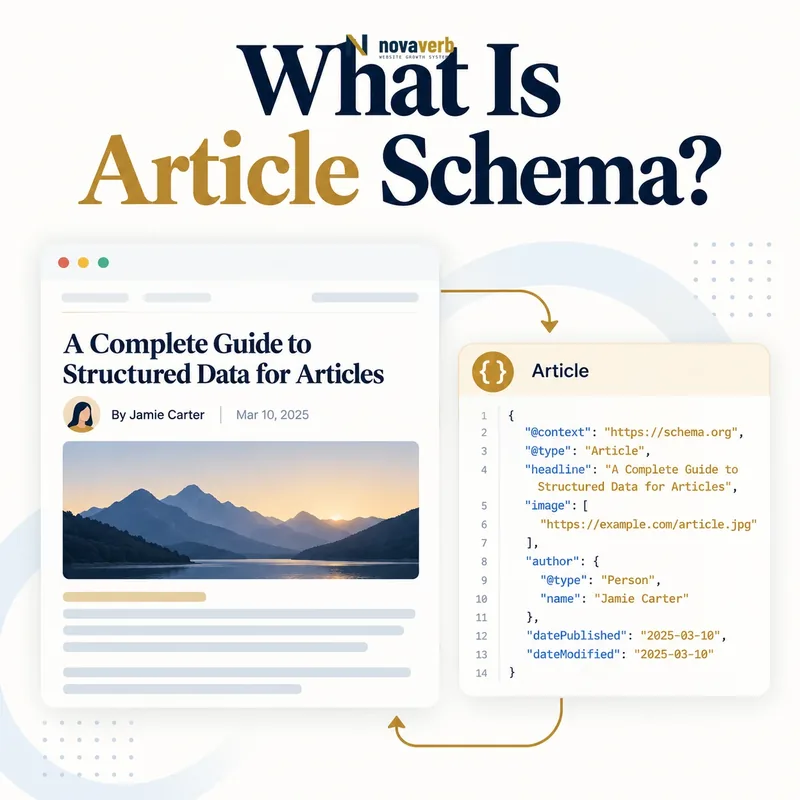
What Is Article Schema?
The Article type provides a machine-readable layer for written editorial content. BlogPosting and NewsArticle are more specific subtypes that can communicate the publication context. The graph should describe the actual article users see, not a category archive, search page, sales landing page or generic website shell.
Markup cannot prove reporting quality, establish expertise or guarantee a rich search appearance. Its value comes from connecting accurate article facts to stable Person, Organization, WebPage and ImageObject identities. The editorial page and structured representation must evolve together.
- Frame the decision raised by What Is Article Schema.
- Confirm its value type and the object it describes.
- Compare the markup with visible page information.
- Correct the source data or template without inventing values.
- Validate the rendered result and monitor future changes.
| Property or node | Represents | Evidence source |
|---|---|---|
| @type | Article classification | Actual page format |
| headline | Primary article title | Visible H1 |
| author | Responsible creator | Byline and profile |
| publisher | Publishing organization | Site ownership |
| datePublished | Initial publication time | Editorial record |
| dateModified | Meaningful latest update | Revision history |
| image | Representative article image | Visible media asset |
| mainEntityOfPage | Canonical page relationship | Preferred URL |
- Describe a real editorial article.
- Connect stable author and publisher identities.
- Keep dates and images truthful.
Article schema is an accurate publication record for editorial content, not a substitute for editorial quality or authority.
The decision for What Is Article Schema should rest on live, traceable evidence and a verified follow-up check.
How Does Article Schema Work?
A parser reads the rendered graph and evaluates the relationships. The Article can reference a Person as author and an Organization as publisher. The WebPage can identify the Article as its main entity, while the Article can point back through mainEntityOfPage. Consistent IDs keep those references from fragmenting across templates.
Syntax validation checks whether properties are shaped correctly, but it cannot verify that an author wrote the piece or that a modification date reflects a substantive update. Publishing systems need source fields, ownership and release rules that make the graph honest by default.
- Evidence for How Does Article Schema Work: the live structured-data entity and property relationship
- The expected value type and any nested object
- Visible page information that supports the structured value
- Related offer or catalog fields needed for interpretation
- A fresh validation result after the page changes
| Stage | Graph action | Failure example |
|---|---|---|
| Classify | Choose Article subtype | Product page marked as Article |
| Identify | Assign stable article or page ID | New identity on each render |
| Attribute | Connect real author | Brand inserted as Person |
| Publish | Connect publisher organization | Unrelated corporate entity |
| Date | Output editorial timestamps | Current time on every request |
| Media | Reference representative image | Logo used as article image |
| Validate | Compare rendered graph and page | Schema passes while byline differs |
- Confirm the page is editorial content.
- Select the truthful subtype.
- Map authoritative CMS fields.
- Connect stable entities.
- Validate rendered output.
The markup works when one canonical article connects verifiable publication facts through a coherent structured graph.
The decision for How Does Article Schema Work should rest on live, traceable evidence and a verified follow-up check.
Article vs BlogPosting vs NewsArticle
A company tutorial, opinion piece or evergreen guide commonly fits BlogPosting or Article. Time-sensitive reporting produced through a news editorial operation may fit NewsArticle. A press release does not automatically become independent news, and a product update is not NewsArticle merely because it is recent.
Subtype choice should reflect content, governance and user expectations. The fields overlap substantially, so changing the type will not rescue incomplete authorship, misleading dates or weak page quality. When no specific subtype is clearly supported, Article is the safer truthful model.
- Frame the decision raised by Article vs BlogPosting vs NewsArticle.
- Confirm its value type and the object it describes.
- Compare the markup with visible page information.
- Correct the source data or template without inventing values.
- Validate the rendered result and monitor future changes.
| Content situation | Likely type | Key distinction |
|---|---|---|
| Evergreen SEO guide | Article or BlogPosting | Educational editorial content |
| Company blog update | BlogPosting | Published within blog |
| Original news report | NewsArticle | Newsroom reporting workflow |
| Opinion column | Article or suitable subtype | Attributed commentary |
| Press release | Article where appropriate | Publisher-originated announcement |
| Product landing page | Product or WebPage | Commercial page, not article |
| Category archive | CollectionPage | Lists articles rather than being one |
| Forum question | QAPage when eligible | Community question model |
- Match the page’s actual editorial purpose.
- Use NewsArticle only for genuine news content.
- Keep non-article templates out of article markup.
Choose the narrowest honest editorial subtype and never use NewsArticle as a freshness or visibility label.
The decision for Article vs BlogPosting vs NewsArticle should rest on live, traceable evidence and a verified follow-up check.
Which Article Schema Properties Matter Most?
The headline should describe the same story as the visible primary title, even if character handling differs slightly by interface. Author can be a Person or, when editorial responsibility genuinely belongs to an organization, an Organization. A stable author profile gives the relationship clearer identity than an unlinked name string.
Publisher should represent the entity publishing the article and can connect to the Organization node described in Organization schema. Images need accessible, crawlable URLs and should represent the article rather than a generic placeholder. Optional properties should be added only when supported by editorial data.
- Evidence for Which Article Schema Properties Matter Most: the live structured-data entity and property relationship
- The expected value type and any nested object
- Visible page information that supports the structured value
- Related offer or catalog fields needed for interpretation
- A fresh validation result after the page changes
| Property | Priority | Audit question |
|---|---|---|
| headline | High | Does it match the visible article title? |
| author | High | Is responsibility correctly attributed? |
| publisher | High | Is this the real publishing entity? |
| datePublished | High | Is it the original publication time? |
| dateModified | High when used | Was a meaningful change made then? |
| image | High | Is it relevant and accessible? |
| mainEntityOfPage | High | Does it reference the canonical page? |
| description | Useful | Does it accurately summarize the article? |
| articleSection | Optional | Does it match real taxonomy? |
- Map the visible headline.
- Connect the responsible author.
- Reference the canonical publisher.
- Preserve original and modified dates.
- Use a maintained article image.
Prioritize identity, attribution, dates, canonical relationships and representative media before optional enrichment.
The decision for Which Article Schema Properties Matter Most should rest on live, traceable evidence and a verified follow-up check.
How Should Author and Publisher Markup Be Built?
Use a stable Person ID and profile URL when an identifiable writer is responsible. The profile should contain truthful biographical and editorial context, not fabricated credentials. Guest authors can have their own nodes without being treated as employees. Multiple authors should remain distinct rather than combined into one name string.
The publisher usually references one stable Organization ID across the site. Its name, URL and logo should agree with the canonical business identity. Do not use a hosting provider, parent investor or content-management platform as publisher unless it truly performs that role.
- Frame the decision raised by How Should Author and Publisher Markup Be Built.
- Confirm its value type and the object it describes.
- Compare the markup with visible page information.
- Correct the source data or template without inventing values.
- Validate the rendered result and monitor future changes.
| Entity case | Recommended model | Avoid |
|---|---|---|
| Named staff writer | Person with stable ID | Plain name changing across pages |
| Guest contributor | Separate Person | Treating guest as employee |
| Multiple writers | Array of Person nodes | One combined Person name |
| Editorial team byline | Organization only when genuinely responsible | Invented individual author |
| Site publisher | Canonical Organization ID | New publisher node per article |
| Parent company | Relationship only if relevant | Replacing actual publication brand |
| AI-assisted draft | Attribute accountable human or organization truthfully | Assigning software as accountable expert |
| No public author | Use supportable responsible entity | Fabricated persona |
- Identify accountable creators.
- Reuse stable entity IDs.
- Publish only supportable credentials and roles.
Clear author and publisher identities make responsibility legible without manufacturing expertise or corporate relationships.
The decision for How Should Author and Publisher Markup Be Built should rest on live, traceable evidence and a verified follow-up check.
How Should Publication and Modified Dates Work?
Changing a punctuation mark, refreshing a cache or rebuilding a template does not justify presenting an article as substantively updated. Meaningful changes may include corrected facts, new analysis, revised recommendations or material additions. The visible page should communicate the update consistently when recency matters to users.
Use complete ISO-formatted timestamps with the correct timezone. Avoid setting dateModified to the current request time, deployment time or latest database save when that field includes administrative changes. Preserve a revision source so editors can explain why a date changed.
- Evidence for How Should Publication and Modified Dates Work: the live structured-data entity and property relationship
- The expected value type and any nested object
- Visible page information that supports the structured value
- Related offer or catalog fields needed for interpretation
- A fresh validation result after the page changes
| Event | datePublished | dateModified |
|---|---|---|
| First public release | Set original time | Usually same or omitted by policy |
| Substantive factual revision | Preserve | Update to revision time |
| New research or examples | Preserve | Update when materially changed |
| Typo correction | Preserve | Usually preserve |
| Template redesign | Preserve | Preserve |
| Image compression | Preserve | Preserve |
| URL migration | Preserve | Preserve unless content changed |
| Republished syndicated copy | Respect original and publication policy | Do not fabricate freshness |
- Store the original public timestamp.
- Define meaningful-update criteria.
- Record revision reason and effective time.
- Keep visible and structured dates aligned.
Publication dates establish origin, and modified dates should record meaningful editorial change rather than automated freshness.
The decision for How Should Publication and Modified Dates Work should rest on live, traceable evidence and a verified follow-up check.
How Do Canonicals and Syndicated Articles Affect Markup?
A canonical tag, internal links, sitemap entry and mainEntityOfPage should point toward the intended preferred URL when the publishing arrangement supports that choice. Cross-domain syndication agreements require explicit policy because partners may retain indexable copies. Structured data alone does not consolidate duplicate URLs.
Track original authorship and dates across versions. Do not replace the originating publisher or author simply because another domain republishes the text. Excerpts, translations and materially adapted editions may require separate page identities and relationships rather than a blind copy of the source graph.
- Frame the decision raised by How Do Canonicals and Syndicated Articles Affect Markup.
- Confirm its value type and the object it describes.
- Compare the markup with visible page information.
- Correct the source data or template without inventing values.
- Validate the rendered result and monitor future changes.
| Publishing case | Canonical approach | Schema responsibility |
|---|---|---|
| Tracking URL duplicate | Canonical to clean article | Describe preferred page consistently |
| Print version | Canonical to main article | Avoid separate competing identity |
| Syndicated full copy | Follow explicit partner agreement | Preserve true source and publisher roles |
| Authorized translation | Often separate locale URL | Identify translated edition truthfully |
| Updated edition | Canonical based on editorial policy | Preserve real dates and identity |
| Excerpt page | Canonical or self-canonical by purpose | Do not claim full article content |
| Scraped copy | Not controlled by source publisher | Address through evidence and enforcement |
| Domain migration | Canonical and redirect to new URL | Keep article identity stable where possible |
- Align canonical, sitemap and graph relationships.
- Preserve original attribution.
- Model editions rather than cloning identities blindly.
Use canonical signals to identify the preferred page and preserve truthful authorship, publisher and edition relationships across syndicated copies.
The decision for How Do Canonicals and Syndicated Articles Affect Markup should rest on live, traceable evidence and a verified follow-up check.
What Article Schema Mistakes Are Common?
Template leakage is a major source of scale errors. If Article JSON-LD sits in a global layout, category pages, product pages and search results may inherit it. Multiple SEO plugins can also generate competing Article nodes with different publishers or dates.
Another failure is confusing content optimization with evidence. Adding a Person node does not prove expertise, and a recent date does not make old guidance current. Audit the editorial source fields and rendered page together. Fix inaccurate facts before adding optional properties.
- Evidence for What Article Schema Mistakes Are Common: the live structured-data entity and property relationship
- The expected value type and any nested object
- Visible page information that supports the structured value
- Related offer or catalog fields needed for interpretation
- A fresh validation result after the page changes
| Mistake | Risk | Correction |
|---|---|---|
| Article on non-editorial page | Wrong page classification | Limit output by template |
| Automatic current dateModified | False freshness | Use meaningful revision source |
| Fabricated author profile | False attribution | Identify accountable entity |
| Duplicate Article nodes | Conflicting facts | Assign one graph owner |
| Logo as article image | Weak representation | Use relevant editorial image |
| Headline mismatch | Ambiguous story identity | Sync title source |
| Wrong canonical relation | Duplicate URL confusion | Reference preferred page |
| Hidden unsupported metadata | Trust gap | Match visible evidence |
- Inventory every Article node.
- Identify template leakage and duplicates.
- Verify authors, dates and publisher.
- Align headline, image and canonical.
- Retest rendered output.
Article schema quality depends on truthful editorial fields and controlled templates, not the number of properties emitted.
Start with a relevant free SEO check, continue the evidence workflow in Site Health, and review pricing when comparing continuous monitoring with a one-time manual review.
The decision for What Article Schema Mistakes Are Common should rest on live, traceable evidence and a verified follow-up check.